
The estate freeze is a tax strategy, but the family conversation is a human one. Getting the legal structure right while getting the family dynamic wrong defeats the purpose of the entire exercise. The most successful freezes we see are the ones where the family understood the plan before the lawyers drafted it.
Every estate freeze guide — including this one — spends most of its time on the technical side. Section 86 reorganizations under the Income Tax Act (ITA), preferred share terms, Lifetime Capital Gains Exemption (LCGE) crystallization, Tax on Split Income (TOSI) planning, trust structures. The mechanics matter, and getting them right takes genuine expertise.
But here is what we’ve observed after years of implementing these plans: the freeze that fails isn’t usually the one with the technical flaw. It’s the one where the family didn’t understand what was happening, or why, or what it meant for them personally. It’s the one where a child felt blindsided, or a spouse felt excluded, or a sibling felt the plan was unfair — and nobody had the conversation that could have prevented it.
This article is about that conversation. Not the ITA references or the corporate restructuring, but the human side — how to explain what you’re doing, why you’re doing it, and what it means for the people you love. We’ll walk through the five conversations every freeze requires, the hardest question your children will ask, and the one topic that derails more family discussions than any technical issue: the marriage contract.
Before the Conversation
You built this business. You spent decades making it work, sacrificing weekends and holidays, managing risk that nobody else in the family fully understood. And now you’re being asked to sit at the kitchen table and explain that you’re restructuring ownership — that you’re, in some real sense, beginning to let go. That’s not just a tax conversation. It touches on mortality, legacy, identity, and control all at once. Remember that the freeze is a structural decision, not a measure of love. You’re not choosing favourites — you’re designing a structure that gives each child what actually serves them. If you can hold that distinction clearly in your own mind, your children are more likely to hear it that way too.
Your children have their own experience of this conversation. What you’re hearing as a planning discussion, they may be hearing as the first concrete signal that their parents are getting older. When a parent says "we’re restructuring the business for the next generation," the child hears "my parents are planning for a time when they won’t be here." And every child at that table is quietly measuring their role against their siblings’. The child who gets the business wonders whether the weight of running it is really a gift. The child who doesn’t wonders what that says about how the parent sees them. Acknowledging that dynamic doesn’t make it worse. Ignoring it does.
Not every family is ready for this conversation at the same time. Before you schedule the meeting, ask yourself a few honest questions. Can you talk about the business’s future without becoming defensive? Can your spouse discuss the plan calmly, even if they have reservations? Are your children in a stable enough place — emotionally, professionally — to absorb what you’re telling them? If the answer to any of those is "not yet," that’s useful information, not a failure. Talk to your spouse first. Resolve any disagreements between the two of you privately. The family conversation goes much better when the parents walk into the room already aligned.
This gives everyone time to absorb the information, ask questions, consult their own advisors if they want to, and come to terms with the plan before anyone signs anything. The single biggest mistake we see is the business owner who has the lawyers draft everything, gets to the signing stage, and then tells the children what’s happening. At that point, the children feel like they’re being presented with a fait accompli. Even if the plan is exactly right, the process feels wrong. The freeze itself takes weeks to execute — the family conversation takes months to do well.
The Five Conversations Every Freeze Requires
An estate freeze isn’t a single conversation — it’s at least five, and the order matters. Each one builds trust for the next. Rush through the early conversations and the later ones become exponentially harder. Skip the later ones entirely and you’ve planted a time bomb in your family structure.
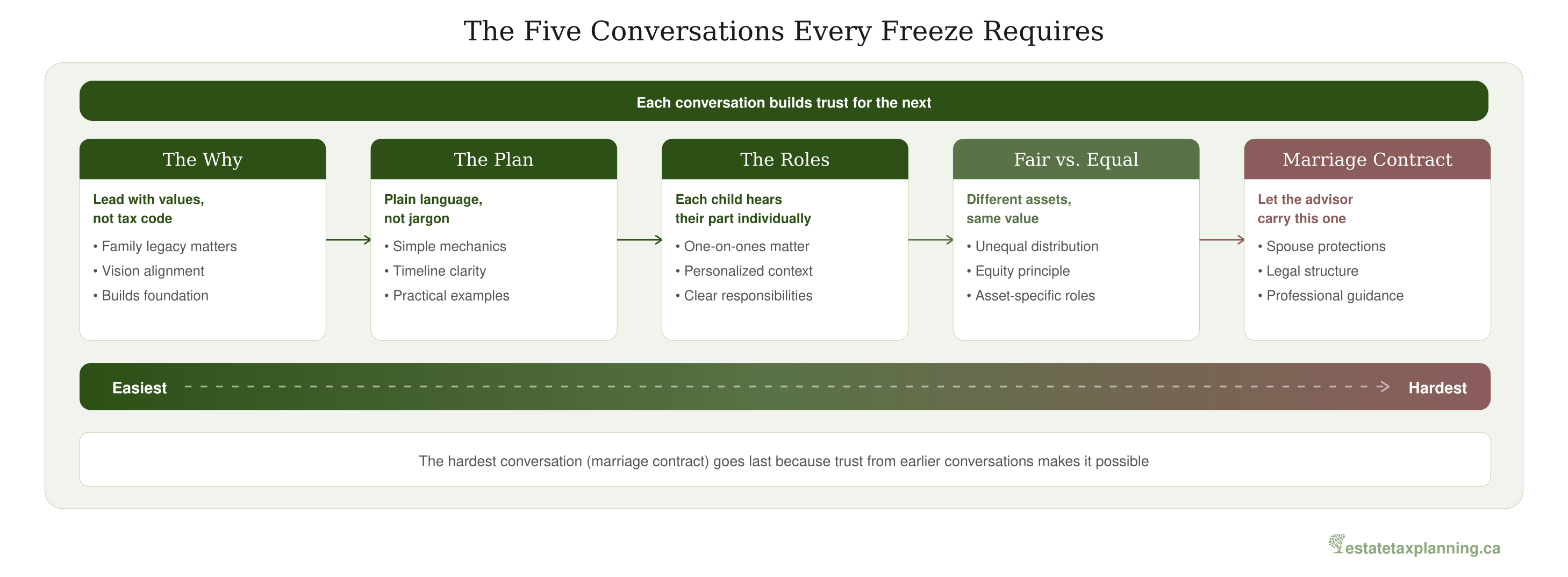
Conversation 1: The Why
Start here, and start with values. Before you explain what the freeze does, explain what matters to you. What do you want for your children? What role has the business played in the family’s life? What kind of legacy do you want to leave? These aren’t soft questions — they’re the foundation that makes the technical plan feel meaningful rather than mechanical.
The most effective opening we’ve seen from clients sounds something like this: "I’ve been thinking about how to make sure this business takes care of all of you — not just now, but after I’m not running it anymore. I’ve been working with my accountant on a plan, and I want to walk you through what we’re thinking." Notice what’s absent: no mention of tax, capital gains, or corporate restructuring. The motivation is family. The tax savings are a byproduct. If your children hear "estate freeze" and their first thought is "tax scheme," you’ve lost the framing. If they hear it and their first thought is "Mom and Dad are trying to take care of us," you’re starting from the right place.
Have this first conversation with your spouse before anyone else. If one parent is enthusiastic and the other is visibly uncertain, the children will fixate on the uncertainty. Don’t rush spousal alignment — it’s the foundation of everything that follows.
Conversation 2: The Plan
Once the family understands why, they can absorb the how. But "the how" doesn’t mean a technical briefing. It means explaining, in plain language, what’s going to change and what isn’t. A good summary might sound like this: "Right now, I own all the shares of the company. What we’re going to do is lock in the current value of those shares in my name — that’s the ‘freeze.’ Then we set it up so that any future growth goes to a family trust for you and your siblings. The business doesn’t change. My role doesn’t change. But the way the ownership is structured changes, and that’s what saves the family a significant amount of tax down the road."
The temptation, especially for business owners who’ve spent hours with their CPA, is to explain every detail: preferred share terms, retractable vs. redeemable, wasting freeze schedules. (Those details are covered in Share Design and the Estate Freeze) Resist this. Your children need to understand the concept, not the implementation. If they want the details, they can ask. Most won’t.
Anticipate the two questions that always come up. First: "Does this mean you’re retiring?" Usually no — explain that you’re restructuring ownership, not stepping back from operations. Second: "Does this mean we owe tax on something?" No — the freeze is designed to defer tax, not create it. Having these answers ready prevents the conversation from derailing into anxiety about change.
Conversation 3: The Roles
This is where the conversation gets personal. Each child needs to hear, individually, what the plan means for them. The child who works in the business needs to understand their path to ownership (we map that path in Succession Planning and the Estate Freeze). The child who doesn’t work in the business needs to understand that the plan is fair to them too — just structured differently.
Be specific and be honest. If Sarah is going to run the business and eventually own it, say that. If James is going to receive his share through life insurance or other assets rather than company shares, say that too. Ambiguity breeds anxiety, and anxiety breeds resentment. We often recommend having the "roles" conversation one-on-one before having it as a family. This gives each child the space to ask questions, express concerns, and process their feelings without performing for their siblings. The family meeting can come after — but it goes much better when nobody is hearing their role for the first time in front of everyone else.
This is often the harder one-on-one conversation. A framing that works well: "James, you’ve built your own career and we’re proud of that. The plan doesn’t give you shares in the company — because we don’t think being a minority shareholder in a business you don’t run is a good position for anyone. Instead, we’ve set things up so that you receive your share as cash, through a life insurance policy. It’s the same value — just in a form you can actually use." The key is to frame the alternative as an advantage, not a consolation prize.
The Hardest Question: "But Is It Fair?"
This is the conversation that keeps business owners up at night, and the one most of them handle badly — not because they’re bad parents, but because the question itself feels impossible. How do you give one child the business and the other child something else, and have both feel that the outcome is fair?
Fair and equal are not the same thing. This is the single most important concept in the family conversation, and it’s worth spending real time on. An equal split — giving each child 50% of the company shares — feels fair in the abstract. But in practice, it creates a structure that serves neither child well.
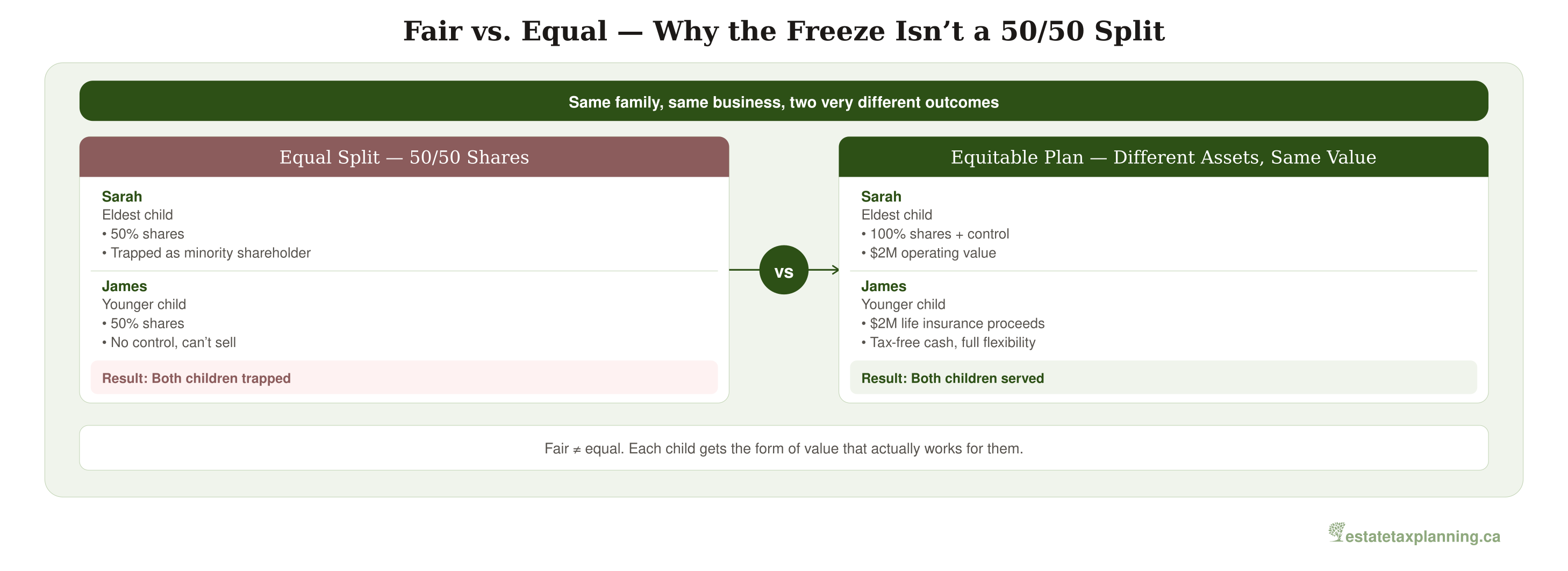
The child who runs the business ends up with a co-owner who has no operational role, no control, and no liquidity. The child who doesn’t run the business ends up with an illiquid asset they can’t sell, in a company they don’t control, earning no income. An equitable approach — different assets, same value — gives each child what actually serves them. The operator gets the business and the control that comes with it. The non-operator gets liquid assets, typically life insurance proceeds or a separate investment portfolio, that they can use without any dependence on the sibling’s business decisions.
Consider a business worth $4 million with two children. Rather than giving each child $2 million in illiquid shares, the parents take out a $2 million joint-last-to-die life insurance policy naming James (the non-operating child) as beneficiary. At current market rates, premiums might run $15,000–20,000 per year (subject to underwriting and health status). Over 20 years, that’s $300,000–$400,000 in premiums to deliver $2 million in tax-free cash — a fraction of the cost of the family conflict that an equal share split would produce. For a deeper look at policy structures and premium strategies, see Life Insurance and the Estate Freeze
Even when the math clearly favours an equitable split, the child who isn’t getting business shares may feel a sense of loss. They may say: "But I grew up in that business too." Or: "You’re choosing her over me." These are emotional responses, not logical ones, and they deserve an emotional — not a technical — answer. Acknowledge the feeling before explaining the structure.
| What They Might Say | How to Respond |
|---|---|
| "Why doesn’t everyone get the same thing?" | "Because the same thing doesn’t serve everyone the same way. Sarah needs control to run the business. You need liquidity to build your own path. We’re giving each of you what actually works for you." |
| "It feels like she’s getting more." | "The business is worth $4 million on paper, but Sarah can’t sell it — she has to run it. Your $2 million comes as cash, tax-free, with no strings. If anything, your position is more flexible than hers." |
| "I thought I’d inherit half of everything." | "You will receive fair value — just in a different form. We worked with our advisors to make sure the total value is equitable. This isn’t about favouring one child — it’s about giving each of you the right kind of value." |
| "What if I want to join the business later?" | "That’s a possibility we’ve thought about. The structure doesn’t lock anyone out permanently. If you decide you want to be involved, we can revisit the plan with our advisors. But we don’t want to build the structure around a maybe — we want to build it around what’s real today." |
| "Why does she get the business and not me?" | "Because she’s been working in it for eight years and she’s ready to lead it. This isn’t about who we love more — it’s about who’s in the best position to run the company. You’ve built something impressive in your own career, and we want to support that too." |
When There Are More Than Two Children
Two children is the simplest version of the fair-versus-equal problem. But many families have three or more, and the dynamics become more complex. Same principle, more variety in the asset forms. Each child receives value appropriate to their stage of life and relationship with the business.
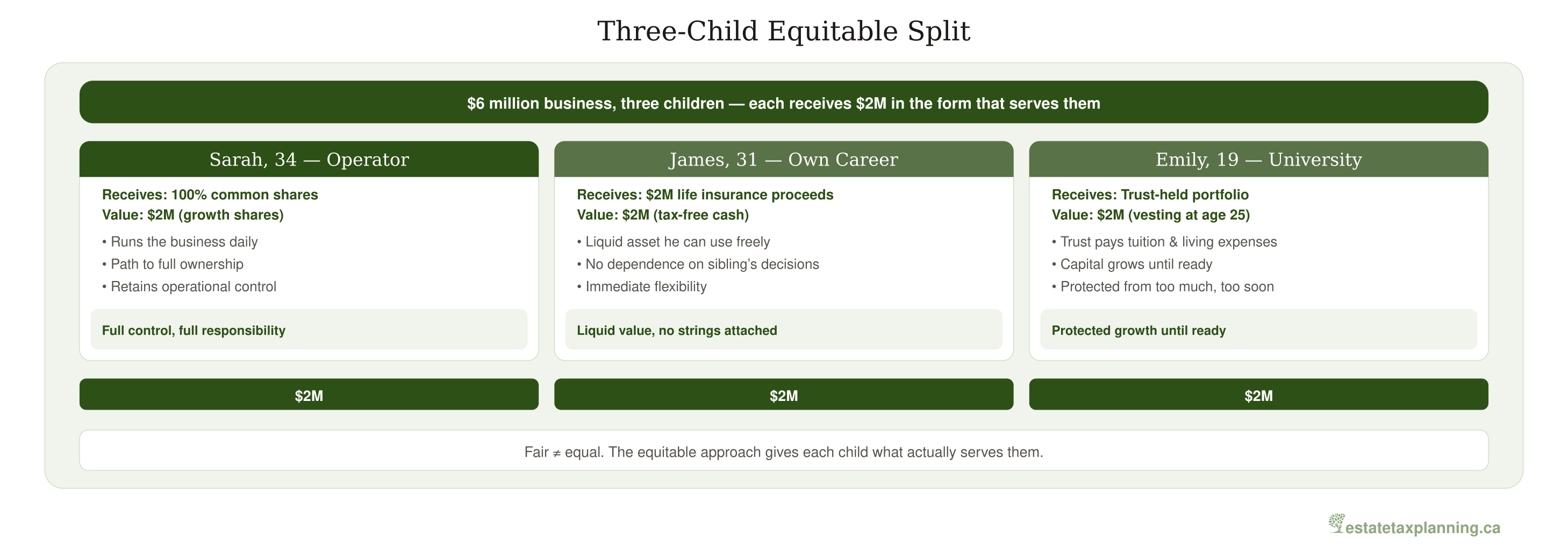
A trust-held portfolio for a younger child introduces a concept worth explaining to the family: fairness sometimes means protecting someone from receiving too much too soon. A 19-year-old with $2 million in cash faces different risks than a 34-year-old with the same amount. The trust provides for Emily’s immediate needs — tuition, living expenses — while allowing the capital to grow until she’s ready to manage it herself. This isn’t about trust in the emotional sense. It’s about structure in the financial sense.
The Marriage Contract Conversation
If the fair-versus-equal conversation keeps business owners up at night, the marriage contract conversation keeps them awake the night before that. Nothing in the estate freeze process feels more personal, more intrusive, or more likely to damage a family relationship than telling your child (or your child’s spouse) that the transfer of shares requires a domestic contract. And yet it’s not optional. If your freeze transfers value through a family trust and a beneficiary’s marriage breaks down, the shares can become a matrimonial asset — exposing growth that was meant for the family to equalization with a former spouse.
A domestic contract can specifically exclude the company shares and trust interests from the equalization calculation. It doesn’t affect the couple’s home, their savings, or anything else in their life together. It only protects the business asset. We cover the legal mechanics in detail — including provincial differences across Ontario, British Columbia, and Quebec — in Protecting Estate Freeze Shares from Divorce This section focuses on how to have the conversation.
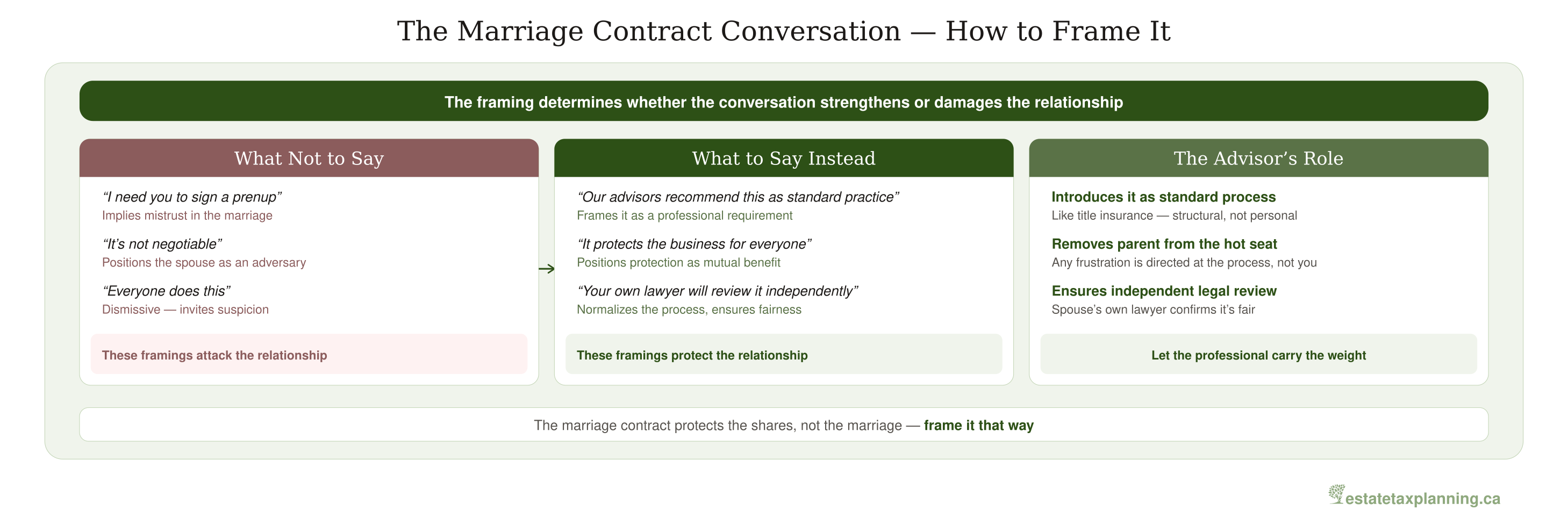
Here is the single most important piece of advice we give clients on this topic: do not have this conversation yourself if you can avoid it. Let your CPA or lawyer introduce it as a standard part of the process — the same way title insurance is standard when buying a house. "Every family we work with goes through this" carries a very different weight than "I need you to get a prenup." It removes you from the adversarial position entirely. Your child can direct any frustration at the process, not at you.
A business worth $4 million at the time of the freeze could grow to $8 million over ten years. Without a marriage contract, a marriage breakdown could expose up to $2 million of that growth to equalization. That’s $2 million of family wealth transferred to a former in-law, not because of anything anyone did wrong, but because a document wasn’t put in place. The conversation is uncomfortable. The consequences of not having it are far more expensive.
If the spouse pushes back, focus on what the contract protects, not what it excludes: it carves out only the business shares and trust interests. Everything else remains fully subject to equalization. And the spouse’s own lawyer will review the contract independently — it’s a negotiated agreement, not a take-it-or-leave-it document. For families with blended dynamics — second marriages, step-children, or children from prior relationships — the conversation becomes even more nuanced. We cover those situations in Estate Freezes and Blended Families
When It Doesn’t Go as Planned
Even with careful preparation, these conversations don’t always go smoothly. A child may go silent — which usually means they’re processing, not agreeing. Don’t push for a response in the moment; follow up within a week. A child may get angry, and your instinct will be to defend the plan. Resist that. Instead: "Help me understand what specifically feels unfair to you, because that’s exactly the kind of input that can shape the plan." That phrase — "shape the plan" — signals that their concerns have the power to change the outcome. A spouse may refuse to engage on the marriage contract; if so, suggest they speak with their own independent lawyer, who represents only their interests. A 30-minute consultation can resolve more objections than any number of family discussions.
If a conversation goes badly enough that a key family member is no longer willing to participate, it may be better to pause the freeze process than to push through. A freeze executed over a family member’s objection is a freeze that’s vulnerable to challenge — legally and relationally. Give it time. Revisit in a month. If there’s an unresolved conflict between siblings, a spouse already hostile to the idea of a marriage contract, or multiple branches of an extended family involved, consider a neutral third party. A family business facilitator or mediator can hold the process while you focus on the substance.
When It Goes Right
A client of ours — a manufacturing business owner, early sixties, two adult children — did this well. He and his wife spent three weeks aligning privately before involving anyone else. He had the "why" conversation with each child individually over coffee, weeks apart. No documents, no numbers. His son, who works in finance, actually said he was relieved — he’d been quietly worried about getting stuck as a minority shareholder. The marriage contract was handled entirely by their lawyer. No drama.
Six months later, the freeze was executed. At the first annual check-in, the whole meeting took forty-five minutes. His daughter told us afterward: "It wasn’t the structure that made it work. It was the fact that nobody was surprised." That’s the pattern: parents align first, each child hears their role one-on-one, a professional carries the marriage contract, and the whole process takes months instead of weeks.
After the Conversation
Put the understanding in writing. Within a few days, send a brief email or letter to everyone who participated. It doesn’t need to be a legal document — just a summary, in the same plain language you used at the table, covering what you discussed, each person’s role, and the next steps. End with something like: "Nothing here is final until you’re comfortable with it. If anything doesn’t feel right, let’s talk." That last sentence matters more than the rest of the email.
And then wait. Some children process quickly. Others need a week before the real questions surface. The child who said nothing at the table might call you on a Tuesday evening with the most important question of all. When that happens, listen. If you’re wondering why your daughter heard the freeze as exciting news while your son heard it as a slight, remember that everyone was listening from a different position. The child in the business heard a career opportunity. The child outside it heard an inheritance decision. Your daughter-in-law heard a financial security question. None of them was wrong. When you follow up, give each person the reassurance that matches their actual concern.
The freeze isn’t a one-time conversation, and it isn’t a set-it-and-forget-it structure. Share values change. Children get married, have kids, change careers. A brief annual check-in keeps everyone aligned and gives you a natural moment to revisit any concerns. As we discuss in The Annual Estate Freeze Review this covers four things: the current business value, any changes in family circumstances, whether the life insurance is still adequate, and any new tax or legal developments. It doesn’t need to be formal. It just needs to happen.
We have seen freeze structures worth millions of dollars unwound — not by a CRA reassessment, not by a technical deficiency, but by a family member who felt excluded from the process. A child who challenges the freeze in court. A spouse who refuses to sign the marriage contract because they were brought in too late. A sibling who stops speaking to the other because they didn’t understand the plan. These outcomes are preventable. They are prevented by having the conversation early, honestly, and with genuine care for everyone’s concerns.
For definitions of the key terms used in this article — including estate freeze, family trust, preferred shares, marriage contract, and LCGE — see our Key Terms and Definitions reference guide.
Your tax advisor, CBV, and legal counsel can help you evaluate how this applies to your situation, especially when family dynamics are part of the planning.
This article is for informational purposes only and does not constitute legal, tax, or financial advice. Estate freezes are complex transactions that require the coordinated involvement of qualified tax, valuation, and legal professionals. Always consult your advisors before acting on any of the information discussed here.