
Corporate-owned life insurance is the only financial tool that lets you fund the estate freeze tax bill with low-taxed corporate dollars and deliver the proceeds to your family tax-free through the Capital Dividend Account. Size it from an independent valuation, lock in coverage while you’re healthy, and review it whenever the frozen value changes.
One of the great advantages of an estate freeze is that it makes the freezor’s future tax liability known and quantifiable. The preferred shares are fixed at today’s fair market value, which means the capital gain that will arise on death is no longer a moving target. It becomes a number you can plan against.
The question then becomes: where will the money come from to pay that tax bill? If the estate has to sell business assets or redeem shares to cover the liability, the succession plan is undermined. The business may need to be partially liquidated at exactly the wrong time.
Life insurance solves this problem. A properly structured corporate-owned policy creates a pool of funds that flows to the family tax-free, giving the estate the liquidity it needs without touching the business.
Why Corporate-Owned Life Insurance?
When a corporation owns the policy and pays the premiums, two advantages emerge. First, premiums are paid with after-tax corporate dollars. A Canadian-controlled private corporation in Ontario pays a combined federal and provincial rate of approximately 12.2% on the first $500,000 of active business income (dropping to approximately 11.2% effective July 1, 2026 under Ontario’s 2026 budget), compared to the owner’s personal marginal rate of up to approximately 53.53%. The same dollar goes much further inside the corporation.
Premiums are not deductible. Owners sometimes assume they are because the corporation pays them — that’s wrong. But the after-tax cost of paying premiums with corporate dollars is still substantially lower than paying with personal after-tax income, because of the large gap between the corporate small business rate and the top personal rate.
Second, when the insured dies, the death benefit is received by the corporation on a tax-free basis. The proceeds then flow to the shareholders through a mechanism called the Capital Dividend Account, which allows a portion of the death benefit to be paid out as a tax-free capital dividend. No other financial instrument provides this combination of tax-advantaged funding and tax-free distribution.
- The math is straightforward: corporate dollars are taxed at roughly 12% (small business rate), while personal dollars are taxed at up to 53%. Every dollar of premium costs you less when the corporation pays it.
- The death benefit is received by the corporation tax-free.
- The CDA mechanism allows tax-free distribution of proceeds to shareholders or the estate. This is the piece that makes the whole structure work.
- No other financial tool provides this combination of tax-efficient funding and tax-free payout. It’s why we recommend corporate-owned insurance in virtually every freeze we implement.
Insurance vs. Saving Inside the Corporation
The obvious alternative to insurance is to skip the policy, keep paying corporate tax on the operating income, and let cash accumulate inside the corporation. The estate then uses that pool to pay the tax bill on death. It sounds simpler — but for most owners it leaves the family short. Several differences explain why insurance wins in almost every freeze we implement:
| What matters | Corporate-Owned Life Insurance | Cash Accumulated in the Corp |
|---|---|---|
| Tax on growth | Tax-deferred inside an exempt policy | ~50% corporate tax on passive investment income every year |
| Payout to family | Tax-free via the CDA (death benefit minus ACB) | Taxable dividend on distribution, with a partial RDTOH refund at the corp |
| If death is early | Full death benefit pays out from day one | Only what the corp managed to accumulate — usually far less than the tax bill |
| If death is late | Full death benefit; ACB erosion lifts the CDA credit | A larger pool, but personal tax still applies on the way out |
| Predictability | Premium and death benefit locked in by underwriting | Depends on business performance and investment returns |
The early-death scenario is the one that breaks the cash-only approach. An owner who freezes at 55 and dies at 60 leaves a family with a tax bill that five years of retained earnings cannot cover. Insurance pays the full death benefit from day one, regardless of how long the freezor has lived — and that asymmetry is why we recommend it in nearly every freeze, even when the corporation has cash to spare.
How It Works: The Capital Dividend Account
The Capital Dividend Account is a notional account maintained by every private corporation. It tracks amounts that can be distributed to shareholders as tax-free capital dividends. The most significant source of CDA credits is life insurance proceeds.
When a corporate-owned life insurance policy pays a death benefit, the corporation receives a credit to its CDA equal to the death benefit minus the policy’s adjusted cost basis. The adjusted cost basis, or ACB, represents the accumulated investment component of the policy under the rules in section 148 of the Income Tax Act. The corporation can then elect under subsection 83(2) to pay a capital dividend up to the CDA balance, and that dividend is received tax-free by the shareholders.
A critical structural requirement: the corporation must be both the owner and the beneficiary of the policy for the CDA credit to arise. If the estate or an individual is named as beneficiary instead of the corporation, the death benefit bypasses the corporation entirely. The proceeds are received personally, no CDA credit is generated, and the tax-free capital dividend mechanism is unavailable. There is also an upstream trap: if the corporation has been paying the premiums on a policy where it is not the beneficiary, those premium payments can be reassessed as taxable shareholder benefits under subsection 15(1). The shareholder ends up taxed on the very corporate dollars that were supposed to fund the insurance efficiently. This is a structuring decision that must be made at the time the policy is purchased, and it should be reviewed whenever policy ownership or beneficiary designations are updated.
The Five-Step Flow
Consider a business owner who completed an estate freeze at a fair market value of $5,000,000. On death, the deemed disposition of the preferred shares will trigger a capital gain of approximately $4,999,900 (assuming a nominal adjusted cost basis of $100). At a 50% inclusion rate and Ontario’s top combined rate of approximately 53.53%, the tax liability is roughly $1,338,000.
The corporation purchased a $1,500,000 whole life insurance policy on the freezor’s life. At the time of death, the policy’s ACB has been reduced to $100,000 through the annual deduction of the net cost of pure insurance (NCPI) — a mechanic explained in the next section. Here is how the proceeds flow:
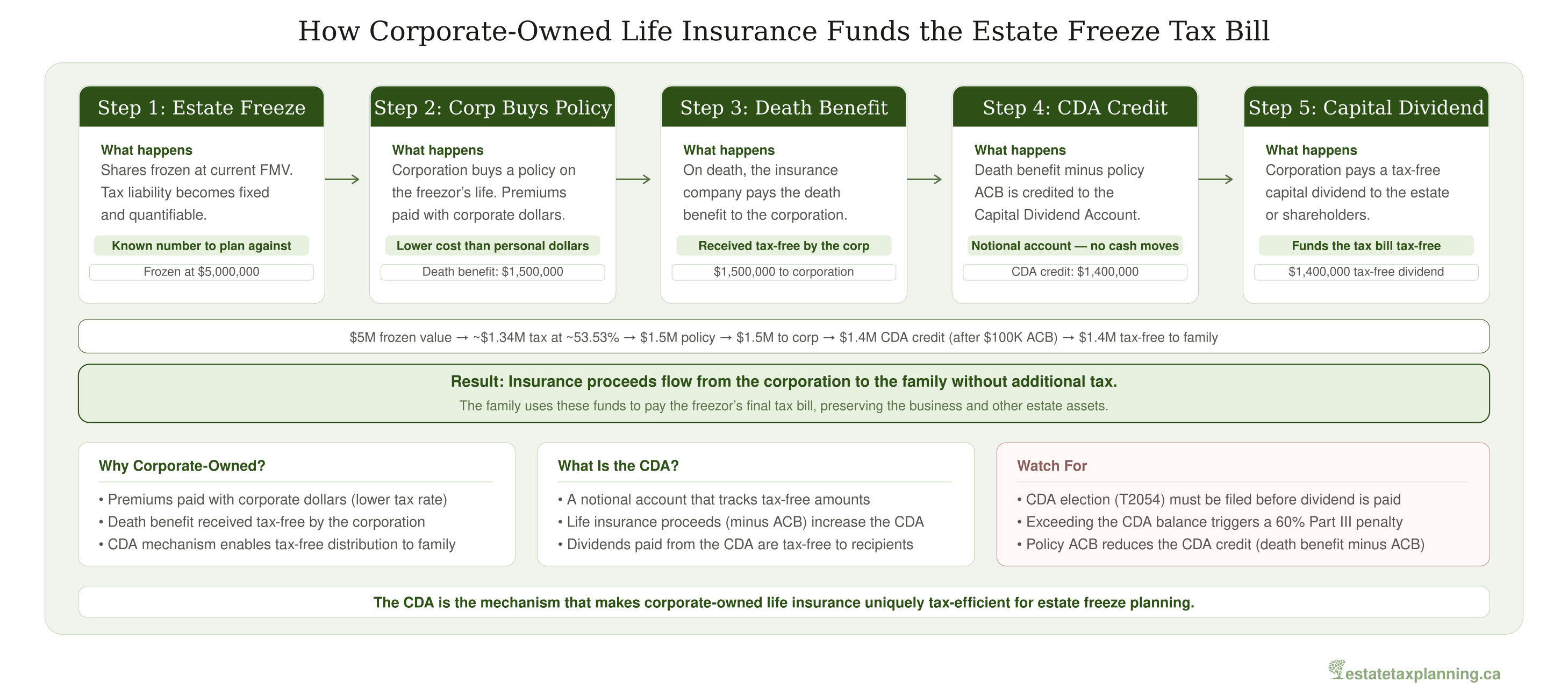
The death benefit of $1,500,000 is paid to the corporation tax-free. The corporation receives a CDA credit of $1,400,000 (the $1,500,000 death benefit minus the $100,000 ACB). The corporation files a CDA election on Form T2054 and pays a capital dividend of $1,400,000 to the estate. The estate receives these funds tax-free and uses them to pay the $1,338,000 tax liability, with $62,000 remaining to cover professional fees and other estate costs.
The ACB Erosion Trap
The adjusted cost basis of a life insurance policy does not remain static. Each year, the net cost of pure insurance (NCPI) is deducted from the ACB under the formula in subsection 148(9) of the Income Tax Act. The NCPI represents the mortality cost component of the premium, and it increases as the insured ages. Over time, this annual deduction can reduce the ACB to zero or near zero.
A lower ACB means a larger CDA credit, because the credit equals the death benefit minus the ACB. In the example above, the policy’s ACB was reduced from its original level to $100,000 by the time of death, which is why the CDA credit was $1,400,000 rather than a lower amount.
However, this erosion also has implications during the policyholder’s lifetime. If a policy with a low or zero ACB is surrendered, the full cash surrender value becomes a taxable policy gain. This is one reason why policies intended for estate freeze planning are typically held until death, not surrendered.
- The net cost of pure insurance (NCPI) is deducted annually from the policy’s ACB under subsection 148(9).
- A lower ACB at death means a larger CDA credit — this is generally a positive outcome for estate planning.
- However, if the policy is surrendered during the insured’s lifetime, a low ACB means a larger taxable policy gain.
- Policies purchased after January 1, 2017 are subject to updated NCPI calculation rules that may result in higher ACB erosion over time.
The CDA Election: Getting It Right
The corporation must file a CDA election on Form T2054 before or at the time the capital dividend is paid. This is not optional. If the election is not filed, the dividend is treated as a taxable dividend, and the intended tax-free treatment is lost.
Equally important, the elected amount must not exceed the CDA balance at the time of the election. If the corporation pays a capital dividend that exceeds the available CDA balance, the excess is subject to a penalty tax of 60% under Part III of the Income Tax Act (subsection 184(2)). This penalty applies to the corporation, not the shareholder, and it can be triggered by something as simple as an accounting error or an outdated CDA schedule.
Maintaining an accurate, up-to-date CDA schedule is essential. The CDA is a notional account — it doesn’t appear on the corporation’s financial statements or tax return as a single line item. It is a running total, maintained from the date the corporation was incorporated, that accumulates every CDA-eligible event over the life of the corporation. At any point in time, the balance equals:
- Half of the corporation’s cumulative net capital gains since incorporation (lifetime gains minus lifetime losses, taken at the 50% non-taxable portion).
- Plus: net life insurance proceeds the corporation has received over its life (each death benefit minus the policy’s ACB at the time).
- Capital dividends the corporation has received since incorporation.
- Minus: capital dividends the corporation has already paid out to its shareholders.
Before declaring a capital dividend, the corporation’s tax advisor should verify the CDA balance and confirm that the election can be filed without risk of a Part III assessment.
- If the capital dividend exceeds the CDA balance, the excess is subject to a 60% penalty under subsection 184(2).
- The penalty applies to the corporation, not the individual shareholder.
- An outdated CDA schedule or accounting error can trigger this penalty.
- Always verify the CDA balance with your tax advisor before filing the T2054 election.
If an excess capital dividend is discovered after the fact, subsection 184(3) provides a limited relief mechanism. The corporation can elect — within 90 days of the notice of assessment — to treat the excess as a separate taxable dividend rather than face the full 60% penalty. This shifts the tax burden to the shareholders, who pay personal tax on the excess as a taxable dividend rather than the corporation absorbing the 60% penalty. It is damage control, not a planning strategy, but it can substantially reduce the cost of an honest error.
How Insurance and the Freeze Work Together
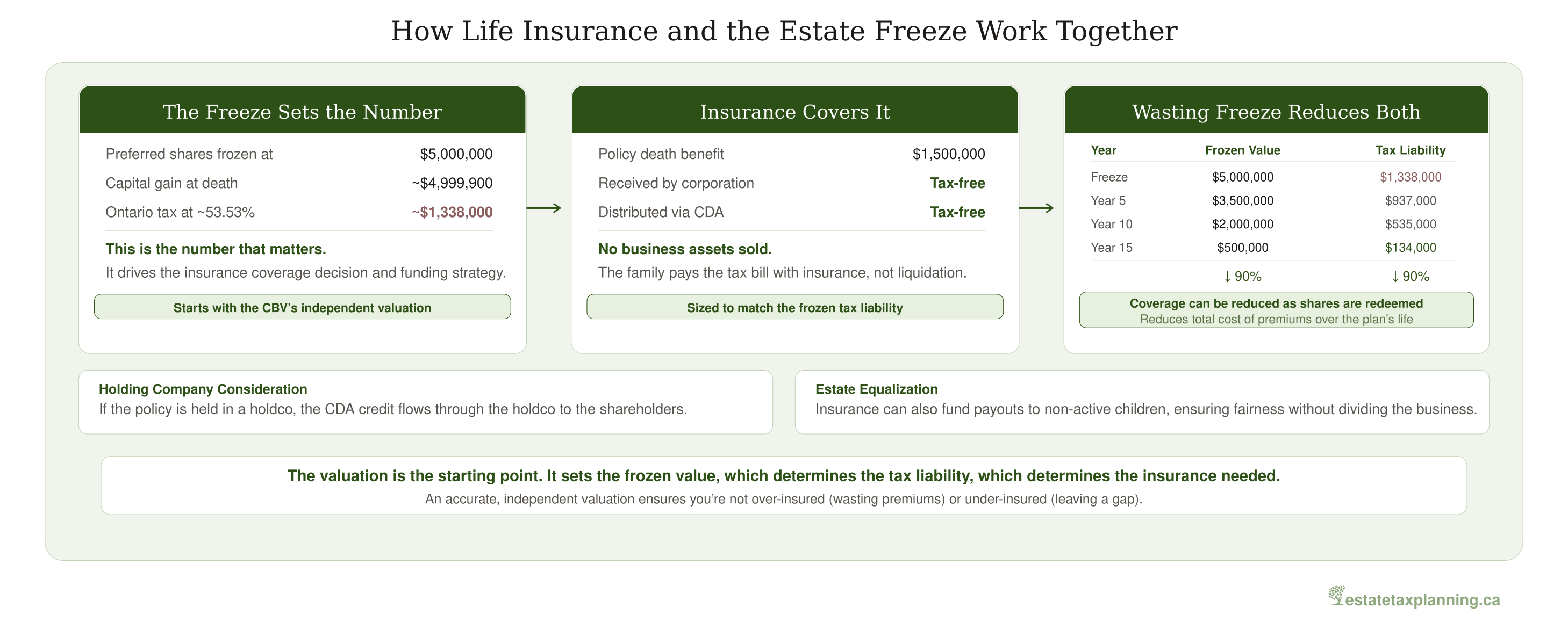
The freeze, the valuation, and the insurance are a coordinated system. The freeze fixes the tax liability. The insurance funds it. The valuation establishes the number that connects the two.
An independent, defensible valuation by a Chartered Business Valuator is the starting point. If the frozen value is too low, the CRA may reassess under subsection 69(1), triggering an unexpected capital gain. If the frozen value is too high, the freezor is over-insured and the family pays unnecessary premiums for decades. Either way, the insurance coverage is misaligned with the actual liability.
When the valuation is accurate, the insurance can be precisely sized. The corporation purchases a policy with a death benefit sufficient to cover the expected tax on the deemed disposition at death, plus a margin for professional fees and estate administration costs.
The Wasting Freeze: A Dynamic Approach
As discussed in Freeze, Gel, Thaw, and Wasting Freeze, a wasting freeze involves the gradual redemption of preferred shares over time. Each redemption reduces the frozen value and, with it, the capital gain that will arise on death. As the frozen value declines, so does the required insurance coverage.
This creates a planning opportunity. If the corporation implements a wasting freeze, the insurance coverage can be reviewed periodically and reduced in step with the declining frozen value. The result is lower total premium costs over the life of the plan. In the example illustrated above, a $5,000,000 frozen value declining to $500,000 over fifteen years would reduce the tax liability from roughly $1,338,000 to approximately $134,000 — a 90% reduction. The insurance coverage can be adjusted accordingly, either by reducing the death benefit on a universal life policy or by allowing term riders to lapse as they are no longer needed.
- Business value moves more than 20% (up or down) — coverage may be over- or under-sized.
- Preferred shares are redeemed under a wasting freeze — coverage can step down with the frozen value.
- Marriage, divorce, death, or birth in the family — beneficiary designations and equalization plans may need updating.
- Sale of part of the business or major restructuring — the policy may no longer match the freeze.
- A family member enters or exits the business — TOSI position and equalization needs change.
- Annually, as part of the year-end review with your advisor team — the cheapest insurance review is the one done before something goes wrong.
Choosing the Right Policy
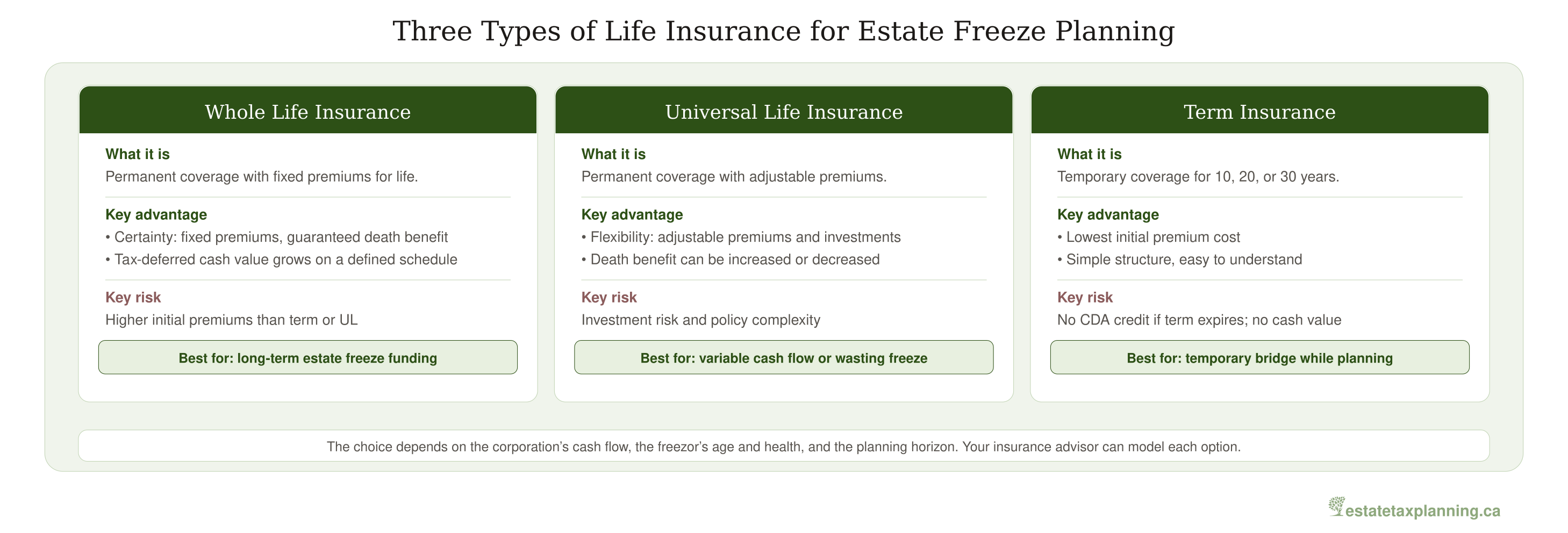
The type of insurance policy matters. Each structure offers different trade-offs between cost, flexibility, and certainty. The right choice depends on the corporation’s cash flow, the freezor’s age and health, and the planning horizon.
Exempt vs. Non-Exempt Policies
Two terms matter here: exempt and non-exempt policies. An exempt policy satisfies the "exempt test" in Regulation 306, which limits how much the investment component can grow relative to the death benefit. As long as the policy stays exempt, the investment growth inside it is not taxed annually — the policyholder pays no tax on the cash value growth until the policy is surrendered or lapses.
A non-exempt policy, by contrast, is subject to annual accrual taxation under section 12.2 of the Income Tax Act. The income earned inside the policy is taxed each year as it accrues, which eliminates the tax-deferral advantage that makes corporate-owned insurance attractive for estate freeze planning. For this reason, virtually all policies used in estate freeze planning are structured to maintain exempt status.
- An exempt policy grows tax-deferred inside the corporation — the investment component is not taxed until surrender.
- A non-exempt policy is subject to annual accrual taxation under section 12.2, which significantly reduces the planning benefit.
- Over-funding a policy (paying premiums beyond the exempt test limits) can cause it to lose exempt status retroactively.
- Your insurance advisor should confirm that the policy is designed to remain exempt for its entire life, and should monitor it periodically.
Whole Life Insurance
Whole life insurance provides a guaranteed death benefit and guaranteed premiums for the life of the insured. The policy builds cash value on a tax-deferred basis inside the corporation. It is the most predictable option: the premium is fixed at issue, the death benefit is known, and the cash value grows on a defined schedule. For estate freeze planning where the goal is certainty, whole life is the most common choice.
Universal Life Insurance
Universal life insurance separates the insurance component from the investment component, giving the policyholder flexibility in both premium payments and investment allocation. Premiums can be adjusted within limits, and the investment component can be directed into various sub-accounts. This flexibility makes universal life attractive when the corporation’s cash flow varies from year to year, or when the policyholder wants more control over the investment strategy. However, this flexibility also introduces more complexity and investment risk.
The investment risk deserves emphasis. If the sub-account investments inside a universal life policy underperform — whether due to market downturns, poor fund selection, or prolonged low interest rates — the policy’s cash value may not grow as projected. When that happens, the policyholder may be required to pay additional premiums to maintain the death benefit, or the death benefit itself may be reduced. For an estate freeze where the insurance is sized to cover a specific tax liability, an underfunded universal life policy creates a gap in coverage at exactly the moment it is needed. Business owners considering universal life should understand that the premium flexibility comes with a corresponding investment risk that does not exist with whole life.
Term Insurance
Term insurance provides coverage for a fixed period — typically 10, 20, or 30 years — at a much lower initial premium than permanent insurance. It does not build cash value and does not generate a CDA credit at the end of the term if the insured is still alive. Term insurance may be appropriate as a temporary bridge: for example, to cover the freeze liability during the early years while the corporation builds sufficient retained earnings or while a permanent policy is being underwritten. It is not a long-term solution for estate freeze funding because the coverage expires.
- Whole life offers certainty — guaranteed premiums, guaranteed death benefit, predictable cash value growth.
- Universal life offers flexibility — adjustable premiums and investment options, but with more complexity.
- Term insurance is a temporary bridge — lower initial cost, but no permanent coverage or CDA credit if the term expires.
- The choice depends on the corporation’s cash flow, the freezor’s age and health, and the planning horizon.
Living Use of the Policy
Insurance discussions usually focus on the death benefit, but during the freezor’s lifetime a permanent policy is building substantial cash surrender value inside the corporation. That value is otherwise idle. A structure called the Immediate Financing Arrangement (IFA) lets the corporation unlock it without surrendering the policy or losing the eventual CDA credit.
The mechanics are straightforward. The corporation purchases a permanent policy and assigns it as collateral to a bank or other regulated lender. The bank then lends the corporation up to roughly 90% of the policy’s cash surrender value. The corporation pays interest annually on the loan and reinvests the loan proceeds in the business or in income-producing assets. At the insured’s death, the death benefit is paid first to retire the bank loan; the remainder flows out through the CDA mechanism described earlier.
Paragraph 20(1)(c) makes the interest on the bank loan deductible, on the same general principles that apply to any loan used to earn income from a business or property. This is the dominant economic benefit of the structure — the corporation borrows against its own asset and writes off the carrying cost.
Paragraph 20(1)(e.2) goes further. It allows the corporation to deduct a portion of the policy premiums themselves, but only when three conditions are met: the policy must be assigned as collateral to a restricted financial institution (Canadian banks, life insurers, and similar regulated lenders, as defined in subsection 248(1)), the lender must require the assignment as a condition of the loan, and the interest on the loan must itself be deductible. The deductible amount is capped at the lesser of the premiums payable or the net cost of pure insurance for the year. The cap matters in practice: NCPI starts low and rises with age, so premium deductibility is most useful in the early years when the gap between premium and NCPI is widest, and erodes as the insured ages.
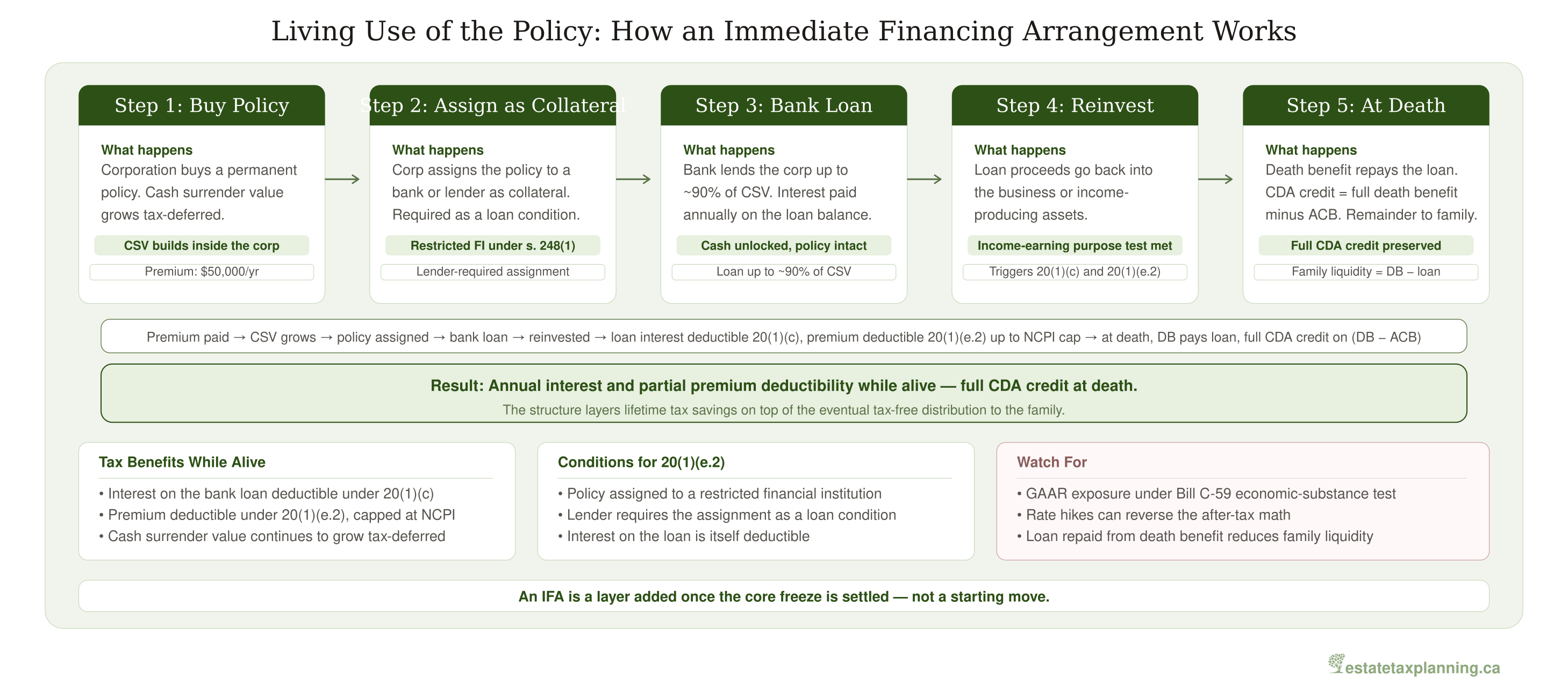
Used appropriately, an IFA is a layer added once the core freeze is settled — not a starting move. We don’t recommend it for first-time freezes or for owners who would not otherwise be buying permanent insurance. The structure makes most sense for cash-flow-positive corporations that have already committed to permanent coverage and would otherwise leave their premium dollars sitting idle.
- The 2024 GAAR amendments (Bill C-59, royal assent June 20, 2024) added an explicit economic-substance test and a 25% penalty when GAAR applies. Aggressive IFA structures whose main purpose is the tax benefit are now materially more exposed than they were before the amendments.
- Interest-rate risk: if rates rise faster than CSV grows, the after-tax math reverses. This is a particular concern for IFAs entered into during a low-rate environment.
- CSV underperformance can trigger margin calls. Universal-life sub-account losses are the most common cause — the bank can demand additional collateral or call the loan if the loan-to-CSV ratio breaches its threshold.
- The death benefit is applied first to repay the loan. The CDA credit on (death benefit − ACB) is preserved, but the cash actually flowing to the family is reduced by whatever the loan balance has grown to.
- Get specialist tax advice before implementing. We treat the IFA as a candidate for an advance income tax ruling on anything but the most plain-vanilla structure.
Joint Last-to-Die Policies
When a freezor is married or has a common-law partner, a joint last-to-die (JLTD) policy is often the preferred structure. A JLTD policy insures both spouses and pays the death benefit only on the second death. This aligns with the way the Income Tax Act treats spousal transfers: under subsection 70(6), assets can roll over to the surviving spouse on a tax-deferred basis, meaning the capital gain on the preferred shares is typically not triggered until the second death.
JLTD policies have significantly lower premiums than equivalent single-life coverage because the insurer is covering a longer expected period before the benefit is paid. For a couple in their mid-fifties, the JLTD premium may be 30% to 50% lower than the cost of insuring each spouse individually. This makes the insurance funding more affordable over the life of the plan.
To illustrate the scale: for a non-smoking couple both aged 55, a $1,500,000 JLTD whole life policy might cost approximately $25,000 per year, compared to roughly $40,000 to $45,000 for equivalent single-life coverage on just one spouse. Over a 25-year planning horizon, the premium savings can exceed $375,000 — a meaningful reduction in the total cost of funding the estate freeze. These figures assume a participating whole life policy with level premiums to age 100. Actual premiums will vary based on the insurer, the health classification of each spouse, and the specific policy structure, but the directional savings are consistent across the market.
The key planning point is timing: the insurance proceeds arrive precisely when the tax liability crystallizes — on the second death. There is no gap between when the tax is owed and when the funds are available.
Securing Coverage Early
One risk that business owners rarely consider at the planning stage is the possibility of becoming uninsurable. A business owner who implements an estate freeze at age 50 but develops a serious health condition at 55 may find they cannot obtain the coverage they need — or can only obtain it at substantially higher premiums with exclusions or rated classifications. The insurance funding strategy that underpins the entire freeze plan is then compromised.
For this reason, life insurance should be secured at or before the time of the freeze, not deferred as a follow-up item. Even if the exact coverage amount is still being finalized, locking in insurability while both spouses are healthy is critical. A guaranteed insurability rider can also provide valuable protection: it allows the policyholder to increase coverage at specified future dates without additional medical underwriting, regardless of any health changes that have occurred in the interim. The modest additional cost of a guaranteed insurability rider is well worth the protection it provides against a risk that, once realized, cannot be undone.
Holding Company Considerations
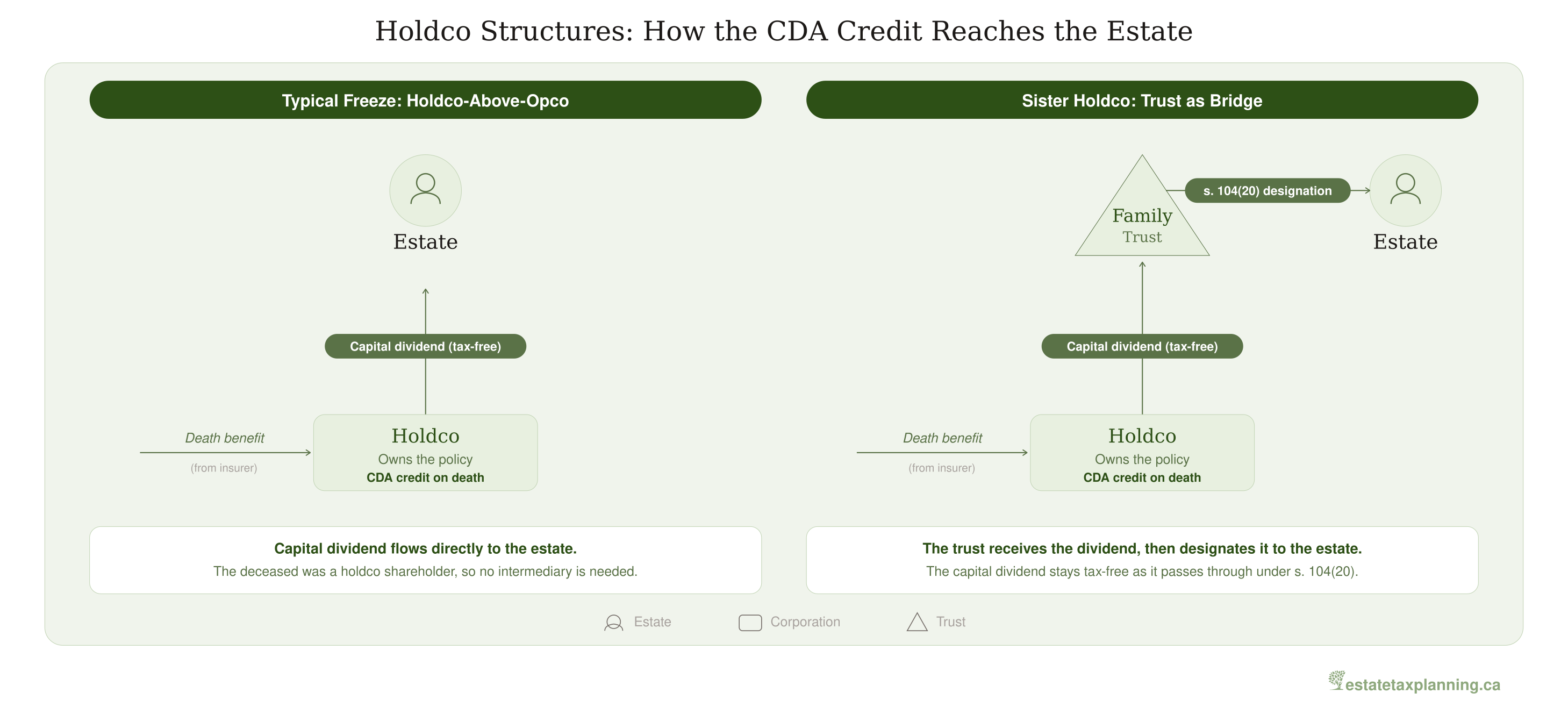
In many estate freeze structures, a holding company sits between the operating company and the shareholders. When the life insurance policy is held by a holding company rather than the operating company, the CDA credit is created in the holding company. The holding company can then pay a tax-free capital dividend to its shareholders.
Holding the policy in a holdco can provide several advantages. It separates the insurance asset from the operating company’s creditors. It keeps the operating company free of passive investment assets, which is important for maintaining eligibility for the small business deduction. And it consolidates the insurance planning with other passive investments that may already be held in the holdco.
Holding the policy in a holdco adds one structural requirement. Capital dividends flow upward to shareholders, not downward to subsidiaries. So the holdco’s CDA only helps the estate if the deceased held holdco shares — directly or through a trust. In a typical freeze that’s automatic: the freeze put the preferred shares in the holdco, so the capital dividend flows straight to the estate.
It gets harder when the deceased held opco shares directly and the policy sits in a separate holdco — say, one owned by the spouse or by a different trust. A family trust usually bridges the gap. The trust holds shares of the holdco, receives the capital dividend, and designates it to the estate or surviving spouse under subsection 104(20). The dividend stays tax-free as it passes through the trust.
This only works if every entity files its election. The holdco files Form T2054. A trust must designate the dividend under subsection 104(20) on its T3 return. Miss any step and the entire amount becomes taxable — document the chain before death so the executor and trustees know what to file.
TOSI doesn’t apply to capital dividends from the CDA. The rules discussed in TOSI and the Estate Freeze. TOSI applies to taxable dividends and certain other amounts, but a properly elected capital dividend under subsection 83(2) is received tax-free and falls outside the TOSI framework. This makes the holdco insurance structure particularly effective for families where TOSI would otherwise limit income-splitting opportunities.
Estate Equalization
Life insurance also addresses one of the most common sources of conflict in family business succession: the inequity between children who are active in the business and those who are not.
In a typical estate freeze, the active children receive growth shares (often through a family trust) and eventually inherit the operating business. A child who is not involved in the business does not hold growth shares and may receive little or nothing from the estate if the family’s wealth is concentrated in the corporation. This imbalance creates resentment and, in many cases, litigation.
A life insurance policy can equalize the estate. The corporation purchases a policy with a death benefit equal to the approximate value of the growth shares held by the active children. On death, the insurance proceeds flow through the CDA and are directed to the non-active child as a tax-free capital dividend. The result: each child receives roughly equal value without selling or dividing the business.
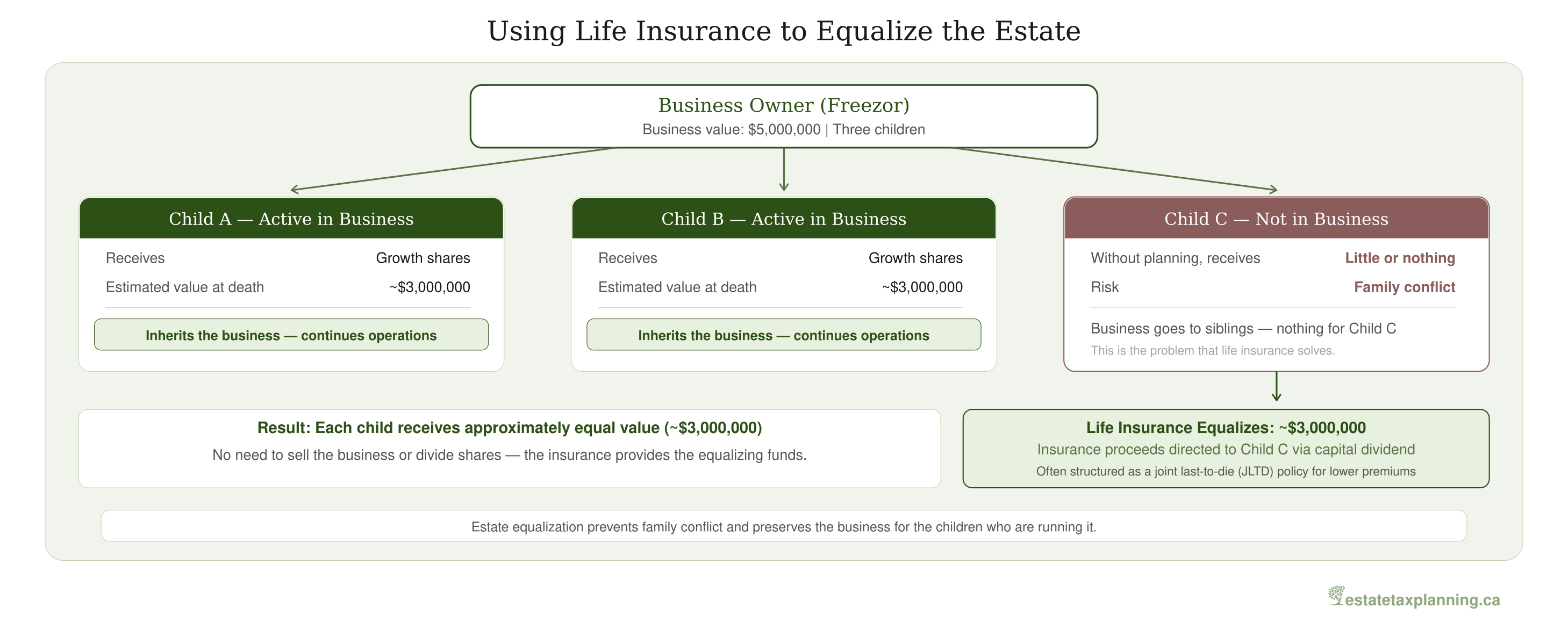
In the example above, two children are active in a business worth $5,000,000 at the time of the freeze. Their growth shares are expected to reach approximately $3,000,000 each over the next 15 to 20 years (assuming roughly 8% to 10% compound annual growth). A third child is not involved in the business. Without planning, that child receives little or nothing. A JLTD insurance policy with a $3,000,000 death benefit, owned by the corporation, provides the equalizing funds. The proceeds flow through the CDA to the third child, giving all three children approximately equal value.
Insurance plays a parallel role in shareholder agreements — funding a buy-sell on the death of a co-owner so the surviving owners can purchase the deceased’s shares from the estate. The mechanics rhyme with the equalization use described above. See Shareholder Agreements for that application in detail.
Advanced Strategy: The Loss Carryback
When a shareholder dies, the deemed disposition of their shares triggers a capital gain on the terminal return. But the shares still exist in the estate, and when the estate disposes of them (through redemption or sale), a second gain or loss may arise. If the estate realizes a capital loss on that second disposition, subsection 164(6) of the Income Tax Act allows the loss to be carried back to the deceased’s terminal return, offsetting the capital gain that arose on death.
This loss carryback mechanism can work alongside the insurance strategy. The insurance proceeds provide immediate liquidity to pay the tax liability, while the subsection 164(6) election may reduce the actual tax owed by carrying back losses. For deaths occurring on or after August 12, 2024, Bill C-15 (enacted March 26, 2026) extended the carryback window from the estate’s first taxation year to its first three taxation years, giving executors significantly more time to execute the strategy. The two approaches are complementary: the insurance ensures the estate has the cash to pay the tax bill, and the loss carryback may reduce the bill itself.
This is advanced post-mortem planning that requires coordination between the estate’s tax advisor and legal counsel. The timing of the share redemption, the CDA election, and the loss carryback election must all be sequenced carefully to achieve the optimal result.
The Claims Process: What to Expect
One practical reality that is often overlooked in estate planning discussions is the timeline for receiving insurance proceeds after a death. While the CDA election and post-mortem tax planning depend on having the insurance funds available, the claims process takes time.
In most cases, a straightforward life insurance claim in Canada is paid within two to four weeks of the insurer receiving all required documentation. However, the documentation itself can take time to assemble: the death certificate, the original policy, a claimant statement, and in some cases medical records or a coroner’s report. If the death occurs within two years of the policy’s issue date (the "contestability period"), the insurer may conduct a more thorough review of the original application, which can extend the timeline to several months.
For estate freeze planning, this means the executor should be aware that the insurance proceeds will not be available on the day of death. The estate may need bridge financing or access to other liquid assets to cover immediate obligations while the claim is being processed. This is another reason why the executor should know about the insurance policy and the claims process in advance, not discover it after the death.
What This Means for You
If you’re considering a freeze: build the insurance plan into the design from day one, not as an afterthought. Premiums climb with age, and the consequences of becoming uninsurable later are larger than most owners realize.
If you’ve already frozen: the most common gap we find on review is coverage that hasn’t kept pace with the business or the family. Revisit the valuation; revisit the policy. The cost of doing it once a year is small. The cost of doing it never is whatever the gap turns out to be.
A conversation with a qualified CBV and CPA is the place to start.
What’s Next
Now that you understand how insurance funds the estate freeze tax liability, the next step is understanding how to maximize the Lifetime Capital Gains Exemption — one of the most powerful tools for reducing the tax that the insurance is designed to cover. In The Lifetime Capital Gains Exemption and the Estate Freeze, we explain how to qualify for the LCGE, how to multiply it across the family through a trust, when and how to crystallize it at the time of the freeze, and how to navigate the AMT trap that catches many advisors off guard.
For definitions of the key terms used in this article — including COLI, CDA, capital dividend account, NCPI, and criss-cross insurance — see our Key Terms and Definitions reference guide.
This article is for informational purposes only and does not constitute legal, tax, or financial advice. Estate freezes are complex transactions that require the coordinated involvement of qualified tax, valuation, and legal professionals. Always consult your advisors before acting on any of the information discussed here.