
An estate freeze locks in your company's current value for tax purposes — so future growth passes to the next generation without triggering a massive tax bill at death. It's the single most important planning tool for Canadian business owners with a growing private corporation.
When Maria started her engineering consulting firm in 2005, it was worth the $100 she paid for the shares. Twenty years later, the company is worth $5 million — and unless she does something about it, the CRA will treat that $4.9 million gain as income the day she dies. At Ontario’s top combined rate, her estate would owe roughly $1.3 million in tax. That’s $1.3 million that comes due at the worst possible time, before her children have had a chance to decide what they want to do with the business.
Maria’s situation is not unusual. We see it every month — a business owner who has built something valuable over decades, and who is just starting to realize that the CRA’s deemed disposition rules will hand their estate a tax bill they haven’t planned for. The good news is that there’s a well-established strategy for dealing with it. It’s called an estate freeze, and it’s one of the most powerful planning tools available to Canadian business owners.
This guide explains what estate freezes are, why they matter, and how they work — in plain language, with diagrams and worked examples. We cover the full picture: the tax planning strategy, the business valuation that anchors it, and the legal implementation that brings it to life.
- If you own a Canadian private corporation that has grown significantly in value — and you’ve started wondering what happens to that value when you’re no longer here — this article is for you. It’s also for the advisors around the table: the accountants, financial planners, and lawyers who help business owners navigate these decisions.
- You don’t need a tax background to follow along. We’ll walk through every concept from the ground up, with Maria’s story as the thread that ties it together.
The Problem: A Growing Tax Bill You Can’t See
In Canada, when you pass away, the Canada Revenue Agency treats you as if you sold all your assets at their fair market value immediately before death. This rule — under subsection 70(5) of the Income Tax Act — is called a deemed disposition . You don’t actually sell anything, but the tax bill arrives as though you did. Any capital gains that have accumulated over your lifetime become taxable on your final return.
For Maria, the math is straightforward — and sobering. She paid $100 for her shares. They’re now worth $5 million. The accrued capital gain is $4,999,900. At a 50% inclusion rate and Ontario’s top combined marginal rate of approximately 53.53%, her estate would owe roughly $1.3 million. And that bill must be paid before the estate can be settled.
Here’s the part that keeps business owners up at night: the longer the business continues to grow, the bigger that eventual tax bill becomes. If Maria’s company grows to $8 million over the next decade, her estate’s tax exposure grows with it — silently, in the background, every single year. It’s a liability she can’t see on any financial statement, but it’s very real.
The Solution: Freeze the Value, Transfer the Growth
An estate freeze is a strategy that allows you to lock in (“freeze”) the current value of your business and transfer any future growth to the next generation — your children, other family members, or a family trust.
In practical terms, you exchange your existing common shares — the ones that grow in value — for a new class of preferred shares with a fixed, frozen redemption value. New common shares are then issued to your successors for a nominal amount. From that point forward, all future growth in the company accrues to the new common shares, not to you.
For Maria, this means exchanging her common shares for preferred shares worth $5 million. Her two adult children receive new common shares through a family trust for $1. If the business grows to $8 million over the next decade, that $3 million of growth belongs to her children — not to Maria’s estate. Her tax exposure at death stays locked at $5 million, regardless of how much the company grows after the freeze.
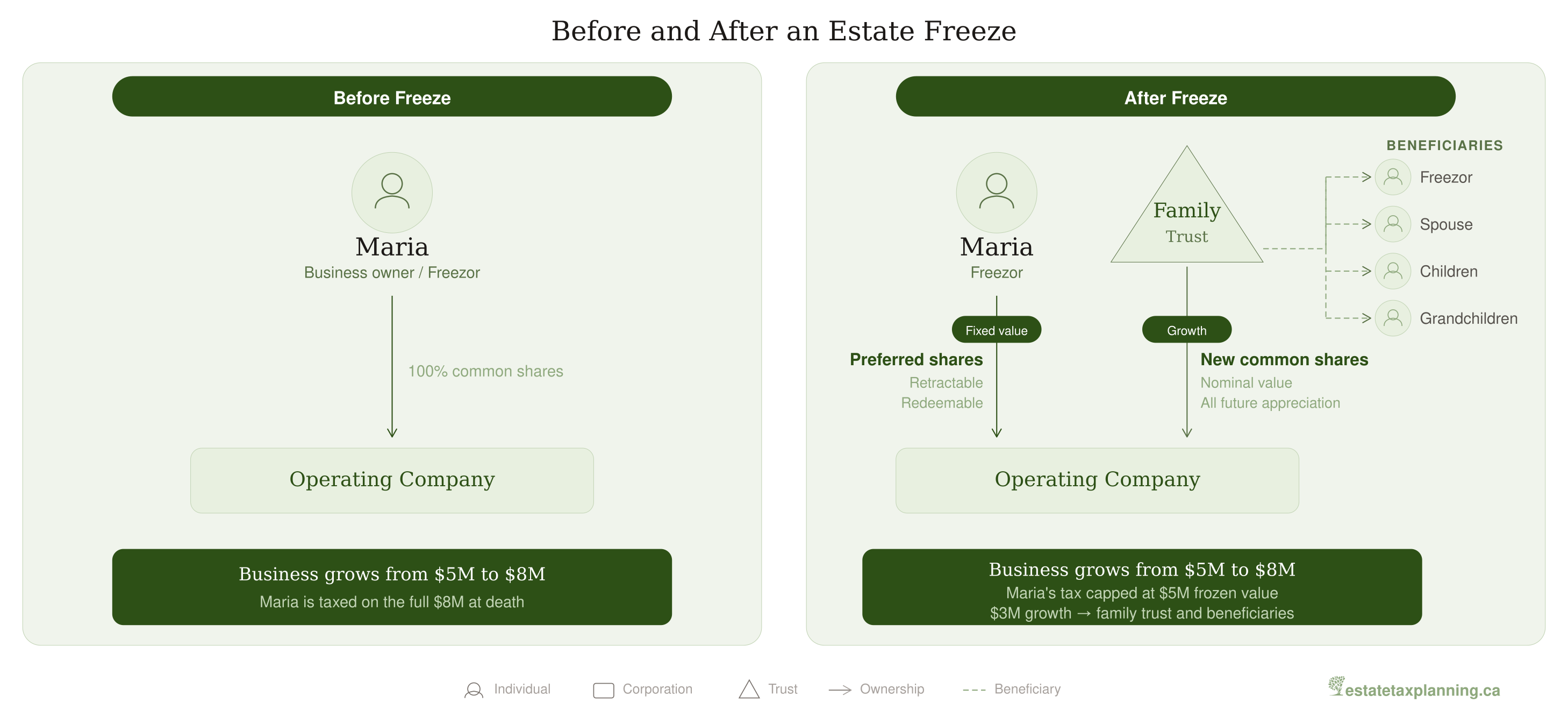
The diagram above illustrates the core concept. Before the freeze, the business owner holds common shares that capture all the value and all the future growth. After the freeze, the owner holds preferred shares locked at today’s value, while a family trust holds new common shares that capture all growth going forward. The trust’s beneficiaries — which can include the freezor, a spouse, children, and grandchildren — ultimately benefit from that growth.
- The freezor exchanges common shares for preferred shares under a tax-deferred rollover — typically subsection 85(1) or section 86 of the ITA. No tax is triggered at the time of the freeze.
- The preferred shares have a fixed redemption value equal to the company’s current fair market value — in Maria’s case, $5 million.
- New common shares are issued to family members or a family trust for a nominal amount ($1 or less).
- All future growth in the company accrues to the new common shares, not to the freezor. The freezor’s tax exposure is capped at the frozen value.
Why Does This Matter? The Tax Advantage
The primary benefit is tax deferral and reduction. By freezing your interest at today’s value, you accomplish two things:
Your tax liability is capped. At death, you are only taxed on the frozen value of your preferred shares — not on any growth that occurred after the freeze. Maria’s estate will owe tax on $5 million, not on whatever the company is worth in 2035 or 2040.
Your tax liability is known. Because your preferred shares have a fixed value, you and your advisors can estimate exactly how much tax will be owed and plan for it — for example, by purchasing a life insurance policy sized to cover that specific liability.
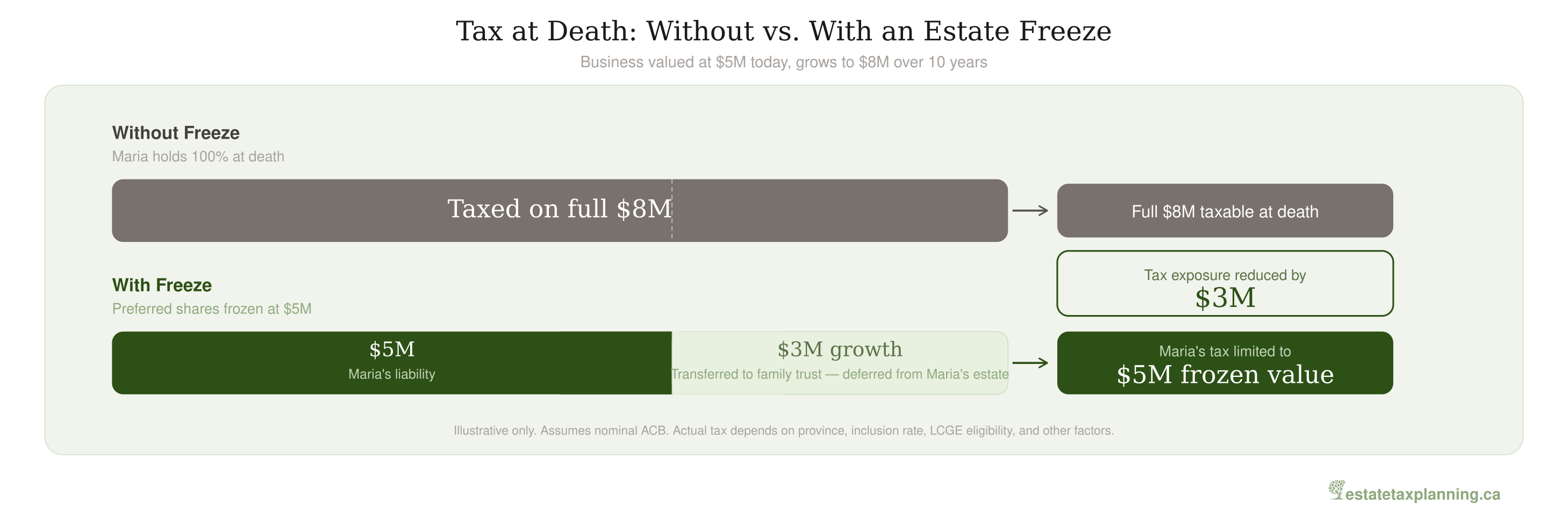
In the example above, Maria’s company — frozen at $5 million today — grows to $8 million by the time she passes away. Without a freeze, her estate would face tax on the full $8 million value — roughly $2.14 million at Ontario’s effective capital gains rate of 26.76%. With the freeze, Maria’s tax exposure is limited to the $5 million frozen value — roughly $1.34 million — and the $3 million of growth is deferred to the next generation. That’s a difference of over $800,000.
But the savings can be even larger. The table below shows what happens when the freeze is combined with the Lifetime Capital Gains Exemption (LCGE) — currently $1,275,000 per individual for 2026. Each Canadian resident can shelter up to $1,275,000 in capital gains on qualified small business corporation shares from tax. By involving multiple family members as shareholders through a trust, the exemption can be multiplied.
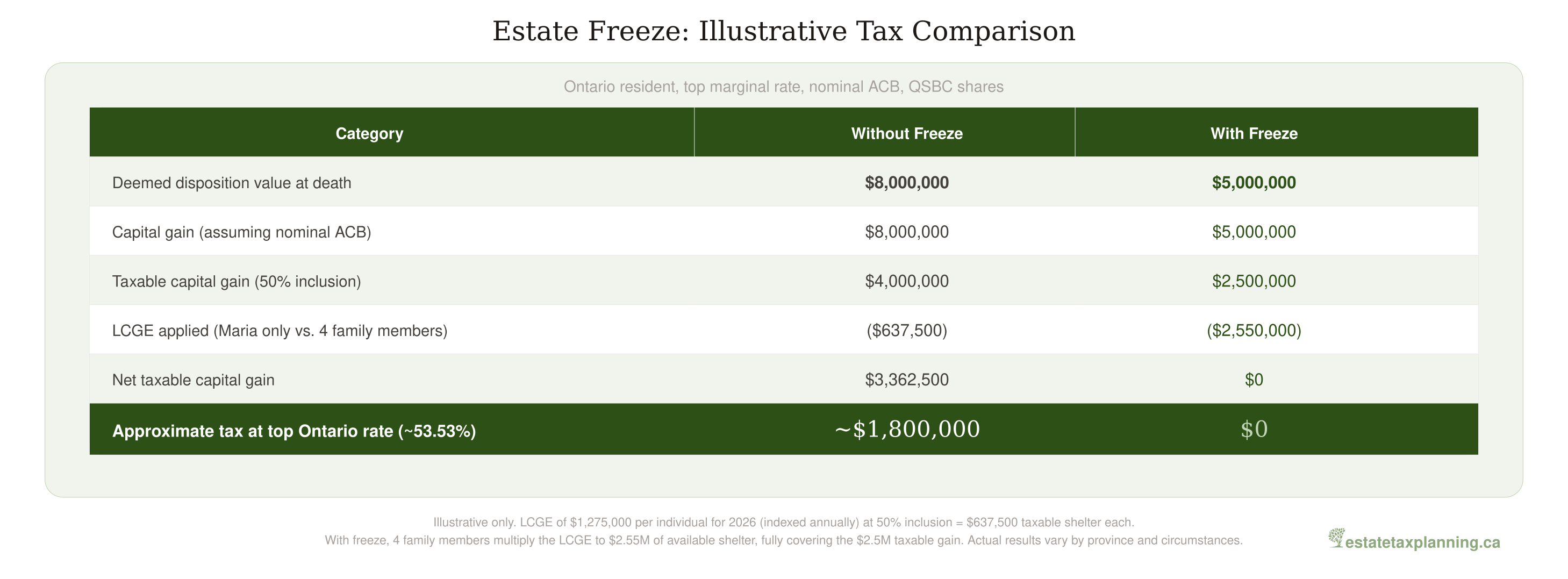
In the table above, four family members each claim their $1,275,000 LCGE on the frozen $2 million value. Their combined exemptions of $5.1 million (at 50% inclusion, sheltering $2.55 million of taxable capital gains) are more than enough to cover the $1 million taxable gain on the $2 million frozen value. The result: the tax on the frozen shares is completely eliminated . Without the freeze, the estate would have owed approximately $1.07 million on the full $8 million value. That’s a savings of over $1 million for a single family.
- The entire structure rests on the fair market value determined at the time of the freeze. If the shares are valued too low, the CRA may reassess and trigger an immediate capital gain. If valued too high, the freezor faces a larger tax liability than necessary.
- This is why we always recommend a formal valuation by an independent Chartered Business Valuator (CBV). It’s the best insurance against a CRA reassessment — and it establishes the number that anchors every other element of the freeze.
Beyond Tax: Other Benefits of an Estate Freeze
The tax savings alone make estate freezes compelling. But the business owners we work with often find that the broader strategic benefits are equally valuable.
Succession planning. An estate freeze is often the first concrete step in a broader business succession plan. It allows you to bring family members into the ownership structure while you’re still active and in control — and it does so without giving up your voting rights or your seat at the head of the table. For Maria, the freeze means her children now have a stake in the company’s future, which opens conversations about who might eventually run the business.
Income splitting opportunities. Once family members hold shares (typically through a trust), the company may be able to pay dividends to them at lower tax rates. However, the Tax on Split Income (TOSI) rules under section 120.4 of the ITA significantly limit this benefit. Not every family member will qualify, and careful structuring is essential.
Multiplying the LCGE. Each Canadian individual is entitled to a Lifetime Capital Gains Exemption of $1,275,000 (indexed annually) on the disposition of qualified small business corporation shares. By involving multiple family members as shareholders through a family trust, this exemption can be multiplied across the family. In the worked example above, four family members’ combined LCGEs completely eliminate the tax on the $5 million frozen value — a benefit worth nearly $1 million compared to a single individual claiming the exemption alone.
Reducing probate fees. In provinces like Ontario and British Columbia, where probate fees can be significant, reducing the value of assets in your estate through a “wasting freeze” — gradually redeeming your preferred shares during retirement — can lead to meaningful savings on Estate Administration Tax.
Maintaining control. This is the question every business owner asks first: “Do I lose control?” The answer is no. Freeze structures are designed so the owner retains control through voting rights attached to the preferred shares, a separate class of voting shares, and/or by serving as trustee of the family trust. Maria still runs her company. She still makes every decision. The freeze changes the tax outcome, not the day-to-day reality.
- A family trust holding growth shares is subject to a deemed disposition every 21 years under subsection 104(4) of the ITA. That means the trust must eventually deal with the accrued gain on the common shares.
- This isn’t a trap — it’s a planning milestone. We build the 21-year timeline into the freeze strategy from the outset, so the family has years to prepare rather than scrambling at the deadline.
- Early planning creates far more options for managing this disposition tax-efficiently — distributing shares to beneficiaries, triggering selective gains, or restructuring the trust before the clock runs out.
- The Tax on Split Income rules (section 120.4) apply the top marginal tax rate to certain dividends and capital gains received by family members who are not meaningfully contributing to the business.
- The “excluded business” and “excluded shares” exceptions provide important carve-outs, but they have specific requirements that must be met — active involvement in the business on a regular, continuous, and substantial basis, or direct ownership of at least 10% of the corporation’s shares.
- We model the TOSI implications for every family member before finalizing the freeze structure. This is one area where the planning makes all the difference.
Getting It Right: Tax, Valuation, and Legal
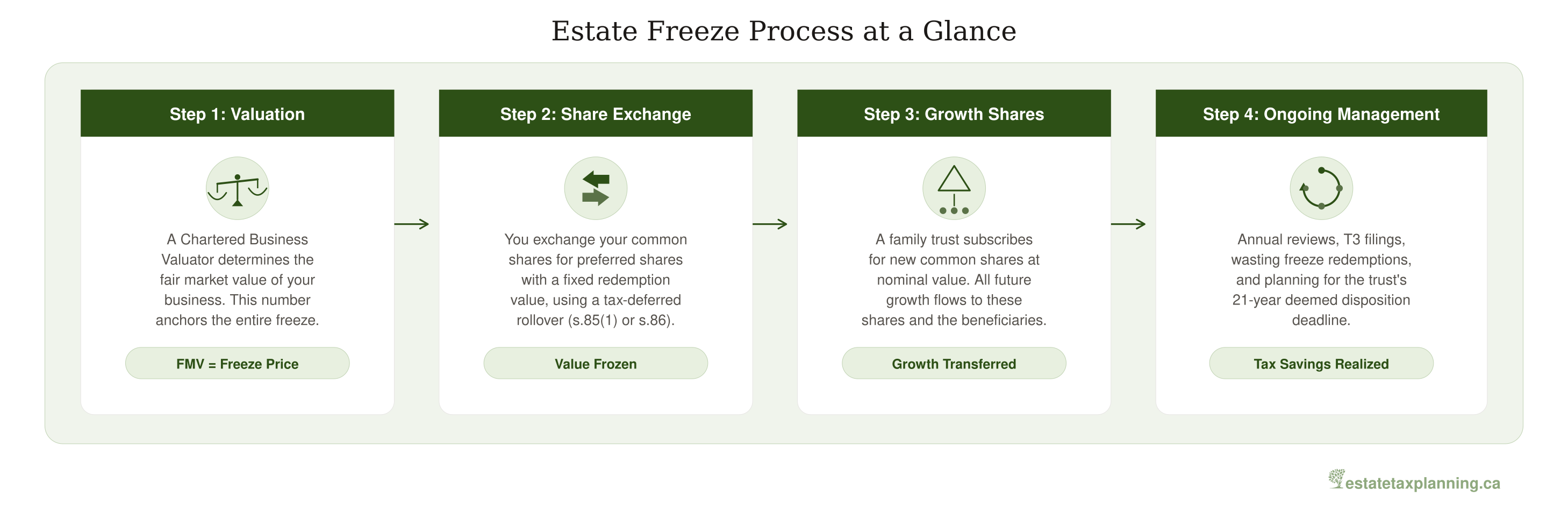
A successful estate freeze isn’t a single transaction — it’s a coordinated effort across three disciplines. When all three are working from the same playbook, the freeze achieves what it’s designed to do. When they’re not, things fall through the cracks.
Tax planning determines the structure — which rollover provision to use (Section 85 or Section 86), how to handle TOSI, whether to crystallize the LCGE at the time of the freeze, and how to plan for the trust’s 21-year deemed disposition.
Business valuation anchors the freeze — the fair market value at the time of the freeze determines the redemption amount of the preferred shares, the freezor’s lifetime tax exposure, and the starting point for the next generation’s growth. For Maria, a valuation that’s $500,000 off means roughly $134,000 in unexpected tax — or an unnecessary overpayment.
Legal implementation brings it to life — articles of amendment, share terms, trust deeds, price adjustment clauses, and corporate resolutions must all be drafted with precision. The trust deed alone can run to forty pages, and a single drafting error can undermine years of planning.
When all three work together, the result is a freeze that achieves the intended tax savings, withstands CRA scrutiny, and gives the family the flexibility they need for the next two decades.
What’s Next
Now that you understand what an estate freeze is and why it matters, the natural next question is whether it’s the right strategy for you — and when. In Is It Time for an Estate Freeze? , we walk through the indicators that suggest a freeze may be worth exploring, the situations where it may not be the right fit, and the financial readiness questions you should answer before proceeding.
For definitions of the key terms used in this article — including estate freeze, deemed disposition, LCGE, family trust, preferred shares, and price adjustment clause — see our Key Terms and Definitions reference guide.
Maria hasn’t implemented her freeze yet — but she’s having the right conversations. She knows the number, she understands the strategy, and she has a team in place. That’s exactly where every business owner in her position should be. The planning conversation is the first step, and the earlier it happens, the more options are on the table. If Maria’s story sounds familiar, it’s worth finding out what a freeze could mean for your family.
This article is for informational purposes only and does not constitute legal, tax, or financial advice. Estate freezes are complex transactions that require the coordinated involvement of qualified tax, valuation, and legal professionals. Always consult your advisors before acting on any of the information discussed here.