
Freeze too early and you may not have enough to fund your retirement. Wait too long and you leave hundreds of thousands of dollars in tax savings on the table. Five indicators tell you when the timing is right.
If you own a private company that has grown in value, the question isn't whether you'll face a tax bill on death — it's how large it will be. An estate freeze can cap that liability at today's value and shift future growth to the next generation. But when to do an estate freeze is often the hardest question of all. Timing matters: freeze too early and you may not have enough to fund your retirement; wait too long and you leave money on the table.
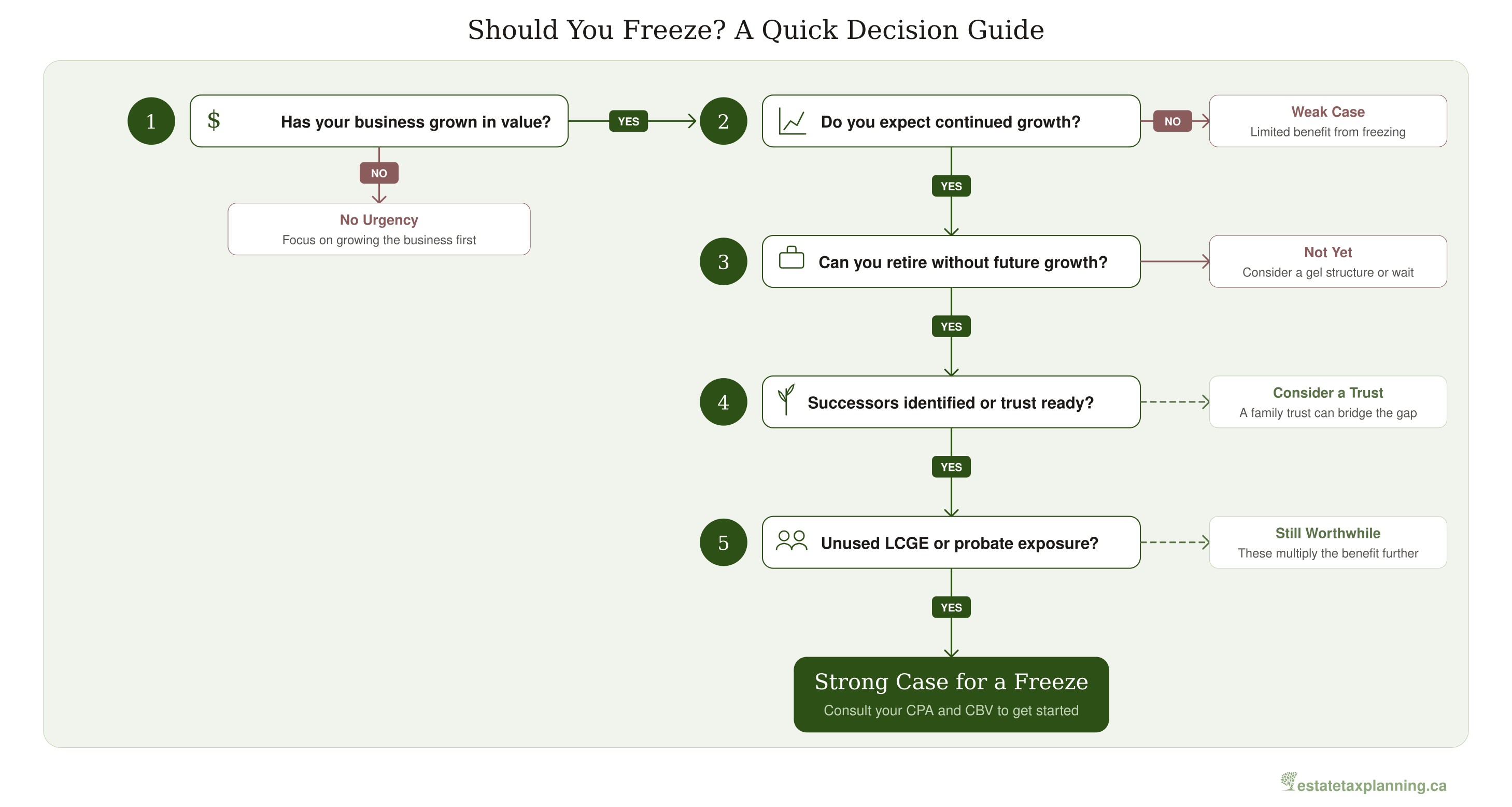
This guide walks through the five most common indicators that suggest an estate freeze may be worth exploring — and the situations where it may not be the right fit.
Five Signs It May Be Time for an Estate Freeze
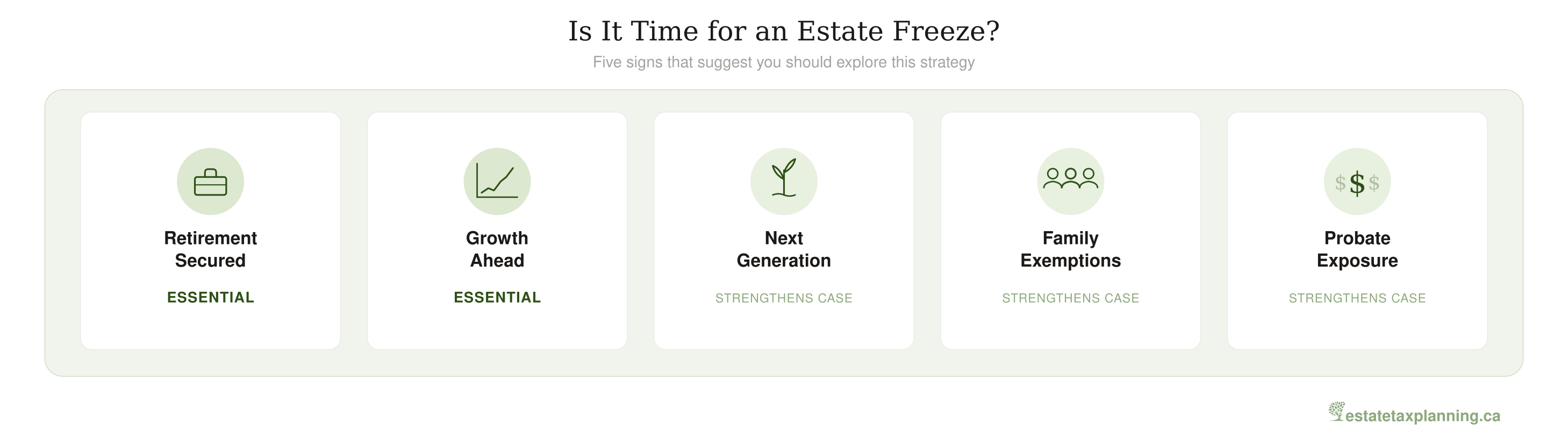
Sign 1: You Have Enough to Fund Your Retirement
This is the most commonly overlooked prerequisite. An estate freeze transfers future growth to the next generation. If you still need that growth to fund your retirement or lifestyle, freezing too early could leave you short.
Before considering a freeze, you should be confident that the value of your preferred shares, along with any other retirement savings, pensions, and investments, will be sufficient to meet your needs for the rest of your life.
The retirement funding analysis. Before any estate freeze, your financial planner should project your annual retirement income needs (adjusted for inflation), then map each income source to confirm the gap can be filled by preferred share redemptions:
- CPP and OAS entitlements (up to approximately $25,000 combined annually at current maximums)
- RRSP/RRIF drawdowns (scheduled withdrawal plan)
- TFSA withdrawals (tax-free, flexible timing)
- Employer pensions and rental income
- Planned wasting freeze redemptions from your preferred shares — this is typically the largest single source and the one most directly affected by the freeze
A simple example: if you need $200,000 per year in retirement, and CPP/OAS provides $25,000, RRSP drawdowns provide $50,000, and other investments provide $25,000, then you need $100,000 per year from preferred share redemptions. On $3 million in frozen preferred shares, that's over 30 years of retirement income before the shares are fully redeemed — likely sufficient, but the numbers should be modeled carefully with your advisor.
- When the corporation redeems your preferred shares, the excess of the redemption amount over paid-up capital (PUC) is treated as a deemed dividend under subsection 84(3) — not as a capital gain. Dividends and capital gains are taxed at different rates, so this distinction matters when modeling your after-tax retirement income. Your advisor should factor this into the funding analysis.
Sign 2: Your Business Is Expected to Keep Growing
An estate freeze only creates a benefit if the business continues to grow after the freeze. The stronger the growth outlook, the stronger the case for freezing.
If your company is worth $3 million today and you expect it to be worth $10 million in 15 years, the freeze would shift $7 million of future capital gains away from your estate. Conversely, if the business is mature and stable with limited growth expected, the tax benefit is minimal and the professional fees may not be justified.
- Future growth shifted away from your estate: $7 million
- Taxable capital gain at 50% inclusion rate: $3.5 million
- Tax at the top combined marginal rate (~53%): approximately $1.85 million
- This is the tax your estate would otherwise owe on death — and it grows every year the business appreciates
Sign 3: You Have Clear Successors — or a Trust Can Bridge the Gap
An estate freeze works best when you know who will receive the growth shares. But you don't need to have every detail figured out.
If you're not yet sure how ownership will be divided among your children, or if some children are still too young to hold shares directly, a family trust is an excellent interim solution. The trust holds the growth shares on behalf of a broad group of beneficiaries, and you (as trustee) retain the flexibility to decide later how the income and shares will be distributed.
One timing consideration: the Income Tax Act (subsection 104(4)) imposes a deemed disposition on trust assets every 21 years. If your children are very young at the time of the freeze, you'll need to plan for this deadline — potentially distributing shares to beneficiaries or implementing a new freeze before the 21st anniversary.
And if you don't have children yet? A family trust can name future or unborn beneficiaries. This is common for younger business owners who want to freeze now — while the value is low — but whose family circumstances haven't fully taken shape. The trust deed should be drafted broadly enough to include children born after the freeze is implemented.
Sign 4: Your Family Has Unused Capital Gains Exemptions
Every Canadian individual is entitled to a Lifetime Capital Gains Exemption (LCGE) of up to $1.275 million on the sale of qualified small business corporation (QSBC) shares. If your company's value already exceeds your personal LCGE limit, an estate freeze can help multiply the exemption by involving your spouse, children, or other family members as shareholders through a trust.
For a family of four, this could mean up to approximately $5.1 million in capital gains sheltered from tax — a benefit that is only available when multiple individuals hold qualifying shares.
- To qualify, at least 90% of the corporation's assets must be used in an active business carried on primarily in Canada at the time of disposition.
- Additional holding period and ownership tests apply. Your tax advisor should confirm QSBC status before relying on the exemption — and before structuring an estate freeze around it.
Sign 5: You Live in a High-Probate Province
In Ontario, probate fees (Estate Administration Tax) are approximately 1.5% on estate assets over $50,000. On a $5 million estate, that's roughly $75,000 in fees. In British Columbia, the effective rate is approximately 1.4% on larger estates. By contrast, Alberta charges a flat maximum of $525 regardless of estate size, and Quebec has no probate fees at all — so this sign is most relevant for business owners in Ontario, BC, and other high-fee provinces.
By freezing your estate and gradually redeeming your preferred shares during your lifetime (a "wasting freeze"), you reduce the value of assets that pass through your estate at death. Every dollar of preferred shares redeemed before death is a dollar that avoids both capital gains tax and probate fees.
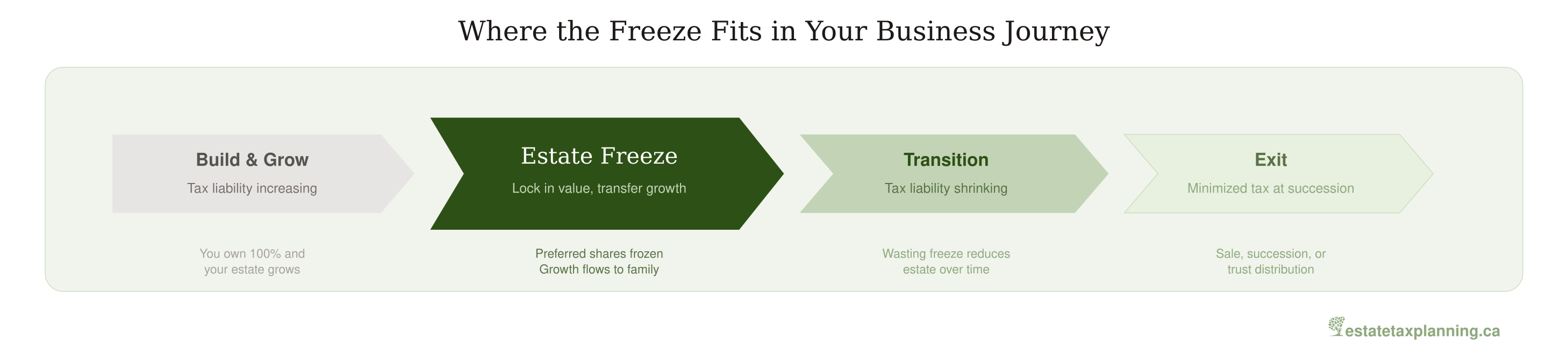
Where the Freeze Fits in Your Business Journey
Most business owners consider a freeze somewhere between the growth and transition phases — once the business has meaningful value and retirement funding is secure, but before a sale or full succession is imminent.
When an Estate Freeze May Not Be the Right Fit
Not every situation calls for a freeze. Here are the most common reasons to hold off:
- You need the growth: If you're not financially secure enough for retirement without continued business growth, a freeze may be premature. Consider a gel structure (a partial freeze that caps some growth while letting you participate in the rest) instead, or revisit the freeze in a few years.
- Limited growth expected: If your business is stable but not appreciating, the tax benefit of a freeze is minimal. The savings come from shifting growth — if there's little growth to shift, the professional fees may outweigh the benefit.
- No succession plan and no trust appetite: If you don't have successors and aren't ready to establish a family trust, there may be better planning options for your situation.
- Assets are already "tax-paid": If the assets in question are portfolio investments or other holdings that are likely to be sold (and taxed) during your lifetime anyway, there may be limited benefit to freezing them. Estate freezes are most powerful for assets you intend to hold long-term — typically an operating business or long-term real estate.
- If you or your intended beneficiaries are U.S. citizens, green card holders, or U.S. residents, an estate freeze can trigger adverse U.S. income and gift tax consequences — particularly related to U.S. grantor trust rules.
- A qualified cross-border tax advisor should be consulted before proceeding. The interaction between Canadian estate freeze structures and U.S. tax obligations is complex and the consequences of getting it wrong can be severe.
A Simple Way to Think About It
Here's the simplest way to frame the decision: are you willing to bet that the value of your business will grow?
If you believe the business will be worth more in the future than it is today, the freeze locks in today's value as your tax liability and shifts all future growth to the next generation.
And if you're wrong — if the business doesn't grow or even declines — the structure can be adjusted. A "refreeze" at the lower value actually improves your position. A "thaw" can reverse all or part of the freeze if your circumstances change fundamentally. These modifications require professional guidance and may have tax implications, but the key point is that an estate freeze is not irreversible.
The downside is manageable — professional fees to implement, and some complexity in your corporate structure. The upside can be transformational — potentially hundreds of thousands of dollars in tax savings for your family over a decade or more.
- If the business declines in value, a "refreeze" at the lower value can improve your position.
- If your circumstances change fundamentally, a "thaw" can reverse all or part of the freeze.
- Both modifications require professional guidance and may have tax implications — but the key point is that an estate freeze is not a one-way door.
What’s Next
If you’ve decided the timing is right, the next step is understanding the mechanics. In How an Estate Freeze Actually Works , we walk through the four steps of an estate freeze, compare the two most common methods under the Income Tax Act, and illustrate the process with a practical example.
The decision to freeze is ultimately a conversation between you and your advisors — not a checklist you score on your own. But if three or four of these signs ring true, the conversation is one worth having sooner rather than later. Every year of growth that passes without a freeze in place is a year of tax savings your family won’t get back.
For definitions of the key terms used in this article — including estate freeze, preferred shares, common shares, family trust, LCGE, wasting freeze, gel structure, and fair market value — see our Key Terms and Definitions reference guide.
This article is for informational purposes only and does not constitute legal, tax, or financial advice. Estate freezes are complex transactions that require the coordinated involvement of qualified tax, valuation, and legal professionals. Always consult your advisors before acting on any of the information discussed here.