
Professional corporations can absolutely benefit from an estate freeze, but regulatory restrictions on share ownership mean you often need a holding company as the freeze vehicle. Establish the holdco early, confirm current rules with your regulator, and coordinate your CPA, CBV, and corporate lawyer from the outset.
If you’re a dentist, doctor, lawyer, accountant, or other regulated professional who operates through a professional corporation, the estate freeze principles we’ve covered in this series still apply to you — but with some important twists. Professional corporations are subject to regulatory restrictions that limit who can hold shares, how shares can be transferred, and what structures are available. These restrictions vary by province and by profession, which means there’s no one-size-fits-all answer.
The good news is that these restrictions don’t prevent you from implementing a freeze. They do require you to plan more carefully, coordinate with your professional regulator, and often use a holding company as a central piece of the strategy. This article walks through what makes professional corporations different, the two common paths to a freeze, and the planning considerations that professionals and their advisors need to address.
What Makes Professional Corporations Different?
Professional corporations live in two worlds: corporate law and the rules of your professional regulatory body. Each province and each profession has its own rules about who can incorporate, who can hold shares, and what restrictions apply. The common thread is that regulators want the professional to retain ultimate control over the practice — they don’t want non-professionals having undue influence over professional decision-making. That’s a reasonable goal, but it creates real constraints for estate planning.
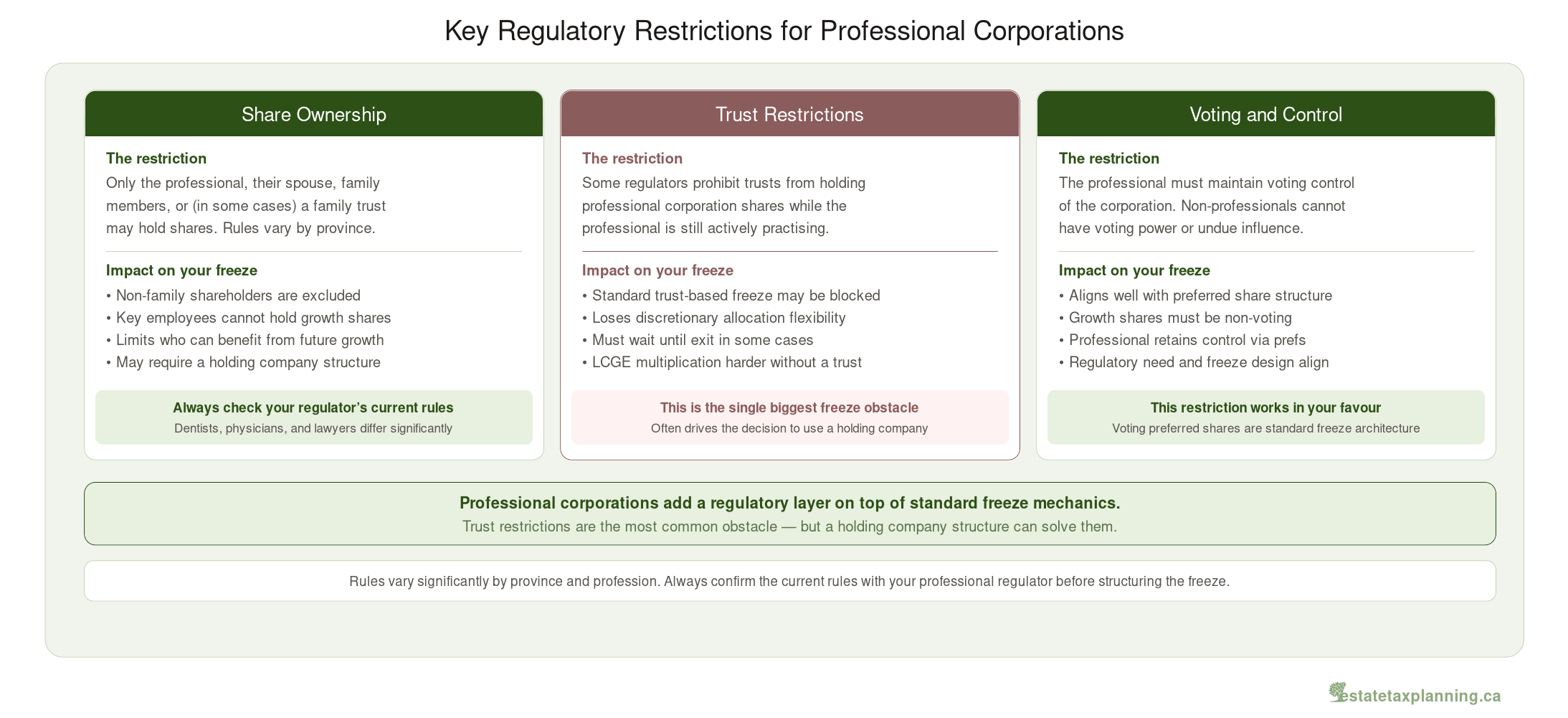
The most significant restriction for freeze purposes is the limitation on who can be a shareholder. In most provinces, shares of a professional corporation can only be held by the professional, their spouse, their family members, or in some cases a family trust — but the specific rules vary by province and profession. Non-family members, including key employees, are typically excluded. The following diagram summarizes the three main categories of restrictions.
Share Ownership Restrictions
Most professional regulators limit share ownership to the professional and their immediate family. In some professions, a family trust or holding company may also hold non-voting shares. But the specific list of permitted shareholders varies considerably — what’s permitted for a lawyer in Ontario may not be permitted for a dentist in the same province. This is why you need to check the current rules with your specific regulatory body before any shares are issued. Don’t assume that what worked for a colleague in a different profession will work for you.
Trust Restrictions
This is often the single biggest obstacle. Some regulators restrict or prohibit trusts from holding shares of a professional corporation while the professional is still practising. Ontario health professions governed by O. Reg. 665/05, for example, generally prohibit trust ownership of professional corporation voting shares — though the regulation does permit non-voting shares to be held in trust for minor children, a narrow exception with limited planning flexibility. For most professionals in this situation, the standard estate freeze structure — using a family trust to hold growth shares — isn’t available until after you exit the practice. This is the primary reason so many professionals turn to a holding company structure instead.
- If your regulator prohibits trusts from holding professional corporation shares during active practice, you cannot use the standard family trust freeze at the professional corporation level.
- This eliminates the flexibility of discretionary income allocation and makes LCGE multiplication more difficult.
- The holding company strategy (discussed below) is the most common workaround for this restriction.
Voting and Control Requirements
The good news: voting control requirements actually align with the freeze. Professional regulators typically require the professional to maintain voting control of the corporation. This fits naturally with the preferred share structure, where the freezor retains voting preferred shares and the growth shares held by family members or a trust are non-voting. The regulatory requirement and the freeze architecture point in the same direction — the professional keeps control, and the next generation receives non-voting growth shares.
Transfer Restrictions on Death or Retirement
When a professional dies or retires, most regulatory bodies require the professional corporation’s shares to be transferred to another licensed professional or the corporation to be wound up within a specified period — often 90 days to one year. That’s a tight timeline, especially when the family is dealing with everything else that comes with a death or retirement. An estate freeze, combined with proper shareholders’ agreements and corporate documentation, can help ensure the transition proceeds smoothly within the regulatory window. The time to plan for this is now, not when the clock starts running.
Shareholder Agreements for Professional Corporations
A well-drafted shareholders’ agreement is especially important for professional corporations, because it must address requirements that do not arise in ordinary private companies. The agreement should set out what happens to the shares on death, disability, or loss of professional licence — including mandatory buyout or retraction provisions that comply with the regulator’s timeline for winding up. It should also address how the buyout price will be determined, whether insurance funding is in place to support the purchase, and how voting control will be maintained throughout any transition. Without these provisions, the estate may face conflicting obligations between the shareholders’ agreement and the regulatory requirements, creating unnecessary risk and delay at the worst possible time.
How the Freeze Typically Works for Professionals
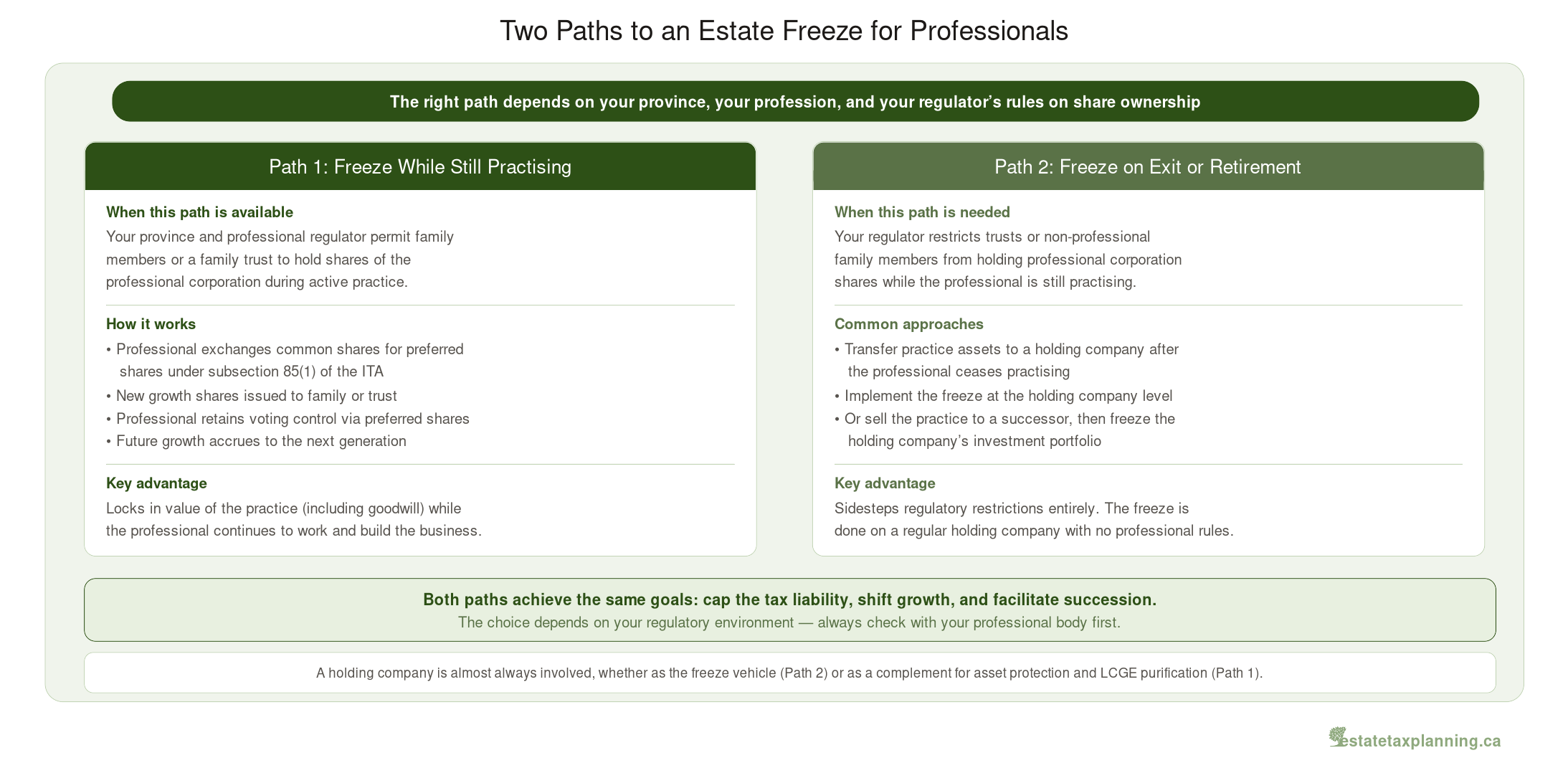
Despite all of these restrictions, estate freezes are widely used by professionals — and they work. The implementation usually follows one of two paths, depending on what your regulator permits.
Path 1: Freeze While Still Practising
In provinces and professions where family members or trusts are permitted to hold shares of the professional corporation, the freeze can be implemented while the professional is still active. The mechanics are the same as a standard freeze: the professional exchanges common shares for preferred shares under subsection 85(1) of the ITA, and new common shares are issued to family members or a family trust.
This approach allows the professional to lock in the current value of the practice — including goodwill — and shift future growth to the next generation while still working. It is the simpler path, and it preserves all the flexibility of a trust-based freeze structure, including discretionary allocation of income and capital gains among beneficiaries.
Path 2: Freeze on Exit
In provinces or professions where trusts cannot hold professional corporation shares during active practice, the freeze is typically implemented as part of the exit strategy. The professional may first transfer the practice assets to a non-professional holding company after ceasing to practise, and then implement the freeze at the holding company level.
Alternatively, the professional may sell the practice to a successor, transfer the proceeds to a holding company, and implement a freeze of the holding company’s investment portfolio. This is particularly common for dentists, where the practice itself is often sold to an associate or outside buyer. The freeze then applies to the investment assets rather than the practice itself.
You do not have to wait until retirement to use Path 2. Many professionals establish a holding company during active practice, accumulate surplus in it over time through inter-corporate dividends, and implement the freeze at the holding company level — all while continuing to practise. The timing depends on the amount of surplus available in the holding company and the professional’s overall succession plan. The holding company strategy section below explains how this works in detail.
- Cap the professional’s tax liability at the current fair market value.
- Shift future growth to the next generation or a family trust.
- Facilitate succession planning and eventual transfer of wealth.
- The choice between Path 1 and Path 2 depends entirely on what your professional regulator permits. In practice, we find that a holding company usually makes Path 2 available even while the professional is still practising.
Valuation Challenges for Professional Practices
Professional practices present unique valuation challenges, and this is an area where we see problems most often. The value of a practice is often heavily concentrated in goodwill — the reputation, patient or client relationships, and earning capacity of the professional. For freeze purposes, the distinction between personal goodwill and enterprise goodwill can make a significant difference in the frozen value.
Personal goodwill stays with the professional. It reflects the individual’s reputation, skill, and relationships that would walk out the door with them. Enterprise goodwill belongs to the corporation — the practice’s location, systems, trained staff, and patient base that would remain even if the founding professional left. Only enterprise goodwill is properly included in the corporate valuation for freeze purposes. Getting this distinction right is critical.
A Chartered Business Valuator with experience in professional practice valuations will consider the practice’s revenue and profitability trends, the patient or client base, location and lease terms, the associate structure, equipment and technology, and — most importantly — the degree to which the practice can operate independently of the founding professional. This is an area where an independent, defensible valuation is particularly important, because CRA scrutiny of professional corporation valuations tends to focus on the personal-versus-enterprise goodwill split.
- If the freeze valuation includes personal goodwill that properly belongs to the professional rather than the corporation, the frozen value may be overstated.
- An overstated freeze value means the preferred shares are worth more than they should be, which can create problems on redemption and at death. For example, if $500,000 of personal goodwill is incorrectly included in a $2 million practice valuation, the preferred shares are overstated by 25% — potentially triggering a benefit assessment under subsection 15(1) on the $500,000 difference.
- CRA has challenged freeze valuations where personal and enterprise goodwill were not properly distinguished.
The Holding Company Strategy
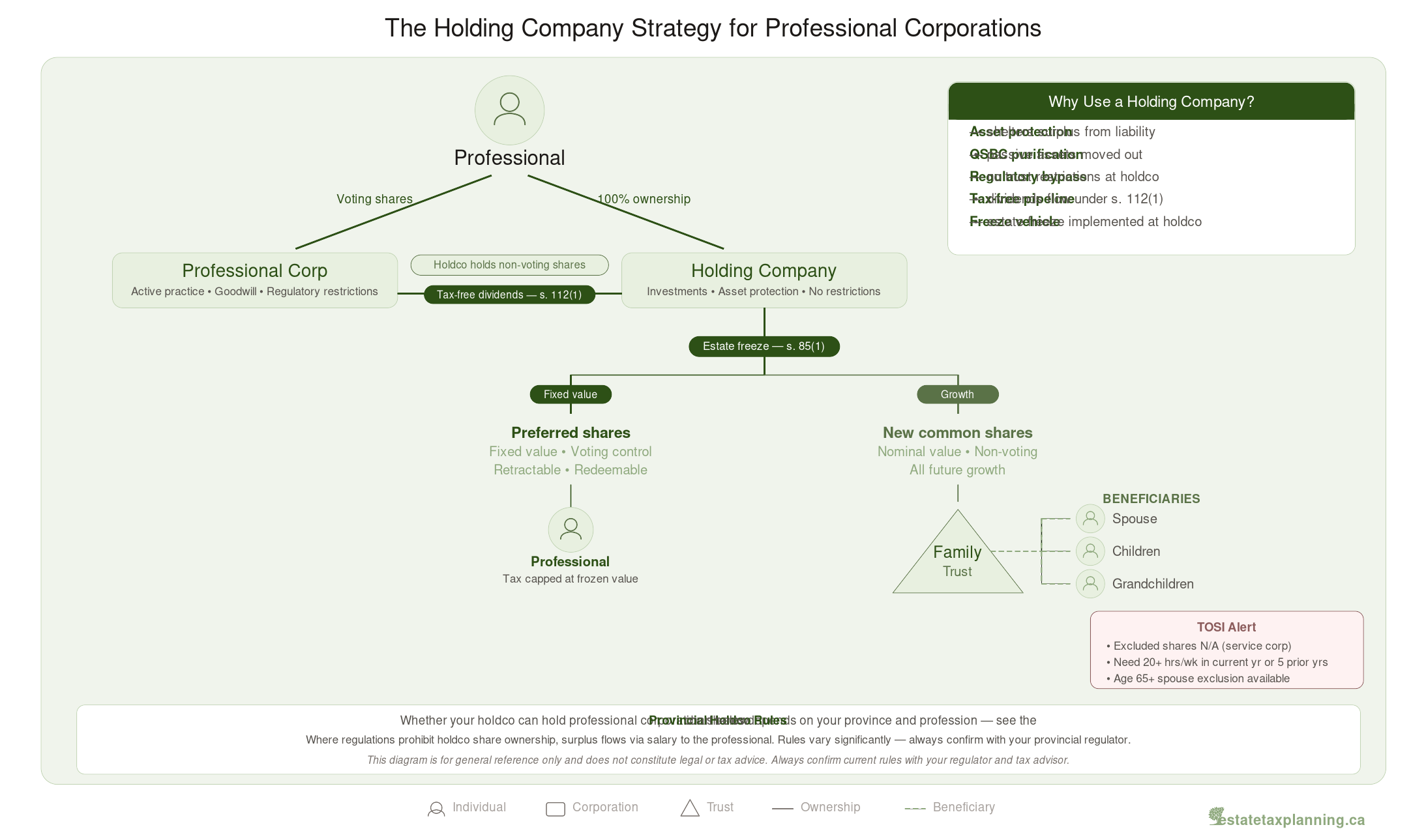
This is where the planning gets interesting. Many professionals use a holding company as a central element of their estate freeze and succession plan. For professionals subject to trust restrictions, it’s often the only practical path to a freeze — and even where it’s not strictly required, it brings significant additional benefits. The following diagram shows how the pieces fit together.
| Purpose | How It Works | Key Benefit |
|---|---|---|
| Asset protection | Surplus flows to holdco via tax-free inter-corporate dividends (s. 112(1)) | Shelters accumulated wealth from malpractice liability |
| Investment management | Passive portfolio held separately from practice | Cleaner corporate structure; independent investment mandate |
| Passive income (AAII) | Keeps passive assets out of the professional corporation | Preserves QSBC status even though AAII is pooled across associated group |
| LCGE purification | Moves non-active assets to holdco | Professional corporation meets 90% asset test and 50% active business test |
| Life insurance | Policies owned by holdco, not professional corporation | CSV outside professional corporation for QSBC; creditor-protected; CDA on death |
| Freeze vehicle | Freeze implemented at holdco level when trust restrictions block freeze at PC level | Bypasses regulatory restrictions on trust share ownership |
| LCGE multiplication | Family trust holds holdco growth shares; gains allocated among beneficiaries | Family of four can shelter $5M+ vs. $1,275,000 for professional alone |
The Inter-Corporate Dividend Pipeline
For the holdco strategy to work most efficiently, the holding company holds shares of the professional corporation — typically non-voting shares, while the professional retains voting control. Surplus earnings from the practice can then be paid to the holding company as inter-corporate dividends, which are generally received tax-free under subsection 112(1) of the ITA. This shelters them from the practice’s professional liability exposure — a significant consideration for professions with malpractice risk.
Not all regulators permit this direct holdco ownership, however — and that’s a key variable. The provincial rules section below provides a detailed breakdown by province and profession. Where regulations prohibit holdco ownership of professional corporation shares, surplus has to flow through the professional via salary or bonuses — a less tax-efficient route, since the funds pass through the personal level before being contributed to the holding company. But even in these cases, the holding company still serves as the freeze vehicle once it’s funded.
- Some Ontario dentists use a workaround in which the holding company briefly holds dental professional corporation shares on a non-operating day to effect a dividend transfer, after which the ownership is retracted.
- This practice is not endorsed by the RCDSO, and no enforcement action is publicly known. It remains a regulatory gray area rather than a sanctioned planning technique.
- Professionals considering this approach should obtain written advice from both their tax advisor and their regulatory body before proceeding.
- When transferring professional corporation shares to a holding company, section 84.1 of the ITA can recharacterize what would otherwise be a capital gain as a deemed dividend — eliminating access to the LCGE.
- This rule applies when a taxpayer disposes of shares of a corporation to another corporation with which they do not deal at arm’s length, and the shares are capital property. For example, a professional transferring $2 million of professional corporation shares to a holdco could see the entire gain recharacterized as a deemed dividend — taxed at up to 47% rather than the ~27% effective capital gains rate, and with no LCGE shelter available.
- Professional corporation freezes that involve a holding company must be carefully structured to avoid triggering section 84.1. This is covered in detail in Section 84.1 and Intergenerational Transfers.
Passive Income and the AAII Trap
Since 2019, every dollar of adjusted aggregate investment income (AAII) above $50,000 earned by an associated group reduces the small business deduction (SBD) by $5. At $150,000 of AAII, the SBD is eliminated entirely. AAII is essentially the passive investment income earned by a private corporation from interest, rents, royalties, and taxable capital gains.
The dollar impact adds up faster than most professionals realize. A professional corporation group earning $100,000 of passive income faces a $250,000 reduction in the SBD limit, costing roughly $36,000 in additional corporate tax on active business income. That’s tax on the practice earnings — triggered solely by the level of passive income in the group.
Moving passive investments from the professional corporation to the holding company does not, on its own, reduce the group’s total AAII — because the professional corporation and the holding company are associated under subsection 256(1), AAII is pooled across the group. However, the separation still matters for two reasons. First, it keeps the professional corporation’s own balance sheet clean of passive assets, which is essential for qualified small business corporation (QSBC) share qualification. Second, it creates an entity where the passive portfolio can be managed independently, with its own investment mandate and risk profile, separate from the operating cash flow needs of the practice. By moving passive assets to the holding company, the professional corporation’s shares are more likely to meet the 90% asset test and the 50% active business test required for LCGE access on a sale or deemed disposition.
Life Insurance and the Freeze Vehicle
Many professionals hold life insurance policies inside the holding company rather than the professional corporation. This keeps the cash surrender value — which is a non-active asset — outside the professional corporation for QSBC purposes, and it shelters the policy from malpractice creditors at the practice level. On death, the proceeds received by the holding company may be credited to the capital dividend account, enabling tax-free distribution to shareholders.
In jurisdictions where the freeze cannot be done at the professional corporation level due to trust restrictions, the holding company becomes the entity at which the freeze is implemented. The professional freezes the holding company shares instead, and the growth shares of the holding company are issued to family members or a trust — with no professional regulatory restrictions to navigate. When a family trust holds the growth shares, capital gains realized on a future sale or deemed disposition can be allocated among the trust’s beneficiaries, each of whom can claim their own Lifetime Capital Gains Exemption. A family of four could potentially shelter up to $5 million or more in capital gains, compared to $1,275,000 for the professional alone. This strategy requires careful structuring and is subject to the TOSI rules discussed below.
The 21-Year Clock
One important timing consideration for trust-based freeze structures is the 21-year deemed disposition rule under subsection 104(4) of the ITA. Every 21 years, a trust is deemed to have disposed of all its capital property at fair market value, triggering any accrued capital gains. For a professional who implements a freeze at age 45 when the holding company is worth $1 million, the 21-year anniversary arrives at age 66. If the holding company has grown to $4 million by then, the trust faces a deemed capital gain of $3 million — generating approximately $800,000 in tax at the top combined rate.
Planning for this event should begin well before the anniversary, and may involve distributing property to beneficiaries, triggering gains strategically, or implementing a refreeze. A refreeze involves the trust exchanging its current common shares for new preferred shares at the appreciated value, with fresh common shares issued to continue the growth-shifting strategy for another 21-year cycle. This is covered in detail in the trust planning articles later in this series.
- For many professionals, the holding company is not optional — it is the only practical path to a freeze.
- It simultaneously solves asset protection, QSBC purification, and the regulatory bypass needed to use a family trust.
- The inter-corporate dividend pipeline from the professional corporation to the holding company is the mechanism that makes it all work.
Provincial Rules: Can Your Holdco Own Professional Corporation Shares?
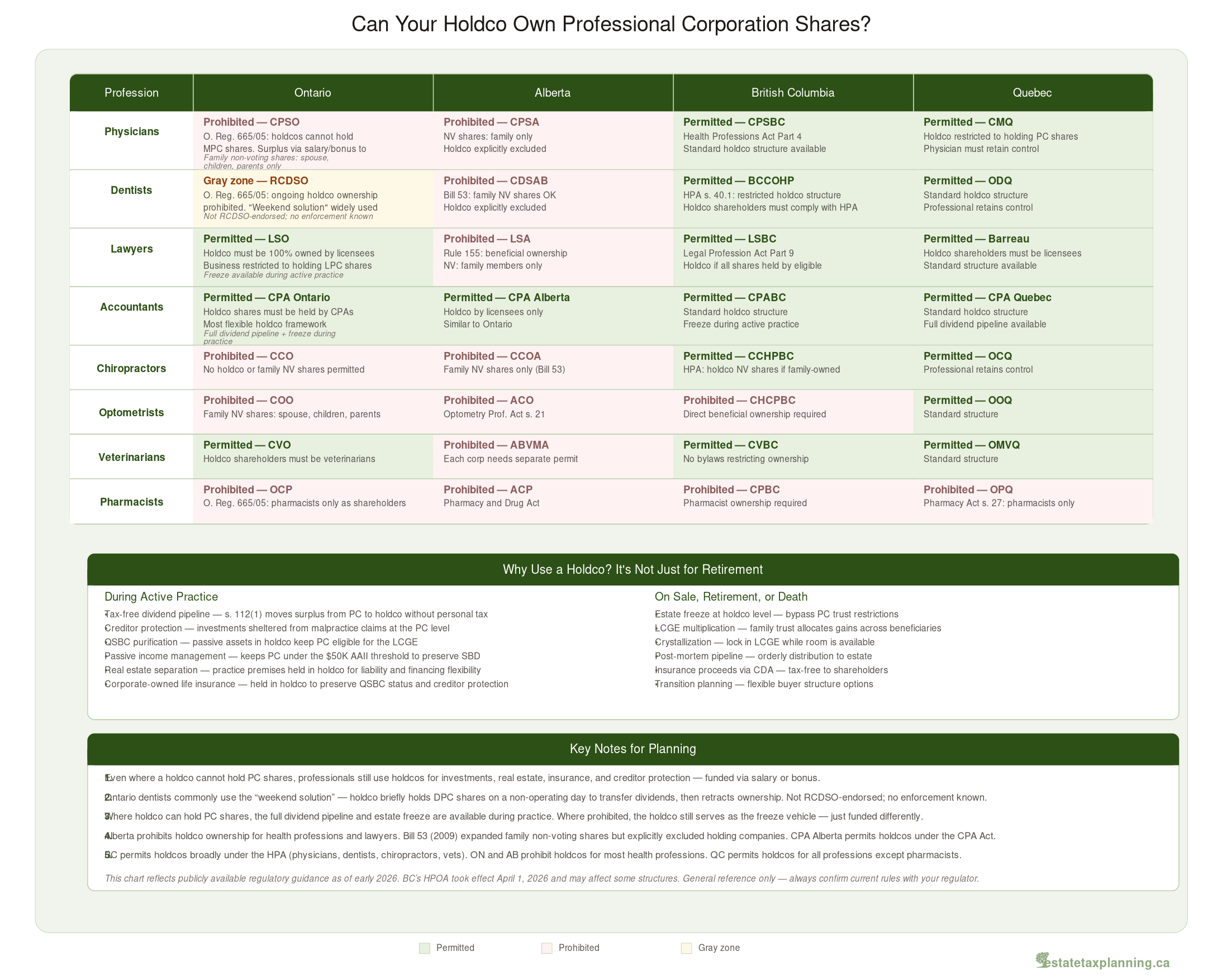
Whether a holding company can hold shares of a professional corporation depends on both the province and the profession. The rules vary significantly, and they change over time as regulators update their policies. The following chart summarizes the current landscape for eight regulated professions across four provinces. In all cases, you should confirm the current rules with your own regulatory body before implementing any structure.
Current as of April 2026. These rules are subject to legislative change.
Ontario
Ontario health professions governed by O. Reg. 665/05 — including physicians (CPSO), dentists (RCDSO), chiropractors, optometrists, and pharmacists — are prohibited from having a holding company own their professional corporation shares. The regulation does permit non-voting shares to be held by the professional’s spouse and family members, but holding companies are explicitly excluded from the permitted classes of shareholders. Ontario lawyers (LSO) and accountants (CPA Ontario) may use holding companies, subject to conditions set by their respective regulators. Veterinarians (CVO) are also permitted to use holding company structures.
British Columbia
British Columbia is one of the more permissive provinces for professional corporation structuring. Health professions regulated under the Health Professions and Occupations Act (HPOA, effective April 1, 2026, replacing the former Health Professions Act) — including physicians (CPSBC), dentists (BCCOHP), and chiropractors (CCHPBC) — generally permit holding companies and family trusts to hold shares of professional corporations. Veterinarians (CVBC) are regulated separately under the Veterinarians Act, and accountants (CPABC) under the Chartered Professional Accountants Act, but both also permit holdco structures. Each regulator sets its own specific conditions, so the details of permitted shareholders, share classes, and corporate governance requirements should be confirmed with the relevant college.
Alberta
Alberta prohibits holdco ownership for health professions and lawyers. Bill 53 (2009) expanded non-voting share ownership to family members — including spouses, common-law partners, and children — but explicitly excluded holding companies from the permitted classes. This applies across professions regulated under the Health Professions Act (physicians, dentists, chiropractors) and the Legal Profession Act (lawyers). Accountants regulated by CPA Alberta under the Chartered Professional Accountants Act may be subject to different rules — confirm current holdco permissions with CPA Alberta directly, as the rules have evolved independently from the health and legal professions.
Quebec
Quebec’s Professional Code permits professional incorporation broadly, and holdco structures are used across many Quebec professions. The specific rules vary by professional order — each order sets its own conditions for who may hold shares and what governance requirements apply, so professionals should confirm current rules with their own order. Pharmacists are a notable exception: the Pharmacy Act s. 27 restricts pharmacy ownership to pharmacists, partnerships of pharmacists, or corporations where all shares and all director positions are held by pharmacists, effectively prohibiting external holding companies from the ownership chain.
- The exact list of permitted shareholders for your profession in your province — including whether a holding company, a family trust, or a spouse can hold voting or non-voting shares.
- Whether the regulator requires all voting shares to be held by licensed members, and whether there are separate rules for voting versus non-voting shares.
- The timeline for transferring or winding up the professional corporation on death, disability, or loss of licence — and whether your shareholders’ agreement aligns with it.
- Any pre-approval or notification requirement before issuing new share classes, admitting a holdco as a shareholder, or amending the articles. We have seen freezes delayed because this step was missed.
- Whether your regulator’s rules have changed in the last 12 months — provincial health profession legislation has been unusually active since 2024.
TOSI Considerations for Professionals
The TOSI rules hit professionals harder than most other business owners, and this is an area that requires careful attention. The “excluded shares” exception — which allows income splitting when a family member holds 10% or more of the votes and value of a corporation — specifically does not apply to shares of a “specified service corporation.” Most professional corporations fall squarely into this category because more than 90% of their income comes from providing professional services — services that depend on the reputation, skill, or effort of a specific individual.
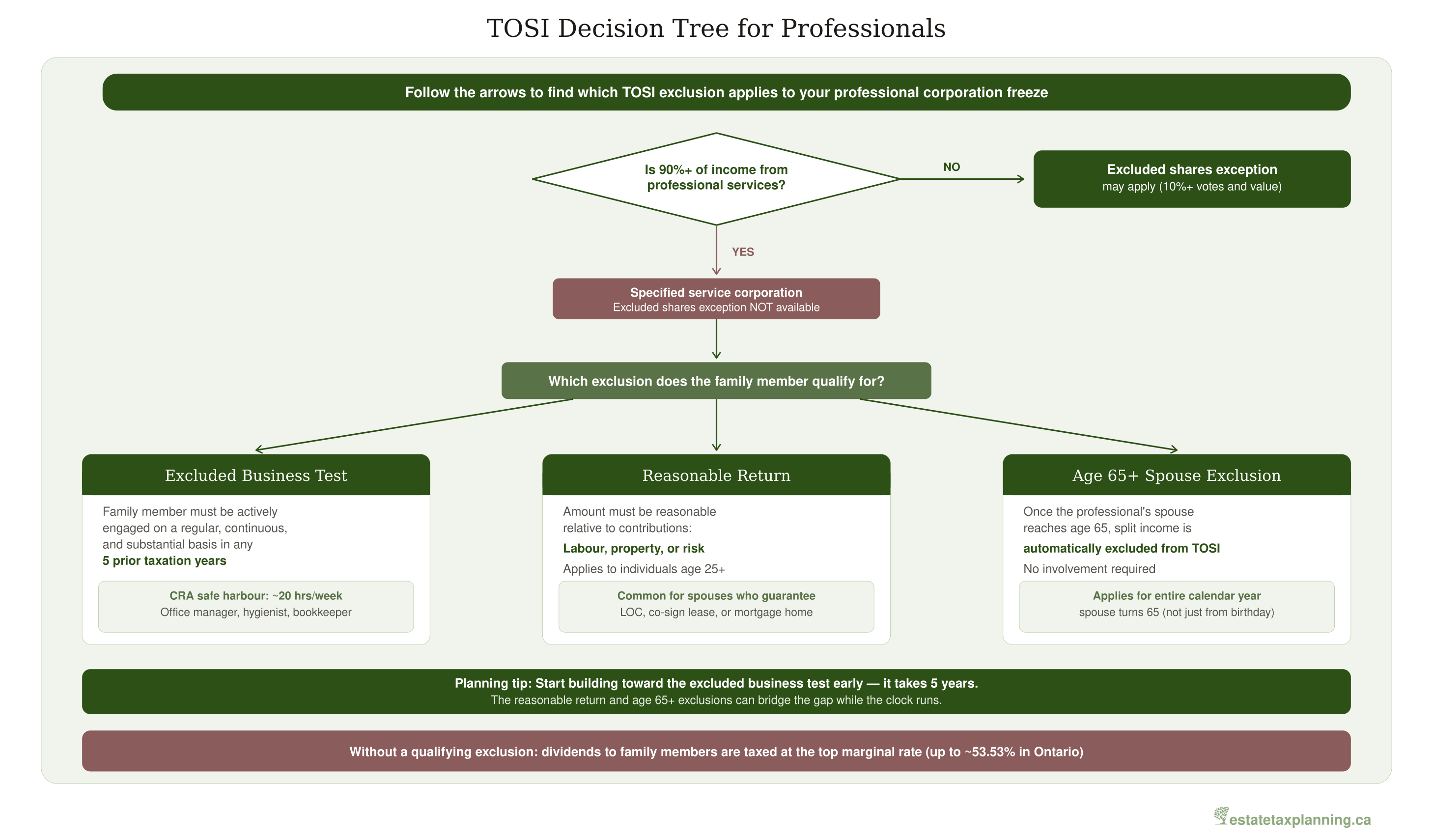
What this means in practice: even if a family member holds shares directly, they cannot rely on the excluded shares exception to avoid TOSI on dividends they receive. For professionals, the most reliable TOSI exclusion is the “excluded business” test under subsection 120.4(1): the family member must be actively engaged in the business on a regular, continuous, and substantial basis in any five prior taxation years. CRA generally interprets this as approximately 20 hours per week, though the statutory test is based on the nature of involvement rather than a fixed hourly threshold. Family members who work in the practice — office managers, hygienists, dental assistants, bookkeepers — can build toward TOSI-exempt status over time. It takes five years, so the earlier they start, the better.
The Spouse’s Role and the Reasonable Return Exception
Even if a spouse does not work in the practice, they may still be able to receive dividends that are exempt from TOSI. The reasonable return exception considers whether the amount received is reasonable in light of the spouse’s contributions, including labour, property, and risk assumed. A spouse who has guaranteed a line of credit, co-signed a lease, or mortgaged the family home to finance the practice may have assumed meaningful financial risk that supports a reasonable return.
This exception applies to individuals aged 25 and older. However, it is not a blanket entitlement — the amount must actually be reasonable relative to the risk assumed, and the CRA will evaluate the specific facts. CRA’s administrative guidance indicates that the risk assumed continues to be relevant even after the underlying obligation has been repaid, but the quantum of a reasonable return may diminish over time as the risk recedes. An ongoing personal guarantee on a substantial operating line of credit will typically support a larger reasonable return than a guarantee that was discharged years earlier.
The age 65+ spouse exclusion is also relevant for professionals approaching retirement. Once the professional’s spouse reaches age 65, split income from the professional corporation is excluded from TOSI, which can enable meaningful income splitting in the years leading up to and following retirement. For professionals who implement a freeze in their late fifties or early sixties, this exclusion often becomes the primary TOSI planning tool.
- The excluded shares exception does not work for most professional corporations.
- Family members need 5 years of 20+ hours per week to qualify under the excluded business test.
- The reasonable return exception for a spouse’s risk contribution is fact-specific and should be reviewed with your tax advisor.
- The age 65+ spouse exclusion becomes relevant as the professional approaches retirement.
Bringing It All Together
Estate freezes work for professionals, but the regulatory landscape adds complexity that requires a coordinated approach. Let’s walk through an example to see how all the pieces fit together.
Dr. Patel: A Worked Example
Dr. Patel is a 48-year-old dentist in Ontario. Her dental professional corporation is worth $2.5 million, including $1.8 million of enterprise goodwill. As an Ontario health professional governed by O. Reg. 665/05, she can’t have a family trust hold shares of the dental corporation while she’s still practising, and a holding company can’t directly own dental corporation shares. So the standard freeze at the professional corporation level isn’t available to her.
Her advisor recommends the holdco route. She establishes a holding company and begins paying herself a combination of salary and dividends, contributing the after-tax surplus to the holdco. Over several years, the holdco accumulates $1.2 million. Her life insurance policies are held in the holdco, keeping the cash surrender value out of the dental corporation for QSBC purposes. The passive investment portfolio is also in the holdco — so while AAII is pooled across the associated group, the dental corporation’s balance sheet stays clean for the 90% asset test.
At age 52, with $1.8 million in the holdco, Dr. Patel implements a freeze at the holding company level. She exchanges her holdco common shares for $1.8 million of voting preferred shares under subsection 85(1), and a family trust subscribes for new common shares. Because Dr. Patel uses a Section 85 election rather than a Section 86 share exchange, she has the option to crystallize her LCGE at the time of the freeze — electing a transfer amount that triggers a capital gain equal to her available $1,275,000 exemption, then offsetting it with the LCGE deduction. This steps up the ACB of her preferred shares, reducing the capital gain that will arise at death and lowering the insurance coverage she needs by roughly $341,000 in eventual tax savings. Her advisor models the AMT before finalizing the elected amount, as the post-2024 rules can produce $55,000 to $65,000 in combined federal and provincial AMT on a full crystallization. Her spouse, who has managed the dental office for six years at 25 hours per week, qualifies under the excluded business test for TOSI purposes. Their two adult children are named as beneficiaries of the trust but won’t receive distributions until they can demonstrate a reasonable return basis or reach age 65.
The result: Dr. Patel has locked in $1.8 million of value in her preferred shares. Future growth accrues to the family trust. She retains voting control of both the holdco and the dental corporation. If the holdco grows to $4 million by the trust’s 21-year anniversary, the family will plan a refreeze or strategic distribution well in advance. And her shareholders’ agreement addresses the RCDSO’s requirements for share transfer on death, disability, or loss of licence — including a funded buyout provision that complies with the regulatory timeline. Nothing was left to chance.
The Implementation Checklist
Dr. Patel’s example illustrates three principles that apply to every professional freeze. First, establish the holding company early — even where it can’t hold professional corporation shares directly. The earlier it’s established, the more surplus it accumulates and the more effective the eventual freeze. Second, coordinate your advisory team from the outset. The tax advisor, the corporate lawyer, the valuator, and the financial planner each need to understand the regulatory restrictions that apply to your specific profession and province. A typical implementation takes six to nine months. Third, confirm the current rules with your professional regulator before any shares are issued. Regulatory rules change — Alberta’s Bill 53 amendments, British Columbia’s new HPOA, and the 2024 Quebec Professional Code amendment have all shifted the landscape in recent years.
For professionals whose spouse provides financial support through guarantees or co-signed obligations, the freeze strategy should consider the spouse’s own estate plan. The interaction between the two estates on death needs to be coordinated — including the subsection 70(6) spousal rollover, the optional subsection 70(6.2) election to trigger gains at death, and the impact on each spouse’s LCGE. Where both spouses are professionals operating through separate professional corporations, the planning complexity increases further.
- Professional corporations can absolutely benefit from an estate freeze — thousands of Canadian professionals have implemented them successfully. The regulatory restrictions are real, but they’re manageable.
- The holding company is the cornerstone of the strategy: it protects assets, purifies the professional corporation for LCGE, and serves as the freeze vehicle where trust restrictions apply.
- Start early, confirm your regulatory rules, and coordinate your advisors from the beginning. The earlier the holdco is in place, the more options you’ll have when the time comes to freeze.
What’s Next
If your freeze strategy involves transferring professional corporation shares to a holding company, the next critical consideration is section 84.1 of the Income Tax Act — an anti-avoidance rule that can recharacterize capital gains as deemed dividends. In Section 84.1 and Intergenerational Transfers, we explain how this rule works, when it applies, and how the intergenerational business transfer rules have evolved. Bill C-208 (2021) first introduced a limited exception for genuine family transfers, and Bill C-59 (2024) replaced and expanded those rules with a more structured framework — including a three-year transition test for parents transferring to children and grandchildren. For professionals planning a holdco freeze, understanding this progression is critical.
Every regulatory college has its own rules, and they change. Before you commit to a freeze structure, confirm the current restrictions with your regulator — then bring your CPA, CBV, and corporate lawyer to the table together. We’ve helped dozens of professionals navigate this, and the coordination is what makes it work.
For definitions of the key terms used in this article — including professional corporation, holding company, AAII, QSBC, reasonable return, and specified service corporation — see our Key Terms and Definitions reference guide.
Your tax advisor, CBV, and legal counsel can help you evaluate how this applies to your situation — for your professional corporation freeze — ensuring the regulatory restrictions, the tax strategy, and the corporate documents align from the start.
This article is for informational purposes only and does not constitute legal, tax, or financial advice. Estate freezes are complex transactions that require the coordinated involvement of qualified tax, valuation, and legal professionals. Always consult your advisors before acting on any of the information discussed here.