
Section 84.1 can recharacterize a capital gain as a deemed dividend on any non-arm’s-length share transfer, eliminating LCGE access and increasing the tax rate from ~27% to ~47%. The intergenerational transfer rules under Bill C-59 provide a structured pathway, but the conditions are specific. Run the numbers with your CPA before any family share transaction.
If your succession plan involves transferring shares to the next generation, this rule could cost your family hundreds of thousands of dollars. Section 84.1 of the Income Tax Act is one of the most important — and most misunderstood — anti-avoidance provisions affecting estate freezes and family business transfers.
Section 84.1 is designed to prevent shareholders from extracting corporate surplus tax-free through non-arm’s-length share transactions. If you’re planning to sell or transfer shares to a corporation controlled by your children or other non-arm’s-length parties, this rule can dramatically change the tax outcome. What you expected to be a capital gain eligible for the LCGE gets recharacterized as a deemed dividend — taxed at a much higher rate, with no access to the exemption.
This article explains what Section 84.1 does, how it applies to estate freezes, and why the intergenerational transfer rules under Bill C-59 matter for every business family planning a succession.
What Section 84.1 Does
Here’s what the rule does in plain terms: it limits the amount of non-share consideration — cash or a promissory note — that you can receive on a non-arm’s-length transfer of shares to a corporation. If the non-share consideration exceeds the greater of the paid-up capital (PUC) and the “modified” adjusted cost base (ACB) of the shares transferred, the excess is treated as a deemed dividend rather than a capital gain.
This matters for two reasons. First, dividends are generally taxed at a higher effective rate than capital gains. Second — and this is the real problem — a deemed dividend under Section 84.1 cannot be offset by the LCGE, because the LCGE only applies to capital gains, not dividends. The combined effect can be devastating.
Section 84.1 also grinds down the paid-up capital of any shares issued by the purchasing corporation as part of the transaction. The PUC of the new shares is reduced so that the seller cannot later extract the inflated PUC as a tax-free return of capital. In other words, Section 84.1 attacks both the non-share consideration at the time of transfer and the PUC of the shares received — closing off two potential routes for surplus stripping.
The Six Conditions
All six of the following conditions must be met for Section 84.1 to apply:
- Condition 1 — The seller is a taxpayer resident in Canada (individuals and trusts included).
- Condition 2 — The purchaser is a corporation.
- Condition 3 — The property disposed of is shares of a Canadian-resident corporation.
- Condition 4 — The seller and purchaser do not deal at arm’s length.
- Condition 5 — The purchaser corporation and the corporation whose shares were sold are “connected” after the transaction (one controls the other, or owns more than 10% of its votes and fair market value).
- Condition 6 — The non-share consideration received by the seller exceeds the greater of the PUC and the modified ACB of the transferred shares.
In most estate freeze scenarios involving a family holding company, conditions 1 through 5 are almost always met. The real question is condition 6: does the non-share consideration exceed the safe threshold? And that threshold depends on the modified ACB — which is where most people get tripped up.
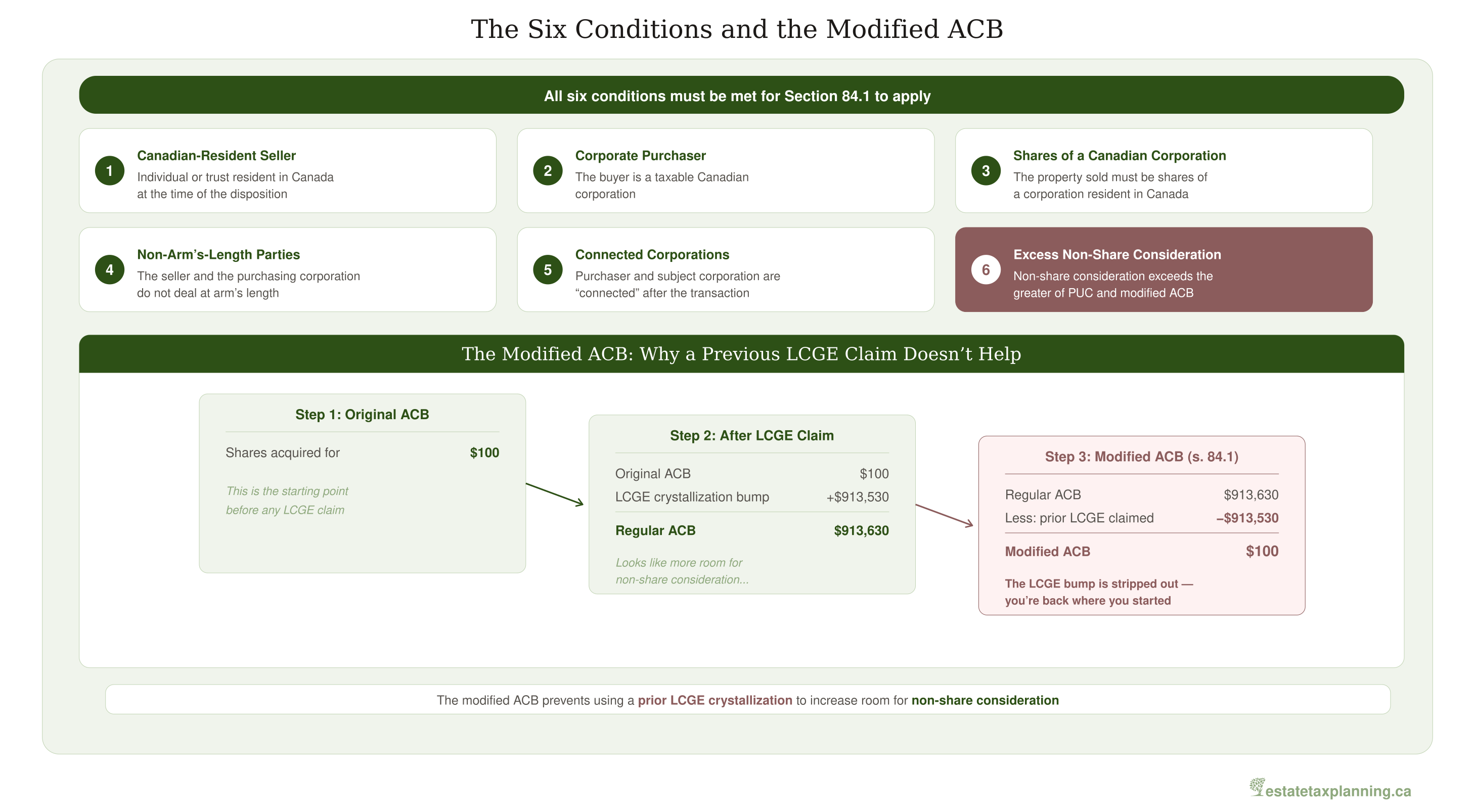
The lower half of the diagram illustrates the modified ACB in three steps. In step 1, the shares have an original ACB of $100. In step 2, the owner crystallizes the LCGE, bumping the regular ACB to $913,630 — which appears to create significant room for non-share consideration. But in step 3, Section 84.1 strips out the LCGE component, returning the modified ACB to $100. The apparent room disappears entirely.
A Numerical Example
The impact of Section 84.1 is best understood through a side-by-side comparison. Consider a business owner with shares that have an ACB and PUC of $100 and a fair market value of $1,000,000. If the LCGE is available, the tax outcome depends entirely on who the buyer is.
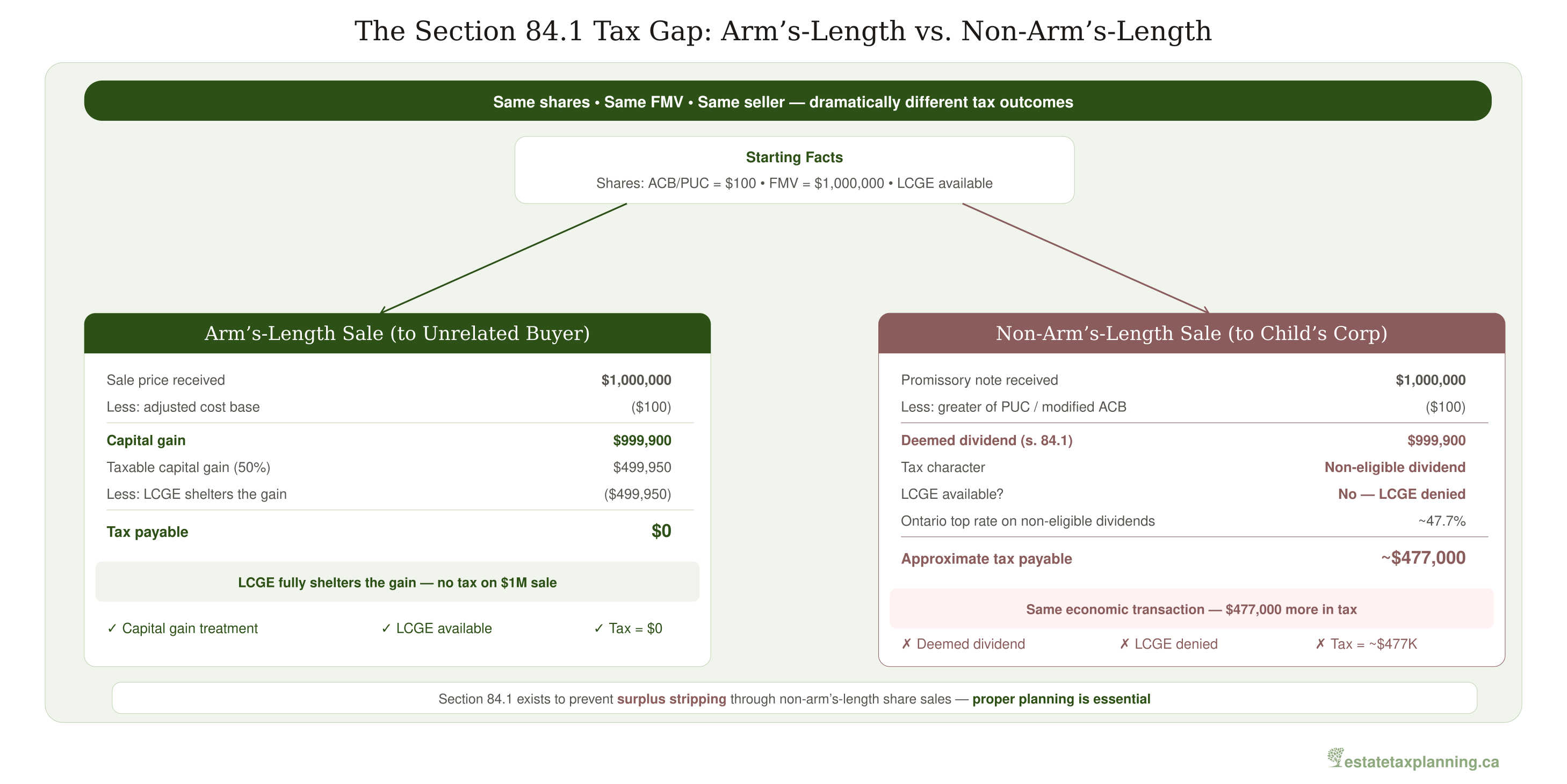
In the arm’s-length sale, the capital gain of $999,900 is fully sheltered by the LCGE ($1,275,000 for 2026). Tax payable is zero. In the non-arm’s-length sale to a child’s corporation, Section 84.1 treats the excess non-share consideration over PUC as a deemed dividend. The LCGE is denied. At Ontario’s top marginal rate for non-eligible dividends of approximately 47.74%, the tax bill is roughly $477,000.
The difference is staggering. The identical economic transaction — same shares, same value, same seller — results in approximately $477,000 more tax simply because the buyer is a related party rather than a stranger. This is the inequity that the intergenerational transfer rules are designed to address.
The Modified ACB
Section 84.1 doesn’t use your regular adjusted cost base. It uses a “modified” ACB — and the difference can be enormous.
The modified ACB starts with the regular ACB and then strips out any portion that was created by a previous LCGE claim. The policy rationale makes sense: without this rule, you could crystallize the LCGE to inflate your ACB, then use that inflated ACB as a platform to extract corporate surplus tax-free through a non-arm’s-length transfer. The modified ACB closes that loop.
Here’s where it bites: if you crystallized your LCGE and your ACB increased from $100 to $913,630, Section 84.1 reduces your modified ACB back down to $100 for calculating the deemed dividend. The LCGE bump to your ACB is effectively ignored. This is a critical trap for business owners who crystallized the LCGE years ago and assumed they had more room for non-share consideration than they actually do.
- Many business owners crystallized their LCGE in the 1990s or 2000s, increasing their ACB. They may assume this higher ACB gives them room to receive a larger promissory note on a non-arm’s-length transfer. We see this assumption in at least a third of new files we inherit.
- Section 84.1’s modified ACB strips out the LCGE component — the effective room for non-share consideration is the same as if the LCGE had never been claimed.
- Always verify the modified ACB with your tax advisor before structuring any non-arm’s-length share transaction. This is one of the first calculations we run on every freeze file.
For more on how crystallization works and how the LCGE interacts with an estate freeze, see The Lifetime Capital Gains Exemption and the Estate Freeze.
How Section 84.1 Applies to Estate Freezes
In practice, Section 84.1 most commonly comes up when a business owner transfers shares to a holding company as part of an estate freeze. Whether the freeze uses a subsection 85(1) rollover or a Section 86 share exchange, the result is the same: if the non-share consideration — like a promissory note — exceeds the greater of PUC and modified ACB of the transferred shares, Section 84.1 can recharacterize the excess as a deemed dividend.
Let’s say you hold common shares of your operating company with a PUC and ACB of $100. The fair market value is $1 million. You want to transfer the shares to a new holding company, take back preferred shares worth $1 million, and also take back a promissory note. If the promissory note exceeds $100 — the greater of PUC and ACB — Section 84.1 treats the excess as a deemed dividend.
The practical solution in most freeze structures is straightforward: minimize the non-share consideration. If the freezor takes back only preferred shares and limits any promissory note to the amount of the PUC or modified ACB, Section 84.1 does not apply. This is why most estate freeze advisors structure the freeze so that substantially all of the consideration is in the form of preferred shares rather than cash or notes.
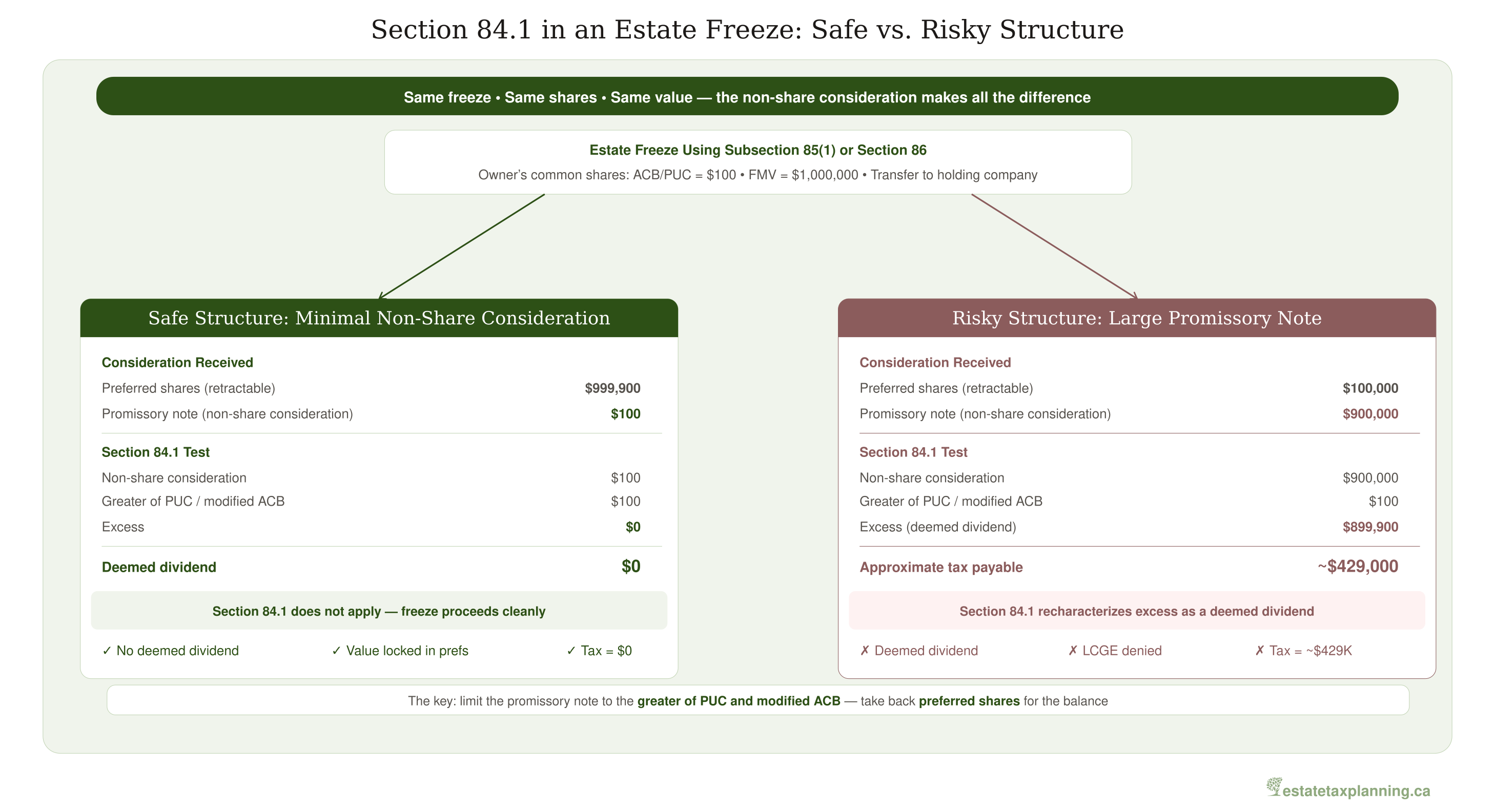
- In a standard estate freeze, the safest approach is to limit the promissory note to the greater of PUC and modified ACB — often just a nominal amount. We default to this structure in virtually every freeze we implement.
- The preferred shares provide the economic value and the retractable feature gives the freezor access to liquidity over time. It’s a cleaner approach than relying on a large promissory note.
- This structure avoids Section 84.1 entirely while still achieving the freeze objectives. It’s also the structure that CRA is least likely to challenge.
The Intergenerational Transfer Problem
This is the part that frustrates business families the most. If you sell your shares to an unrelated buyer, you can use the LCGE, pay tax on the capital gain at favourable rates, and the buyer can use corporate funds to pay the purchase price. If you sell the same shares to a corporation controlled by your children, Section 84.1 may deny the LCGE and recharacterize the gain as a dividend.
The asymmetry is real: a parent who sells to a stranger gets better tax treatment than a parent who transfers the business to a child who has been working in it for years. This was widely seen as unfair — and for good reason. It became a significant policy issue, and eventually led to the intergenerational transfer rules.
Bill C-208 and Bill C-59
Bill C-208, which received Royal Assent on June 29, 2021, introduced the first exceptions to Section 84.1 for genuine intergenerational business transfers. However, the original rules were criticized as too loose — they lacked safeguards to ensure the transfer was genuine. Bill C-59, enacted on June 20, 2024, replaced the Bill C-208 framework with significantly tighter conditions. The new rules apply to transfers on or after January 1, 2024.
Who Qualifies
| Requirement | Details |
|---|---|
| Seller | Canadian-resident individual (not a trust) |
| Shares | Qualified small business corporation (QSBC) shares or family farm/fishing corporation (FFFC) shares |
| Purchaser | Corporation controlled by one or more of the seller’s adult children (18+) |
| Expanded "child" definition | Includes nieces, nephews, grandnieces, and grandnephews — not just direct descendants |
| Joint election | Seller and each child must file Form T2066 by the seller’s tax filing deadline |
| One-time use | The exception can only be claimed once per seller per business |
Two requirements in this table deserve emphasis. First, the seller must be an individual — trusts are excluded. The IBT rules are designed for direct parent-to-child transfers, so if shares are held through a family trust, the trust must distribute them to the individual before the IBT election can be made. Second, the purchasing corporation must be “controlled” by the seller’s adult child or children. Controlled means the power, whether direct or indirect, to elect a majority of the board of directors of the purchasing corporation.
The Form T2066 election must be accompanied by an independent assessment of the fair market value of the shares being transferred. The assessor must be unrelated to the corporation, have no financial interest in the transaction, and possess sufficient knowledge and experience to value similar businesses in the industry. This is not a formality — the CRA expects a valuation report that meets the same standard as one prepared for a contested proceeding.
Supporting documentation — including the valuation report, the signed election, and all corporate records demonstrating compliance with the transfer conditions — must be retained for the entire reassessment window. For an Immediate IBT, that window is three additional years beyond the normal limitation period. For a Gradual IBT, it is ten additional years. Given these extended timelines, the compliance file should be assembled and organized before the transaction closes, not assembled retroactively.
- The intergenerational business transfer rules under amended section 84.1 are now in effect for transactions on or after January 1, 2024. Both the Immediate Business Transfer (36-month) and Gradual Business Transfer (60 to 120-month) pathways are available. We’ve already implemented several of these for family business clients.
- A joint election on Form T2066 is required, filed no later than the transferring parent’s tax return deadline for the year of transfer. Miss the deadline and the entire benefit is lost.
- Getting the structure right the first time is essential — there is no opportunity to correct a flawed election after the filing deadline. We treat the T2066 as a one-shot document and build in multiple review rounds before filing.
Current as of April 2026. These rules are subject to legislative change.
The Two Transfer Pathways
Bill C-59 created two distinct transfer pathways, and the choice between them shapes the entire succession plan. Here’s how they compare.
| Feature | Immediate IBT | Gradual IBT |
|---|---|---|
| Timeline | 36 months | 5 to 10 years |
| Legal control | Must give up within 36 months | Must give up at time of disposition |
| Factual control | Must give up within 36 months | Can transition gradually |
| Ownership reduction | No requirement — may retain preferred shares or debts indefinitely | Must reduce to below 30% (QSBC) or 50% (FFFC) within 10 years |
| Best for | Clean break — parent ready to exit | Gradual succession with mentoring period |
The Immediate IBT is the clean-break option. The parent gives up both legal and factual control within 36 months, and the child takes over management in that same window. The trade-off? Flexibility on the economic side — the parent can retain non-voting preferred shares or debts indefinitely, so the financial separation happens on its own timeline.
The Gradual IBT is closer to what we see in most real-world successions: the parent steps back over time while mentoring the next generation. Legal control transfers at the time of disposition, but factual control can shift more gradually. The trade-off here is the ownership reduction requirement — within 10 years, the parent’s interest must fall below 30% for QSBC shares or below 50% for FFFC shares.
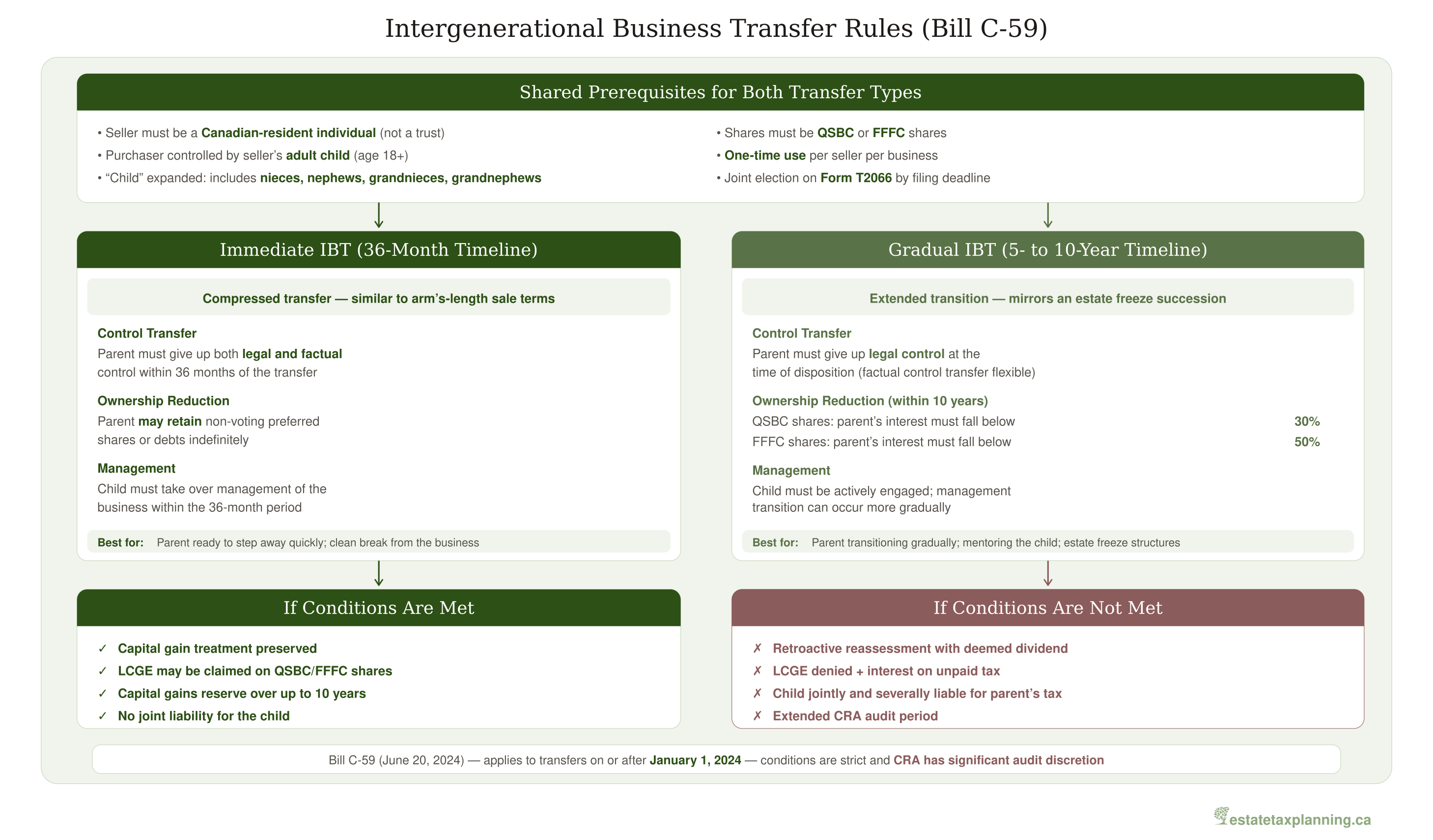
If the conditions for either pathway are met, the result is transformative: the transferor gets capital gain treatment instead of a deemed dividend. The LCGE is available if the shares qualify as QSBC or FFFC shares. And the transferor can spread the gain over up to ten years using the extended reserve under subsection 40(1.2) — double the standard five-year window. That reserve alone can make the difference between a manageable buyout and a cash-flow crisis.
The Moreau Family: A Worked Example
Let’s walk through the numbers with a real-world scenario. Sophie Moreau, age 62, owns an Ontario manufacturing business through an operating corporation. She wants to transfer the business to her daughter Émilie, who’s been managing operations for eight years. The shares have a PUC and ACB of $100 and a fair market value of $2,000,000. They qualify as QSBC shares.
Sophie plans to sell the shares to a new holding company controlled by Émilie. Because Émilie controls the purchasing corporation, Sophie and the buyer don’t deal at arm’s length — which means Section 84.1 applies.
Without the IBT rules, the entire $1,999,900 excess over PUC gets recharacterized as a deemed dividend. At Ontario’s top rate for non-eligible dividends (47.74%), the tax bill is approximately $955,000. The family keeps roughly $1,045,000 of the $2 million value. More than half goes to tax.
Now look at the same transfer with the Gradual IBT pathway. Sophie’s LCGE shelters $1,275,000 of the $1,999,900 gain. The remaining $724,900 is taxed as a capital gain at the effective rate of approximately 26.76%, producing a tax bill of roughly $194,000. The family keeps approximately $1,806,000 — and Sophie can spread the remaining tax over ten years using the extended reserve under subsection 40(1.2).
The IBT saves the Moreau family approximately $761,000 in tax on this single transaction. That is the difference between keeping 52% of the business value and keeping 90%. For families with higher-value businesses, the savings scale proportionally.
This example uses simplified assumptions for illustration. Your actual tax outcome depends on your specific circumstances.
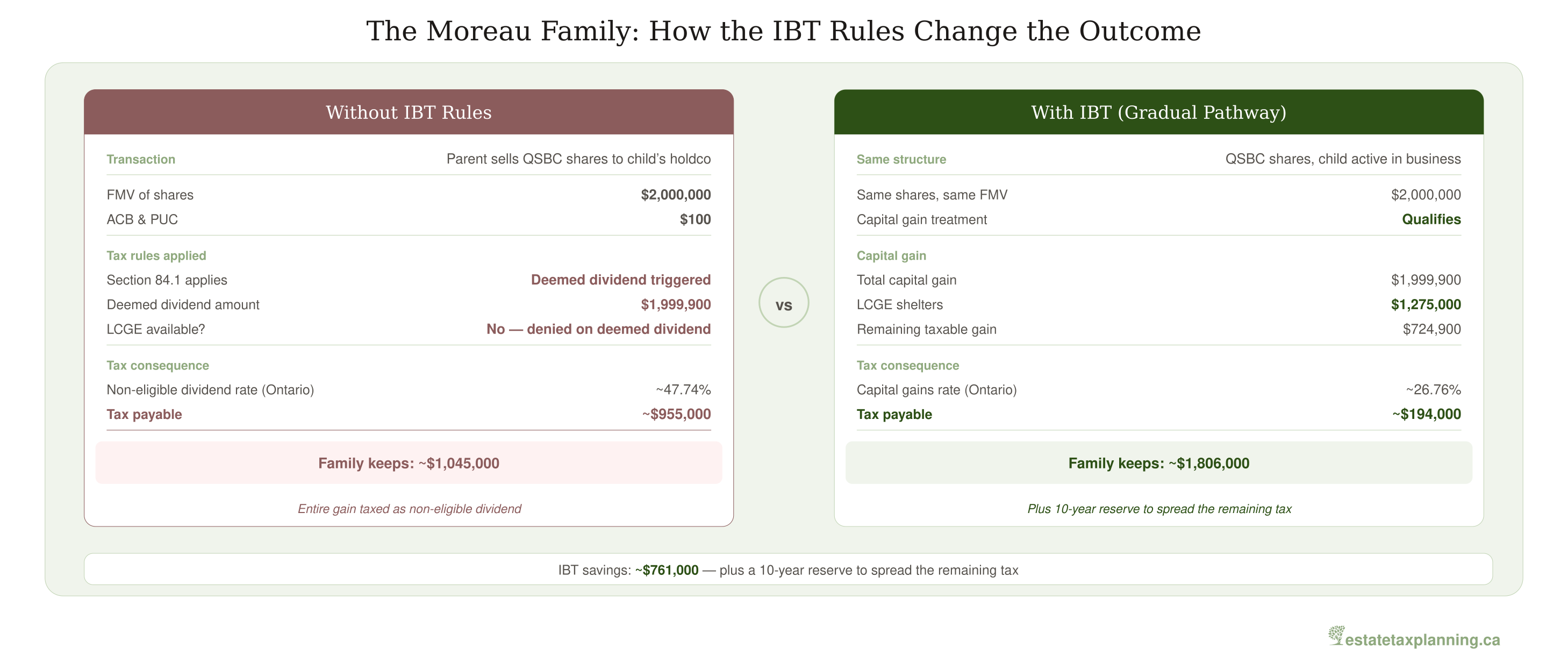
These numbers reflect Ontario’s top marginal rates. Other provinces will produce different dollar figures, but the structural advantage of capital gain treatment over deemed dividend treatment is consistent everywhere.
The extended reserve under subsection 40(1.2) deserves a closer look, because it’s often underappreciated. It lets the seller defer recognition of the gain based on how much of the purchase price remains unpaid at year-end. If the purchase price is $2 million and only $200,000 has been received by December 31, the seller can defer up to 90% of the gain to future years. The minimum annual inclusion is one-tenth, so the full amount must be recognized within ten years. In practice, this means the tax bill tracks the actual cash flow from the buyout — which matters enormously when the purchasing corporation is funding payments from future earnings.
- If the CRA later determines that the conditions were not genuinely met, the intergenerational exception can be revoked retroactively.
- This results in a reassessment with the full deemed dividend, denial of the LCGE, plus interest on the unpaid tax. We’ve seen reassessments in this area go back several years — the interest alone can be significant.
- Critically, the child who filed the joint election is jointly and severally liable for the parent’s additional tax. This means the CRA can collect from either the parent or the child — a significant compliance risk that transfers to the next generation. We always make sure both parties understand this before signing.
And the CRA has plenty of time to look. The reassessment period is extended specifically for IBT transactions: three additional years beyond the normal limitation period for the Immediate IBT, and ten additional years for the Gradual IBT. That’s a long window during which any slip in the conditions can unwind the entire structure.
Section 84.1 at Death: Post-Mortem Pipeline Planning
Section 84.1 doesn’t stop at lifetime transfers. It also applies to post-mortem pipeline transactions — one of the most common estate planning strategies we work with, where the estate sells shares of the deceased’s corporation to a related purchaser corporation to extract value without double taxation.
Here’s how the problem arises. When a shareholder dies, there’s a deemed disposition at fair market value under subsection 70(5), triggering a capital gain in the terminal return. If the estate then sells the shares to a related corporation to access the corporate cash, Section 84.1 can recharacterize the non-share consideration as a deemed dividend — creating a second layer of tax on top of the capital gain already reported at death. The pipeline has to be structured carefully to keep non-share consideration within the PUC and modified ACB limits, and to comply with the CRA’s administrative guidance on timing and structure.
The good news is that recent CRA interpretations have confirmed the post-mortem pipeline remains an accepted planning tool when done properly. The CRA has also indicated in recent advance rulings that earlier promissory note repayments may be acceptable where needed to fund estate taxes — a departure from the prior practice of deferring all payments for at least one to two years after death.
That said, the pipeline still has to demonstrate economic substance. Both the operating corporation and the new holding company should remain active, and the overall structure can’t be designed solely to circumvent the surplus stripping rules under sections 84 and 84.1.
Post-mortem pipeline planning is a complex topic that warrants its own detailed treatment. For a full discussion of the pipeline strategy, the subsection 164(6) alternative, and the interaction between these tools and Section 84.1 at death, see Post-Mortem Tax Planning: Pipeline Transactions and the Loss Carryback Election.
- The post-mortem pipeline should generally be completed early in estate administration, before the terminal return is filed, to align with CRA administrative practice. Timing matters — we’ve seen estates lose the window by waiting too long.
- The non-share consideration must not exceed the greater of PUC and modified ACB — exactly the same constraint as a lifetime transfer.
- The estate is at its most vulnerable during this period: a technical error can trigger both the capital gain at death and a deemed dividend on the pipeline, resulting in effective double taxation. This is the scenario that keeps estate planners up at night.
Planning Around Section 84.1
These strategies apply whether the transfer happens during lifetime or as part of a post-mortem pipeline. Each one addresses a different dimension of the Section 84.1 risk, and in most engagements we end up using several of them together.
- Minimize non-share consideration. Limit the promissory note to the greater of PUC and modified ACB — in most estate freezes, this means taking back preferred shares for substantially all of the value. This is our default approach.
- Verify your modified ACB. If you crystallized your LCGE in the past, have your tax advisor calculate the modified ACB before the transaction is structured. Do not assume the regular ACB provides room for a large promissory note — we’ve caught this assumption more times than we can count.
- Explore the intergenerational transfer rules. If the transfer is to the next generation, determine whether the Bill C-59 Immediate or Gradual IBT pathway applies. The conditions are strict and the election is one-time-use, so model both pathways before committing.
- Plan for the post-mortem scenario. The modified ACB and PUC limits apply equally at death, and the compressed pipeline timeline leaves little room for error. We build the post-mortem plan into the freeze from the start.
- Document everything from day one. The Form T2066 election, independent valuation report, and all compliance records must be retained for the full extended reassessment period and audit-ready before the transaction closes. We assemble the compliance binder before closing, not after.
- Is the non-share consideration within the safe limit? Calculate the greater of the PUC and the modified ACB — not the regular ACB — of the shares being transferred. If the promissory note or cash exceeds that amount, Section 84.1 applies.
- Do the Bill C-59 intergenerational transfer rules apply? If the transfer is to a corporation controlled by the seller’s adult child and the shares are QSBC or FFFC shares, explore whether the Immediate or Gradual IBT pathway can preserve capital gain treatment. Remember: one use per seller per business, and the Form T2066 election is irrevocable.
- Has the structure been reviewed for GAAR risk? Technical compliance is necessary but not sufficient. The transaction must have genuine commercial substance and a bona fide business purpose. If the primary motivation is tax reduction rather than a real transfer of the business, GAAR can override the result.
GAAR and Recent Case Law
This is an area where practitioners need to be especially careful. The Canadian Tax Foundation has flagged a potential surplus-stripping opportunity within the Bill C-59 framework itself. Where the younger generation already controls the business and the parent’s management role is limited, the IBT election could be used primarily to access capital gains treatment on what is effectively a corporate distribution — not a genuine succession. The CRA has made it clear that GAAR may apply in those circumstances, and we treat GAAR risk as a standing concern in every IBT structure we review.
The 2025 Tax Court decision in D’Arcy v. The King (2025 TCC 128) shows just how aggressively the courts will go after surplus stripping. The taxpayers reorganized their operating company through a series of rollover transactions, issuing shares of the same class to both themselves and their operating company. This triggered the paid-up capital averaging rules under subsection 89(1), inflating the PUC of their personal shares from $2 to over $928,000 — without any new capital being contributed.
The Tax Court held that the inflated PUC frustrated the purpose of Section 84.1, and that the share issuances had no bona fide commercial justification apart from circumventing the anti-surplus-stripping rules. The PUC was recharacterized as taxable dividends under GAAR. The message is clear: technical compliance isn’t enough.
- Sophisticated corporate reorganizations that artificially inflate PUC to circumvent Section 84.1 will be challenged under GAAR. The Tax Court looks beyond the form of the transactions to their substance and purpose. This decision reinforced what we’ve been telling clients for years.
- For families planning estate freezes or intergenerational transfers, the structure must have genuine commercial substance — not just technical compliance with the letter of the law. Pre-planned steps with no independent commercial rationale are particularly vulnerable. If the only reason for a step is tax, that’s a red flag.
What’s Next
Section 84.1 is the rule that separates arm’s-length from family transactions — and it will recharacterize a capital gain as a deemed dividend whenever the non-share consideration exceeds the safe threshold. The Bill C-59 rules have opened a genuine pathway for families who meet the conditions, but those conditions are strict, the election is irrevocable, and the CRA’s extended reassessment windows mean the file has to be bulletproof from day one. In our practice, every family business transfer starts in the same place: a modified ACB calculation, a clear understanding of which IBT pathway fits, and a structure that’s designed to hold up under scrutiny — not just at closing, but for years afterward.
This rule is only one piece of the anti-avoidance framework that affects estate freezes. For the companion rules that apply alongside Section 84.1, see Corporate Attribution Rules. For how the general anti-avoidance rule applies to aggressive structures that Section 84.1 alone may not catch, see Estate Freezes and GAAR. And for a deeper look at the exemption that Section 84.1 is designed to prevent being misused, see The Lifetime Capital Gains Exemption and the Estate Freeze.
For definitions of the key terms used in this article — including section 84.1, deemed dividend, modified ACB, intergenerational business transfer, PUC grind, GAAR, and Form T2066 — see our Key Terms and Definitions reference guide.
Section 84.1 is one of those rules that rewards careful planning and punishes shortcuts. If you’re contemplating a share sale to a family member or a new holding company, run the numbers with your CPA and CBV first — the cost of getting it wrong is almost always higher than the cost of getting advice.
This article is for informational purposes only and does not constitute legal, tax, or financial advice. Estate freezes are complex transactions that require the coordinated involvement of qualified tax, valuation, and legal professionals. Always consult your advisors before acting on any of the information discussed here.