
If anyone in your freeze chain is a U.S. citizen, green card holder, or U.S. tax resident, your Canadian estate freeze can trigger U.S. gift tax, grantor trust classification, PFIC rules, and estate tax. Get specialized cross-border advice before implementing the freeze — not after. The penalties for missed U.S. filings alone can exceed the underlying tax.
This is the article we wish more business owners would read before they start their estate freeze — not after. If you, your spouse, or any of your intended beneficiaries are U.S. citizens (including dual citizens), green card holders, or U.S. tax residents, a freeze that works perfectly under Canadian tax law can create unexpected and severe consequences under U.S. tax law.
The two systems don’t treat trusts, gifts, or estate transfers the same way — and the differences can be dramatic. A freeze that is routine in Canada can trigger gift tax, grantor trust classification, PFIC rules, estate tax, and extensive reporting obligations under the U.S. Internal Revenue Code. We’ve seen situations where the U.S. compliance costs alone exceeded $25,000 per year.
This article builds on the mechanics described in How an Estate Freeze Actually Works and the trust structures explored in The Role of the Family Trust in an Estate Freeze. It’s not a substitute for specialized cross-border tax advice — it’s a guide to the issues you and your advisors need to identify before implementing a freeze where any U.S. connection exists.
- The freezor, their spouse, or any beneficiary was born in the United States — even if they have lived in Canada their entire life.
- Anyone in the freeze chain holds or has ever held a U.S. green card, even if they moved to Canada decades ago and the card has expired.
- A beneficiary’s parent is a U.S. citizen (the child may have derivative U.S. citizenship without knowing it).
- The freezor or a family member is a snowbird or frequent traveler who spends more than four months per year in the United States.
- A child or grandchild is studying, working, or living in the United States — they may acquire U.S. tax obligations during the life of the trust.
- If any of these apply, stop and get specialized cross-border advice before proceeding with the freeze.
Who Is a “U.S. Person”?
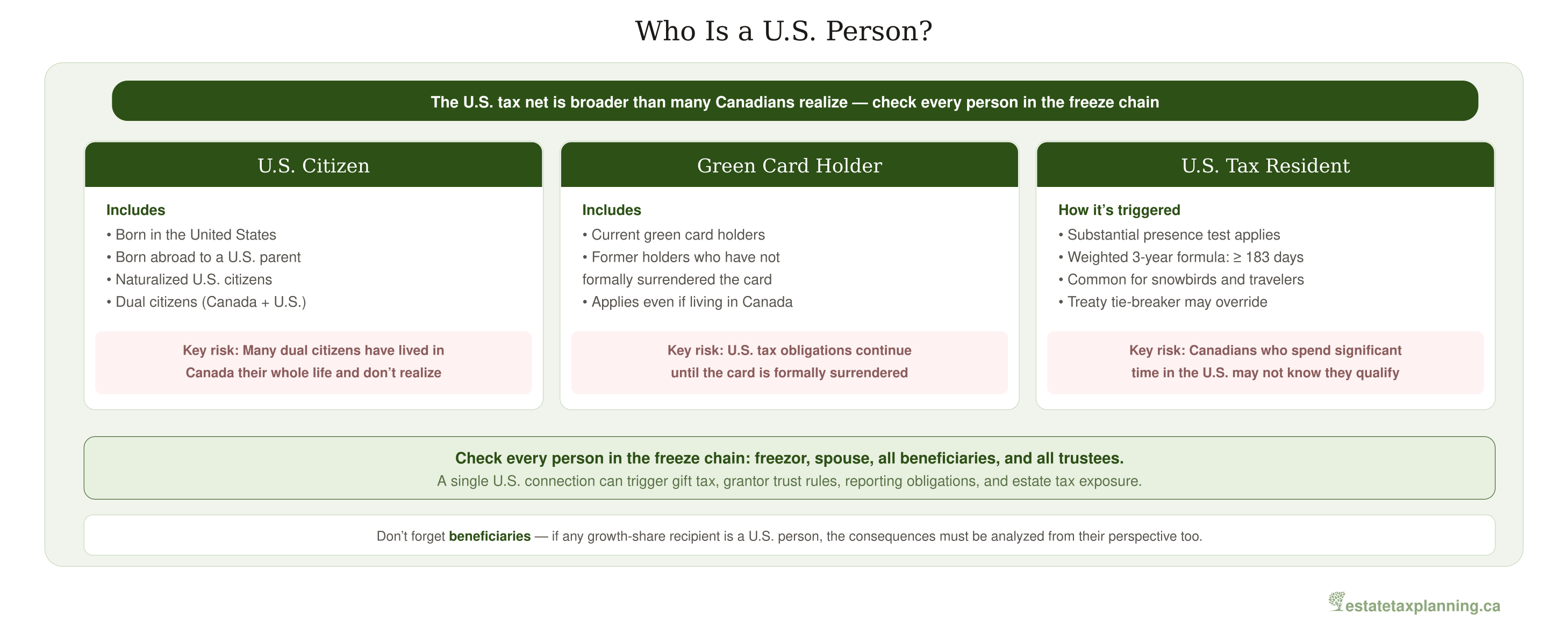
The U.S. tax net is broader than most Canadians realize. You can be caught by these rules even if you’ve lived in Canada your entire adult life — and many people are.
U.S. Citizens
This includes anyone born in the United States, born abroad to a U.S. parent who meets certain residency requirements, or naturalized as a U.S. citizen. And here’s the one that catches people: it includes dual citizens who may have lived in Canada their entire lives but hold U.S. citizenship through birth or parentage. Many of these individuals have no idea they have U.S. tax filing obligations.
Green Card Holders
Current and former holders of a U.S. permanent resident card are subject to U.S. tax on worldwide income. This obligation continues until the green card is formally surrendered through the proper legal process — and this is important — simply moving to Canada and letting the card expire is not sufficient. We’ve encountered clients who moved back to Canada decades ago and assumed the obligation was gone. It wasn’t.
U.S. Tax Residents
Even without citizenship or a green card, you can be treated as a U.S. resident for tax purposes under the substantial presence test. The test uses a weighted formula: days present in the current year, plus one-third of the days in the prior year, plus one-sixth of the days two years prior. If the total equals or exceeds 183, you may be a U.S. tax resident — though a treaty tie-breaker may apply. This is the one that catches snowbirds and frequent business travelers.
- It’s not just the freezor who matters. If any of the intended recipients of the growth shares are U.S. persons, the U.S. tax consequences must be analyzed from their perspective as well.
- A beneficiary who is a U.S. person and receives distributions from a foreign trust (the Canadian family trust) faces their own reporting obligations under Forms 3520 and 3520-A.
- The penalties for non-compliance apply to each U.S. person independently.
The Three Major Danger Zones
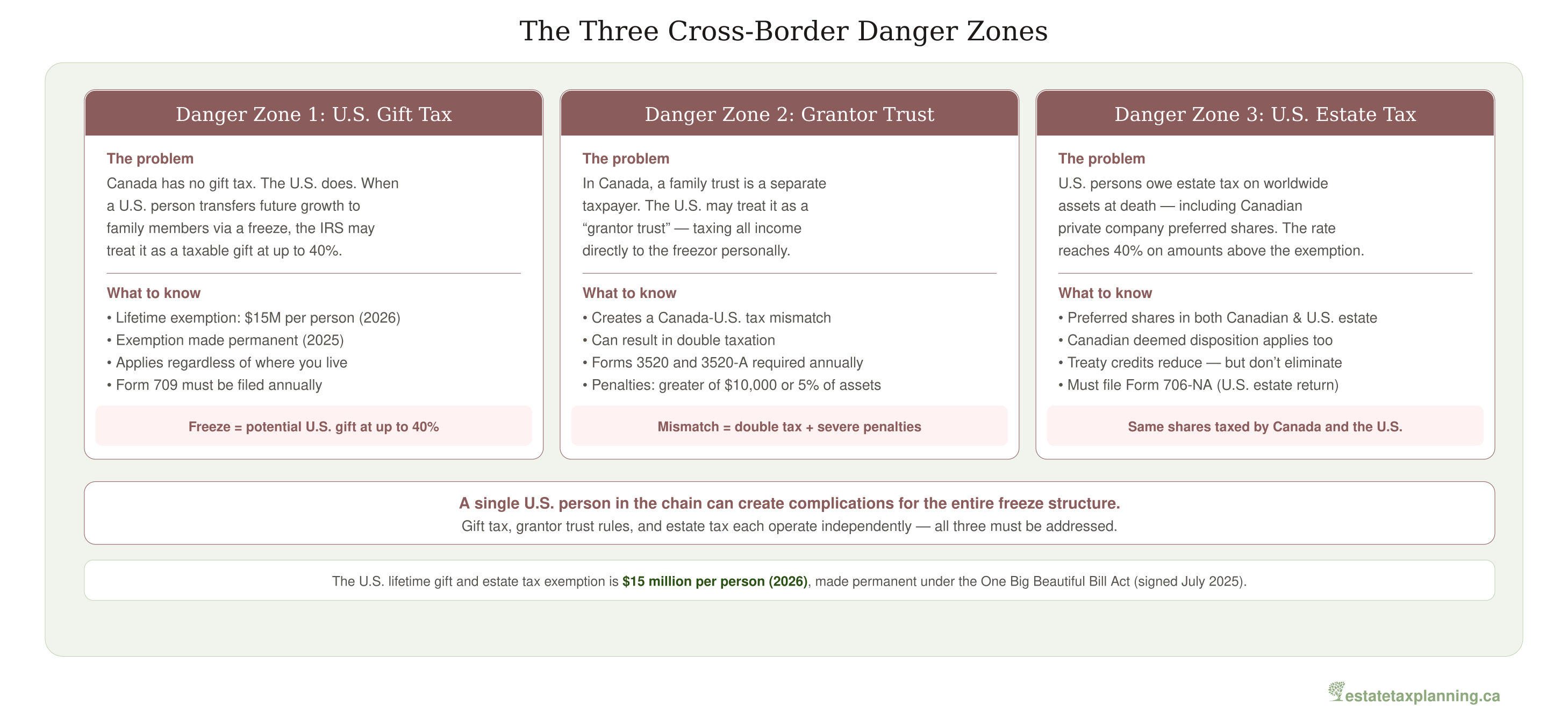
When a U.S. person is involved in an estate freeze, three separate areas of U.S. tax law come into play. Each one operates independently — and all three need to be addressed. Missing any one of them can be costly.
Danger Zone 1: U.S. Gift Tax
Canada has no gift tax. You can give property to your children without triggering a separate gift tax — though Canadian tax rules may deem you to have disposed of the property at fair market value, triggering a capital gain. This is one of the reasons estate freezes work so well in Canada: the transfer of future growth to the next generation simply isn’t treated as a gift.
The United States does have a gift tax — and that changes everything. It applies to U.S. citizens and green card holders regardless of where they live. When a U.S. person implements an estate freeze and transfers growth potential to family members, the IRS may treat this as a taxable gift. The gift tax rate can reach 40%.
The good news is that U.S. persons have a lifetime gift and estate tax exemption of $15 million per person for 2026, made permanent under the One Big Beautiful Bill Act (signed July 2025). For married couples, the combined exemption is $30 million through portability. That’s a generous threshold. But even if the exemption covers the gift, the freeze still needs to be structured carefully to minimize the exposure, and a U.S. gift tax return (Form 709) must be filed for the year of the freeze regardless.
- The same $15 million exemption covers both lifetime gifts and your estate at death.
- Every dollar used to shelter a gift during your lifetime reduces what is available to shelter your estate.
- For a business owner with a company worth $20 million or more, the exemption may not be sufficient to cover the full freeze.
- Proper planning can structure the freeze to minimize the amount treated as a taxable gift.
Danger Zone 2: U.S. Grantor Trust Rules
Under Canadian tax law, a family trust is a separate taxpayer. Income earned inside the trust can be allocated to beneficiaries, and the trust files its own T3 return. This separation is fundamental to how estate freezes work in Canada — it’s what makes income splitting and the 21-year deemed disposition rule possible.
Under U.S. tax law, the same trust may be classified as a “grantor trust” — and that’s where the trouble starts. A grantor trust means all of the trust’s income is taxable to the person deemed to be the grantor, regardless of whether the income is actually distributed. If the freezor is a U.S. person and is treated as the grantor, all trust income flows back to their personal U.S. return.
Think about what this means in practice: income may be allocated to Canadian beneficiaries for Canadian tax purposes, but taxed to the freezor personally for U.S. purposes. The same income, taxed twice, in two countries, to two different people. The relief available under the Canada-U.S. Tax Treaty for this specific mismatch is limited.
- U.S. persons who are grantors or beneficiaries of foreign trusts must file Forms 3520 and 3520-A annually.
- The penalty for failure to file Form 3520-A is the greater of $10,000 or 5% of the gross value of the trust assets treated as owned by the U.S. person.
- There is no statute of limitations on these penalties until a complete and accurate return is filed.
- Continuation penalties apply if the IRS notifies you and you still fail to file within 90 days.
- A Canadian family trust used in an estate freeze is a “foreign trust” for U.S. purposes.
Danger Zone 3: U.S. Estate Tax
U.S. citizens and green card holders are subject to U.S. estate tax on their worldwide assets at death — and that includes shares of Canadian private corporations. The U.S. estate tax rate reaches 40% on amounts above the exemption. For business owners with significant value in a Canadian company, this is the danger zone that keeps cross-border advisors up at night.
Here’s the core problem: if you’re a U.S. person and you’ve implemented an estate freeze, the preferred shares you hold at death are included in both your Canadian estate (triggering a deemed disposition under subsection 70(5) of the Income Tax Act) and your U.S. estate (for estate tax purposes under the Internal Revenue Code). The same shares, taxed twice, under two different systems.
The Canada-U.S. Tax Treaty provides mechanisms to reduce this double taxation — foreign tax credits and the marital credit under Article XXIX B — but it doesn’t eliminate the issue entirely. Coordinating the two systems requires careful planning to ensure credits are properly claimed and the overall burden is minimized.
- The Canadian deemed disposition triggers capital gains tax. The U.S. estate tax is a separate levy on the value of the estate.
- The Treaty allows a credit in one country for tax paid to the other, but the mechanics are complex.
- A U.S. estate return (Form 706-NA for non-domiciliaries, or Form 706 for citizens) must be filed.
- Without proper coordination, the combined tax burden can be devastating.
- The federal $15 million exemption is only part of the picture. Several U.S. states impose their own estate taxes with much lower thresholds.
- Massachusetts: $2 million (not indexed). Oregon: $1 million (one of the lowest in the country; a 2025 proposal to conform to federal thresholds did not pass). Washington: $3 million (reset by ESB 6347, effective July 2026). Minnesota: $3 million.
- If the freezor owns U.S. real estate or other U.S.-situs assets in one of these states, state estate tax may apply even when the federal exemption covers the full estate.
- State estate taxes are separate from the federal tax and are not always offset by the Treaty’s credit provisions.
The PFIC Trap: A Fourth Danger Zone
Beyond the three headline dangers, there’s a fourth issue that catches many advisors off guard — and it’s a technical one: the Passive Foreign Investment Company (PFIC) rules under the Internal Revenue Code.
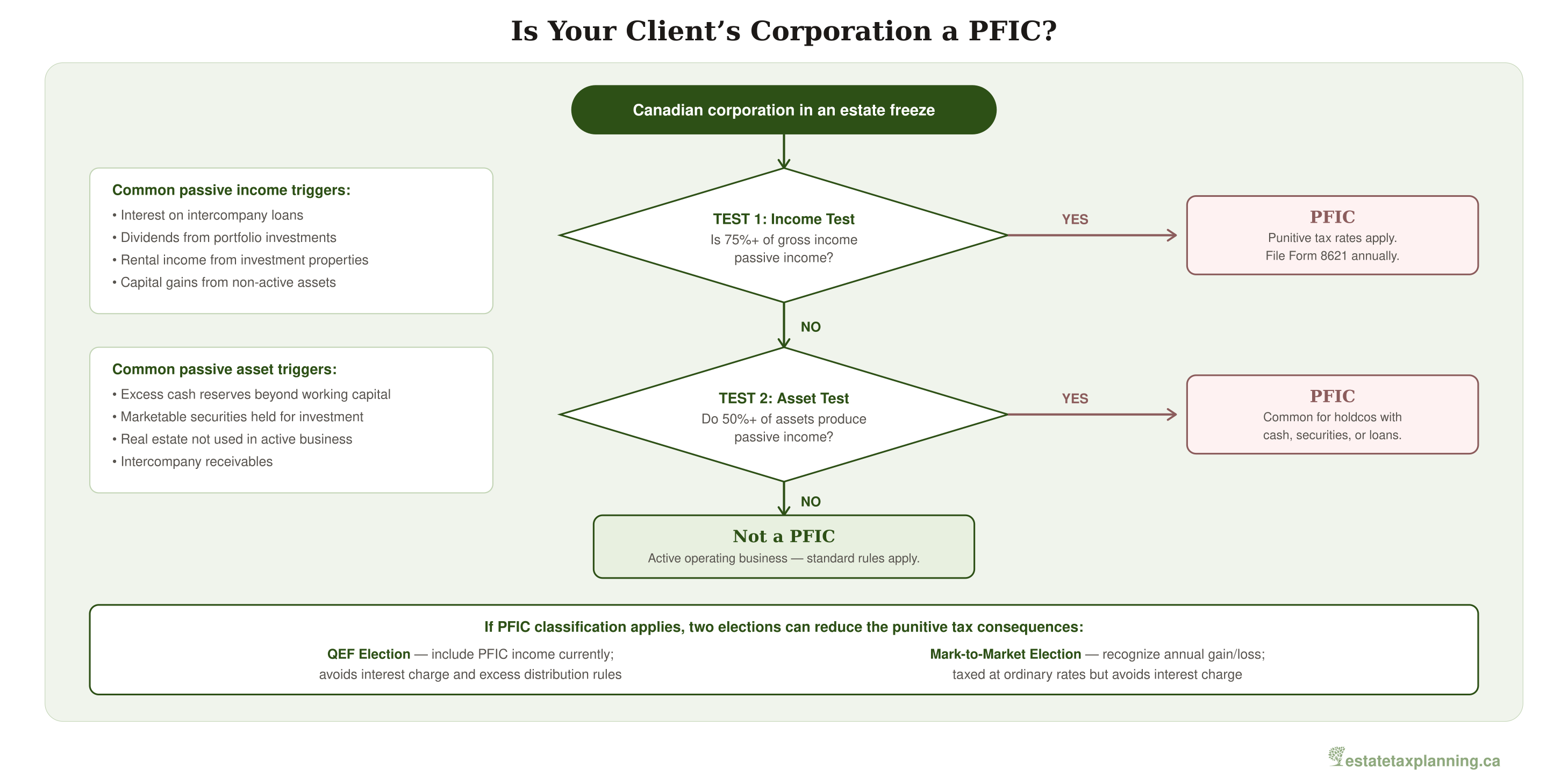
A PFIC is any non-U.S. corporation where either 75% or more of gross income is passive income, or 50% or more of its assets produce or are held to produce passive income. There’s no minimum ownership threshold — even a single share held by a U.S. person triggers the rules.
In a typical estate freeze, the Canadian corporation is an active operating business that wouldn’t meet the PFIC definition. But the analysis isn’t always as straightforward as it looks. If the corporation holds significant investment assets — cash reserves, marketable securities, rental properties, or intercompany loans — the asset test may be triggered. And if the freeze involves a holding company structure, the holdco itself may be classified as a PFIC even if the operating subsidiary is not. This is a common trap in multi-entity structures.
When PFIC classification applies, the tax consequences are punitive. Distributions to a U.S. shareholder are taxed at the highest ordinary income rate (not capital gains rates), plus an interest charge that compounds for each year the gain is deemed to have accrued. The U.S. person must also file Form 8621 annually for each PFIC they hold. A QEF (Qualified Electing Fund) election or mark-to-market election can mitigate these consequences, but both require careful planning and timely filing.
- If a U.S. person is a beneficiary of the family trust that holds growth shares in a Canadian corporation, the PFIC rules may apply to them — even if the corporation is primarily an active business.
- The analysis must be done at the entity level, considering all assets and income sources.
- A holding company sitting above the operating company is particularly at risk.
- Form 8621 must be filed annually for each PFIC — the penalties for non-compliance are in addition to the Forms 3520 and 3520-A penalties.
The Generation-Skipping Transfer Tax
There’s one more U.S. tax that can apply when your freeze involves multi-generational planning: the generation-skipping transfer tax, or GSTT. It’s a separate federal tax — at a flat rate of 40% — imposed on transfers that skip a generation, either directly to grandchildren or through a trust that benefits them.
In a typical Canadian estate freeze, the family trust includes grandchildren among the potential beneficiaries. Under Canadian law, this is routine and tax-efficient — it’s one of the reasons we use trusts in the first place. Under U.S. law, any distribution from the trust to a grandchild (a “skip person”) can trigger the GSTT in addition to any other gift or estate tax that applies. The tax is calculated on the full value of the distribution, not just the gain.
The GSTT has its own separate $15 million exemption for 2026, matching the federal estate and gift tax exemption. However, unlike the estate tax exemption, unused GSTT exemption does not port to a surviving spouse — it is lost at death. The exemption must be affirmatively allocated to specific transfers or trusts, typically on the gift tax return (Form 709). Failing to allocate the exemption properly can result in the full 40% GSTT applying to distributions that could have been sheltered.
- If the family trust has any U.S.-person beneficiaries who are two or more generations below the transferor, the GSTT may apply.
- The GSTT is in addition to — not instead of — any gift or estate tax. Both taxes are calculated independently on the same transfer, so the combined effective rate can reach 80% (40% estate tax plus 40% GSTT on the same base).
- The exemption must be allocated on Form 709. A missed allocation cannot be corrected retroactively.
- Even if all current beneficiaries are the freezor’s children, future distributions to grandchildren (common in long-lived trusts) can trigger the GSTT.
The Canada-U.S. Tax Treaty: What It Does and Does Not Do
Article XXIX B of the Canada-U.S. Tax Treaty is the primary mechanism for reducing double taxation on estates. It helps — but it has significant limitations that business owners and their advisors need to understand before counting on it.
For U.S. citizens living in Canada: the full unified credit ($15 million exemption for 2026) is available against U.S. estate tax on worldwide assets. Canada provides a credit under paragraph 6 of Article XXIX B for U.S. estate or inheritance taxes paid on property situated in the United States. This credit reduces Canadian tax but applies only to the U.S.-situs portion of the estate.
For Canadian residents who are not U.S. citizens: the Treaty provides a pro rata share of the unified credit. The pro rata amount is based on the ratio of U.S.-situs assets to worldwide assets. If only 10% of the estate consists of U.S.-situs property, the available credit is 10% of the full unified credit. This can leave a significant estate tax exposure on non-U.S.-situs assets.
- U.S. real estate, U.S. corporate shares, and tangible personal property in the U.S. are considered U.S.-situs assets.
- Shares of Canadian private corporations are generally not U.S.-situs property.
- This means the Treaty’s credit relief is limited for estates that consist primarily of Canadian business interests.
- For a U.S. citizen whose main asset is a Canadian private company, the full unified credit applies — but the coordination of Canadian and U.S. taxes still requires expert planning.
The Treaty also provides a marital credit under Article XXIX B that may allow additional relief when the surviving spouse is a Canadian resident. But this credit has its own conditions and limitations. The bottom line: the Treaty is a tool, not a complete solution. Relying on it without expert guidance is risky.
When One Spouse Is a U.S. Person
One of the most common cross-border scenarios we see is a married couple where one spouse is a U.S. person and the other is not. This single fact creates a layer of complexity that’s easy to overlook and difficult to unwind once the freeze is in place.
The U.S. unlimited marital deduction allows tax-free transfers of any amount between spouses — but only if the receiving spouse is a U.S. citizen. If the surviving spouse is a Canadian resident who is not a U.S. citizen, the unlimited marital deduction does not apply. Instead, transfers to the non-citizen spouse are limited to an annual exclusion of approximately $194,000 (2026, indexed). Any amount above this threshold is treated as a taxable gift.
For estate freeze purposes, this means that if the freezor is a U.S. citizen and their spouse is a Canadian resident (not a U.S. citizen), even routine transfers between spouses — such as transferring preferred shares to the spouse’s holding company or adding the spouse as a shareholder — can trigger gift tax consequences. The freeze must be structured to avoid inadvertent gifts that exceed the annual exclusion.
The Qualified Domestic Trust (QDOT). When a U.S. person dies and the surviving spouse is not a U.S. citizen, the estate tax marital deduction is only available if the assets pass to a Qualified Domestic Trust. A QDOT requires that at least one trustee be a U.S. citizen or U.S. domestic corporation, that the trust meets certain regulatory requirements, and that distributions of principal from the trust are subject to U.S. estate tax when made. Without a QDOT, the full value of assets passing to the non-citizen surviving spouse may be subject to immediate estate tax.
- Determine the citizenship and residency status of both spouses early in the freeze planning process.
- If the receiving spouse is not a U.S. citizen, the $194,000 annual gift exclusion (2026) applies instead of the unlimited marital deduction.
- Consider whether a QDOT is needed in the estate plan of the U.S.-person spouse to preserve the marital deduction at death.
- The Article XXIX B marital credit under the Treaty may provide additional relief, but it does not replicate the full unlimited marital deduction.
- Spousal rollovers under subsection 73(1) of the Canadian ITA do not trigger Canadian tax, but the same transfer may trigger U.S. gift tax if it exceeds the annual exclusion.
Seeing It in Practice: A Cross-Border Example
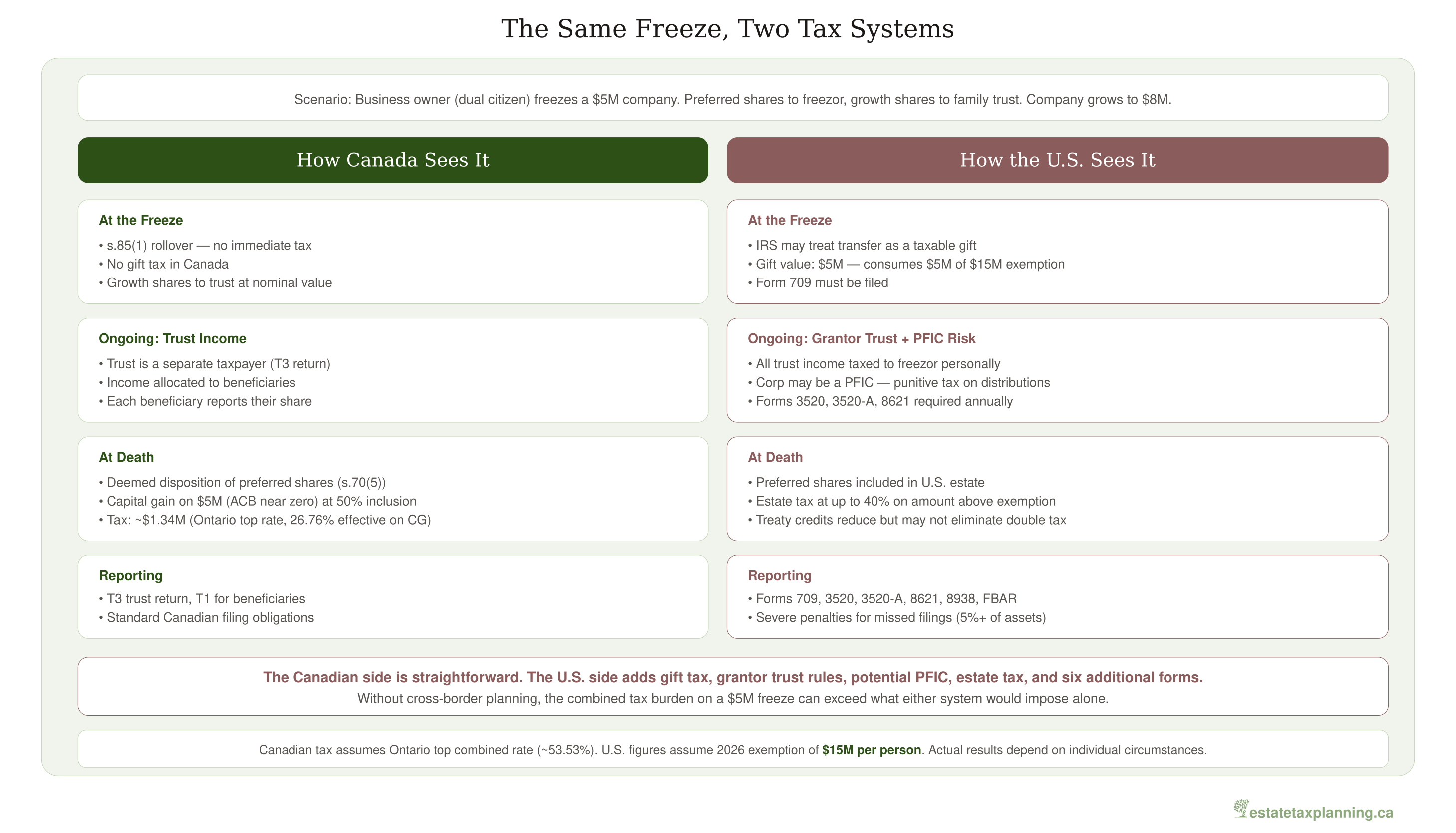
Let’s walk through a scenario to see how all of this comes together. A dual citizen — Canadian and American — owns a Canadian private corporation worth $5 million and implements a standard estate freeze.
| Stage | Canada | United States |
|---|---|---|
| At the Freeze | No immediate tax – s. 85(1) rollover defers gain. No gift tax concept exists. | $0 gift tax (covered by $15M exemption), but $5M of lifetime exemption consumed. Form 709 required. |
| Ongoing (per year) | Trust is a separate taxpayer. Income allocated to beneficiaries on T3. | All trust income may be taxed to freezor personally (grantor trust). Forms 3520, 3520-A, potentially 8621 filed annually. |
| At Death | ~$1.34M tax on deemed disposition of $5M preferred shares (50% inclusion, ~53.53% combined rate). | $0 estate tax in this scenario ($10M exemption remaining covers $5M estate). Form 706 still required. |
| Compliance cost | Standard T3 trust return + terminal T1. | ~$15K–$25K/year in cross-border compliance fees, plus risk of penalties for missed filings. |
| If the company were worth $20M+ | Higher capital gains tax at death, but no separate transfer tax. | Entire $15M exemption consumed at freeze. Estate tax at 40% on any excess at death – potentially millions in additional U.S. tax. |
At the Freeze
On the Canadian side, the section 85(1) rollover proceeds without triggering immediate tax. The freezor receives preferred shares, and the family trust subscribes for growth common shares at nominal value. No gift tax applies because Canada has no such concept. On the U.S. side, the IRS may treat the transfer of growth potential as a taxable gift. If that growth potential is valued at $5 million, the freezor consumes $5 million of their $15 million lifetime exemption. Form 709 must be filed. Same transaction, very different treatment.
Ongoing Operations
In Canada, the family trust is a separate taxpayer. Income can be allocated to beneficiaries, who report it on their own returns. In the U.S., the trust may be classified as a grantor trust, with all income taxed to the freezor personally — regardless of how income is allocated in Canada. If the corporation is classified as a PFIC, distributions to any U.S.-person beneficiary face punitive tax rates plus interest charges. And the U.S. side requires annual filing of Forms 3520, 3520-A, and potentially 8621. The compliance burden alone can run $15,000 to $25,000 per year.
At Death
When the freezor dies, Canada deems the preferred shares disposed of at fair market value under subsection 70(5). Assuming a nominal adjusted cost base (common for many private company owners), the capital gain is approximately $5 million. At the 50% inclusion rate and Ontario’s top combined rate of approximately 53.53%, the Canadian tax on the $2.5 million taxable capital gain is roughly $1.34 million. As discussed in Valuation — The Make-or-Break Step, the valuation at the date of death must be independent and defensible — both the CRA and the IRS will scrutinize it.
At the same time, the U.S. includes the same preferred shares in the freezor’s estate. In this $5 million scenario, the freezor used $5 million of their $15 million lifetime exemption at the time of the freeze, leaving $10 million. The remaining exemption covers the estate — no U.S. estate tax. But Form 706 must still be filed. And the Canada-U.S. Tax Treaty provides a credit mechanism under Article XXIX B to reduce double taxation on amounts that are taxable in both countries.
- In the $5 million example, the unified credit covers both the gift and the estate. But consider a business worth $20 million.
- At the freeze, the $15 million exemption is consumed entirely by the gift. At death, the preferred shares ($20 million) are fully subject to U.S. estate tax at 40% — a potential $8 million U.S. estate tax bill, in addition to approximately $5.35 million in Canadian capital gains tax.
- Even with Treaty credits, the combined burden on a $20 million estate can approach $10 million or more.
- The $15 million exemption is generous, but for the business owners most likely to need an estate freeze, it may not be enough.
Practical Guidance
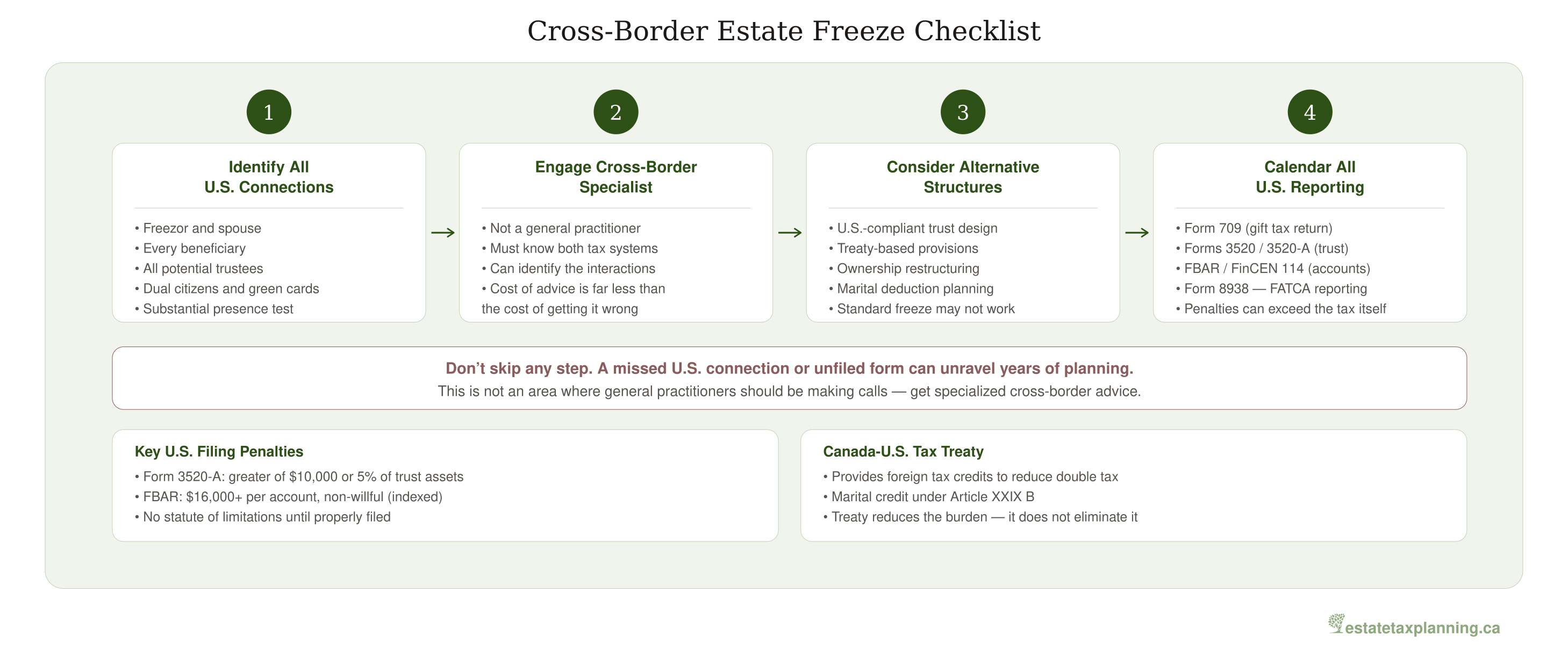
Step 1: Identify All U.S. Connections Early
Before implementing any estate freeze, ask every person who will be involved — the freezor, their spouse, every beneficiary, every potential trustee — whether they have any U.S. tax obligations. Include dual citizens, former green card holders, and anyone who spends significant time in the United States. This needs to happen at the very beginning of the planning process, not halfway through. A single U.S. person anywhere in the chain can change the entire approach.
Step 2: Engage a Cross-Border Tax Specialist
Your regular Canadian tax advisor — even a very good one — may not be familiar with the U.S. rules that apply to estate freezes. You need someone who understands both the Canadian Income Tax Act and the U.S. Internal Revenue Code, and who can spot the interactions between the two systems. As we discuss in Building Your Advisory Team, each professional on the team has a distinct role — but cross-border work requires an additional specialist who is fluent in both regimes. The cost of that advice is a fraction of the cost of getting it wrong.
Step 3: Consider Alternative Structures
In some cases, the standard Canadian estate freeze structure — a section 85(1) rollover with a family trust subscribing for growth shares — may simply not be appropriate when U.S. persons are involved. You may need a U.S.-compliant trust structure, specific treaty provisions, a restructured ownership chain, or marital deduction planning under Article XXIX B of the Treaty. The right answer depends on who the U.S. persons are and where they sit in the freeze chain.
Step 4: Calendar All U.S. Reporting Obligations
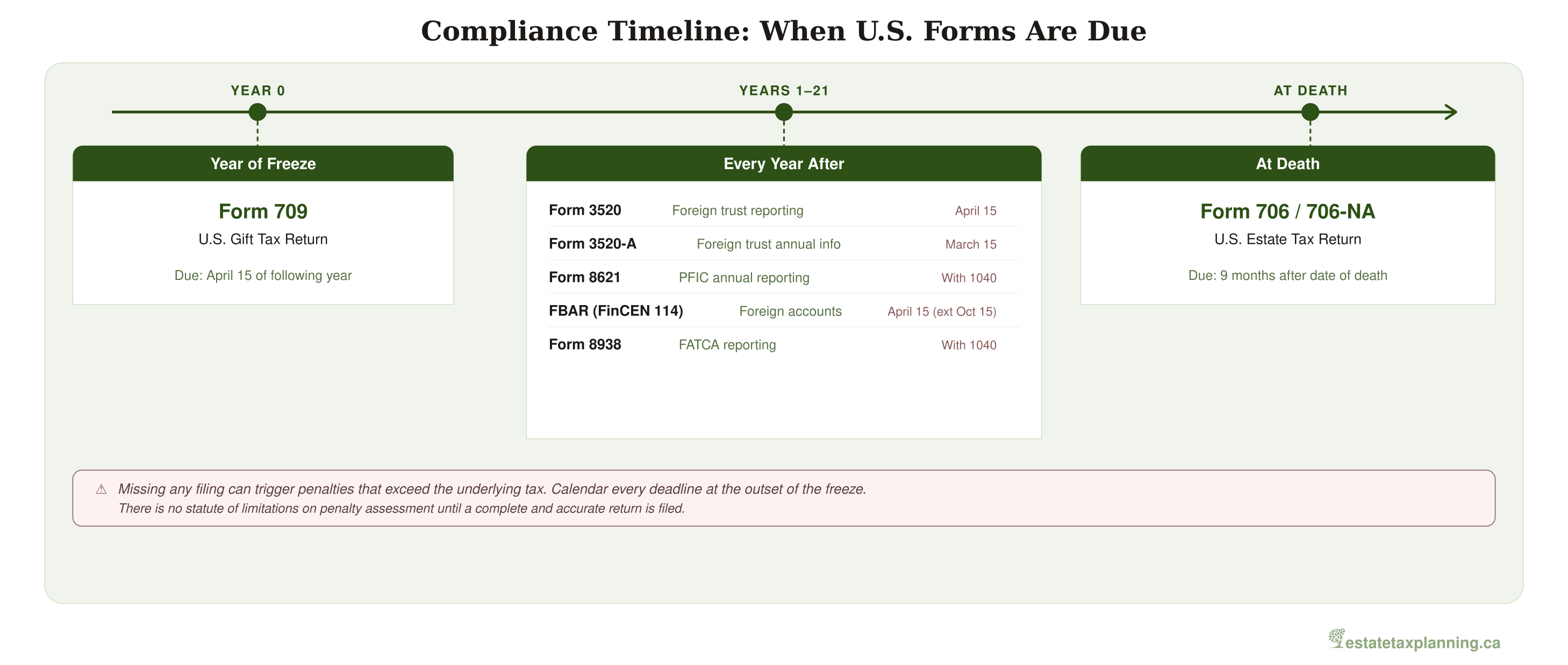
U.S. persons involved in a foreign trust face extensive annual reporting obligations: Form 709 (gift tax return for the year of the freeze), Forms 3520 and 3520-A (foreign trust information returns), Form 8621 (PFIC annual information return), FBAR/FinCEN 114 (foreign bank account reporting), and Form 8938 under FATCA. Missing a single filing can trigger penalties that exceed the underlying tax. A compliance calendar needs to be set up at the outset — not as an afterthought.
- Form 3520-A: greater of $10,000 or 5% of the gross value of trust assets — per year.
- FBAR (FinCEN 114): non-willful penalties of up to approximately $16,500 per report (not per account, following the Supreme Court’s 2023 decision in Bittner v. United States).
- Form 8621 (PFIC): failure to file may result in extended statute of limitations and loss of favorable tax elections.
- No statute of limitations on penalty assessment until a complete and accurate return is filed.
- Continuation penalties apply if you still fail to file within 90 days of IRS notice.
Already Behind? The IRS Streamlined Filing Compliance Procedures
Many dual citizens living in Canada discover their U.S. filing obligations only when they begin planning an estate freeze. If you’ve never filed U.S. returns, the situation can feel overwhelming — but there is a structured path forward, and it’s more manageable than most people expect.
The IRS offers Streamlined Foreign Offshore Procedures specifically for non-willful non-resident taxpayers. To qualify, the taxpayer must have been a non-resident of the United States for at least one of the three most recent tax years, must not have had a U.S. abode during that period, and the failure to file must have been due to non-willful conduct — meaning negligence, inadvertence, or a good-faith misunderstanding of the law’s requirements.
- Filing three years of delinquent U.S. tax returns (typically the most recent three years).
- Filing six years of delinquent FBARs (foreign bank account reports).
- Certifying on Form 14653 that the failure to file was non-willful.
- No penalties are imposed under the streamlined foreign offshore procedures — this is the key benefit.
- The procedures remain available as of 2026, but the IRS can modify or close them at any time.
- Coming into compliance before implementing a freeze is far better than discovering the obligations after the fact.
U.S. Reporting Obligations at a Glance
The reporting burden for U.S. persons involved in a Canadian estate freeze is substantial — and it’s ongoing. The following reference chart summarizes the key forms, who must file them, and what happens if you don’t.
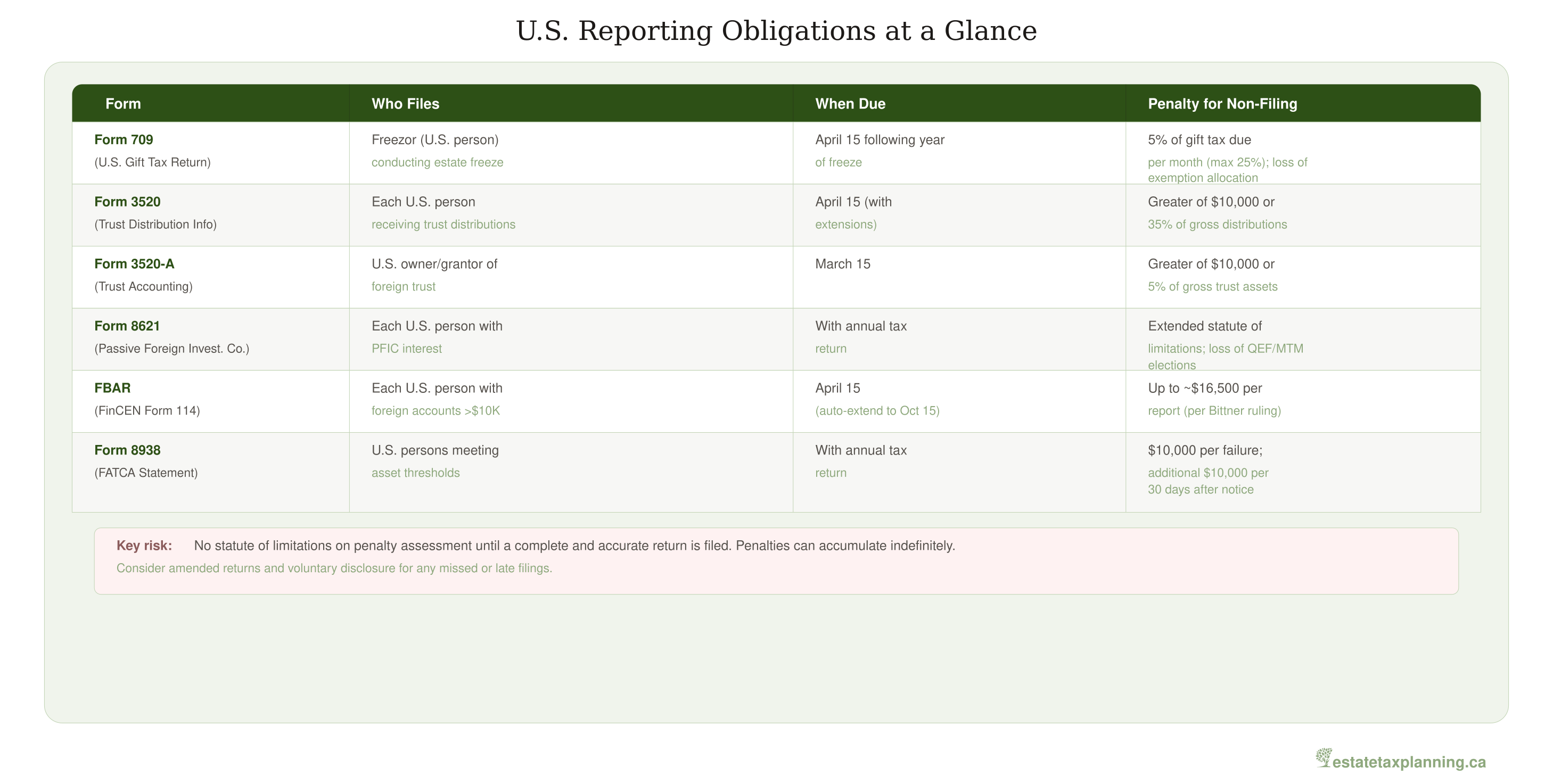
These forms are in addition to the standard U.S. individual income tax return (Form 1040). Many of these returns have different due dates and extension rules than the regular tax return. A cross-border specialist should prepare a compliance calendar at the outset of the freeze to ensure nothing is missed.
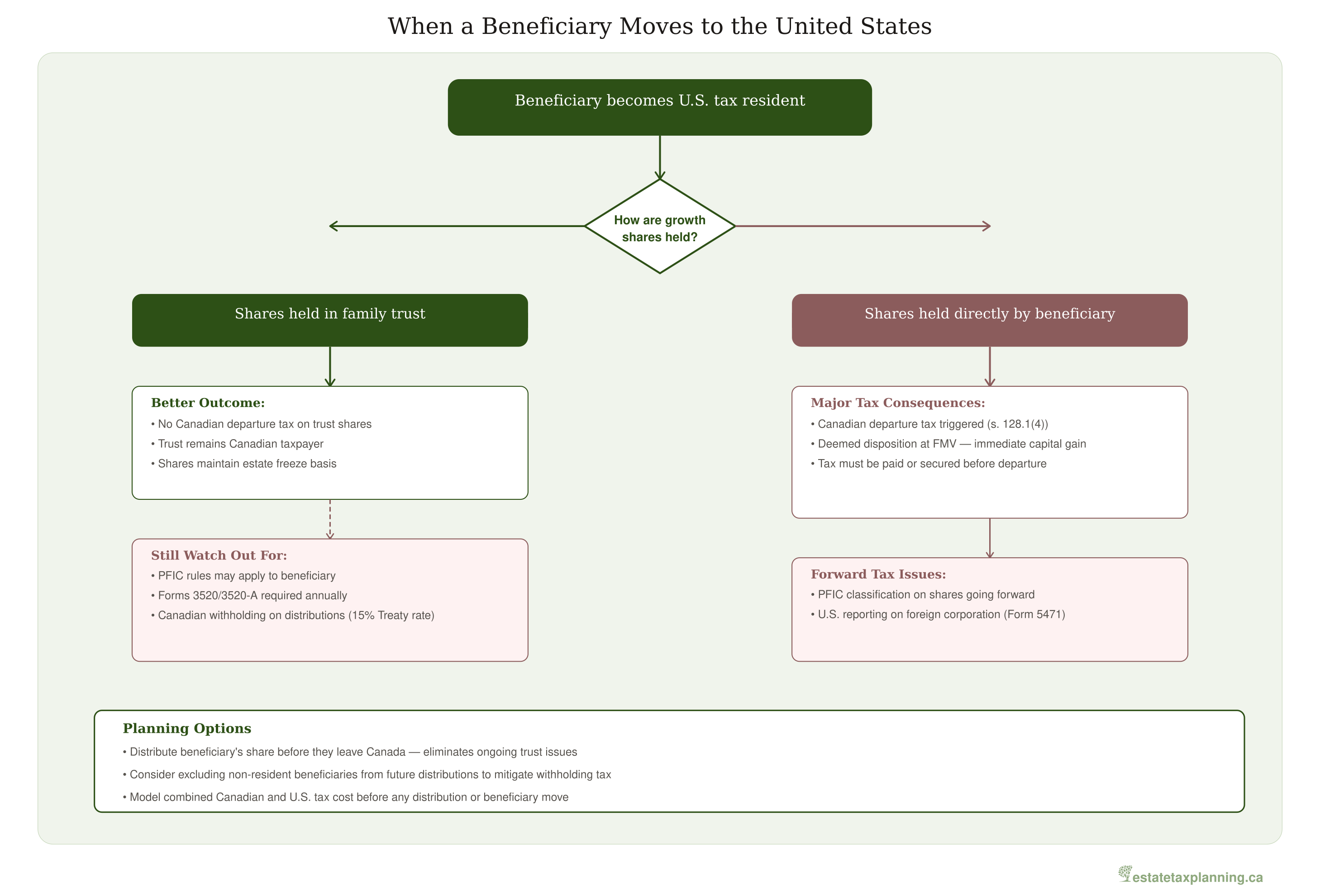
When a Beneficiary Moves to the United States
Here’s a scenario that comes up more often than you might think: the freeze is implemented with a Canadian family trust holding growth shares for the children, and then one of the children moves to the United States for work, marriage, or school — and stays. This single event can create cascading tax complications for the entire freeze structure.
Canadian Departure Tax
When a Canadian resident ceases to be a resident of Canada, subsection 128.1(4) deems them to have disposed of most of their property at fair market value on the date of departure. If the beneficiary holds growth shares directly (not in a trust), the departure triggers an immediate capital gain on the unrealized appreciation — even though no actual sale occurred and no cash was received. The tax must be paid or secured before the individual leaves.
If the growth shares are held in the family trust (as is typical in most estate freezes), the departure of a beneficiary does not trigger the departure tax on the trust’s shares, because the trust — not the individual — owns the property. However, any future distributions from the trust to the now-U.S.-resident beneficiary will be subject to U.S. tax in the beneficiary’s hands, and the trust will face Canadian withholding tax obligations on distributions to a non-resident.
The PFIC Problem for U.S. Residents
Once the beneficiary becomes a U.S. tax resident, the Canadian corporation whose shares are held by the family trust may be classified as a Passive Foreign Investment Company (PFIC) from the beneficiary’s perspective. A PFIC is any non-U.S. corporation where 75% or more of gross income is passive or 50% or more of assets are passive. Operating companies usually avoid PFIC classification, but holding companies and investment companies almost always trigger it. PFIC classification subjects the U.S. resident to punitive tax rates and complex annual reporting requirements on Form 8621.
Trust Distributions to a U.S. Beneficiary
Canadian withholding tax. When the family trust distributes income to a non-resident beneficiary, the trust must withhold Canadian tax at the default Part XIII rate of 25% (reduced to 15% for most income types under the Canada-U.S. Tax Treaty). Capital gains allocated to a non-resident beneficiary may be exempt from Canadian withholding under the Treaty, but the rules are technical and the trust must file the appropriate NR4 and T3 returns.
U.S. foreign trust reporting. From the U.S. side, the beneficiary must report distributions from the Canadian family trust on Form 3520 annually. The trust itself must file Form 3520-A. If the trust is treated as a “foreign grantor trust” for U.S. purposes, the U.S. beneficiary may be taxed on the trust’s income as it is earned, not when distributed. The penalties for failure to file are severe — the greater of $10,000 or 5% of the gross value of trust assets per year.
- Distribute the beneficiary’s share of trust assets before they leave Canada, while the rollout can still qualify for tax-deferred treatment to a Canadian resident.
- If the beneficiary has already left, consider whether a distribution of capital (rather than income) is more tax-efficient under the Treaty.
- Review whether the beneficiary should be excluded from future trust distributions to simplify both Canadian and U.S. compliance.
- In extreme cases, the trust deed may need to be amended to create a separate class of units or to exclude non-resident beneficiaries from certain distributions.
- Always model the combined Canadian and U.S. tax cost before making any distribution to a non-resident beneficiary.
What About Renouncing U.S. Citizenship?
Some business owners, upon learning the full scope of U.S. tax exposure, ask the natural question: can I just renounce my U.S. citizenship? It’s a legitimate option — but it comes with its own severe tax consequences that you need to understand before going down that road.
Under IRC §877A, a “covered expatriate” is subject to a mark-to-market exit tax on the day before expatriation. All worldwide assets are deemed sold at fair market value, and the resulting gain is subject to U.S. tax. For 2026, the first $910,000 of unrealized gain is exempt, but everything above that is taxable.
You are classified as a covered expatriate if any one of three tests is met: your net worth is $2 million or more on the date of expatriation (which covers virtually every business owner implementing an estate freeze), your average annual net income tax for the preceding five years exceeds approximately $211,000 (2026, indexed), or you fail to certify full tax compliance for the prior five years on Form 8854.
- Using the same $5 million business owner from our earlier example, with a nominal adjusted cost base of $100:
- Fair market value of worldwide assets on the day before expatriation: $5,000,000.
- Less: 2026 exclusion amount: $910,000.
- Taxable deemed gain: $4,090,000.
- U.S. federal long-term capital gains rate: 20%. Net Investment Income Tax (NIIT): 3.8%. Combined federal rate: 23.8%.
- Approximate U.S. exit tax: $4,090,000 × 23.8% = ~$974,000 — payable immediately upon renunciation.
- This does not include any state-level taxes that may apply, nor any outstanding U.S. tax liabilities from prior years.
- For a business owner with a $5 million company and nominal cost base, the exit tax on ~$4.09 million of deemed gain (after the $910,000 exclusion) could approach $1 million at the top federal capital gains rate — triggered immediately upon renunciation.
- The $2 million net worth threshold means virtually every freeze candidate is a covered expatriate.
- The exit tax is in addition to any other U.S. tax obligations that have accrued up to that point.
- Renunciation also has non-tax consequences: permanent loss of U.S. entry rights, inability to reclaim citizenship, and potential complications for family members who remain U.S. persons.
- This decision requires its own specialized legal and tax advice — and must be weighed carefully against the ongoing compliance cost of maintaining U.S. status.
Insurance Implications When Crossing Borders
Corporate-owned life insurance adds yet another layer to cross-border estate freezes. If the freezor emigrates from Canada, the corporation typically remains a Canadian entity and the life insurance policy remains a Canadian policy. The CDA mechanism continues to function. But the tax treatment of the death benefit and the CDA election on the non-resident shareholder’s side requires careful coordination between both tax systems.
When a Canadian corporation pays a capital dividend to a non-resident shareholder (or a non-resident estate), the dividend is generally not subject to Canadian withholding tax because it is a return of tax-paid capital. However, the CRA may scrutinize whether the CDA balance is accurate and whether the capital dividend election was properly filed. From the U.S. side, the capital dividend may be treated as a distribution from a controlled foreign corporation, with its own reporting requirements.
- A Canadian corporate-owned policy continues to function after the freezor emigrates, but the CDA election must be coordinated with the non-resident’s tax obligations.
- If the freezor brings a foreign insurance policy into Canada, the policy must be reviewed for exempt test compliance under Canadian Regulation 306.
- Foreign-issued policies may not generate CDA credits in the same way as Canadian policies — the definition of "life insurance policy" in subsection 138(12) requires the policy to be issued by an insurer licensed in Canada or otherwise prescribed.
- U.S.-issued policies on a Canadian resident’s life may have different tax treatment under both the ITA and the IRC — the interaction must be analyzed by a cross-border specialist.
The 21-Year Deemed Disposition: A Cross-Border Coordination Problem
Canadian family trusts are subject to a deemed disposition of their capital property every 21 years under subsection 104(4) of the Income Tax Act. As we covered in detail in the 21-year rule article, this triggers an immediate capital gain on the unrealized appreciation of the trust’s assets. For estate freezes, it’s a known planning event on the Canadian side.
The problem for cross-border planning is that the U.S. doesn’t recognize the 21-year deemed disposition at all. The IRS has no equivalent rule. From the U.S. perspective, no transaction has occurred — no sale, no distribution, no transfer. This creates a fundamental mismatch between the two systems that affects cost basis, foreign tax credits, and ongoing compliance.
The cost basis mismatch. After the 21-year deemed disposition, the trust’s adjusted cost base for Canadian purposes resets to fair market value. But for U.S. purposes, the original cost basis remains unchanged. If the trust later distributes property to a U.S.-person beneficiary or sells the shares, the Canadian gain will be calculated from the stepped-up 21-year basis, while the U.S. gain will be calculated from the original (much lower) cost basis. The U.S. gain will be substantially larger than the Canadian gain, and the foreign tax credit available to offset the double taxation may not fully cover the difference.
Foreign tax credit complications. When the 21-year deemed disposition triggers Canadian tax, the freezor or trust may pay significant Canadian capital gains tax. A U.S. person who is the grantor of the trust (for U.S. purposes) or a U.S.-person beneficiary may seek to claim a foreign tax credit for the Canadian tax paid. However, because no U.S. taxable event has occurred, there may be no U.S. tax liability against which to apply the credit in that year. The credit may be wasted or require complex carry-forward planning.
- Identify the 21-year anniversary date at the outset of the freeze and include it in the compliance calendar.
- Model the cost basis divergence: after the deemed disposition, the Canadian ACB resets but the U.S. cost basis does not.
- Consider whether a trust wind-up or rollout to beneficiaries before the 21-year date is more tax-efficient on a combined Canada-U.S. basis.
- If Canadian tax is paid on the deemed disposition, evaluate whether the foreign tax credit can be utilized on the U.S. side — if not, the credit may be lost.
- The trust deed should anticipate the 21-year event and give the trustees flexibility to restructure if needed.
U.S. Estate Planning Alternatives: GRATs and IDGTs
In the United States, the estate freeze concept takes different forms than the Canadian share exchange. Two of the most common U.S. freeze-equivalent techniques are the Grantor Retained Annuity Trust (GRAT) and the Intentionally Defective Grantor Trust (IDGT). If your client has a U.S. advisor, these are the structures they’ll likely be discussing — so it’s worth understanding the basics and how they compare to what we do in Canada.
A GRAT is an irrevocable trust to which the grantor transfers assets while retaining the right to receive an annuity for a fixed period. At the end of the term, the remaining assets pass to the beneficiaries. If the assets appreciate faster than the IRS assumed rate (the Section 7520 rate), the excess growth transfers to the beneficiaries free of gift and estate tax. An IDGT is a trust that is treated as "defective" for income tax purposes (so the grantor pays income tax on trust income), but is treated as a completed gift for estate tax purposes (so the assets are excluded from the grantor's estate). The grantor's payment of the trust's income taxes effectively transfers additional wealth to the beneficiaries tax-free.
| Feature | Canadian s. 85 Freeze | U.S. GRAT | U.S. IDGT |
|---|---|---|---|
| Mechanism | Share exchange: freezor takes preferred shares, trust subscribes for growth common shares. | Grantor transfers assets to irrevocable trust, retains annuity for fixed term. Excess growth passes to beneficiaries. | Grantor sells assets to trust in exchange for a promissory note. Trust income taxed to grantor (defective for income tax). |
| What it achieves | Freezes value of freezor’s estate at current FMV. Future growth shifts to next generation. | Transfers growth above the IRS assumed rate (Section 7520 rate) free of gift/estate tax. | Removes appreciating assets from grantor’s estate. Grantor’s payment of trust income tax is a tax-free gift. |
| Key risk | 21-year deemed disposition. CRA valuation challenge on freeze amount. | If grantor dies during GRAT term, assets revert to estate — freeze fails entirely. | If IRS recharacterizes the sale as a gift, estate inclusion under Section 2036. |
| Jurisdiction | Canada (ITA s. 85(1)) | United States (IRC) | United States (IRC) |
| Cross-border note | Standard technique. U.S. may treat growth transfer as taxable gift. | Not available under Canadian law, but U.S. advisor may propose for dual citizens. | Canadian tax treatment of IDGT is uncertain — CRA may not recognize the grantor trust classification. |
Section 2036: The Retained Control Risk
A critical difference between U.S. and Canadian planning is IRC Section 2036, which can pull transferred assets back into the transferor's U.S. estate if the transferor retained the right to use, possess, or enjoy the property, or retained the right to designate who may possess or enjoy the property. In the Canadian estate freeze context, this is relevant when a freezor who is also a U.S. person serves as trustee of the family trust. The trustee's discretion over distributions may constitute a "retained interest" under Section 2036, causing the trust assets to be included in the freezor's U.S. estate — negating the freeze entirely from a U.S. estate tax perspective.
- If a freezor who is a U.S. person serves as sole trustee of the family trust with discretion over distributions, Section 2036 may include all trust assets in their U.S. estate.
- The solution is typically to appoint an independent co-trustee or to ensure the freezor-trustee's powers are limited by an ascertainable standard (health, education, maintenance, support).
- This risk applies even if the trust is a Canadian resident trust governed by Canadian law — U.S. estate tax reaches worldwide assets of U.S. persons.
- Always consult a cross-border specialist before a U.S. person assumes the role of trustee in a Canadian estate freeze trust.
Key Takeaways
- A single U.S. person anywhere in the freeze chain — freezor, spouse, beneficiary, or trustee — can trigger U.S. gift tax, grantor trust classification, PFIC rules, estate tax, GSTT, and extensive reporting obligations.
- The U.S. lifetime gift and estate tax exemption is $15 million per person (2026), but for business owners with companies worth $20 million or more, the exemption may not cover the full freeze — and the combined Canada-U.S. tax burden can approach $10 million or more.
- The Canada-U.S. Tax Treaty reduces double taxation but does not eliminate it. The credit mechanisms are complex, and the Treaty does not address every mismatch between the two systems.
- If the surviving spouse is not a U.S. citizen, the unlimited marital deduction does not apply. A QDOT may be required to preserve the deduction.
- The 21-year deemed disposition creates a cost basis mismatch: Canada resets the ACB, but the U.S. does not. Foreign tax credits for the Canadian tax paid may be wasted if there is no corresponding U.S. taxable event.
- Annual compliance costs for cross-border trust structures typically run $15,000–$25,000 per year, and the penalties for missed filings can exceed the underlying tax.
- Get specialized cross-border advice before proceeding. This is not an area for general practitioners.
How to Find a Qualified Cross-Border Specialist
The first question we ask when we’re referring a client to a U.S. tax specialist is simple: have you filed a treaty-based return in the last twelve months? If the answer is no, or if the advisor hesitates, that’s a signal to keep looking. Cross-border work is a specialty within a specialty, and general tax practitioners — even very good ones — can miss the issues that matter most.
- Credentials: a U.S. CPA, Enrolled Agent (EA), or U.S. tax attorney. Dual-qualified practitioners (Canadian CPA plus U.S. CPA or EA) are ideal. Look for IRS Circular 230 authorization, which governs who can practice before the IRS.
- Questions to ask: Have you prepared a Form 3520 or 3520-A for a Canadian trust with a U.S. beneficiary? Are you current on FATCA and CRS reporting? Have you dealt with PFIC excess distribution calculations? Can you coordinate with a Canadian CPA on treaty-based credits?
- Red flags: the advisor doesn’t mention Form 3520 when you describe a trust with a U.S. beneficiary. They aren’t aware of the PFIC rules for Canadian private corporations. They describe the $15 million exemption as if it solves everything without asking about the business’s value or state-level taxes.
- An estate freeze that works perfectly under Canadian tax law can be a disaster under U.S. tax law.
- If there is any U.S. connection — anywhere in the chain — get specialized cross-border advice before proceeding. Not after.
- This is not an area where general practitioners should be making calls. The rules are too complex and the penalties too severe.
- The cost of expert advice is a fraction of the cost of getting it wrong.
- This article provides general information about U.S. tax concepts for educational purposes only. It does not constitute U.S. tax advice or U.S. legal advice.
- The discussion of U.S. Internal Revenue Code provisions, treaty articles, and IRS reporting requirements is intended to help Canadian practitioners and business owners identify issues that require cross-border specialist involvement — not to serve as a basis for U.S. tax compliance or planning.
- U.S. tax law is complex, state-specific, and changes frequently. Always engage a qualified U.S. tax professional (such as a U.S. CPA, Enrolled Agent, or U.S. tax attorney) for any matter involving U.S. tax obligations.
Related Articles
How an Estate Freeze Actually Works — The standard Canadian freeze mechanics that create the cross-border complications
The Role of the Family Trust in an Estate Freeze — Why trust structures create unique U.S. reporting obligations
Building Your Advisory Team — Why cross-border work requires a specialist beyond the standard team
Provincial Nuances — Canadian provincial differences that compound cross-border complexity
Cross-border freezes are not a DIY exercise. The rules are too complex, the penalties too severe, and the interactions between the two tax systems too nuanced for anything less than a coordinated team that includes someone who lives and works in the cross-border space.
For definitions of the key terms used in this article — including PFIC, grantor trust, U.S. estate tax, Treaty Article XXIX B, expatriation, and cross-border freeze — see our Key Terms and Definitions reference guide.
Your tax advisor can help you evaluate how this applies to your specific circumstances — for your cross-border freeze — coordinating your Canadian and U.S. obligations from the beginning, before the structure is finalized.
This article is for informational purposes only and does not constitute legal, tax, or financial advice. Estate freezes are complex transactions that require the coordinated involvement of qualified tax, valuation, and legal professionals. Always consult your advisors before acting on any of the information discussed here.