
This is the story of one family’s estate freeze — from the first phone call to the five-year review. Every technical concept in this series plays a role. If you read nothing else, read this.
The first phone call.
The call came on a Tuesday morning in April. Vikram’s accountant had mentioned the words “estate freeze” during their year-end meeting, and he had written them down on a sticky note that sat on his desk for three weeks. It was his wife, Rani, who finally said: “You’ve been staring at that note for a month. Just call them.”
“I don’t really understand what this is,” he said. “But my accountant says it’s something I should have done five years ago.”
That delay is common. Most business owners we work with have heard the term “estate freeze” before — from their accountant, their lawyer, a colleague who did one years ago. But the idea feels abstract when you’re busy running a company. There’s always a more urgent problem: a new contract, a staffing issue, a capital investment that needs attention. Tax planning for an event that might be decades away rarely wins the priority list. So the sticky note sits on the desk. Sometimes for three weeks. Sometimes for three years.
Vikram was fifty-eight. He had started his precision machining company in 2004 — a shop in the GTA that made custom components for aerospace and automotive clients. Twenty years later, the company employed about forty people and had grown well beyond what he’d imagined when he signed the lease on that first small unit. His daughter Simran, twenty-eight, had been working in the business for four years and was taking on more responsibility every quarter. His son Arjun, twenty-five, was finishing medical school and had no interest in the business — which was fine with everyone.
The problem, as Vikram’s accountant had explained, was straightforward: the company was worth a lot of money, and if Vikram died without doing anything about it, the Canada Revenue Agency would treat the entire value as if he had sold his shares on the day he died. The capital gains tax on that deemed disposition could be enormous — well into seven figures, payable within months of his death. And the company would likely need to come up with that cash at the worst possible moment.
That first phone call lasted about twenty minutes. We explained the basic idea: an estate freeze locks in the current value of the business in the owner’s name and allows all future growth to flow to the next generation — through a family trust — without triggering tax along the way. If the company is worth $4 million today and $10 million in fifteen years, only the $4 million is taxed when the owner eventually passes. The $6 million of growth belongs to the trust and has never been in the owner’s hands.
Vikram asked the question everyone asks: “Do I lose control of my company?” The answer is no. The frozen preferred shares carry voting rights. He would continue to run the business exactly as he had before. The family trust would hold the growth shares, but as a trustee, Vikram would have a say in how and when those shares were dealt with.
We scheduled an assessment meeting for the following week.
The assessment.
Vikram and Rani arrived together with four years of financial statements, the most recent personal tax returns for both of them, and a corporate organization chart Vikram had drawn on a sheet of graph paper. The structure was simple: he owned 100% of the common shares directly. No holding company, no existing trusts, no other shareholders.
We spent the first half of the meeting on a question that most business owners don’t expect: not what the company was worth, but whether the household could afford to give away its future growth. An estate freeze only makes sense if the family’s personal financial position is strong enough to stand on its own. So we walked through the numbers together. Vikram had about $600,000 in personal savings — RRSPs, a TFSA, and a small non-registered portfolio. Rani had roughly $350,000 of her own, mostly in RRSPs and her TFSA, plus a defined benefit pension from her years in education. They owned their home outright and had no debt. Between Vikram’s $180,000 salary, roughly $60,000 a year in dividends, and Rani’s pension income, they were living well within their means.
The question was whether all of that — combined with CPP, OAS, Rani’s pension, and the ability to redeem the preferred shares gradually over time — would fund a comfortable retirement without depending on future business growth. After modelling the scenarios with their financial planner, the answer was yes. The household didn’t need the company to be worth more than it was today. That was the green light.
The second half of the meeting was about the family. Simran was already running the production floor and had been talking about eventually taking over the business. Arjun was supportive but not involved — he wanted to know the plan was fair, but he didn’t want shares in a manufacturing company he’d never work in. This is a dynamic we see regularly.
A reader might reasonably ask: why use a trust at all? Why not issue the new common shares directly to Simran and Arjun? The answer comes down to flexibility. A family trust lets the trustees decide later how to allocate the growth, how much to each child, and when. If Simran ends up buying the business and Arjun doesn’t want shares, the trust can accommodate that. If circumstances change — a divorce, a disability, a child who moves abroad — the trust can adapt.
Issuing shares directly to the children locks in the allocation on day one, before you know what the next twenty years will look like. Most of the families we work with choose the trust for exactly this reason.
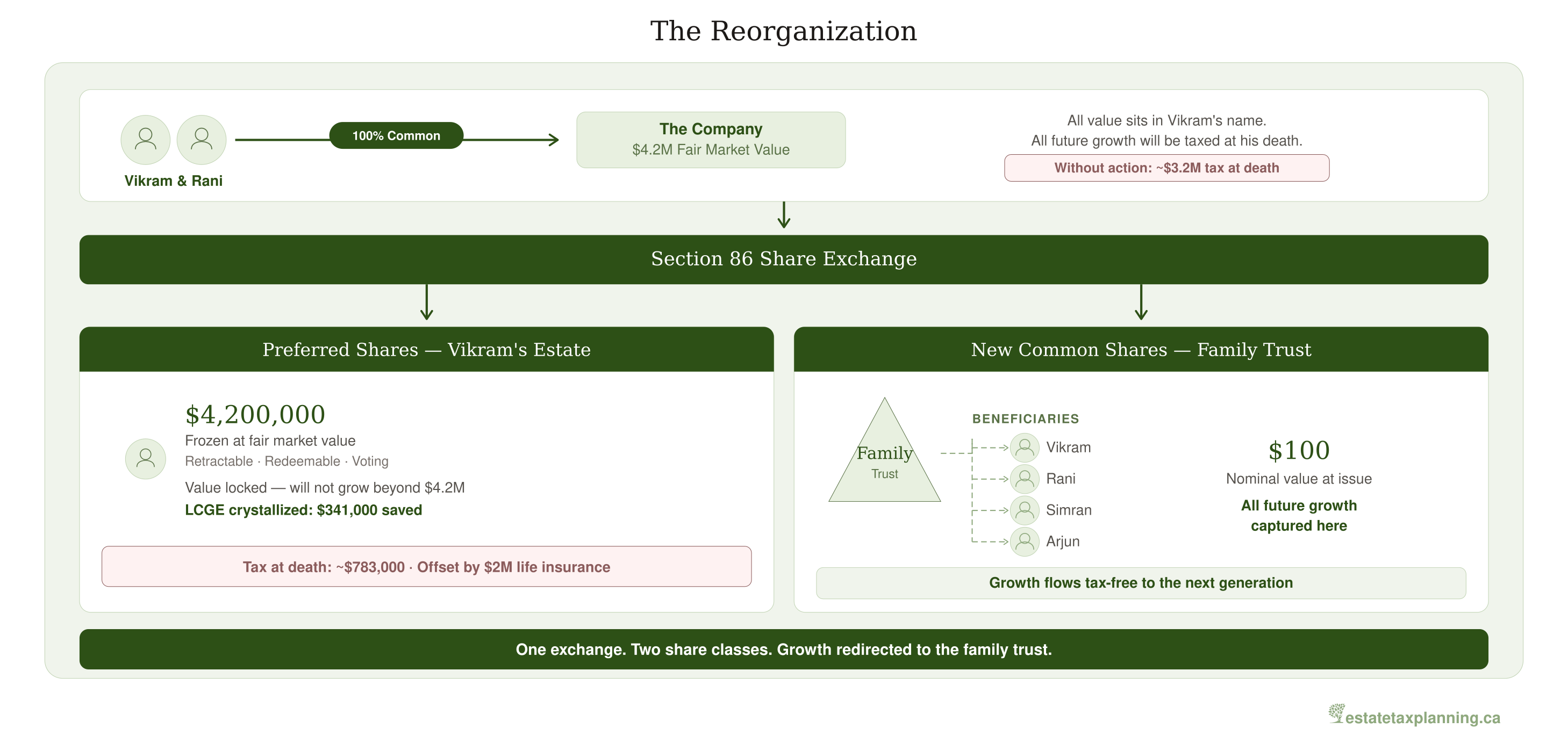
By the end of that meeting, we had a preliminary plan: a Section 86 reorganization. Vikram would exchange his existing common shares for a new class of preferred shares worth the fair market value of the company. New common shares — worth essentially nothing at the time of the freeze — would be issued to a family trust with Vikram, Rani, Simran, and Arjun as beneficiaries. The preferred shares would give Vikram voting control, a fixed redemption value, and the right to receive dividends. All future growth would accrue to the new common shares held by the trust.
But before any of that could happen, we needed a number. We needed to know what the company was actually worth.
The valuation.
The valuation took six weeks. Our business valuator reviewed four years of normalized financial statements, visited the facility, interviewed Vikram about the business’s competitive position and customer concentration, and analyzed comparable transactions in the precision manufacturing sector.
The conclusion: the company had a fair market value of $4.2 million on an en bloc, going-concern basis. The value was driven primarily by long-standing relationships with three major aerospace customers, modern equipment — much of it CNC machinery acquired in the last five years — and a workforce with specialized skills that would be difficult to replicate. The valuator applied a discount for lack of marketability, and arrived at the final figure.
That $4.2 million would become the freeze value: the amount locked into Vikram’s preferred shares.
The LCGE decision.
Before executing the freeze, we had an important decision to make: should Vikram crystallize his Lifetime Capital Gains Exemption?
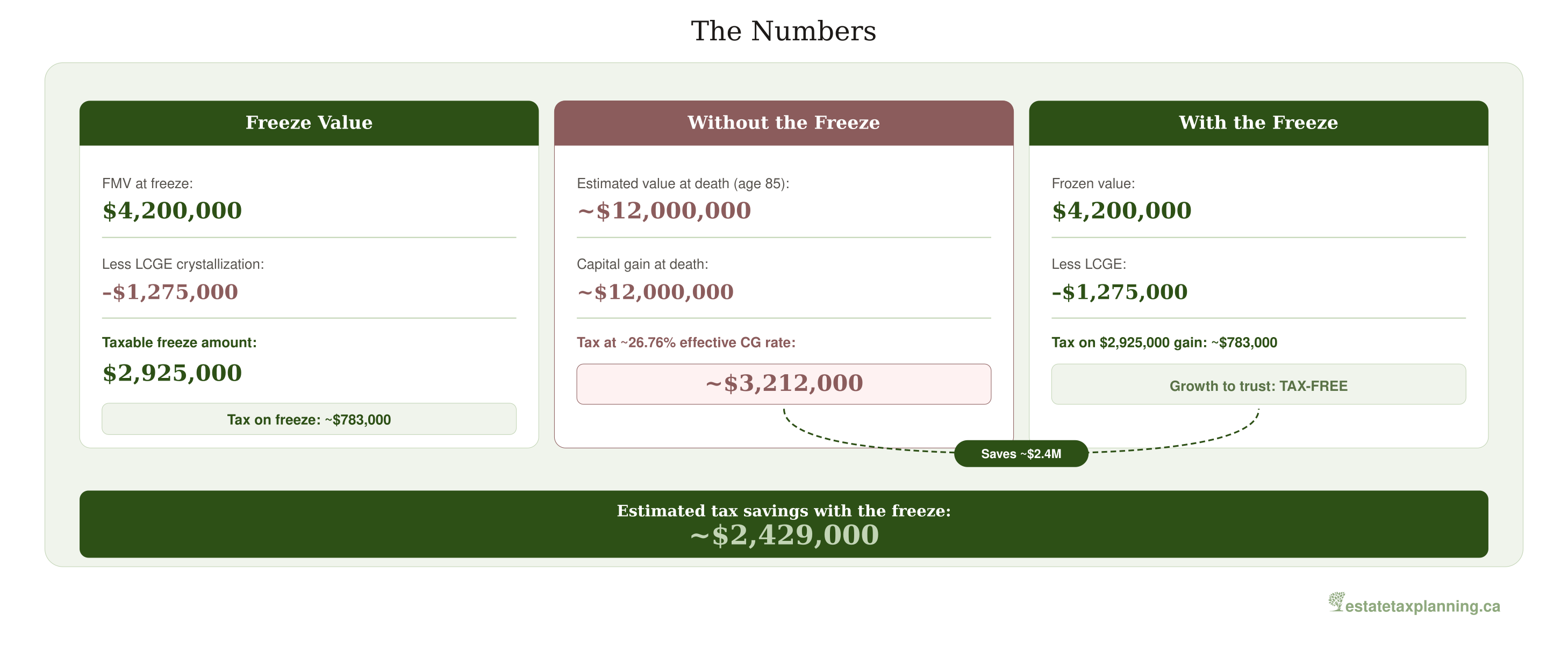
The LCGE allows individuals to shelter up to $1,275,000 (the 2026 indexed amount) of capital gains on the sale of qualifying small business corporation shares from tax. The company qualified — it was a Canadian-controlled private corporation, more than 90% of its assets were used in active business, and Vikram had held the shares for well over twenty-four months.
The mechanics required two coordinated filings. The Section 86 share exchange handled the reorganization itself — swapping Vikram’s old common shares for new preferred shares. But Section 86 on its own doesn’t let you trigger a gain, so we filed a separate Section 85 election to crystallize the LCGE. That election bumped the cost base of Vikram’s preferred shares from $100 — what he’d originally paid to incorporate — to $1,275,000.
The practical effect was a tax saving of roughly $341,000. At Ontario’s effective capital gains rate of approximately 26.76%, sheltering $1,275,000 of the eventual gain from tax was worth real money — money that would otherwise have been payable on Vikram’s death or when the preferred shares were redeemed. The remaining $2,925,000 above the new cost base would still produce a capital gain eventually, but the LCGE had permanently taken a significant piece off the table.
The family conversation.
The week before we executed the freeze, Vikram and Rani sat down with Simran and Arjun over dinner. He had been dreading this conversation more than any of the technical work. Rani had insisted they do it together. “This affects the whole family,” she said. “They should hear it from both of us.”
“The hardest part,” Vikram told us afterwards, “wasn’t explaining the tax. It was telling Arjun that Simran would probably end up with more of the business value than he would — and explaining why that was fair.” Rani had been the one to smooth that moment. She reminded Arjun that the plan included insurance to help equalize things, and that the trust gave them flexibility to adjust as life unfolded.
Vikram had prepared the technical side. He explained that the family trust gave them flexibility: the trustees could distribute the growth shares to Simran and Arjun in whatever proportions made sense when the time came. Simran, who was building the business, would likely receive more of the business value. But Arjun would benefit from some of the growth as well.
The key message was that nobody was being cut out. The plan was designed to be fair to both of them — just not necessarily equal, because their roles in the business were different.
Arjun’s only question was whether this affected his school funding. It didn’t. Simran asked whether she would eventually have voting control. Not yet — that would come later, when Vikram was ready to hand over the reins. For now, the freeze was about tax planning, not succession. Those were related conversations, but they didn’t need to happen on the same night.
The implementation.
The implementation took three weeks once the valuation was final. The lawyer prepared the trust deed, the document that would govern the family trust for up to twenty-one years. The deed named three trustees: Vikram, Rani, and Dev Mathur, a retired engineer and long-time colleague of Vikram’s with no family connection, as the arm’s-length third trustee. Vikram, Rani, Simran, and Arjun were named as beneficiaries. The deed gave the trustees broad discretion over distributions: they could allocate income and capital to any beneficiary, in any proportion, at any time. This flexibility was deliberate. We didn’t know what the next twenty years would look like, and the trust deed needed to accommodate whatever happened.
The corporate articles were amended to create two new share classes: Class A preferred shares (fixed value, voting, redeemable, discretionary dividends) and Class B common shares (nominal value, non-voting, participating in future growth). Vikram exchanged his existing common shares for 4,200,000 Class A preferred shares with a redemption value of $1.00 each — a total of $4.2 million. The family trust subscribed for 100 Class B common shares at $1.00 each, for a total of $100.
We also put a shareholder agreement in place between Vikram and the family trust. With two classes of shares now outstanding, the agreement set out transfer restrictions, redemption procedures, and what would happen in various scenarios: disability, death, family breakdown, or a dispute between the trustees. We always recommend this step. Without it, you’re relying on the corporate articles alone, and those weren’t designed to handle the kind of family-specific situations that come up over twenty years.
The Section 85 election for the LCGE crystallization was filed. The trust deed was executed. The corporate minute book was updated with the new share register, the directors’ resolution approving the reorganization, and the articles of amendment. The freeze was complete.
The entire process, from that first phone call to the signed documents, had taken about four months.
Year one.
The first year after the freeze was mostly about compliance and getting used to the new structure. We filed the first T3 trust return for the family trust — a short return, since the trust had no income in its first year. The new common shares were worth essentially nothing, and no dividends had been declared on them.
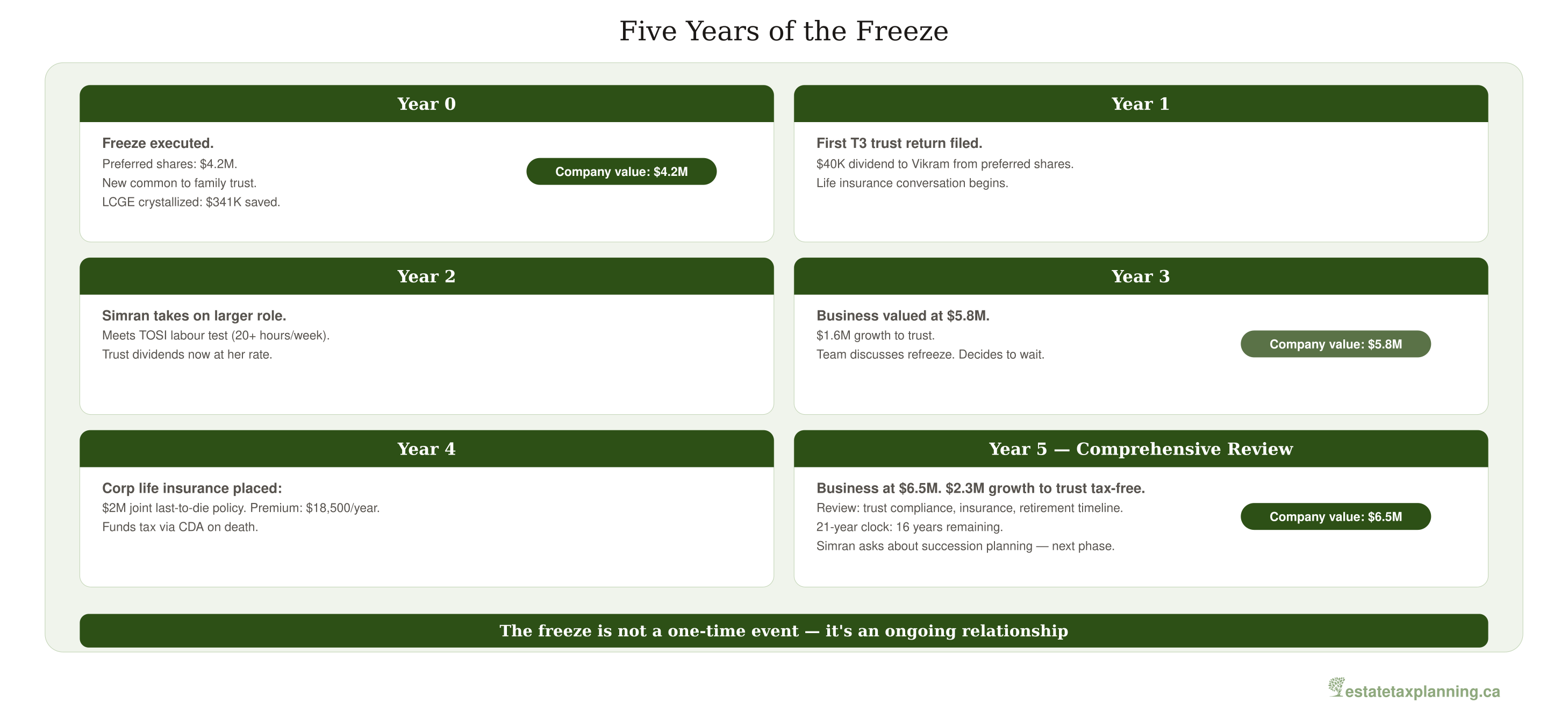
Vikram continued to draw his salary and declared a $40,000 dividend on his preferred shares. The dividend was paid from the company’s retained earnings and was taxed as an eligible dividend in his hands. This was one of the mechanisms that allowed Vikram to access value from the company without redeeming his preferred shares, a flexibility that would matter more as he moved toward retirement.
We also began the conversation about corporate-owned life insurance. The freeze had created a quantifiable tax liability: approximately $783,000 on Vikram’s preferred shares after the LCGE crystallization. If Vikram died, that tax would be due within six months. We needed a funding mechanism, and life insurance was the most tax-efficient option.
There was a quiet moment in that first-year review when Vikram paused and said, “Sometimes I wonder if we did the right thing. The company feels the same — nothing changed day to day. Was it worth all that work?” It’s a fair question. The freeze doesn’t change how you run your business. It doesn’t change your paycheque or your authority. The difference is invisible until the day it matters most — which is exactly when you can’t go back and do it.
Year two.
By the second year, Simran had taken on significantly more responsibility. She was managing the production floor full-time, handling vendor relationships, and sitting in on client meetings. She had also started leading the company’s quality certification process — a six-month project that had her in the plant until seven most evenings.
We were watching this closely, and not just because it was good for the business. Canada’s tax on split income rules can punish families who use trusts to split income with adult children who aren’t meaningfully involved in the business. Dividends get taxed at the top marginal rate instead of the recipient’s own rate. The key exclusion is the labour contribution test: if the child is actively engaged for at least twenty hours a week on average, the punitive rate doesn’t apply.
Simran was well past that threshold. Every late evening she spent on the certification project wasn’t just building the company. It was strengthening the tax position of the family trust for when the time came to distribute income.
Year three.
By year three, the business had grown. Revenue was up 38%, driven by a new contract with a major automotive OEM. We commissioned an updated valuation: the company was now worth approximately $5.8 million. That meant $1.6 million of growth had already shifted to the family trust — $1.6 million that would never be taxed in Vikram’s hands.
The question came up naturally during the annual review: should we refreeze? A refreeze would reset the frozen value to $5.8 million, locking in the growth that had already occurred and giving Vikram a higher redemption value on his preferred shares. The downside was that any future growth above $5.8 million would only be protected if the business continued to grow — and refreezing would mean the $1.6 million of growth was back in Vikram’s estate.
This was the first decision in the process that genuinely made Vikram uncomfortable. He could see the logic of letting the growth stay in the trust — that was the whole point of the freeze. But part of him wanted the security of a higher redemption value on his preferred shares, especially with retirement getting closer. “What if the company doesn’t keep growing?” he asked. “What if we’re giving up $1.6 million I might need?”
After modelling both scenarios, we decided to wait. Vikram’s retirement was still several years away. His personal savings were on track. The whole point of the freeze was to shift growth to the next generation, and the strategy was working. Refreezing would undo some of that progress. We would revisit the question in two years, or sooner if circumstances changed.
Year four.
The insurance piece came together in year four. We placed a $2 million joint last-to-die policy — covering both Vikram and Rani — owned by the corporation. The annual premium was $18,500. Rani had questions about why the policy was joint rather than on Vikram alone; the answer was cost and timing. A joint last-to-die policy is significantly cheaper because it only pays out after both spouses have passed, which is exactly when the deemed disposition tax on the preferred shares comes due. When the second of them passes, the $2 million death benefit flows into the company, and through the capital dividend account, funds the tax liability without anyone writing a cheque.
We had deliberately waited until year four to place the insurance rather than doing it at the time of the freeze. Vikram was fifty-eight when we froze, fifty-nine by the time implementation was complete. By sixty-two, we had three years of post-freeze financial data showing the company’s trajectory, a better sense of the actual tax exposure, and more confidence in the coverage amount.
The premium was slightly higher than it would have been at fifty-eight, but the coverage was more precisely calibrated to the actual need. At $2 million, the policy provided roughly 2.5 times the current tax liability — enough headroom for growth in the tax exposure, estate administration costs, and professional fees.
Year five.
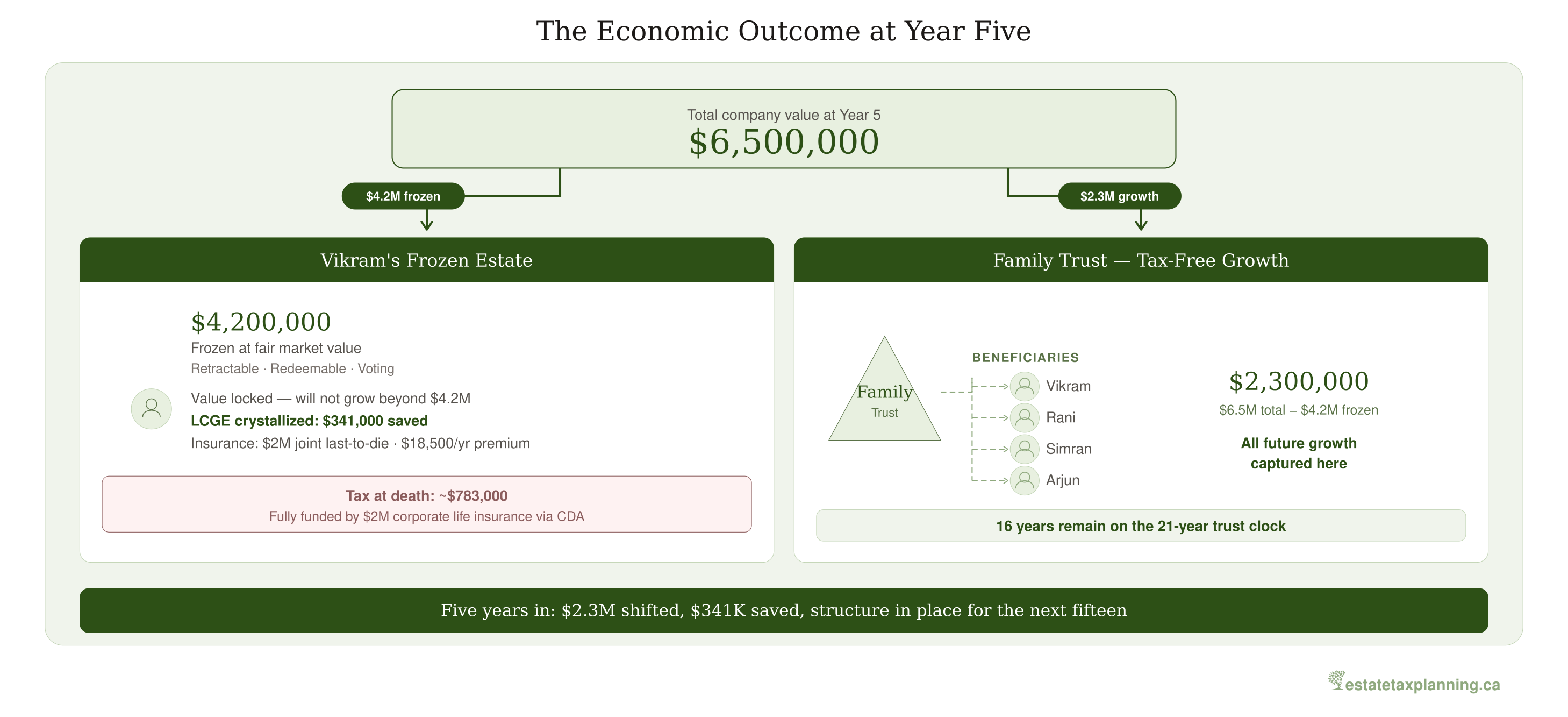
Five years after the freeze, we convened the full team for a comprehensive review. The business was now worth approximately $6.5 million. That meant $2.3 million of growth had shifted to the family trust — growth that would never be taxed in Vikram’s name.
The review covered everything: the trust’s compliance, the insurance coverage, the preferred share dividend schedule, Vikram’s retirement timeline, and the twenty-one-year clock on the family trust. That clock — subsection 104(4) of the Income Tax Act — meant the trust would face a deemed disposition of its assets twenty-one years after it was settled. We had sixteen years left. Plenty of time, but the kind of deadline you want to have on your radar rather than discover at the last minute.
Simran raised the succession question. She was thirty-three now, married, running the day-to-day operations. She wanted to know when — not if — she would formally take ownership. That conversation was for another day, and it would involve a different set of decisions: share transfers, voting control, an updated shareholder agreement, and possibly a new freeze. But the foundation was already in place. The family trust held the growth shares. The structure was flexible enough to accommodate whatever came next.
Arjun, now in his residency, sent a text that evening: “Glad the plan is working. Just make sure I’m not signing anything during my surgery rotation.”
Looking back.
When we asked Vikram, at the five-year review, whether he would do it again, he didn’t hesitate. “The only thing I’d change is that I wouldn’t have waited. That sticky note sat on my desk for three weeks. It should have been a phone call the same day.”
Vikram’s story is not unusual. The names and numbers change, but the arc is remarkably consistent across the families we work with: a business owner who has built something valuable, a next generation with different interests and different timelines, and a tax system that will take a significant share if nothing is done.
The estate freeze is the tool that bridges those realities. It’s not glamorous work — it’s share exchanges and trust deeds and T3 returns. But the outcome is concrete and measurable: $2.3 million of growth shifted to the next generation in five years, $341,000 of tax permanently eliminated through the LCGE, and a structure flexible enough to accommodate whatever the next fifteen years bring.
This scenario is based on situations we encounter regularly in our practice, with details changed for illustration. The figures use simplified assumptions. Your actual tax outcome depends on your specific circumstances, including your province of residence, your adjusted cost base, and whether you qualify for the LCGE. The figures assume Ontario’s top combined marginal tax rate of approximately 53.53% and a 50% capital gains inclusion rate.
For definitions of the key terms used in this article — including estate freeze, preferred shares, family trust, LCGE crystallization, and Section 86 reorganization — see our Key Terms and Definitions reference guide.
If Vikram’s story sounds like yours — if you’ve built a business worth protecting and you’re wondering whether the time is right — the best next step is a conversation. Not a commitment, just a conversation. The earlier it happens, the more growth you can shift to the next generation. And that, in the end, is the whole point.
This article is for informational purposes only and does not constitute legal, tax, or financial advice. Estate freezes are complex transactions that require the coordinated involvement of qualified tax, valuation, and legal professionals. Always consult your advisors before acting on any of the information discussed here.