
The 21-year rule will trigger a tax bill on your family trust that can run into the hundreds of thousands — and the clock may already be ticking. Start planning by year 10, not year 20.
If you've used a family trust as part of your estate freeze — or are considering one — there is one rule you must understand: the 21-year deemed disposition rule.
This rule can trigger a large, unexpected tax bill if you're not prepared. The good news is that with proper planning, the impact can be managed or avoided entirely. But that planning needs to start years before the deadline, not months.
In an estate freeze, the business owner (the "freezor") exchanges their common shares for fixed-value preferred shares, and a family trust subscribes for new common shares at a nominal cost. All future growth accrues to the trust's shares. Over 21 years, that growth can be substantial — and that is precisely what creates the tax exposure this article addresses.
What Is the 21-Year Rule?
Under subsection 104(4) of the Income Tax Act, a family trust is deemed to have disposed of all its capital property at fair market value on the 21st anniversary of its creation. Any unrealized capital gains are triggered, and the resulting tax must be paid by the trust.
The purpose of this rule is to prevent families from using trusts to defer capital gains indefinitely. Without it, property could remain inside a trust for generations, growing in value without ever being taxed. The 21-year rule ensures that, at minimum, the accrued gains are recognized and taxed at regular intervals.
After the deemed disposition, the trust is deemed to have reacquired the property at fair market value. This means the trust continues to exist with a new, stepped-up cost base — the clock resets for cost base purposes, though the trust itself does not need to be wound up.
Why It Matters for Estate Freezes
In a typical estate freeze, the family trust holds common shares representing all future growth. If the business has been growing well over 21 years, the unrealized gain on those shares can be substantial.
The critical point: the deemed disposition gain is taxed in the trust at the highest marginal tax rate — approximately 53.53% in Ontario. The lifetime capital gains exemption (LCGE) is not available to trusts. And the capital gains from the deemed disposition cannot be allocated to beneficiaries unless the shares are actually distributed to them in the same tax year.
- The trust is deemed to dispose of all capital property at fair market value on the 21st anniversary.
- Any unrealized capital gains trigger a tax bill at the highest marginal rate (approximately 53.53% in Ontario).
- The LCGE is not available to trusts, and gains cannot be allocated to beneficiaries after the deemed disposition unless the shares are distributed in the same tax year.
- Without proper planning, this rule can create a large, unexpected tax liability that undermines the entire freeze structure.
A Numerical Example
The scenario: A trust created in 2005 subscribed for common shares of the operating company for $100. By 2026, those shares are worth $5 million. On the 21st anniversary of the trust's creation, the trust is deemed to have disposed of the shares for $5 million.
An important clarification: the 21-year clock starts on the date the trust is created — the date the settlor signs the trust deed and transfers the initial settlement amount — not the date the estate freeze is executed. In practice there is often a gap of days or weeks between trust creation and the share exchange that completes the freeze. For trusts created close to a year-end, even a short gap can affect which taxation year the deemed disposition falls in. Your advisor should confirm the exact trust creation date from the executed trust deed, not the freeze closing documents.
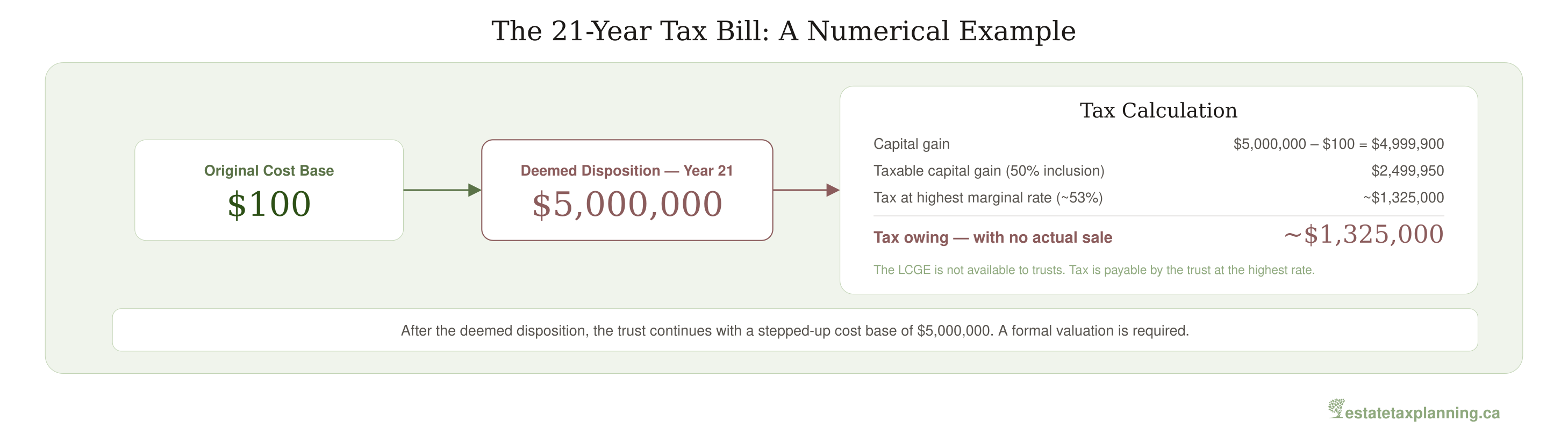
The capital gain is $4,999,900. At a 50% inclusion rate, the taxable capital gain is approximately $2,500,000. Taxed at the highest combined federal and Ontario marginal rate of approximately 53.53%, the resulting tax bill is roughly $1,325,000 — payable by the trust, with no actual sale of shares having occurred.
This is the scenario the 21-year rule is designed to address. The question for every family trust is: what strategy will you use to manage it?
- Option A (rollout to 3 beneficiaries): Each beneficiary receives shares with an accrued gain of approximately $1.67 million. If the shares qualify as QSBC shares, each beneficiary can shelter up to $1,275,000 using their LCGE — potentially eliminating the tax on approximately $3.825 million of the $5 million gain. The remaining $1.175 million gain is taxed at each beneficiary's personal rate. Total family tax: as low as approximately $315,000.
- Option B (re-freeze into a new trust): The gain on the old trust's shares is frozen in new preferred shares distributed to beneficiaries. No immediate tax is triggered. The new trust starts fresh with a 21-year clock and nominal cost base. Tax is deferred, not eliminated — it will arise when beneficiaries eventually sell or redeem.
- Option C (pay the tax): The trust pays approximately $1,325,000 at the top marginal rate. No shares change hands. The trust continues with a stepped-up cost base of $5 million.
Planning Ahead: The 21-Year Timeline
Do not wait until year 20. Most advisors recommend beginning the conversation at the 10-year mark. By years 15 to 20, the strategy should be chosen and implementation underway. Complex strategies like a re-freeze or LCGE crystallization may require two or more years to execute properly.
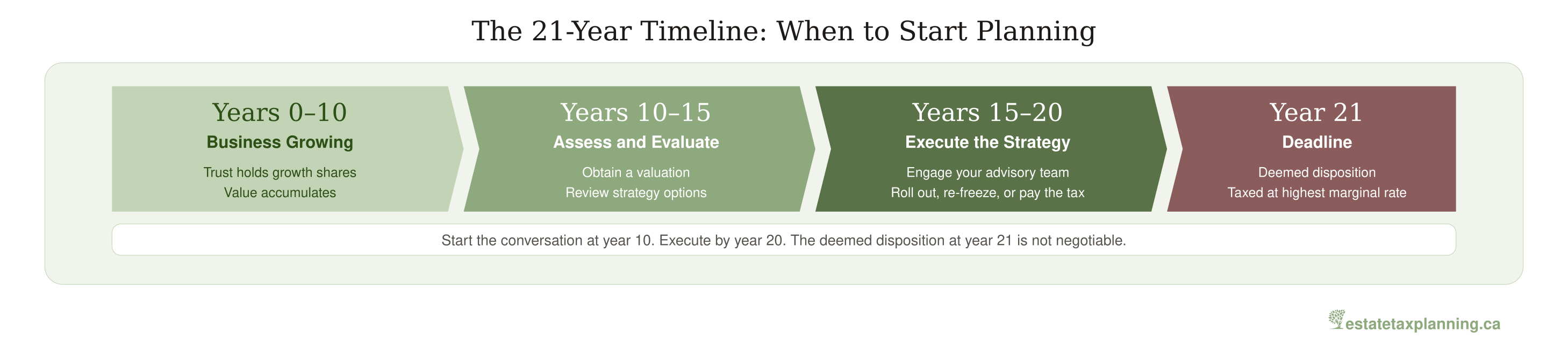
- We start the 21-year conversation at year 10 with every trust client. By year 15, the strategy should be locked in.
- By year 18, implementation should be underway. Complex strategies (re-freeze, LCGE crystallization, etc.) may require two or more years to execute properly.
- Trustees who wait until year 20 may find that the simplest strategies are no longer available. We’ve inherited files where that’s exactly what happened, and the options that remained were all expensive.
Three Strategies for the Deadline
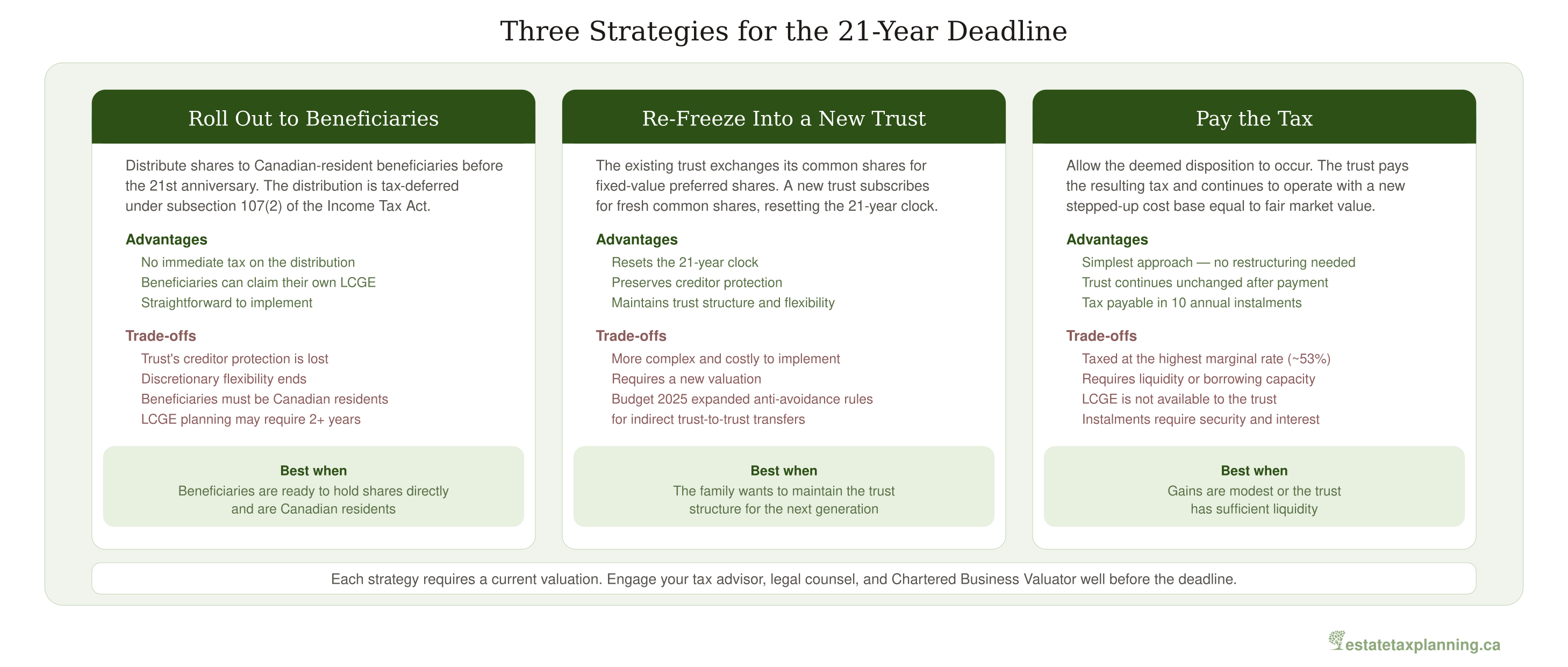
There are three principal approaches to managing the 21-year deemed disposition. Each involves trade-offs, and the right choice depends on the family's circumstances, the size of the unrealized gain, and the trust's specific provisions.
Option A: Roll Out to Beneficiaries
Under subsection 107(2) of the Income Tax Act, a personal trust can distribute capital property to a Canadian-resident capital beneficiary on a tax-deferred basis. The beneficiary receives the property at the trust's adjusted cost base — no gain is triggered on the distribution. This is the most common strategy for managing the 21-year rule.
Once the shares are in the beneficiaries' hands, they can use their own lifetime capital gains exemption (LCGE) on a future sale of qualifying small business corporation (QSBC) shares. This LCGE multiplication — one exemption per beneficiary — is one of the most powerful tax-planning benefits of the family trust structure.
- The subsection 107(2) tax-deferred rollover — the most common strategy for managing the 21-year deadline — is denied if subsection 75(2) has ever applied to the trust. Even once. Even briefly. Even if the trust deed was later amended.
- This means that if your trust was set up incorrectly 15 years ago, your best exit strategy is permanently unavailable. There is no cure.
- This is arguably the single most important planning point in the entire estate freeze process. The trust structure must be right from the outset — an arm's-length settlor, no reversionary features, no freezor control over distributions. See our discussion in The Role of the Family Trust in an Estate Freeze for the full analysis of subsection 75(2).
Practical considerations. Despite being the most common strategy, the rollout is not as simple as it sounds. Before distributing shares, trustees should review the trust deed to confirm it permits capital distributions, consider whether beneficiaries should receive non-voting shares to preserve the freezor's control, and put a unanimous shareholders' agreement in place. Family law implications should also be addressed — distributing shares to a beneficiary who is married may expose those shares to a matrimonial property claim. Encouraging beneficiaries to enter into domestic contracts before the distribution is a prudent step.
QSBC qualification is not a one-time test. For the LCGE to be available when a beneficiary eventually sells, the shares must qualify as QSBC shares at the time of disposition — not just at the time of rollout. This requires that 90% or more of the corporation's assets be used in an active business carried on in Canada at the time of sale, and that more than 50% of assets were used in an active business throughout the 24 months preceding the sale. If the corporation accumulates excess passive investments — real estate, portfolio holdings, or large cash balances — between rollout and eventual sale, QSBC status can be lost and the LCGE becomes unavailable. The rollout is step one; maintaining QSBC qualification until disposition is equally important.
- The most common strategy for managing the 21-year rule.
- Shares are distributed to beneficiaries under subsection 107(2) on a tax-deferred basis at the trust's adjusted cost base.
- Beneficiaries can then use their own LCGE (currently $1,275,000 each) on a future QSBC share sale.
- Requires: beneficiaries ready to receive shares, QSBC status confirmed, domestic contracts in place, non-voting share consideration.
- NOT available if subsection 75(2) has ever applied to the trust.
Option B: Re-Freeze Into a New Trust
If the family wants to maintain the trust structure beyond 21 years, a re-freeze can reset the clock. The existing trust exchanges its common shares of the operating company for fixed-value preferred shares. A new trust — settled by an arm's-length person, just like the original — subscribes for new common shares of the corporation. Future growth now accrues to the new trust's common shares, and the 21-year clock starts fresh.
The new trust must be settled by a different arm's-length person than the individual who settled the original trust. If the same person settles both trusts, the CRA may argue that the two trusts are in substance the same arrangement, potentially triggering the anti-avoidance rules under subsection 104(5.8) or the general anti-avoidance rule (GAAR). Using a different settlor — for example, a different family friend or a different member of the advisory team — reinforces that the new trust is a genuinely separate legal relationship.
The old trust then distributes its preferred shares to beneficiaries under subsection 107(2). The beneficiaries hold fixed-value shares, while the new trust holds the growth.
- Bill C-15 (royal assent March 26, 2026) expanded the anti-avoidance rule under subsection 104(5.8) that prevents trusts from resetting the 21-year clock through trust-to-trust transfers.
- Previously, only direct trust-to-trust transfers on a tax-deferred basis were caught. The expanded rule now targets indirect transfers as well — meaning planning techniques that routed property through an intermediary to achieve the same deferral are no longer effective.
- A re-freeze strategy remains viable in many circumstances, but the structure must be carefully designed to comply with the current rules.
- Any strategy involving trust-to-trust transfers should be reviewed with your tax advisor to confirm it remains viable under Bill C-15.
- Allows the family to extend the trust structure beyond 21 years while resetting the deemed disposition clock.
- The existing trust exchanges common shares for preferred shares (freezing current value).
- A new trust subscribes for new common shares at nominal cost (growth accrues to the new trust).
- Old preferred shares are distributed to beneficiaries on a tax-deferred basis.
- Requires: a second arm's-length settlor, careful planning to avoid unintended tax consequences, compliance with Bill C-15 anti-avoidance rules.
Option C: Pay the Tax
If the unrealized gains are modest or the trust has sufficient liquidity, the simplest approach may be to let the deemed disposition occur and pay the resulting tax. The trust continues to operate after the deemed disposition with a new stepped-up cost base equal to fair market value.
The tax can be paid in ten equal annual instalments under the Income Tax Act, but this requires the trust to provide acceptable security to the CRA and interest is charged on the outstanding balance at the CRA's prescribed rate plus four percentage points — currently 7% per year. On a $1.3 million tax bill, that interest compounds significantly over a decade, potentially adding over $500,000 to the total cost. This option preserves the trust structure completely — no shares change hands, no beneficiaries need to be ready, and no restructuring is required.
The trade-off: the tax is calculated at the highest marginal rate because the trust itself is the taxpayer. The LCGE is not available to trusts. For a trust with $5 million in unrealized gains, this means a tax bill of approximately $1.3 million.
For families choosing this option, corporate-owned life insurance can be an effective companion strategy. If the freezor passes away before or around the 21-year mark, the insurance proceeds can provide the liquidity needed to pay the deemed disposition tax without forcing a sale of business assets. The death benefit credits the corporation's capital dividend account, allowing tax-free extraction by the estate.
- The simplest approach if gains are modest or the trust has sufficient liquidity.
- The deemed disposition occurs automatically; the trust reports the gain and pays the tax.
- No shares change hands, no beneficiaries need to be ready, no restructuring is required.
- Tax can be paid in ten equal annual instalments under subsection 159(6.1), but the trust must provide acceptable security to the CRA and interest is charged at approximately 7% (prescribed rate plus four percentage points).
- Tax is at the highest marginal rate; the LCGE is not available to trusts. Corporate-owned life insurance can provide liquidity. If multiple beneficiaries each claim the LCGE in the same year as part of a rollout strategy, the combined claims may trigger alternative minimum tax — always model the AMT impact before finalizing the distribution plan.
What Happens If You Do Nothing?
If the trustees take no action, the deemed disposition occurs automatically on the 21st anniversary. The trust reports the gain and owes the tax. Trustees are jointly and severally liable for the resulting tax liability. If the trust lacks the liquidity to pay, it may be forced to sell assets — potentially at an inopportune time — or borrow against them.
- Trustees are jointly and severally liable for taxes incurred as a result of the 21-year deemed disposition.
- If the trust lacks liquidity, trustees may be forced to sell assets or borrow to pay the tax bill.
- This personal liability extends to all trustees named in the trust deed, not just the primary trustee.
- Proper planning starting at year 10 protects trustees from this exposure and ensures smooth succession planning.
The 21-year rule is not a reason to avoid using a family trust. It is a reason to plan thoughtfully. The families who get into trouble are the ones who forget about the deadline until it's too late.
Putting It All Together
The earlier you begin, the more options you have. We’ve seen families start planning at year 10 and implement a clean rollout at year 15 with minimal stress. We’ve also seen families discover the deadline at year 20, scramble for a valuation, and end up paying tax that could have been avoided with a few years’ lead time.
A formal valuation is required regardless of which strategy you choose. Whether you roll out shares, re-freeze, or let the deemed disposition occur, the fair market value of the trust’s assets must be established by a Chartered Business Valuator. This valuation takes time — typically several months — and should be initiated well before the 21st anniversary. Starting the valuation process at year 19 is often too late.
- Year 10–12: Begin strategy conversations. Obtain a comprehensive valuation. Model the gain and tax bill under each option (rollout, re-freeze, or pay the tax).
- Year 13–15: Choose the strategy. If rolling shares out to beneficiaries, confirm their readiness and any TOSI or AMT implications.
- Year 16–18: Implement the chosen approach. Obtain updated valuations. Execute share transfers, trust amendments, or corporate reorganizations.
- Year 19–20: Final review window. If you haven’t acted yet, options narrow quickly.
- Year 21: Automatic deemed disposition. Any unresolved trust holdings trigger tax at that date.
What's Next
You've now seen how an estate freeze works, why a family trust is the preferred structure, and how to manage the 21-year deadline. But the freeze itself is just one variation. In Freeze, Gel, Thaw, and Wasting Freeze , we explore the full family of freeze-related strategies — including how to partially reverse a freeze, gradually unwind one during retirement, and structure a gel that preserves your flexibility.
The 21-year rule is not a trap — it’s a planning milestone. The families who handle it well are the ones who treat it as a scheduled conversation, not a last-minute emergency. If your trust was created in the last decade, now is the right time to start that conversation.
For definitions of the key terms used in this article — including 21-year rule, deemed disposition, trust distribution, rollout, refreeze, LCGE, and capital gains exemption — see our Key Terms and Definitions reference guide.
This article is for informational purposes only and does not constitute legal, tax, or financial advice. Estate freezes are complex transactions that require the coordinated involvement of qualified tax, valuation, and legal professionals. Always consult your advisors before acting on any of the information discussed here.