
A discretionary family trust gives you up to 21 years to decide how ownership is divided among your family — while multiplying the LCGE, enabling strategic income allocation, and shielding growth shares from creditors. It’s the most popular freeze structure for a reason.
The family trust is by far the most widely used structure in Canadian estate freezes — and for good reason. It offers flexibility that no other structure can match: the ability to allocate income and capital gains among a pool of beneficiaries over a 21-year window, the potential to multiply the lifetime capital gains exemption (LCGE) — currently $1,275,000 per individual — and built-in creditor protection for family wealth.
But getting the details right matters enormously. A poorly structured trust can trigger devastating tax consequences that are impossible to undo. This article explains how a family trust is specifically used in an estate freeze, what makes a trust well-designed, and the two biggest traps that can undermine the entire structure.
How the Freeze Works
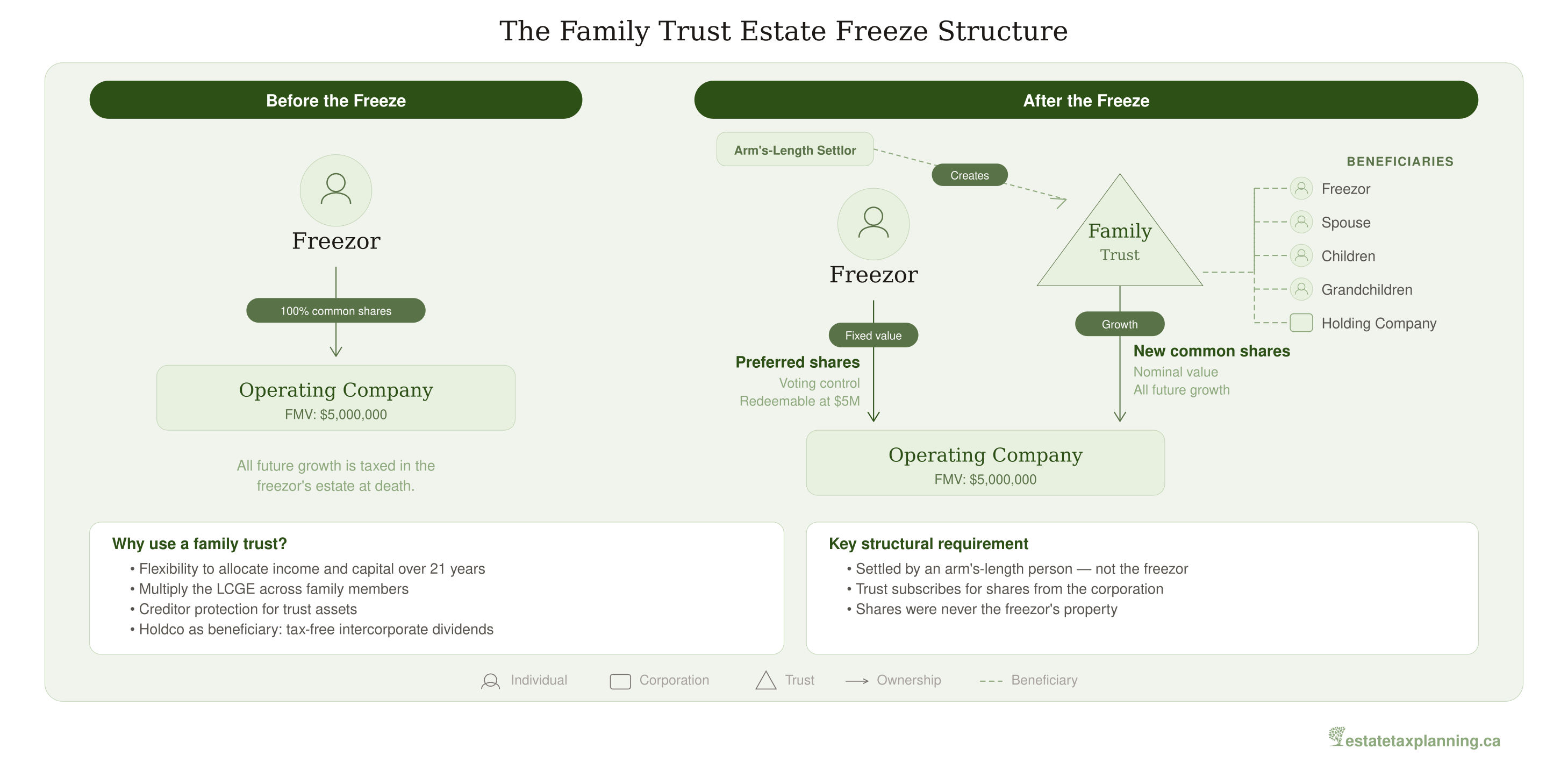
In an estate freeze, the business owner (the "freezor") exchanges their common shares of the operating company for preferred shares with a fixed redemption value equal to the company's current fair market value. These preferred shares are typically redeemable and retractable, giving the freezor the ability to access the frozen value over time. New common shares — worth only a nominal amount at the time of issue — are then issued to a family trust. All future growth in the business accrues to these new common shares, shifting it away from the freezor's estate.
The freezor retains voting control through the preferred shares and can serve as a trustee of the family trust, maintaining influence over how the growth shares are managed. Because the trust is a separate taxpayer, income and capital gains on the growth shares can be allocated to the trust's beneficiaries — potentially at lower tax rates. The trust faces a deemed disposition of its assets for tax purposes every 21 years, which requires careful advance planning — though the trust itself can continue to operate beyond that date.
The Settlor
The settlor should be arm's-length to the freezor and not a beneficiary of the trust. This avoids the "reversionary trust" rules that would attribute income and gains back to the person who contributed the property. In practice, the settlor is often a family friend or the family's lawyer. The settlement itself is typically nominal — often just $100 — but the identity of the settlor is critically important, as we'll see in the subsection 75(2) discussion below.
The Trustees
In most estate freeze trusts, the freezor is named as one of the trustees, often alongside their spouse and an independent third party. This gives the freezor significant ongoing control without personally owning the growth shares. The trust deed sets out the trustees' powers, including the authority to distribute income, allocate capital gains, and wind up the trust. Having an independent co-trustee — such as a lawyer or accountant — helps manage potential conflicts of interest, especially when the freezor is both a trustee and a beneficiary.
The Beneficiaries
Typical beneficiaries include the freezor's spouse, children, grandchildren, and potentially the freezor themselves. When the freezor is named as a beneficiary of their own family trust, this is sometimes called a "gel" — a structure that allows the freezor to participate in future growth alongside the next generation. The great advantage of a discretionary trust is that the trustees don't have to decide at the outset who gets what. The trust deed names the pool of potential beneficiaries, and the trustees allocate over time based on evolving circumstances. Beneficiaries of a discretionary trust do not have a fixed entitlement — they have a right to be considered, but the ultimate decision rests with the trustees.
Including a holding company as a beneficiary. Many well-designed freeze trusts name a holding company as a potential beneficiary. This allows the trust to distribute funds to the holdco, where they can be invested and managed with the benefit of tax-free intercorporate dividends, additional creditor protection, and corporate tax rates on passive income. This is the most sophisticated and flexible post-freeze configuration.
Key Features of a Well-Designed Trust
Not all trust deeds are created equal. A trust deed drafted for a simple family gift is very different from one designed to support a multi-decade estate freeze. The trust deed should be built with the freeze's specific demands in mind — LCGE multiplication, 21-year planning, and the flexibility to respond to changes in tax law, family circumstances, and business value over time.
- Broad trustee discretion to respond to changing circumstances, tax law, and family situations. We’ve seen trust deeds that were too narrowly drafted to allow even basic corporate reorganizations — that’s a problem you don’t want to discover fifteen years in.
- Power to add future beneficiaries (grandchildren, holding companies) without amending the deed.
- Capital gains allocation language to multiply the LCGE across family members.
- Clear 21-year rollout or re-freeze provisions to avoid the deemed disposition trap.
- Successor trustee provisions to address death or incapacity of a trustee. This one gets overlooked more often than you’d expect.
The Reversionary Trust Trap: Subsection 75(2)
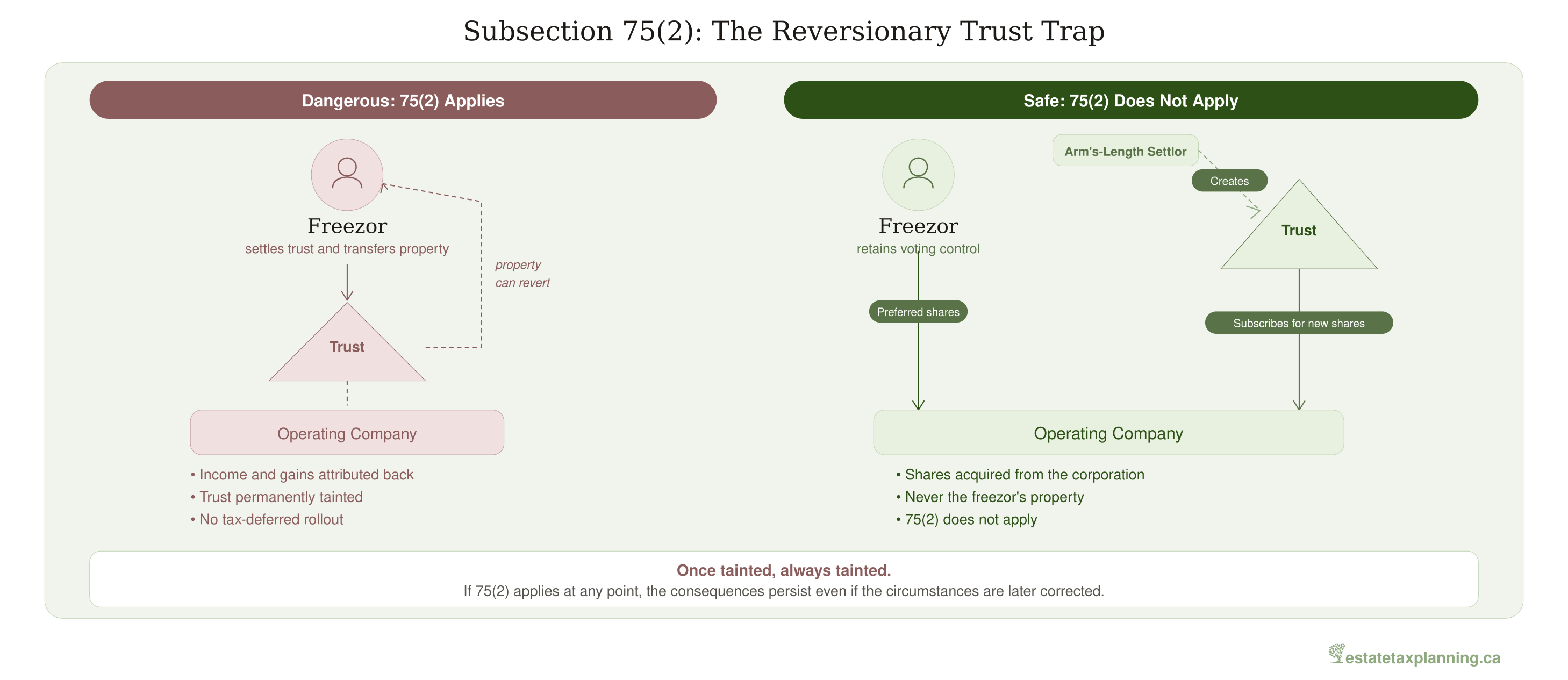
Subsection 75(2) of the Income Tax Act is one of the most dangerous traps in estate freeze planning. If it applies, it attributes all income, capital gains, and losses from the trust property back to the person who transferred the property to the trust — completely defeating the purpose of the freeze. Even worse, if subsection 75(2) has applied at any time, it "taints" the trust permanently, denying the ability to roll out shares to beneficiaries on a tax-free basis.
When does it apply? Subsection 75(2) applies when trust property can revert to the person who transferred it, or when that person can determine who receives the trust property. In plain language: if the freezor contributes property to the trust and the trust deed gives the freezor the power to direct how that property is distributed, subsection 75(2) can apply. Even having a veto over distributions — for example, being one of only two trustees — may be enough to trigger the rule.
Why the settlor matters. This is why the settlor of an estate freeze trust should always be an arm's-length person who is not the freezor and who is not a beneficiary. If the freezor settles the trust (even with a nominal $100 gift) and the trust deed gives the freezor influence over distributions, the entire trust can be tainted.
The safe approach. In a properly structured estate freeze trust, the trust is settled by an arm's-length person. The trust then subscribes for new common shares of the corporation — the trust acquires the shares directly from the corporation, not from the freezor. Because the shares were never the freezor's property, subsection 75(2) does not apply to them. This is a critical structural point that your tax and legal advisors must get right.
- If subsection 75(2) applies, all trust income and gains are attributed back to the contributor for as long as the trust holds the property.
- The trust loses the ability to distribute shares to beneficiaries on a tax-deferred rollover basis — this is essential for 21-year rule planning.
- In the worst case, the entire estate freeze is undermined, and the contributor faces a tax bill that the freeze was designed to avoid.
- The trust is "tainted" permanently. It cannot be cured by later amending the trust deed.
- Critically, if subsection 75(2) has ever applied, the trust loses the ability to distribute shares to beneficiaries on a tax-deferred basis under subsection 107(2) — which is essential for managing the 21-year deemed disposition discussed in the next article.
TOSI and the Family Trust
The TOSI rules have significantly limited income splitting through trusts. Since 2018, dividends and other split income received by family members from a related business are generally taxed at the highest marginal rate unless the recipient qualifies for limited exceptions.
Importantly, shares held by a trust are generally not "excluded shares" for TOSI purposes. This means beneficiaries cannot rely on the 10% votes-and-value test that applies to directly held shares. This is one of the key trade-offs of the trust structure. The main exception available to trust beneficiaries is the "excluded business" exception, which requires the individual to have been actively engaged in the business on a regular, continuous, and substantial basis — either in the current year or in any five prior taxation years (which do not need to be consecutive). The CRA's bright-line test deems this met if the individual works an average of 20 or more hours per week in the business.
| Beneficiary Type | TOSI Result |
|---|---|
| Adult child active in business 20+ hrs/week for 5+ years | Excluded business exception applies — taxed at personal rate |
| Adult child not involved in the business | TOSI applies — taxed at top marginal rate |
| Spouse not involved in business (under 65) | TOSI applies — taxed at top marginal rate |
| Spouse aged 65+ or inherited shares on death | Excluded — taxed at personal rate |
| Freezor (built the business) | Excluded business exception applies — taxed at personal rate |
| Minor child or grandchild | TOSI applies — taxed at top marginal rate (no exceptions for business income) |
Corporate Attribution: Subsection 74.4(2)
Separate from TOSI, corporate attribution under subsection 74.4(2) can apply when property is transferred or loaned to a corporation for the benefit of a spouse or non-arm's-length minor. If the corporation holds mostly passive investment assets (more than 10% of FMV), the freezor may have to include a deemed interest amount in income at the prescribed rate. Corporate attribution does not apply if the corporation is a small business corporation with 90% or more of its assets used in an active business carried on primarily in Canada. Your tax advisor should address both TOSI and corporate attribution when structuring the freeze.
- Shares held by a trust are not “excluded shares” and cannot use the 10% votes-and-value test. This is the trade-off you accept when you choose a trust structure over direct ownership.
- The “excluded business” exception applies if the individual has been actively engaged in the business for at least five years (not necessarily consecutive) or averages 20+ hours per week currently. We always tell families: start the clock early.
- Strategic allocation allows trustees to direct more income to beneficiaries who qualify for the excluded business exception.
- Beneficiaries without an exemption will be taxed at the highest marginal rate on split income. There’s no workaround for this one.
Numerical Example: Strategic Trust Income Allocation
The scenario: The family trust holds growth shares of the operating company. The company declares a $100,000 dividend on the growth shares. The trust has three beneficiaries: Sarah (35, active in the business for 10 years at 20+ hours per week), James (30, not involved in the business), and the freezor (age 62, built the business over 30 years).
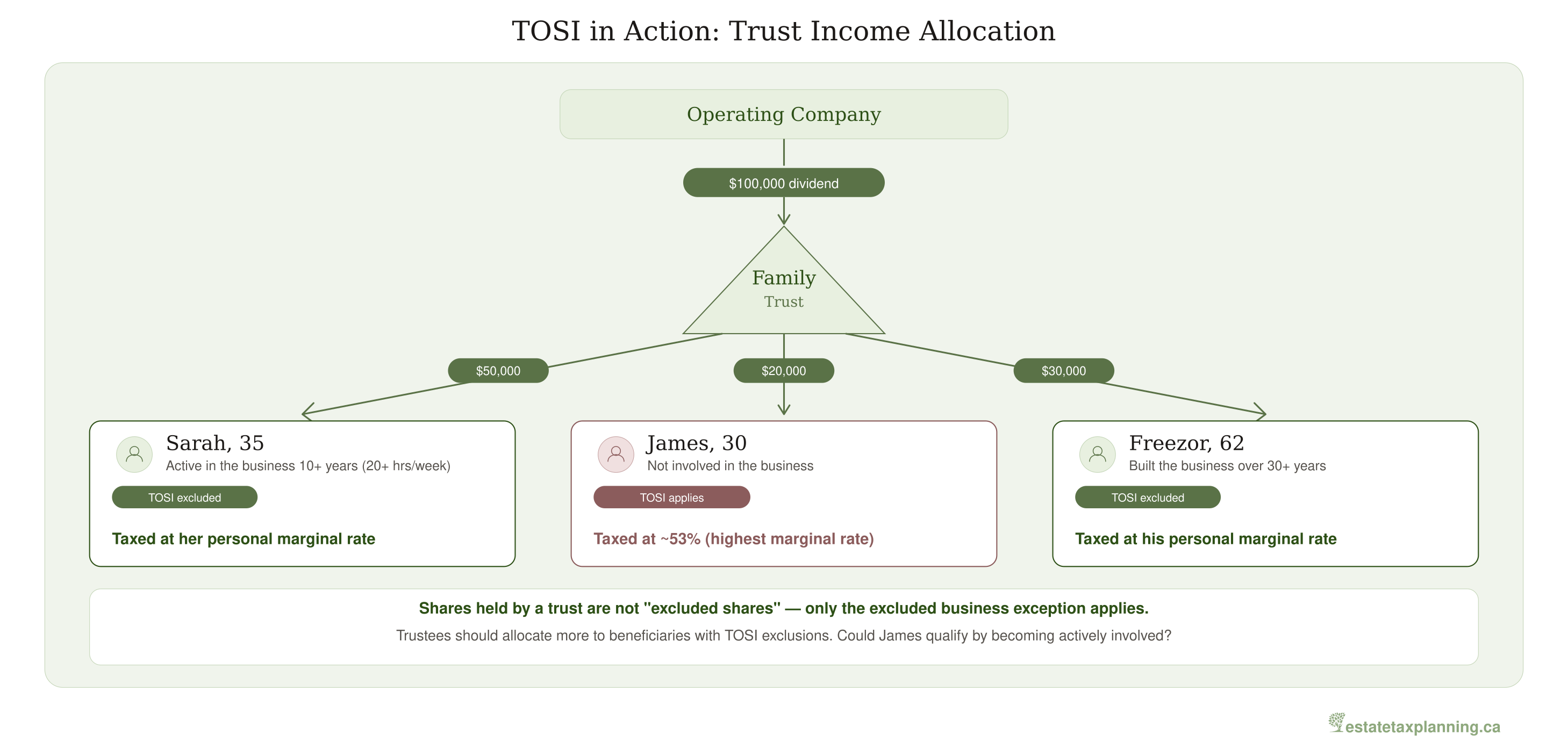
Sarah ($50,000 allocated). Because Sarah has been actively engaged in the business for more than five years, the "excluded business" exception applies. Her allocation is not subject to TOSI and is taxed at her personal marginal rate. If Sarah has modest other income and falls in the 29.65% combined bracket, her tax on this allocation is approximately $14,825.
James ($20,000 allocated). Because James is not actively engaged in the business and the shares are held by a trust (not "excluded shares"), TOSI applies. His allocation is taxed at the highest marginal rate — approximately 53.53% in Ontario — regardless of his actual income level. His tax: approximately $10,706 on just $20,000.
The freezor ($30,000 allocated). The freezor built the business over 30 years and clearly meets the excluded business exception. Assuming the freezor has other income that already pushes them into Ontario’s top combined marginal rate of approximately 53.53%, the tax on this allocation is roughly $16,059.
The planning implication. The total family tax on $100,000 of dividends is approximately $41,590 — but without strategic allocation (for example, splitting equally at $33,333 each), James's TOSI-rate share alone would have cost an additional $4,900 in tax. The trustees strategically allocate more income to Sarah and the freezor (who have TOSI exclusions) and less to James. The trust's discretionary powers make this flexibility possible. Going forward, the family might also consider whether James could qualify for an exclusion by becoming more actively involved in the business — working an average of 20 hours per week for five years would meet the bright-line test.
Spousal Trust Interactions: A Coordination Point
When the freezor’s spouse is a beneficiary of the family trust (which is common), the interaction between the trust, the corporation, and any corporate-owned life insurance policy requires careful attention. Under subsection 70(6), assets can roll over to the surviving spouse or a qualifying spousal trust on a tax-deferred basis, deferring the capital gain until the second death.
An important distinction: a qualifying spousal trust is not the same thing as a discretionary family trust that happens to include the spouse as a beneficiary. A qualifying spousal trust must give the spouse exclusive entitlement to all income during their lifetime, and no one else can receive capital distributions while the spouse is alive. A standard discretionary family trust — the kind most commonly used in estate freezes — gives trustees the power to allocate income and capital among all beneficiaries, including the spouse, children, and grandchildren. That flexibility is the trust’s greatest strength, but it disqualifies the trust from the spousal rollover under subsection 70(6).
If the family trust holds growth shares and you want the spousal rollover, the trust deed must be carefully drafted to restrict distributions during the spouse’s lifetime. Any discretion to allocate capital to other beneficiaries can disqualify the trust, triggering an immediate deemed disposition on the first death rather than a deferral to the second.
- If the family trust is a qualifying spousal trust, the capital gain on the growth shares is deferred to the second death — which means the insurance coverage should be aligned with this timeline (consider a JLTD policy).
- If the trust does not qualify as a spousal trust, the gain is triggered on the first death, and single-life coverage on the freezor is needed.
- The trust deed must not give the trustees discretion to distribute capital to anyone other than the spouse during the spouse’s lifetime — this is the most common disqualifying feature.
- Review the trust deed with legal counsel and your insurance advisor together to ensure alignment.
Ongoing Compliance: The T3 Return and Schedule 15
Once the family trust is established, it becomes a separate taxpayer with its own annual filing obligations. The trust must file a T3 Trust Income Tax and Information Return every year, due within 90 days of the trust's taxation year-end — typically March 31 for calendar-year trusts. Late filing penalties can be significant, particularly if the trust has tax owing.
Since 2023, most trusts must also file Schedule 15 (Beneficial Ownership Information), disclosing details about the trust's settlor, trustees, beneficiaries, and anyone who can influence trustee decisions. This enhanced reporting requirement applies to virtually all inter vivos trusts used in estate freezes.
- Annual T3 return due within 90 days of year-end (typically March 31). Late-filing penalties: 5% of unpaid tax plus 1% per month, up to 12 months.
- Schedule 15 (Beneficial Ownership Information) is mandatory for most trusts since 2023.
- The trust must report all income allocations to beneficiaries on T3 slips (due by March 31).
- Even if the trust has no income in a given year, a nil return is required if the trust holds property. This catches many families off guard in the first year after the freeze — the growth shares may not pay dividends in year one, but the trust still holds property and must file.
- Your tax advisor should calendar these deadlines as part of the freeze implementation.
Putting It All Together
The family trust is the most powerful structure available for an estate freeze — but it is also the most complex. We’ve seen trusts drafted without considering the 75(2) trap, trusts where the TOSI implications weren’t mapped before the first distribution, and trusts where the valuation and the trust deed were prepared by different firms that never spoke to each other. In every case, the cost of fixing the problem exceeded the cost of getting it right the first time.
What's Next
The family trust's 21-year deemed disposition deadline is one of the most important planning milestones in any estate freeze. In The 21-Year Rule , we explain how this rule works, why it matters, and the strategies advisors use to manage it — including share rollouts, refreezes, and wind-up planning.
The family trust isn’t just a tax planning vehicle — it’s a framework for how your family’s wealth will be managed for the next generation. The TOSI rules, the spousal trust distinction, the 75(2) trap, the 21-year deadline — each of these is manageable when planned for from the start. The families who benefit most from a trust are the ones who treat it as a living structure, not a set-and-forget document.
For definitions of the key terms used in this article — including discretionary trust, settlor, trustee, beneficiary, TOSI, excluded business exception, qualifying spousal trust, and subsection 75(2) — see our Key Terms and Definitions reference guide.
This article is for informational purposes only and does not constitute legal, tax, or financial advice. Estate freezes are complex transactions that require the coordinated involvement of qualified tax, valuation, and legal professionals. Always consult your advisors before acting on any of the information discussed here.