
A family trust is the most powerful vehicle for holding estate freeze growth shares — it preserves flexibility for up to 21 years, enables LCGE multiplication, and protects assets from beneficiaries’ creditors. But it comes with strict compliance obligations and tax rules that must be managed from day one.
If you're exploring estate planning for a private business, you've probably encountered the family trust. In Canada, the family trust is the most commonly recommended structure for estate freezes — and for good reason. But what exactly is a trust? How does it work? And why is it such a powerful tool in Canadian tax and estate planning?
This article takes a step back from the estate freeze itself to give you a solid foundation in how trusts work. Whether you're a business owner, a financial advisor, or simply someone exploring estate planning for the first time, understanding trusts is essential — because they're involved in almost every sophisticated planning strategy.
What Is a Trust?
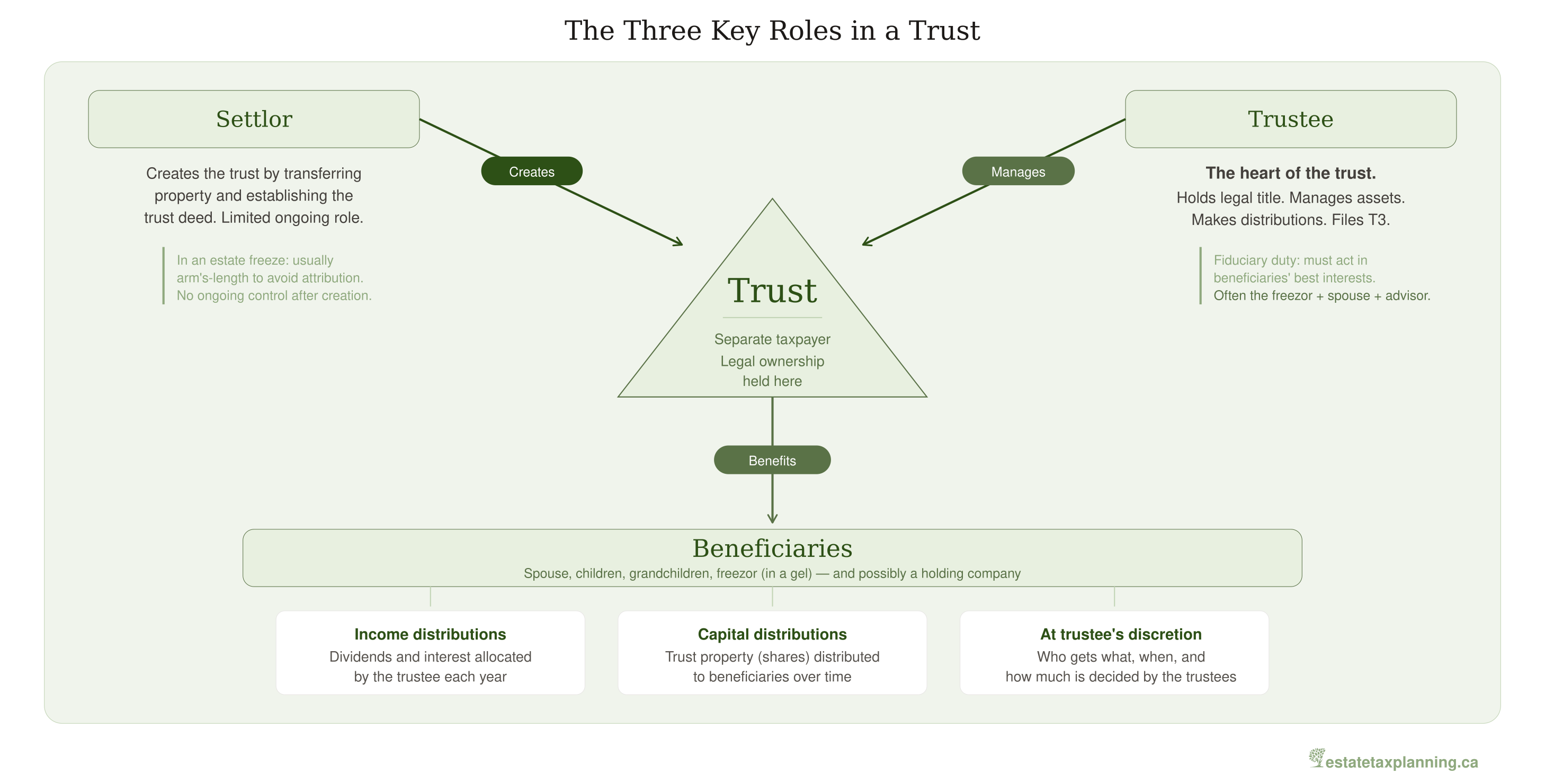
A trust is a legal relationship in which one person (the trustee) holds legal title to property for the benefit of another person (the beneficiary). The trust is created by a third person (the settlor) who transfers property to the trustee and sets out the terms under which the property must be managed and distributed.
A trust is not a corporation, a partnership, or a person. It's a relationship — a set of obligations. But for tax purposes, the Canada Revenue Agency treats a trust as a separate taxpayer with its own tax return (the T3) and its own tax obligations.
The key insight is that a trust separates legal ownership from beneficial ownership. The trustee owns the property in law, but the beneficiaries are the ones who ultimately benefit from it. This separation is what makes trusts so useful for planning purposes.
Trusts serve many purposes in Canada — from protecting vulnerable family members to managing charitable donations and holding real estate. This article focuses specifically on trusts as they relate to estate and business succession planning, because that is where trusts intersect most directly with the estate freeze strategies covered in this series.
The Three Key Roles
The Settlor
The settlor is the person who creates the trust. They do this by transferring property to the trustee and establishing the terms of the trust, typically in a legal document called a trust deed (also called a trust agreement or trust indenture).
In the context of an estate freeze, the settlor is usually not the business owner. Instead, it's an arm's-length person — a family friend, the family's lawyer, or another trusted individual who is not a beneficiary. This is done to avoid the "reversionary trust" rules under subsection 75(2) of the Income Tax Act, which can attribute income and gains back to the person who contributed the property.
The settlor's role is generally limited to creating the trust. Once the trust is established, the settlor typically has no ongoing role or control.
The Trustee
The trustee is the heart of the trust. They hold legal title to the trust property and are responsible for managing it according to the terms of the trust deed. Trustees can be individuals, corporations, or professional trust companies. Many trusts have multiple trustees — for example, the business owner, their spouse, and an independent advisor such as a lawyer or accountant.
Being a trustee is not a ceremonial role. It comes with significant legal responsibilities and potential personal liability. Anyone considering serving as a trustee — including business owners who plan to be trustees of their own family trust — should understand these obligations before accepting the role.
Trustee Duties and Responsibilities
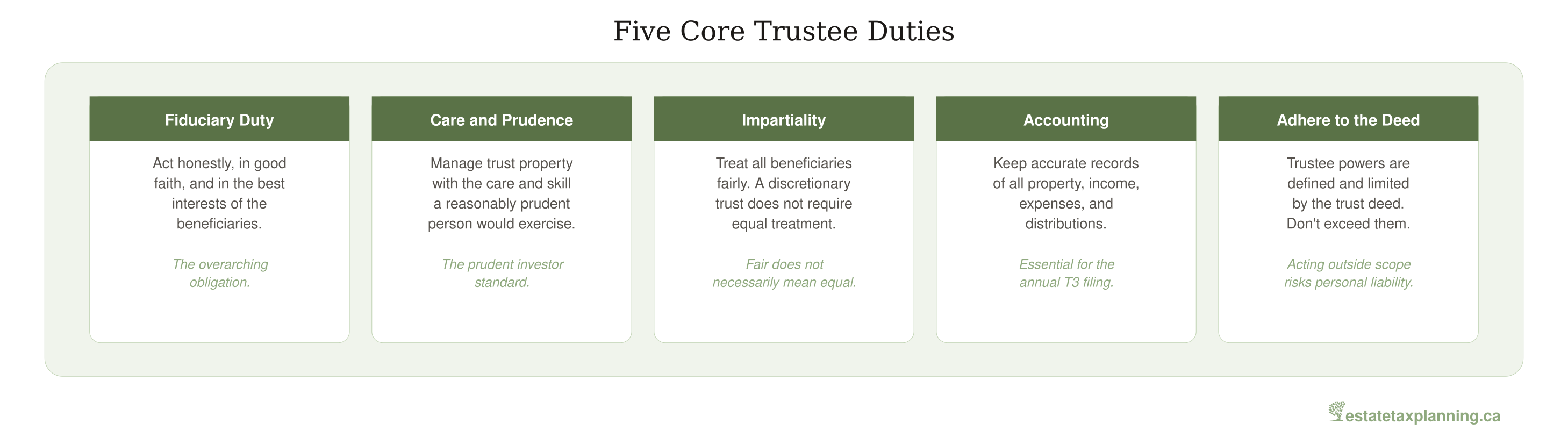
Fiduciary duty. This is the overarching obligation. A trustee must act honestly, in good faith, and in the best interests of the beneficiaries. They must put the beneficiaries' interests ahead of their own. A trustee who is also a beneficiary of the trust (as in a "gel" structure) must be especially careful to act impartially.
Duty of care and prudence. A trustee must manage the trust property with the care, skill, and diligence that a reasonably prudent person would exercise in comparable circumstances. For investment decisions, this is often referred to as the "prudent investor" standard.
Duty of impartiality. When a trust has multiple beneficiaries, the trustee must treat them fairly. This doesn't necessarily mean equally — a discretionary trust allows the trustee to allocate unevenly — but the trustee must genuinely consider each beneficiary's interests.
Duty to account and keep records. Trustees must maintain accurate records of all trust property, income, expenses, and distributions. Beneficiaries have the right to request an accounting. Good recordkeeping is also essential for filing the annual T3 trust tax return.
Duty to comply with the trust deed. The trustee's powers are defined and limited by the trust deed. Acting outside the scope of the trust deed can expose the trustee to personal liability.
- If you implement an estate freeze and serve as a trustee of the family trust that holds the growth shares, you're wearing two hats — business owner (with preferred shares) and trustee (managing the trust's common shares).
- These roles can sometimes conflict.
- Having an independent co-trustee can help manage these potential conflicts and protect everyone involved.
The Beneficiaries
The beneficiaries are the people (or entities) who are entitled to receive the benefits of the trust. They may receive income distributions (such as dividends or interest earned on trust property), capital distributions (the trust property itself), or both.
In a discretionary trust, the beneficiaries do not have a fixed entitlement. They have a right to be considered for distributions, but the trustee decides who gets what and when. This is what makes discretionary trusts so flexible for tax planning — the trustee can allocate income to whichever beneficiaries are in the lowest tax brackets each year.
An important distinction: in an estate freeze, the trust holds the growth shares of the corporation — not the business itself. The business continues to operate normally. The freezor retains voting control through the preferred shares, and the trust's common shares represent the right to participate in future growth. This means the business owner doesn't lose control of the business by using a trust.
Beneficiary rights. Even in a discretionary trust, beneficiaries are not powerless. They have the right to be informed that the trust exists, the right to request an accounting from the trustees, and the right to go to court if they believe the trustees are not fulfilling their duties. Beneficiaries of a discretionary trust do not, however, have the right to demand a specific distribution.
The Trust Deed: The Governing Document
The trust deed is the foundational legal document that creates and governs the trust. It is, in many ways, the constitution of the trust. Everything the trustees can and cannot do, who the beneficiaries are, and how the trust operates is defined by this document.
A well-drafted trust deed is essential. If it's too restrictive, the trustees may lack the flexibility they need. If it's too vague, it may create uncertainty or disputes. If it's missing key provisions, opportunities may be lost and unintended tax consequences may arise.
- Identification of the parties — the settlor, initial trustees, and the class of beneficiaries (including the power to add or exclude beneficiaries over time).
- Description of the trust property — what is being settled into the trust at inception (typically a nominal cash amount, with shares subscribed for afterward).
- Trustee powers — broad enough to participate in corporate reorganizations, exchange or subscribe for shares, borrow, invest, and carry on business. Narrow powers can block future planning.
- Distribution provisions — granting the trustees full discretion over the timing, amount, and recipient of income and capital distributions.
- Capital gains allocation language — enabling the trustees to designate capital gains to specific beneficiaries for LCGE multiplication purposes.
- 21-year planning provisions — giving trustees the authority to distribute trust property before the deemed disposition deadline, including the ability to transfer shares to beneficiaries on a tax-deferred basis.
- Trustee appointment and removal mechanisms — outlining who can appoint or replace trustees and under what circumstances.
- Governing law — specifying the province whose laws govern the trust.
Types of Trusts
Not all trusts are the same. The type of trust you use depends on your planning objectives, your age, and when the trust is created. Here are the most common types in Canadian estate planning:
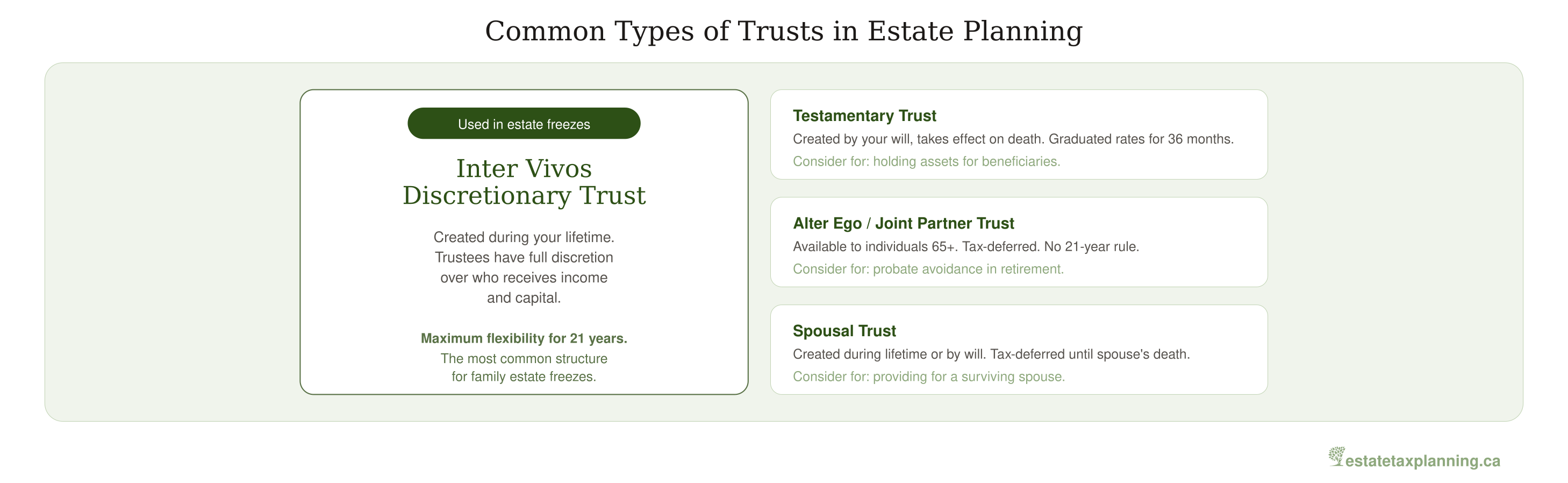
An inter vivos trust (also called a living trust) is created during the settlor's lifetime. It is the standard vehicle used in estate freeze planning because it can be established immediately, before any shares change hands. Inter vivos trusts are taxed at the highest marginal rate on any retained income, which creates a strong incentive to distribute income to beneficiaries each year. They file a T3 return annually and are subject to the 21-year deemed disposition rule.
A testamentary trust is created by a person's will and comes into existence on their death. Historically, testamentary trusts could access graduated tax rates — the same marginal rate brackets available to individuals — which made them attractive for income splitting. Since 2016, however, only a graduated rate estate (GRE) qualifies for graduated rates, and only for the first 36 months after the individual's death. After that window closes, the testamentary trust is taxed at the top marginal rate, just like an inter vivos trust.
For estate freeze purposes, the inter vivos discretionary trust is almost always the right choice. It gives trustees the flexibility to respond to changes in family circumstances, business value, and tax law over the 21-year life of the trust. The other types of trusts may complement an estate freeze — for example, an alter ego trust can help with probate avoidance for the frozen preferred shares — but the discretionary trust is the workhorse of the freeze structure.
How Trusts Are Taxed in Canada
A trust is taxed differently depending on whether income stays in the trust or is distributed to beneficiaries. This distinction drives almost every tax planning decision involving trusts.
Trusts are separate taxpayers. A trust files its own annual tax return (the T3 Trust Income Tax and Information Return). The tax year for most inter vivos trusts is the calendar year, and the T3 return is due within 90 days of year-end — typically March 31.
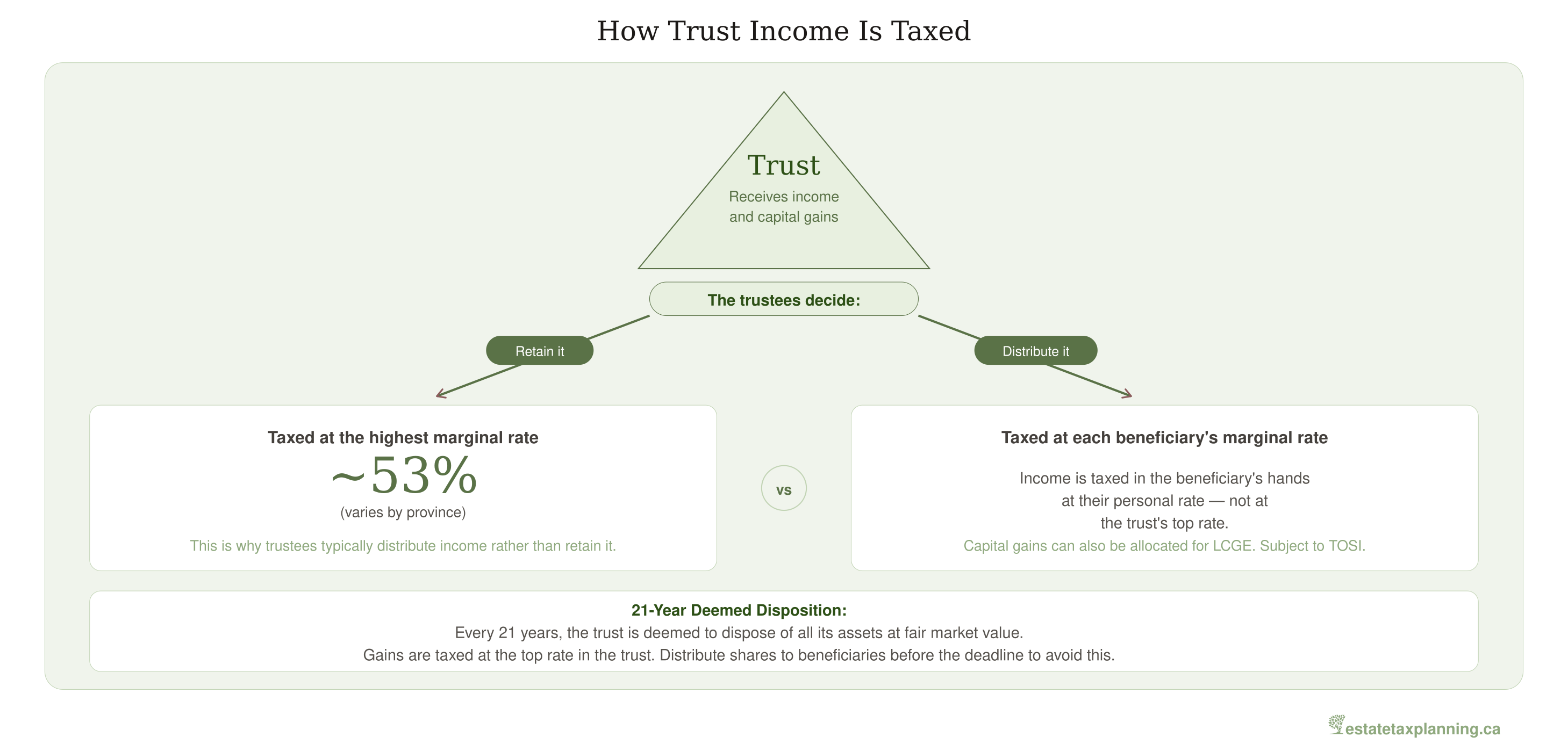
Income can be allocated to beneficiaries. This is the core tax planning feature of trusts. If the trustee distributes income to beneficiaries (or "makes it payable" to them) during the year, that income is taxed in the beneficiaries' hands, not in the trust. Since beneficiaries may be in lower tax brackets, this can significantly reduce the family's overall tax bill. However, the Tax on Split Income (TOSI) rules can override this benefit.
Retained income is taxed at the top rate. Any income not distributed to beneficiaries and retained in the trust is taxed at the highest marginal tax rate — approximately 53.53% in Ontario (varying by province). This makes it generally undesirable to accumulate income inside an inter vivos trust.
A common misconception is that testamentary trusts still enjoy graduated rates. Since 2016, only a graduated rate estate (GRE) — the estate of a deceased individual for the first 36 months after death — qualifies for graduated marginal rates. After the GRE period ends, or for any trust that does not qualify as a GRE, retained income is taxed at the top marginal rate. This change eliminated what had been a significant advantage of testamentary trusts and levelled the playing field between inter vivos and testamentary trusts for income retention purposes.
Capital gains can be allocated. Trustees can designate capital gains to be taxed in the hands of specific beneficiaries, which is particularly important for LCGE planning. If the trust sells QSBC shares, the trustees can allocate the resulting capital gains to individual beneficiaries who can then use their own LCGE — currently $1.275 million — to shelter those gains from tax.
The 21-year deemed disposition. Under subsection 104(4) of the ITA, a trust is deemed to have disposed of all its capital property at fair market value every 21 years. This prevents indefinite tax deferral and requires careful advance planning. If the trust holds shares in a private company, a formal valuation will be required to establish the fair market value at the deemed disposition date.
Enhanced Trust Reporting Requirements
Starting in 2023, the federal government significantly expanded the reporting requirements for trusts. Most trusts are now required to file an annual T3 return with a Schedule 15 (Beneficial Ownership Information), disclosing details about the trust's settlor, trustees, beneficiaries, and anyone who has the ability to influence trustee decisions.
This enhanced reporting applies to most inter vivos and testamentary trusts, with limited exceptions. The reporting requirements are an important compliance consideration for anyone establishing or maintaining a trust as part of an estate freeze. Failure to file can result in significant penalties.
In practice, Schedule 15 requires current contact information and identification details — including date of birth, address, and jurisdiction of residence — for every settlor, trustee, beneficiary, and person with the ability to exert influence over trustee decisions. For trusts with a large or changing beneficiary class, gathering and maintaining this information annually can be a significant administrative burden. Trustees should build this data collection into their annual compliance process well before the March 31 filing deadline.
- Enhanced T3 reporting requires disclosure of settlors, trustees, beneficiaries, and those who can influence trustee decisions. This catches a lot of families off guard in the first year after a freeze.
- This applies to most inter vivos and testamentary trusts since 2023.
- Schedule 15 (Beneficial Ownership Information) must be filed annually.
- Failure to comply can result in significant penalties from the CRA. We calendar these deadlines as part of every freeze engagement.
- Bill C-15 (royal assent March 26, 2026) makes bare trust T3 filing mandatory for taxation years ending on or after December 31, 2026.
- A $50,000 exemption applies for trusts holding property below this threshold.
- Bare trusts used in estate freeze structures — including nominee arrangements for share registration — must now file annual T3 returns with Schedule 15.
- Penalties for non-filing can be significant. Ensure your advisor calendars all bare trust filing obligations.
Alter Ego and Joint Partner Trusts
Two specialized trust types deserve mention for estate freeze planning: the alter ego trust (available to individuals aged 65 or older) and the joint partner trust (available to couples where at least one partner is 65 or older). These trusts allow the settlor (and their spouse, in the case of a joint partner trust) to transfer assets into the trust on a tax-deferred rollover basis during their lifetime, while retaining the right to all income and capital during their lifetime.
The key advantage is probate avoidance: assets held in an alter ego or joint partner trust do not form part of the estate at death, which means they are not subject to probate fees. In Ontario, where probate fees are approximately 1.5% of estate value, this can produce significant savings on large estates. The deemed disposition is deferred until the death of the settlor (or the last surviving spouse in a joint partner trust), similar to the spousal rollover rules.
- The settlor must be 65 or older at the time the trust is created.
- The trust cannot benefit anyone other than the settlor (or the settlor and their spouse) during their lifetime — no discretionary distributions to children or grandchildren.
- The 21-year deemed disposition rule applies, which can create a tax liability if the trust holds appreciated assets for more than 21 years after creation.
- These trusts do not provide the income-splitting or LCGE multiplication benefits that a standard discretionary family trust offers — they serve a different purpose.
We cover alter ego and joint partner trusts in more detail — including provincial variations in probate treatment and the interaction with multiple wills — in Provincial Nuances: How Your Province Shapes the Freeze .
Why Trusts Matter for Estate Freeze Planning
Now that you understand how trusts work, you can see why they're such a natural fit for estate freezes:
Flexibility. A discretionary trust lets you freeze now and decide later who benefits from the growth — ideal when children are young or the future is uncertain.
Tax efficiency. The ability to allocate income and capital gains to beneficiaries in lower brackets (subject to TOSI) can significantly reduce the family's overall tax bill.
LCGE multiplication. Allocating capital gains to individual beneficiaries lets each person use their own $1.275 million exemption.
Creditor protection. Assets held in a trust are generally not accessible to the personal creditors of individual beneficiaries.
Control. The business owner can serve as a trustee, maintaining influence over the trust property without personally owning it.
- Tax advisory — structuring the trust, managing annual T3 compliance, and coordinating income allocation and LCGE planning.
- Legal counsel — drafting a trust deed with the flexibility to handle corporate reorganizations, 21-year planning, and changes in beneficiary circumstances.
- Business valuation — establishing the fair market value that anchors the freeze and supporting any future refreezes or deemed dispositions.
- We coordinate all three disciplines through one engagement, so nothing falls through the cracks between advisors.
What’s Next
Now that you understand how trusts work in Canada, the next step is understanding the specific role they play in an estate freeze. In The Role of the Family Trust in an Estate Freeze , we explore how the family trust holds growth shares, distributes income, and provides the flexibility that makes the freeze structure work over time.
Trusts are one of those structures that look complicated on paper but work intuitively in practice: you’re setting aside assets for your family’s benefit, with rules about who manages them and who benefits. The compliance and tax obligations are real, but they’re manageable with the right team. Understanding how trusts work is the foundation for everything that follows in the estate freeze series.
For definitions of the key terms used in this article — including inter vivos trust, testamentary trust, settlor, trustee, beneficiary, deemed disposition, and alter ego trust — see our Key Terms and Definitions reference guide.
This article is for informational purposes only and does not constitute legal, tax, or financial advice. Estate freezes are complex transactions that require the coordinated involvement of qualified tax, valuation, and legal professionals. Always consult your advisors before acting on any of the information discussed here.