
An estate freeze is a corporate reorganization that locks in today’s value in your hands and routes all future growth to the next generation — on a fully tax-deferred basis. The mechanics are straightforward once you see the four steps.
Understanding how an estate freeze works is simpler than it sounds. At its core, it's a corporate reorganization — a restructuring of who holds what type of shares. The business itself doesn't change. Only the ownership structure does. Once you see the four steps, the mechanics click into place.
This guide walks through the process step by step, compares the two most common methods under the Income Tax Act, and illustrates how it works with a practical example.
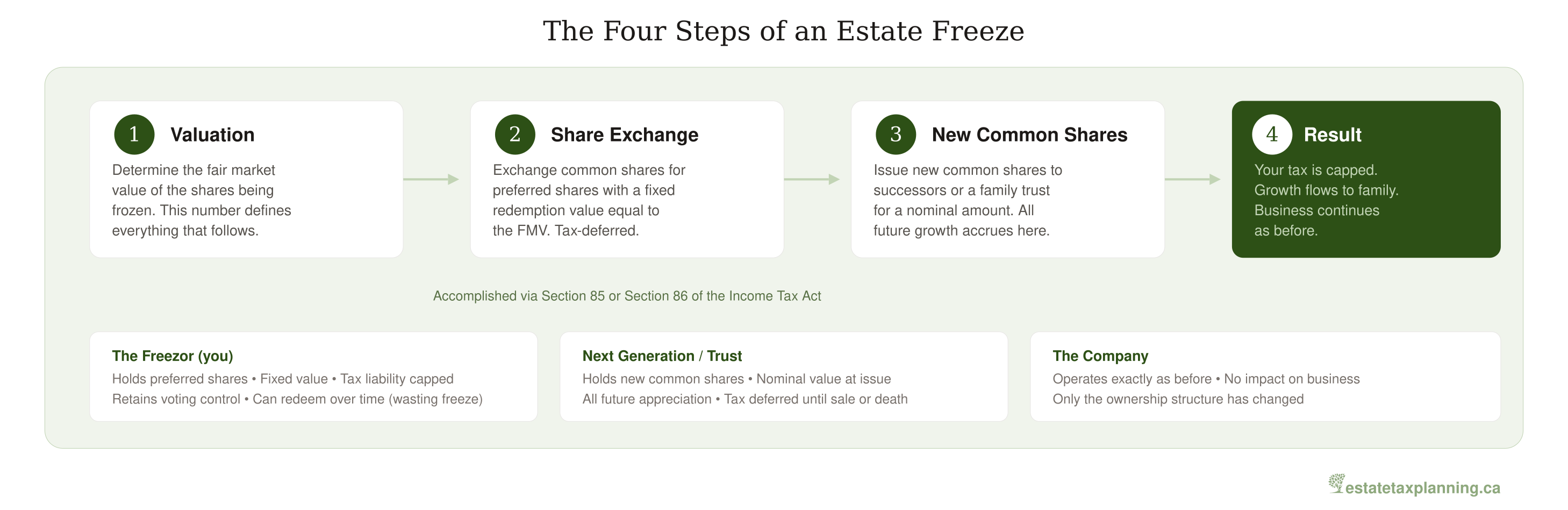
The Four Steps of an Estate Freeze
Step 1: Get a Professional Valuation
Every estate freeze begins with a valuation. You need to determine the current fair market value (FMV) of the shares being frozen. This number defines the redemption value of your new preferred shares, your tax liability at death, and the starting point for the next generation's growth.
Getting the valuation right is critical. If the CRA later determines you undervalued the shares, you may be deemed to have realized a capital gain at the time of the freeze. If you overvalued them, you could be assessed a taxable benefit. Most advisors recommend engaging a Chartered Business Valuator (CBV) to prepare a formal valuation report.
Step 2: Exchange Your Common Shares for Preferred Shares
You exchange your existing common shares for a new class of preferred shares with a fixed redemption value equal to the FMV determined in Step 1. The preferred shares are typically designed to be retractable (redeemable at your option), redeemable (redeemable at the corporation's option), and may carry voting rights and dividend entitlements.
This exchange is accomplished on a tax-deferred basis using rollover provisions in the Income Tax Act — either Section 85 or Section 86, which we compare below.
An important detail: the paid-up capital (PUC) of the new preferred shares is typically set at a nominal amount — often equal to the PUC of the old common shares that were exchanged, which may be as little as $1 or $100. This is true even though the redemption value of the preferred shares may be $3 million or more. PUC matters because it determines the tax consequences when the shares are eventually redeemed: the excess of the redemption amount over PUC is treated as a deemed dividend under subsection 84(3). This is a key concept for post-mortem planning and the wasting freeze strategy, both covered in detail later in the series.
- Redemption value: $3 million (what the shares can be redeemed for)
- Paid-up capital (PUC): Often as little as $1 or $100
- The gap: When shares are redeemed, the excess of redemption value over PUC is taxed as a deemed dividend under subsection 84(3) — not as a capital gain
- This distinction affects post-mortem tax planning and the wasting freeze strategy, both covered later in the series
Step 3: Issue New Common Shares to the Next Generation
With all the company's current value now captured in your preferred shares, new common shares are issued to your successors — or more commonly, to a family trust — for a nominal amount (often as little as $100). From this point forward, any increase in the company's value will be reflected in these new common shares, not in yours.
Step 4: The Result
You hold preferred shares with a fixed value. Your tax liability at death is capped at this amount. You retain voting control and can gradually redeem the shares to fund retirement (the "wasting freeze").
Your successors (or trust) hold common shares issued for nominal value. All future growth accrues to them. Tax on that growth is deferred until they sell or dispose of the shares.
The company continues to operate exactly as before. The freeze is purely a reorganization of the ownership structure — it has no impact on day-to-day operations, employees, customers, or contracts.
- If the new common shares are held by a family trust, the Income Tax Act deems the trust to dispose of all its capital property every 21 years at fair market value (subsection 104(4)). This creates a taxable event that must be planned for from the outset — typically by distributing shares to beneficiaries before the deadline.
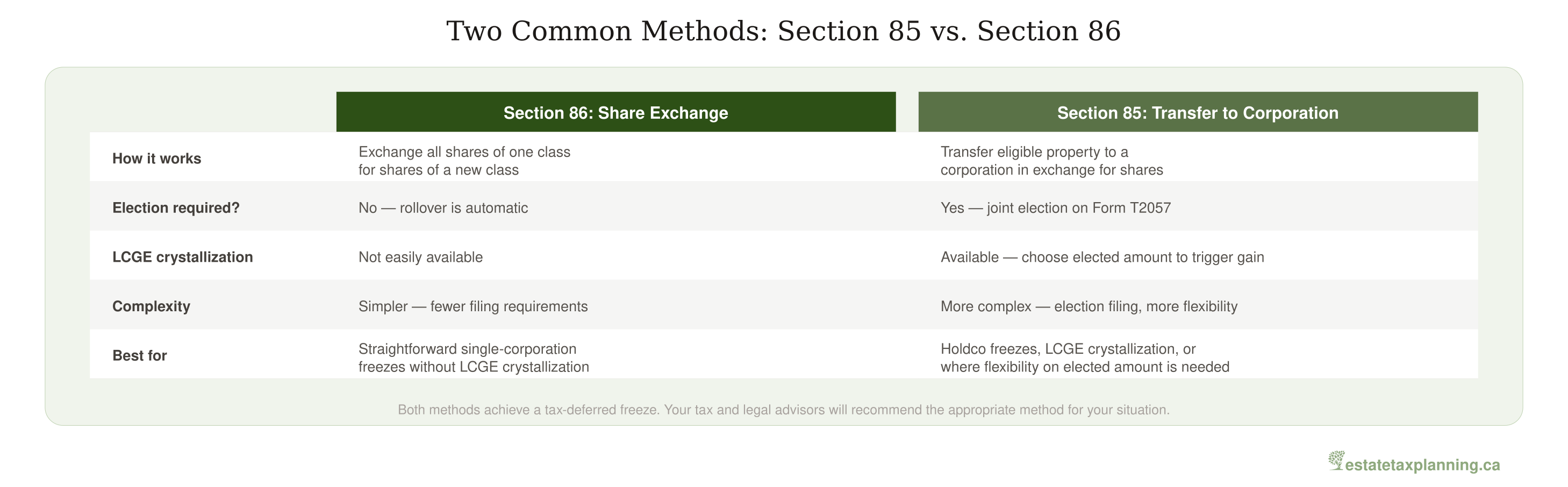
Two Common Methods: Section 85 vs. Section 86
The share exchange in Step 2 can be accomplished under two different provisions of the Income Tax Act. Both achieve a tax-deferred freeze, but they work differently and suit different situations.
- Section 86 is the simpler of the two — it’s an internal share exchange within the same corporation, no election filing required. We use it when the corporate structure is straightforward and we don’t need the flexibility of Section 85. The trade-off is that it doesn’t easily accommodate LCGE crystallization.
- Section 85 requires a joint election (Form T2057) specifying an “elected amount,” which gives us the flexibility to trigger a specific capital gain and crystallize the LCGE. It’s our go-to for holding company structures and any freeze where LCGE planning is part of the strategy.
- Section 51 (Conversion Right): A less common third method that applies where the articles of incorporation already provide for a share conversion right. We don’t see this one often, but it suits specific circumstances.
Section 51: The Third Option
There is a less common third method. Section 51 applies where the corporation’s articles of incorporation already include a conversion right — a provision allowing one class of shares to be exchanged for another at the holder’s option. When this provision exists, the exchange happens automatically under the articles, with no need for a formal rollover election or shareholder resolution.
We don’t see Section 51 freezes often in practice, because most private companies don’t include conversion rights in their articles. But when the right is already built in, it’s the simplest path — no T2057 election, no corporate resolution, and the same tax-deferred result. If your articles don’t already include conversion rights and you want the simplicity of Section 51, the articles can be amended before the freeze, though at that point most advisors default to Section 86 instead.
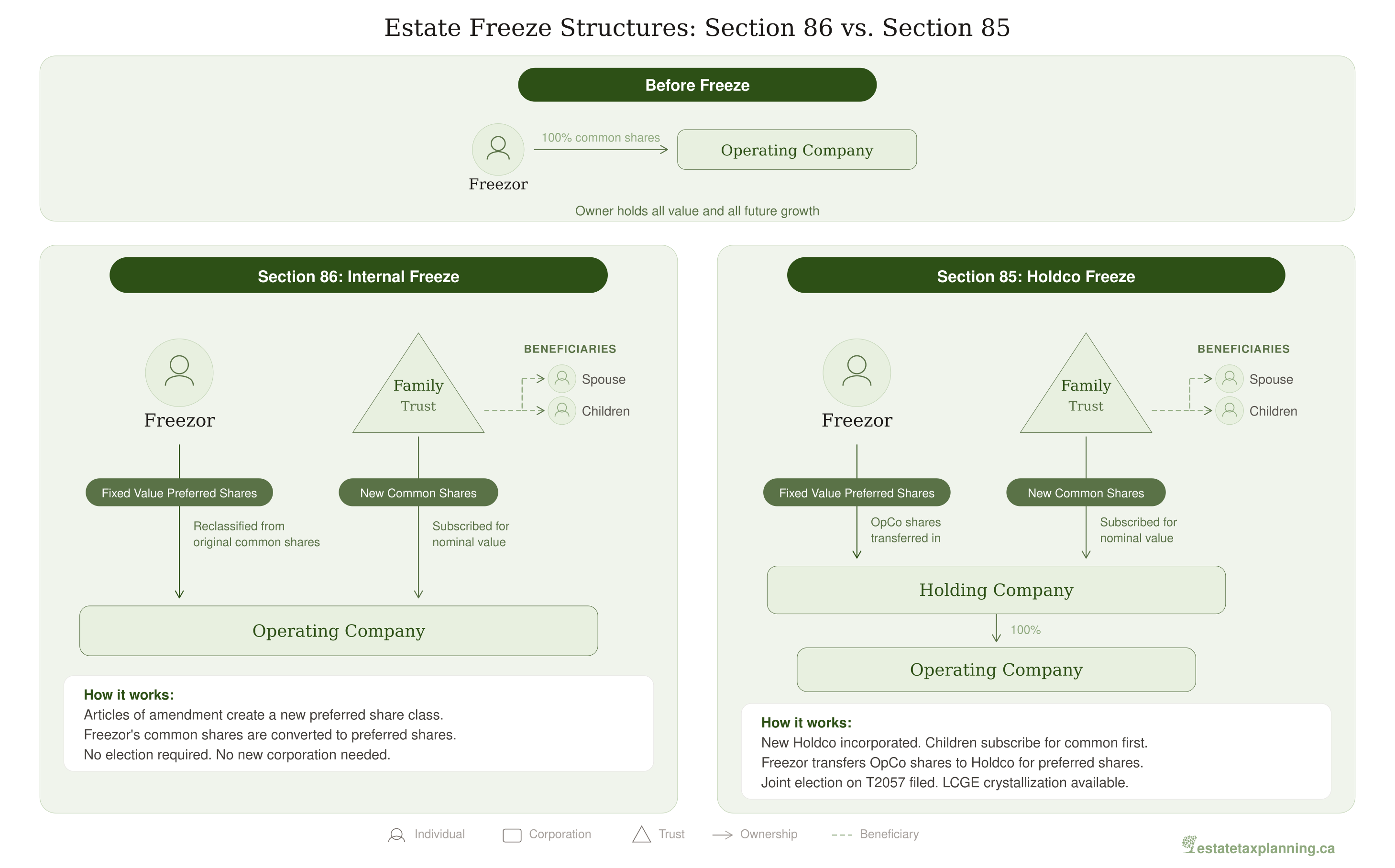
The following diagram illustrates what each post-freeze structure looks like in practice — the Section 86 internal freeze on the left, and the Section 85 holdco freeze on the right.
A Practical Example
Sarah is 58 and owns 100% of the common shares of a manufacturing company worth $3 million. She has two adult children, Emma and James, who both work in the business, and enough personal savings for retirement.
- Valuation: A CBV determines the FMV of Sarah's shares at $3 million.
- Share exchange: Sarah exchanges her common shares for voting, redeemable preferred shares worth $3 million (Section 86, tax-deferred).
- New common shares: A family trust is established with Emma and James as beneficiaries. The trust subscribes for new common shares for $100. As trustee, Sarah retains influence over how and when the shares are eventually distributed to Emma and James.
- Result: If the company grows to $8 million in 10 years, the $5 million of growth belongs to the trust (and ultimately to Emma and James) — not Sarah's estate.
- Ongoing: Sarah gradually redeems preferred shares to fund retirement (the "wasting freeze"), further reducing her estate.
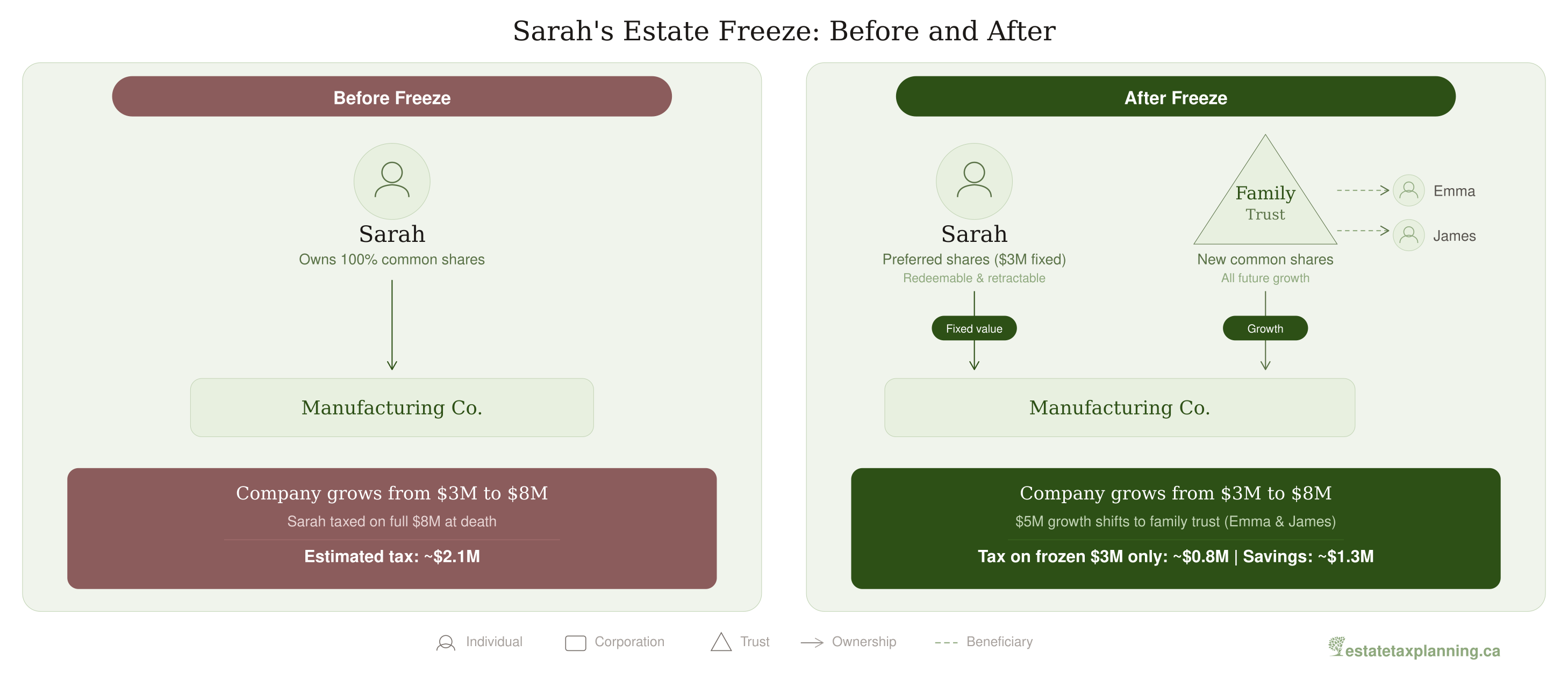
Assuming a nominal adjusted cost base, the math works like this: $5 million in growth, at the 50% capital gains inclusion rate, produces a $2.5 million taxable gain. At Ontario's top combined marginal rate of approximately 53.53%, that's roughly $1.3 million in tax that Sarah's estate avoids by having the growth in the family trust rather than in her own hands. The freeze doesn't eliminate tax — it redirects future growth so that tax is deferred and, with proper planning, shared among multiple beneficiaries at lower effective rates.
There is an additional advantage: when the trust eventually distributes shares to Emma and James, each of them may be able to claim the Lifetime Capital Gains Exemption (LCGE) — currently $1,275,000 per individual for qualifying small business corporation shares — to shelter some or all of their gain from tax. Without the freeze, that exemption would have been available only to Sarah.
What Can Go Wrong?
Estate freezes are powerful, but they involve technical complexity. Here are the most common pitfalls:
- Incorrect valuation: CRA disagreements on valuation can trigger unexpected tax in both directions — too low results in a deemed capital gain, too high results in a taxable benefit. A formal CBV report and a price adjustment clause are your best protection.
- Incomplete documentation: We’ve seen freezes where the share certificates were never issued or the Section 85 election was filed late. Corporate resolutions, share certificates, amended articles, trust deeds, and Form T2057 must all be properly prepared and filed.
- Ignoring TOSI rules: The Tax on Split Income rules under section 120.4 can eliminate the benefit of income splitting if family members aren't actively involved in the business or don't meet the excluded share or excluded business tests.
- Failing to update your estate plan: Wills, powers of attorney, and shareholder agreements must reflect the new ownership structure after the freeze.
- Not planning for the 21-year rule: If a family trust holds the growth shares, the Income Tax Act deems the trust to dispose of its assets every 21 years. This deadline must be planned for from the outset.
- Section 84.1 on share redemptions: This anti-avoidance rule can affect how preferred share redemptions are taxed during a wasting freeze, potentially converting what would otherwise be a capital gain into a deemed dividend. Proper planning with your tax advisor is essential to navigate this rule.
- If the freeze benefits a spouse or minor child, the attribution rules under subsection 74.4(2) may deem interest income back to the freezor. This rule generally does not apply if 90% or more of the corporation's assets are used in an active business in Canada — but if the company holds significant passive investments, careful structuring is required to avoid this trap.
What’s Next?
Now that you understand the mechanics, the next decision is how to structure the freeze. In Choosing Your Freeze Structure , we compare the three main approaches — transferring shares directly to family members, using a holding company, or establishing a family trust — and explain when each one makes sense.
The mechanics of an estate freeze are well established — thousands of Canadian businesses go through this process every year. The difference between a smooth freeze and a costly one comes down to getting the details right: a proper valuation, the right rollover method for your situation, and a clear plan for what happens next. If you’ve read this far, you already understand the structure better than most business owners who walk into our office for the first time.
For definitions of the key terms used in this article — including Section 85 rollover, Section 86 rollover, Section 51, preferred shares, common shares, fair market value, family trust, LCGE, and TOSI — see our Key Terms and Definitions reference guide.
This article is for informational purposes only and does not constitute legal, tax, or financial advice. Estate freezes are complex transactions that require the coordinated involvement of qualified tax, valuation, and legal professionals. Always consult your advisors before acting on any of the information discussed here.