
The right freeze structure depends on your family, your succession timeline, and how much flexibility you need. A direct transfer is simplest; a family trust with a holding company delivers the most tax savings — but also costs the most to maintain. Choose the one that fits where your family is today, not just where the tax math looks best.
An estate freeze restructures your corporate ownership to cap your tax liability at today's value and shift future growth to the next generation. But the freeze itself is only half the decision — the other half is how to structure it.
The mechanics remain the same regardless of the structure: you exchange common shares for preferred shares, and new common shares are issued to the next generation. As discussed in How an Estate Freeze Actually Works, the share exchange is typically implemented using a Section 85 rollover or a Section 86 reorganization. A third method — Section 51 — applies where the corporation's articles already provide for a conversion right that allows common shares to be exchanged for a new class of preferred shares. Section 51 is less commonly used but can be the simplest route when the articles are properly drafted, as it requires no election filing. What changes across the four structures below is who receives the new common shares and what entities sit between the business owner and the operating company.
The four structures below range from the simplest — shares issued directly to family members — to the most sophisticated, where a family trust holds the growth shares and a holding company sits as one of the trust’s beneficiaries. The sections that follow walk through them one at a time: what each looks like, what it costs to run, and when it fits — and then compare them side-by-side in the "How Do You Choose?" section so you can see how the decision plays out in real dollars.
Variations on the freeze mechanism itself — the "gel" (where the freezor remains a discretionary beneficiary of the trust holding the new common shares) and the "partial freeze" (where the freezor retains some growth shares directly) — are a separate topic, covered in Freeze, Gel, Thaw, and Wasting Freeze. This article focuses on the structural choice — who sits where in the ownership chain — that applies regardless of which freeze variation you use.
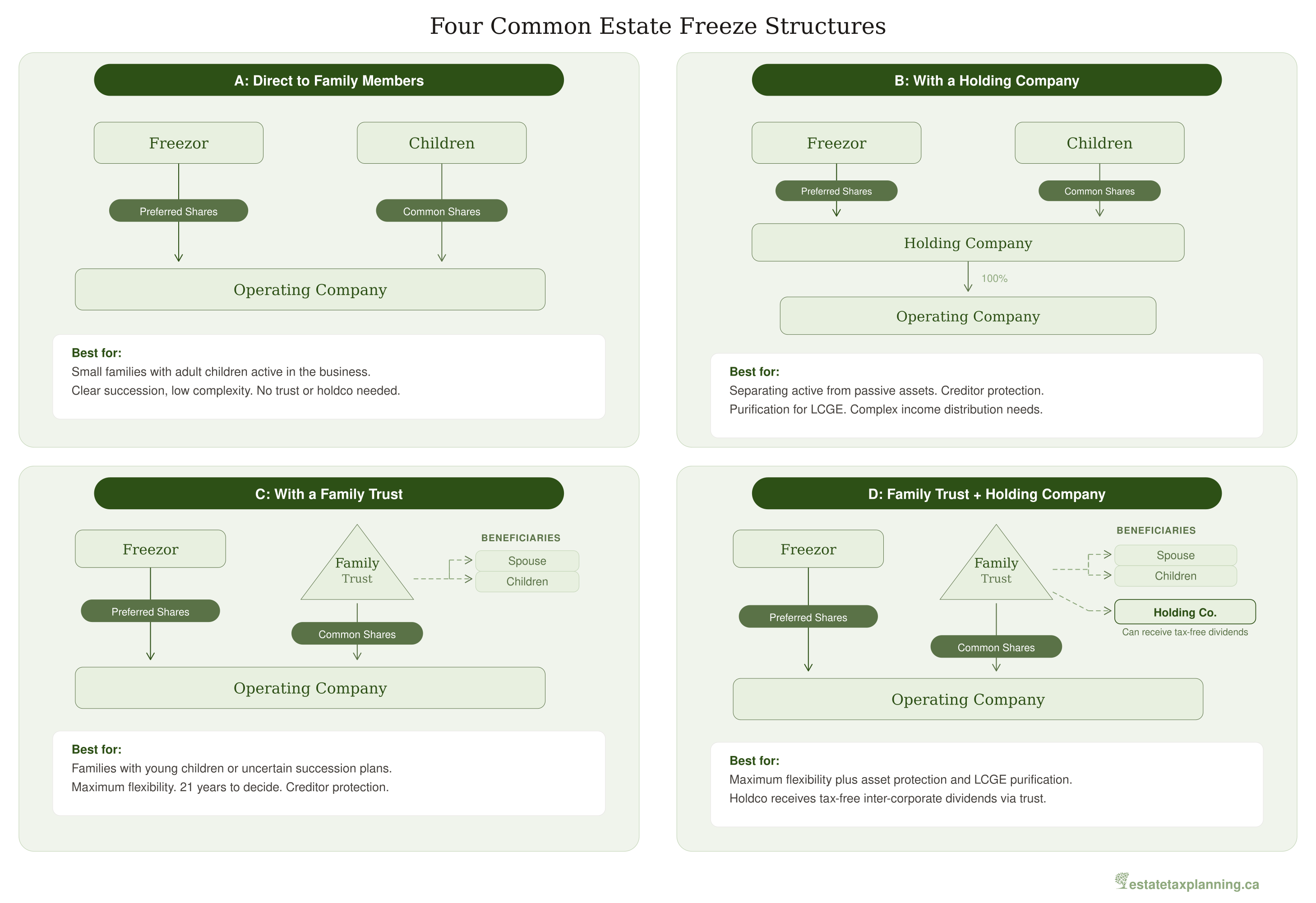
Structure A: Direct to Family Members
This is the most straightforward approach. The freezor exchanges common shares for preferred shares, and new common shares are issued directly to one or more family members — typically adult children who are already involved in the business.
The main appeal is simplicity. There are no trust deeds to draft, no annual trust filings, and no holding company to administer, which makes Structure A the least expensive of the four to implement and maintain. Direct ownership also creates a potential TOSI advantage: shares held by a family member who owns at least 10% of the votes and value may qualify as "excluded shares" under section 120.4, making it easier to pay dividends to that family member without triggering the top marginal tax rate.
The trade-off is a lack of flexibility. Once the common shares are issued, they belong to the named recipients. Direct ownership also exposes the shares to creditor claims — including in the event of a child's marital breakdown — and the decision about who receives shares has to be made at the time of the freeze, not later as circumstances evolve.
- Best for: Owners with a settled succession plan and adult children already active in the business.
- Watch for: Creditor and marital exposure on the direct recipient; no ability to redirect ownership later.
- Cost: Lowest — no trust or holding company to maintain.
Structure B: With a Holding Company
In this structure, the freezor and family members hold shares in a holding company, which in turn owns 100% of the operating company.
The main reason to add a holdco is asset protection. Passive assets — cash, marketable securities, real estate, and other non-active investments — can be moved from the operating company to the holdco through tax-free inter-corporate dividends, shielding them from the operating company's creditors. That same movement helps "purify" the operating company so its shares continue to qualify as qualified small business corporation (QSBC) shares, preserving the family's access to the lifetime capital gains exemption at the shareholder level. The holdco itself cannot claim the LCGE — only individuals can — but it creates the space for individual shareholders to do so.
The cost is more structure to maintain and more rules to watch. Inter-corporate dividend rules under subsection 55(2) have become significantly more complex in recent years, and a qualified tax advisor is needed to make sure dividends are not recharacterized as capital gains. Passive investment income accumulated in the holdco may also reduce the operating company's access to the small business deduction if the two corporations are associated.
- Best for: Owners with significant passive assets inside the operating company who want creditor protection and LCGE-eligible (QSBC) shares.
- Watch for: Subsection 55(2) recharacterization risk; passive-income clawback of the small business deduction.
- Cost: Moderate — extra corporate layer plus annual filings and inter-corporate planning.
Structure C: With a Family Trust
Instead of issuing common shares directly to family members, the new common shares are issued to a discretionary inter-vivos family trust. The trust holds the shares on behalf of a group of beneficiaries — typically the freezor's spouse, children, and sometimes grandchildren.
A trust's defining advantage is flexibility over time. The trustees — who may include the freezor — decide which beneficiaries receive income and capital, and they have up to 21 years to make those calls. Before a future sale, the trust can distribute shares to individual beneficiaries so that each one can claim their own lifetime capital gains exemption, potentially multiplying the LCGE across three, four, or more beneficiaries. Trust-held shares are also generally shielded from beneficiaries' personal creditors.
The cost of that flexibility is complexity. The 21-year deemed disposition rule (subsection 104(4)) forces proactive planning before the trust's twenty-first birthday; otherwise the trust is treated as having sold all its capital property at fair market value. Trust-held shares may not qualify as "excluded shares" under TOSI (section 120.4), which can restrict the ability to split income with family members who are not active in the business. Setup and ongoing compliance costs are higher than either Structure A or Structure B.
Attribution traps to watch for
Two rules can undo the tax benefit of a trust-based freeze if the trust is not carefully drafted.
Subsection 75(2) applies where the settlor retains a reversionary interest or excessive control over the trust property — for example, the power to direct how assets are distributed or to unilaterally revoke the trust. If it applies, all trust income is attributed back to the settlor and taxed in their hands, which can negate the entire freeze. A properly drafted trust deed ensures the settlor does not keep that kind of control.
Subsection 74.4(2) applies when an individual transfers property to a corporation and a spouse or minor benefits from the transfer — a pattern that can arise in a freeze where value moves into a corporation and a spouse or minor is a beneficiary of the family trust that holds the growth shares. CRA can deem a notional interest income amount calculated using the prescribed rate. Ensuring the transfer is at fair market value and structuring the beneficiary class carefully are the main protections.
- Best for: Owners with young children or an unsettled succession plan who want flexibility and the ability to multiply the LCGE across beneficiaries.
- Watch for: The 21-year rule; TOSI limits on dividends to non-active family; the s.75(2) and s.74.4(2) attribution traps above.
- Professional corporations: Several regulated professions — including medicine, dentistry, law, and accounting — restrict who may hold professional corporation shares, and the rules vary by province and by governing body. Some permit a family trust only if every beneficiary is a member of the same profession, others prohibit trust ownership outright, and others allow family-member ownership with restrictions. Confirm the specific rules with your governing body before proceeding.
- Cost: Higher — trust setup, annual T3 filings, legal review, and 21-year planning.
Structure D: Family Trust with Holding Company as Beneficiary
The key innovation is that the holding company is named as one of the beneficiaries of the family trust — alongside the spouse and children. This allows the trust to flow inter-corporate dividends from the operating company to the holding company on a tax-free basis, keeping passive assets out of the operating company.
Structure D stitches Structures B and C together. The trust holds the growth shares, preserving flexibility and the ability to multiply the LCGE. The holdco, as a named beneficiary, can receive dividends from the operating company — routed through the trust — on a tax-free inter-corporate basis, pulling passive assets out of the operating company and keeping it purified for QSBC treatment. Every TOSI, attribution, and 21-year rule consideration that applies to Structure C applies here, and passive income accumulated in the holdco can still affect the operating company's access to the small business deduction if the two are associated. Implementation and ongoing maintenance require careful coordination between tax, legal, and valuation professionals, and the structure is the most expensive of the four to set up and run.
- Best for: Owners who want both maximum flexibility and strong asset protection, and who can absorb the cost of running a holdco and a family trust together.
- Watch for: Everything in Structure C plus the small-business-deduction clawback on passive income held in the holdco.
- Cost: Highest — trust, holdco, and the coordination between them.
- For Structures B and D, passive investment income accumulated in the holding company can reduce or eliminate the operating company's access to the small business deduction if the two corporations are associated. Under the current rules, the business limit is reduced by $5 for every $1 of investment income above $50,000 — meaning the deduction is fully clawed back at $150,000 of passive income. This interaction should be modelled before choosing a holdco structure.
How Do You Choose?
To see how the choice plays out in practice, consider a business owner whose operating company is worth $5 million — of which $1 million sits in passive investments (cash, marketable securities, and rental income) and the remaining $4 million is the active business. The freeze captures the full $5 million in preferred shares at today's value, regardless of which structure is used.
The tax on the preferred shares themselves is identical across all four structures. At death, the preferred shares produce a capital gain of roughly $5 million (assuming nominal adjusted cost base on issuance), a taxable capital gain of $2.5 million at the 50% inclusion rate, and — at Ontario's top combined rate of approximately 53.53% — around $1.34 million of tax if no lifetime capital gains exemption is available at that point. That number does not change with structure. Structure changes two other things: who can claim the lifetime capital gains exemption, and whether passive assets are insulated from the operating company's creditors.
Structures A and B hold the growth shares at the shareholder level, so only the freezor can use the LCGE — $1,275,000 in 2026. Structures C and D issue the growth shares to a family trust, which can distribute them to individual beneficiaries before a future sale so each beneficiary claims their own LCGE. Across three adult beneficiaries that is up to $3.825 million of tax-free capital gains — enough to shelter most or all of the $5 million of growth on a future sale.
Structures B and D add a holding company that receives passive assets through tax-free inter-corporate dividends, pulling them out of the operating company, shielding them from business creditors, and keeping the operating company "purified" (100% active business assets, strengthening its QSBC status). Structures A and C leave those passive assets inside the operating company, exposed.
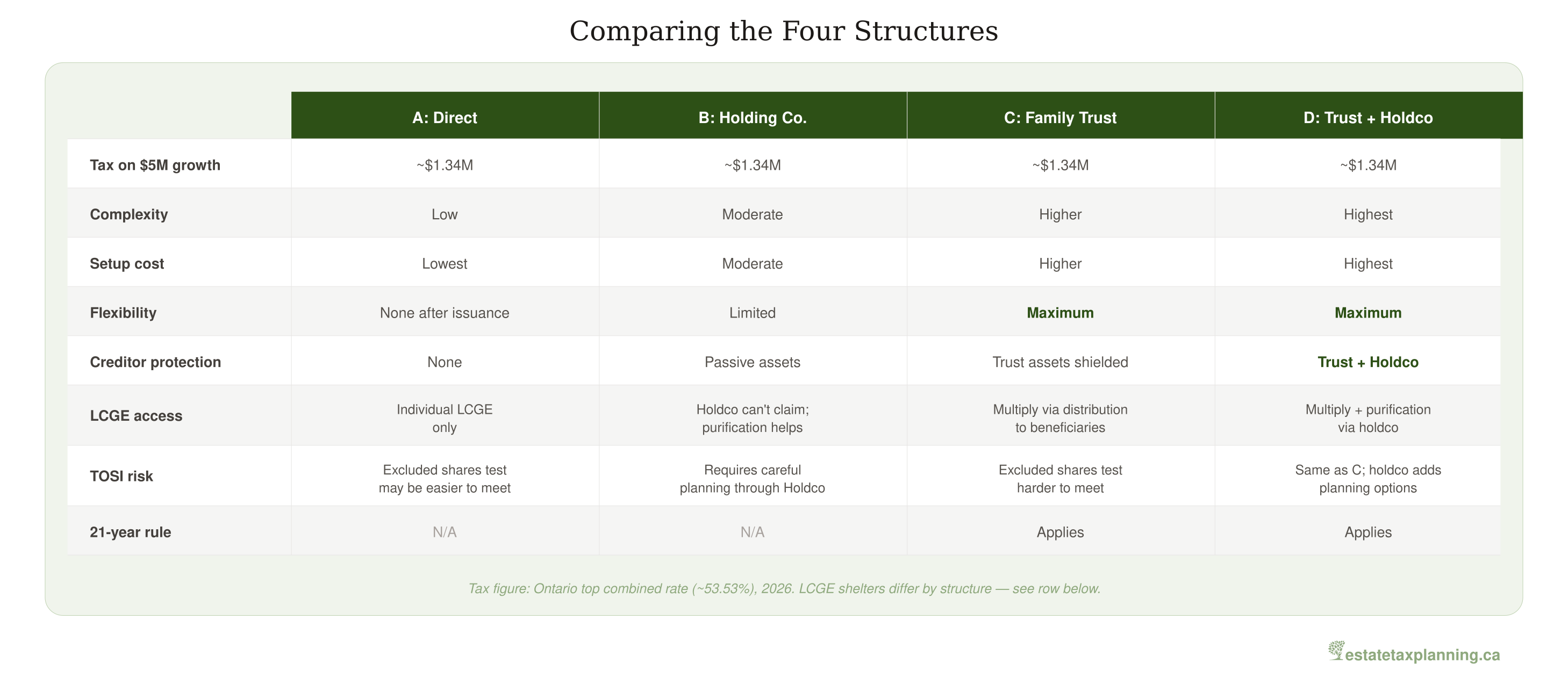
The example simplifies a number of variables — including the deemed dividend on preferred-share redemption, the interaction between capital gains and dividends in post-mortem planning, and the cost of maintaining more complex structures over twenty-plus years. Even so, the shape of the trade-off is consistent.
- Structure does not change the tax on the preferred shares themselves — roughly $1.34 million on this $5 million example.
- It does change LCGE access (up to ~$3.8 million of growth sheltered if multiplied across three beneficiaries) and whether passive assets are insulated from business creditors.
- Complexity rises in step with benefit: each layer (holdco, trust) adds filings, planning, and professional coordination costs.
- Structure A: A 60-year-old business owner with two adult children who both work in the company, clear succession plans, and a straightforward corporate structure. Simple, inexpensive, and effective.
- Structure B (holding company): The same owner with significant passive investments in the corporation — adding a holding company separates those assets and protects them from business creditors.
- Structure C (family trust): A 50-year-old with young children and no clear succession plan. The trust preserves flexibility for 21 years while the family situation clarifies.
- Structure D (trust + holdco): A business owner who wants maximum flexibility and asset protection. The trust provides flexibility while the holdco receives tax-free dividends and shelters passive assets.
Many business owners pair an estate freeze with corporate-owned life insurance to fund the tax liability on the frozen preferred shares. See Life Insurance and the Estate Freeze for how to size, own, and fund the policy.
Key Employee Succession: Freezes Beyond the Family
Estate freezes are not limited to family members. Many business owners want to involve key employees in the ownership of the business — to reward loyalty, incentivize performance, and plan for a transition where no family successor exists.
- A key-employee freeze depends on a defensible fair-market-value split between the new preferred shares and the new common shares. If the preferred shares are valued too low, residual FMV is trapped in the common shares issued to the employee — and the employee is exposed to a taxable benefit under subsection 15(1) or section 7 on the difference. A CBV-prepared valuation is not optional for this structure.
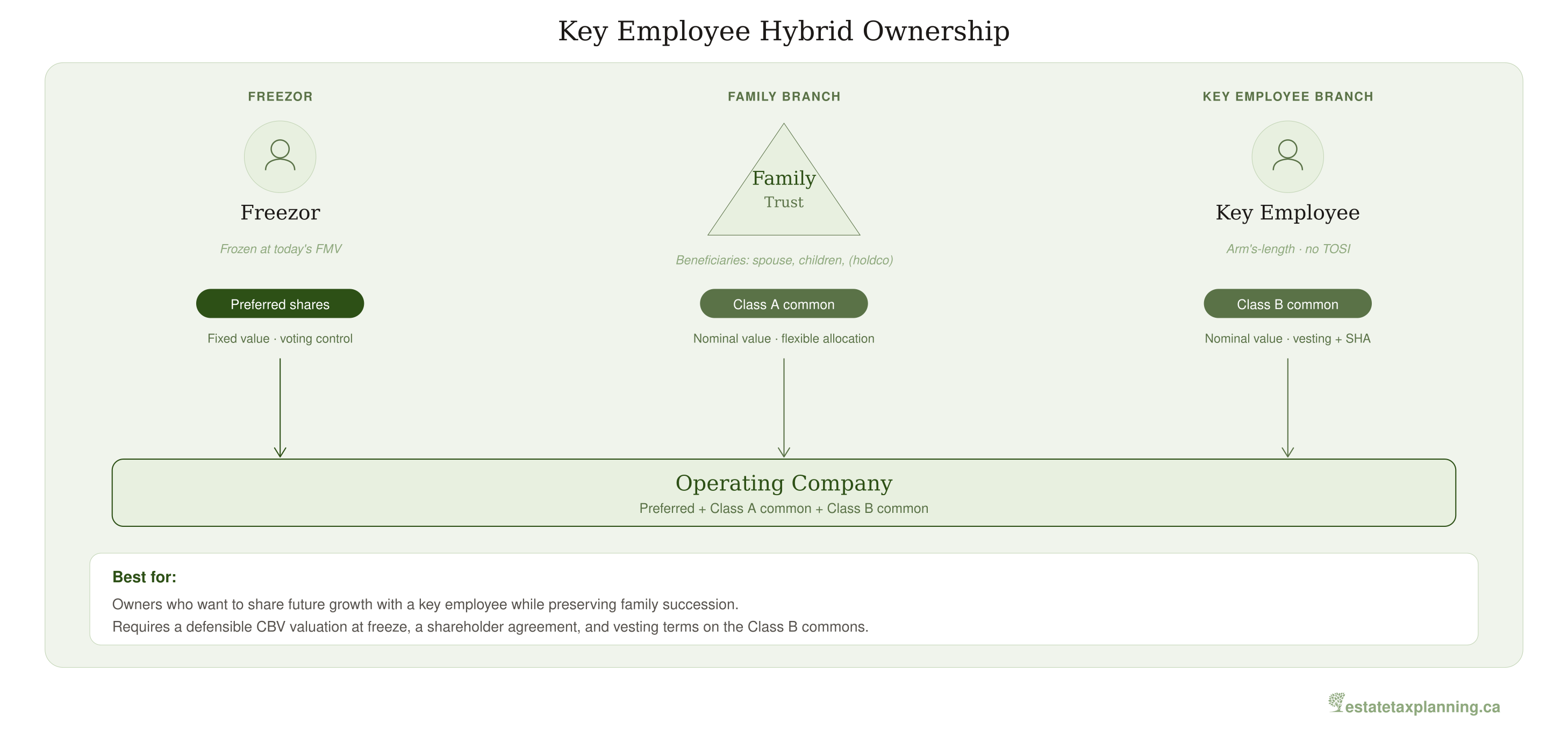
The mechanics are the same as a family freeze. The owner exchanges common shares for preferred shares, and new common shares are issued to the key employee for nominal value. The employee participates in the future growth of the business.
Because the employee is acquiring shares, the employee-benefit rules deserve careful attention. When shares are issued to an employee at below fair market value, the employee can be assessed a taxable employment benefit under subsection 15(1) or section 7 of the Income Tax Act. In a properly executed freeze the common shares have nominal FMV at issuance — all of the current value is captured in the preferred shares — so no benefit should arise. That conclusion is only as good as the underlying valuation.
One structural advantage over a family freeze is TOSI. Key employees who are not related to the business owner are generally not subject to the tax on split income under section 120.4, because TOSI targets "split income" flowing from a "source individual" — typically a related person. Arm's-length key employees have no such relationship, so their dividends and capital gains from the business are taxed normally, and the ownership structure can be simpler than for family members. What becomes critical instead is the shareholder agreement — it needs to address what happens when the employee leaves, including buyback provisions, vesting schedules, non-competition clauses, and the valuation method for shares on departure.
Many owners run a hybrid: growth shares issued to both family members (or a family trust) and key employees, using different classes of shares. That lets the owner tailor rights, restrictions, and economic participation for each group — for example, giving key employees a smaller percentage of growth with specific vesting conditions, while the family trust holds the majority of the growth shares with full flexibility.
What's Next
Structures C and D both rely on a family trust to hold the growth shares. But what exactly is a trust, and how does it work? In How Trusts Work in Canada, we step back from the estate freeze itself to give you a solid foundation in how trusts are created, governed, and taxed — essential knowledge for understanding any freeze structure that involves a trust.
If you’re unsure which structure fits, start the conversation with your advisor. The answer usually becomes clear once you map it against your family’s actual situation.
For definitions of the key terms used in this article — including family trust, holding company, gel structure, preferred shares, LCGE, TOSI, excluded shares, and inter-corporate dividends — see our Key Terms and Definitions reference guide.
This article is for informational purposes only and does not constitute legal, tax, or financial advice. Estate freezes are complex transactions that require the coordinated involvement of qualified tax, valuation, and legal professionals. Always consult your advisors before acting on any of the information discussed here.