
The valuation is the single number that determines your tax liability, your insurance needs, and whether the CRA will challenge your freeze. An independent CBV report with a price adjustment clause is the best protection you can buy.
The entire estate freeze rests on the fair market value (FMV) of the shares being frozen. Get the number right, and the freeze proceeds smoothly. Get it wrong, and you may face unexpected tax consequences that can be difficult and expensive to resolve.
In this article, we explain why valuation matters so much, what can go wrong in both directions, and the practical steps you can take to protect yourself and your family.
Why Valuation Is So Critical
When you implement an estate freeze, the FMV of your common shares becomes the redemption value of your new preferred shares. This single number determines three things:
- Your frozen tax liability — the higher the frozen value, the more tax you'll owe at death. The lower the frozen value, the more growth is shifted to the next generation.
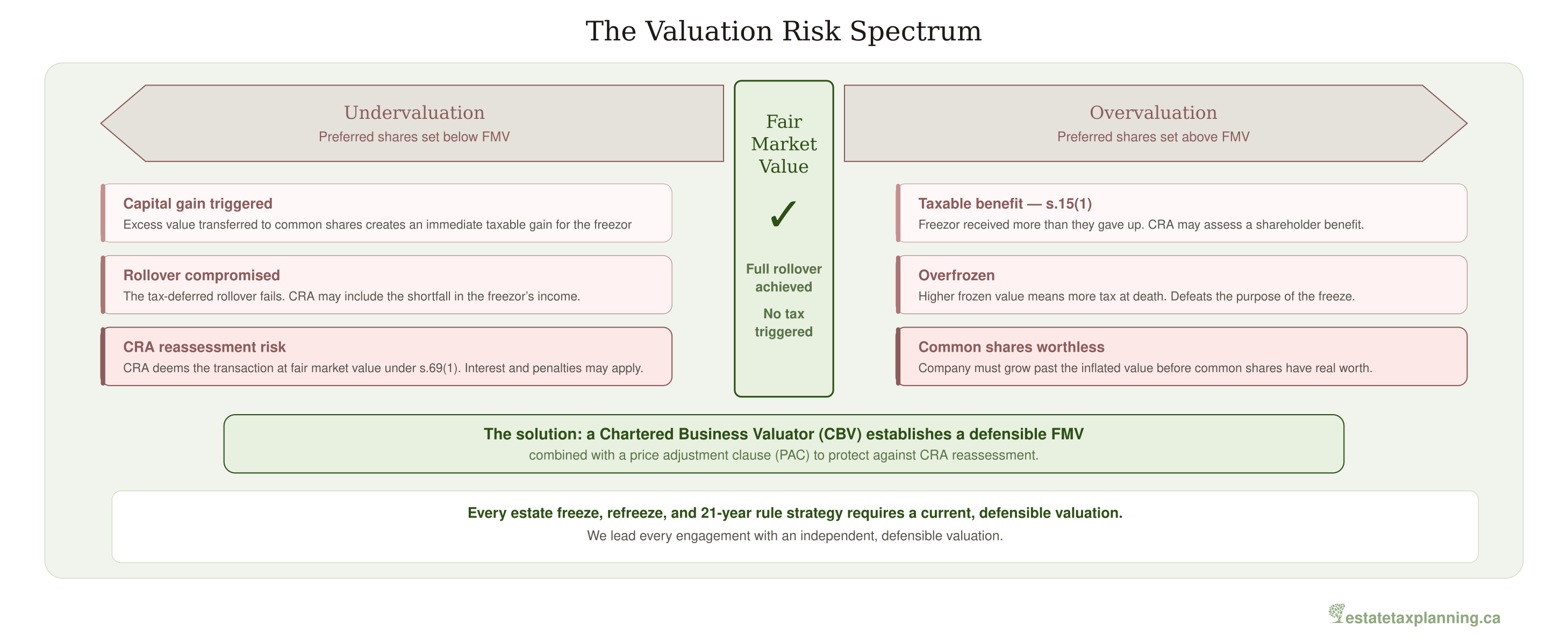
- The validity of the rollover — for the share exchange to qualify for a tax-deferred rollover under Section 85 or Section 86, the value of the preferred shares received must equal the FMV of the common shares given up. If there's a mismatch, the CRA can reassess under subsection 69(1) of the ITA (inadequate consideration).
- Whether a benefit has been conferred — if the preferred shares are set too high or too low relative to FMV, the CRA may argue that a benefit has been conferred under subsection 15(1) of the ITA on one of the parties, triggering additional tax.
What Can Go Wrong
Undervaluation
If the preferred shares are set below FMV, the new common shares effectively receive a "built-in" value at the time they're issued. The CRA may argue that the freezor has realized a capital gain on the excess value transferred to the common shareholders. Under Section 85, the elected amount may be bumped up, triggering unexpected tax. Under Section 86, the CRA may apply subsection 86(2), which deems the excess to be a capital gain in the freezor’s hands.
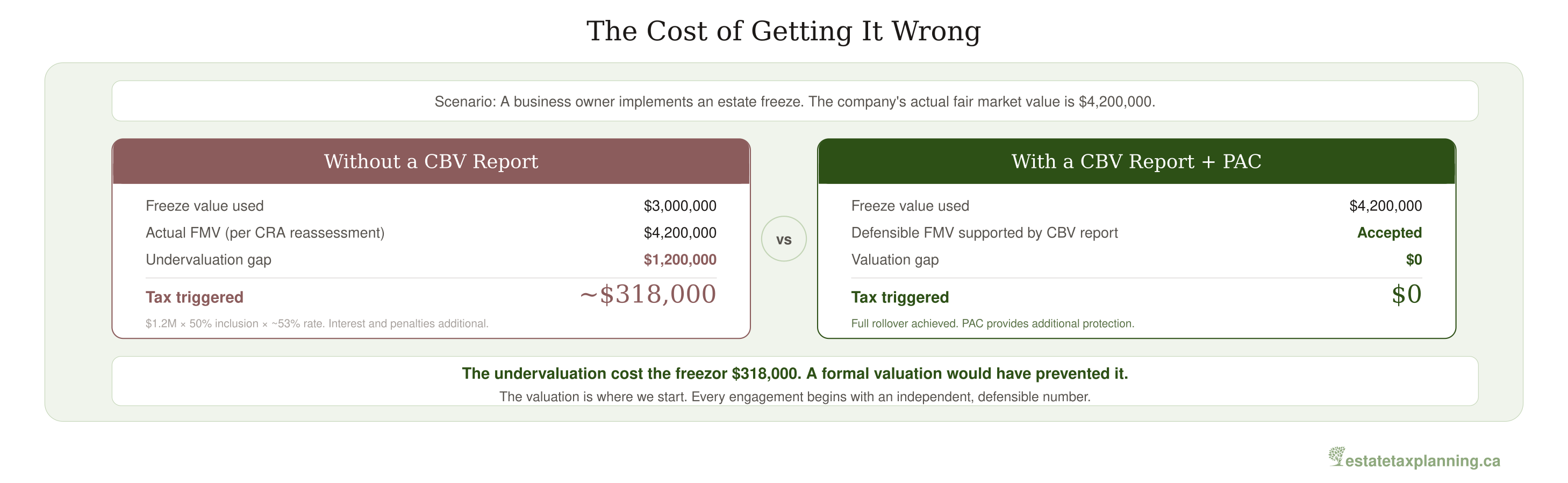
Consider a concrete example: A business is worth $3 million, but the freeze is implemented using a valuation of only $2.7 million. The $300,000 gap represents value transferred to the new common shareholders without compensation. The CRA may reassess the freezor for a capital gain on the $300,000 transfer. At a 50% inclusion rate and Ontario's top combined marginal rate of approximately 53.53%, the tax cost would be roughly $80,000 — just to correct the undervaluation.
Overvaluation
If the preferred shares are set above FMV, the freezor has received more than they gave up. The CRA may assess a taxable benefit under subsection 15(1). Additionally, the common shares may effectively have a negative economic value — the company would need to grow past the inflated preferred share value before the common shares have any real worth. This undermines the entire purpose of the freeze and can create years of frustration for the next generation.
Consider the reverse: a business is worth $3 million, but the freeze is implemented using a valuation of $3.5 million. The freezor's preferred shares now carry a redemption value $500,000 higher than the company's actual equity. The new common shares are economically underwater from day one — the company must grow past $3.5 million before those shares have any real value. If the CRA reassesses, the $500,000 excess may be treated as a benefit under subsection 15(1), taxable to the common shareholders. And even if the CRA doesn't reassess, the next generation may spend years waiting for growth that should already have been theirs.
- Undervaluation triggers CRA reassessment for capital gain to the freezor — roughly $80,000 in additional tax on a $300,000 miss. We’ve seen it happen.
- Overvaluation triggers a benefit assessment and undermines successor incentives — the next generation starts underwater.
- Both scenarios create permanent mismatches that are difficult to correct after the fact.
- An independent CBV valuation is the only practical defense. It’s also the first thing CRA asks for on review.
How to Protect Yourself
1. Engage a Chartered Business Valuator (CBV)
A CBV is a professional specifically trained and accredited to value businesses and business interests. Their valuation report carries significant weight with the CRA — far more than an estimate from the company's regular accountant. The scope of a formal valuation varies with the complexity of the business, but the investment in getting the number right is always justified by the risk of getting it wrong.
What a CBV does that your accountant doesn't: A CBV applies standardized valuation methodologies (income, market, and asset approaches), makes normalization adjustments to the company's financial statements (removing non-recurring items, adjusting owner compensation to market rates, restating related-party transactions), applies appropriate minority and marketability discounts, and produces a formal report that documents every assumption and conclusion. This level of rigour is what the CRA expects to see.
To illustrate one common normalization: if the business owner pays themselves $80,000 when a replacement manager would cost $180,000, the CBV adjusts earnings downward by $100,000 to reflect what the business would actually cost to operate under arm's-length management. This single adjustment can change the valuation by hundreds of thousands of dollars — and it's the kind of detail that makes business owners realize their gut sense of "what the business is worth" may be significantly off.
The estate freeze planning literature puts it clearly: valuation reports prepared by the freezor's usual accounting advisors tend to be more vulnerable to a CRA challenge than reports from an independent specialist. An independent CBV report is the gold standard.
2. The Three Valuation Approaches
| Approach | Method | Best For | Key Consideration |
|---|---|---|---|
| Income | Present value of future earning capacity | Profitable operating businesses | Requires normalized earnings and appropriate capitalization rate |
| Market | Comparable transaction multiples (revenue, EBITDA) | Businesses with reliable comparable data | Depends on availability of similar transactions |
| Asset | Net assets minus liabilities, restated to FMV | Holding companies, real estate, liquidation | Must reflect latent tax liabilities on unrealized gains |
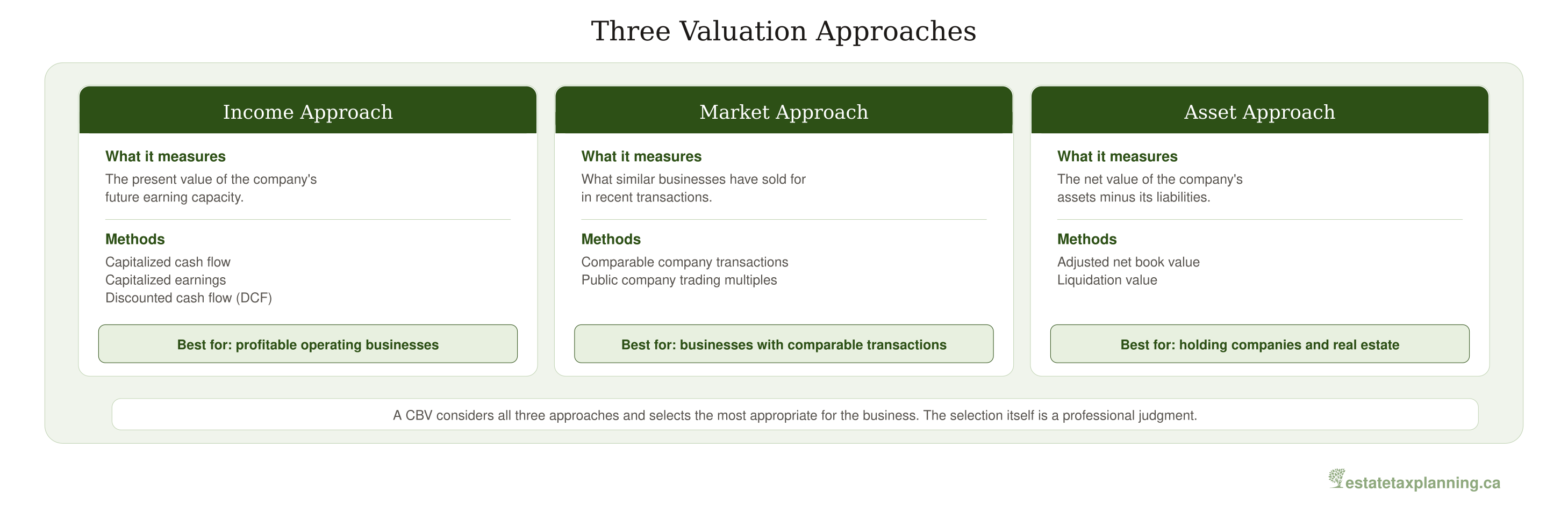
Under the income approach, the CBV normalizes the company's historical earnings — removing non-recurring items, adjusting owner compensation to market rates, restating related-party transactions — and then selects a capitalization rate based on the company's risk profile. The result is what a hypothetical buyer would pay for the earnings stream. Under the market approach, the CBV identifies comparable transactions in the same industry and derives multiples that can be applied to the subject company. Under the asset approach, each underlying asset is restated to fair market value and liabilities are deducted.
In practice, a CBV considers all three approaches and selects the most appropriate for the business. A profitable operating company might weight the income approach heavily, while a holding company might rely entirely on the asset approach. The selection and weighting of approaches is itself a professional judgment that requires CBV expertise.
3. Include a Price Adjustment Clause
A price adjustment clause (PAC) is a provision in the freeze documents that allows the parties to adjust the value of the preferred shares if the CRA subsequently determines that the FMV was different from the amount used. The CRA has accepted PACs as valid, provided they are included at the time of the freeze (not added after a reassessment) and the parties genuinely intended to transact at FMV.
A PAC is standard practice in estate freezes and provides an important safety net. Without one, a CRA reassessment can create a permanent mismatch between the frozen value and the actual FMV, leading to double taxation or other adverse consequences.
The CRA's position on PACs is set out in Income Tax Folio S4-F3-C1 (which replaced the earlier Interpretation Bulletin IT-169 in 2013). The folio confirms that a price adjustment clause will be respected where: (1) the parties genuinely intended to transact at fair market value, (2) the clause was included in the original transaction documents (not added retroactively after a reassessment), and (3) the adjustment is implemented in accordance with its terms if the CRA determines a different value. These conditions trace back to Guilder News Co. (1963) Ltd. v. MNR (73 DTC 5048), where the Federal Court of Appeal rejected a PAC because the parties had not genuinely intended to transact at FMV — the clause was found to be a sham. The case established the test that continues to govern PACs: the intention to transact at fair market value must be real, not just words on paper.
- The PAC must be included in the freeze documents at the time of the transaction — adding one after a CRA reassessment is too late.
- The parties must have genuinely intended to transact at FMV — if the CRA finds the valuation was deliberately low or the PAC was a sham, the clause will be disregarded (as in Guilder News).
- S4-F3-C1 requires that the adjustment actually be implemented if the CRA determines a different value. A PAC that exists on paper but is never acted upon provides no protection.
- An independent CBV valuation is the strongest evidence of a genuine intention to transact at FMV.
4. Get the Valuation Date Right
The FMV must be established as of a specific date — typically the date of the share exchange. If the valuation is prepared months before the freeze is executed and the business has changed materially in the interim (a major contract won or lost, a key employee departure, a shift in market conditions), the valuation may be stale. The valuation should be dated as close to the freeze date as practical, and any material changes between the valuation date and the freeze date should be disclosed and addressed in the freeze documentation.
5. Document Everything
Keep detailed records of the valuation process, including the financial statements used, the valuation methodology, the assumptions made, and any adjustments. If the CRA ever questions the valuation, you'll need to be able to demonstrate that it was conducted properly and in good faith. The burden of proof in a valuation dispute rests with the taxpayer.
6. Review and Monitor
The valuation at the time of the freeze is a snapshot. If the company's value changes dramatically after the freeze — either up or down — it may be appropriate to refreeze. A refreeze at a lower value can reduce the freezor's tax liability by hundreds of thousands of dollars. A refreeze requires a new valuation by a CBV to establish the current FMV.
Similarly, trusts are subject to a deemed disposition every 21 years. This requires a current valuation to determine the tax consequences and available strategies: rolling out shares to beneficiaries, refreezing into a new trust, or paying the tax. In all cases, the valuation is the starting point.
What to Expect from the Valuation Process
If you've never been through a formal business valuation, the process can feel unfamiliar. A formal valuation typically takes four to eight weeks from engagement to final report, depending on the complexity of the business and the availability of financial information.
- Three to five years of historical financial statements (income statements, balance sheets, and cash flow statements).
- Corporate tax returns for the same period.
- Shareholder agreements, articles of incorporation, and any buy-sell agreements.
- Information about the company's operations, key customers, competitive position, and growth prospects.
- Details of any recent transactions in the company's shares or any offers to purchase the business.
- Owner compensation details and any related-party transactions.
The cost of a formal valuation varies with the size and complexity of the business. For a straightforward operating company, expect to invest in the range of $10,000 to $25,000 for a comprehensive valuation report. For larger or more complex businesses — particularly those with multiple subsidiaries, significant intangible assets, or cross-border operations — the cost may be higher. In every case, the cost of the valuation is modest relative to the tax consequences of getting the number wrong.
Special Valuation Considerations
Minority and liquidity discounts. The value of shares in a private corporation may be subject to discounts for lack of marketability and, in some cases, minority position. Discounts for lack of marketability (DLOM) in private companies typically range from 10% to 35% depending on the circumstances, a range supported by restricted-stock and pre-IPO studies cited in CBV professional literature — on a $5 million business, that's $500,000 to $1.75 million. The appropriate level of discount is one of the most frequent areas of disagreement between taxpayers and the CRA, and a CBV's professional judgment on this issue is one of the most valuable aspects of the engagement.
Goodwill and intangible assets. For many businesses, the largest component of value is goodwill and other intangible assets — customer relationships, brand, intellectual property, assembled workforce. These can be difficult to value and are often the focus of CRA challenges. A CBV has the methodological tools to quantify these assets in a way that will withstand scrutiny.
For companies that primarily hold investments or real estate, the valuation approach differs from that used for operating businesses. Asset-based approaches are more common, with each underlying asset restated to FMV. Latent tax liabilities on unrealized gains — the tax that would be payable if the assets were sold — must be reflected as a deduction from net asset value. For example, if a holding company holds a portfolio with $2 million in unrealized capital gains, the valuation must account for the corporate tax that would be triggered on disposition. The rate depends on whether the gains are on active business assets (taxed at the general corporate rate of roughly 26.5%) or passive investments inside a CCPC (taxed at approximately 50.17% including the refundable portion). On $2 million in passive investment gains at a 50% inclusion rate, the latent tax could be as high as roughly $500,000 — nearly double what many owners expect. Many business owners are surprised to find that their holdco's net asset value is significantly lower than the gross value of the underlying investments.
Professional practices present their own challenges. Medical, dental, legal, and accounting practices require a distinction between personal goodwill (the value attributable to the practitioner personally) and enterprise goodwill (the value attributable to the practice itself). This distinction has significant implications for the estate freeze because personal goodwill cannot typically be transferred to a successor — meaning the freeze value may be lower than the owner expects.
- Professional practices require personal vs. enterprise goodwill analysis.
- Holding companies need latent tax liability adjustments.
- Minority discounts and liquidity discounts require professional judgment.
- Real estate components often have separate valuation approaches.
Putting It All Together
Every estate freeze begins with an independent, defensible valuation. It's the step that anchors everything else — the share exchange, the trust structure, the TOSI planning, and the long-term monitoring. Combined with a price adjustment clause and thorough documentation, it ensures your freeze will withstand CRA scrutiny.
The cost of a professional CBV valuation is modest compared to the cost of getting it wrong. A CRA reassessment following an inadequate valuation can result in unexpected capital gains, loss of rollover treatment, and tens of thousands of dollars in professional fees to defend the position.
If you’re considering an estate freeze or reviewing an existing one, the valuation is the place to start. A qualified CBV can quantify what your business is worth today, document the assumptions behind that number, and give you a report that stands up to CRA scrutiny. That single engagement often saves multiples of its cost in avoided reassessments and advisory fees down the road.
What's Next
With the valuation anchoring your freeze, the next question is how to protect the value you've built from the tax that arises at death. In Life Insurance and the Estate Freeze , we explore how life insurance fits into the estate freeze structure — funding the tax liability on your frozen shares so your family doesn't have to liquidate the business to pay the CRA.
For definitions of the key terms used in this article — including fair market value, CBV, price adjustment clause, minority discount, and DLOM — see our Key Terms and Definitions reference guide.
This article is for informational purposes only and does not constitute legal, tax, or financial advice. Estate freezes are complex transactions that require the coordinated involvement of qualified tax, valuation, and legal professionals. Always consult your advisors before acting on any of the information discussed here.