
The TOSI rules can tax dividends from your estate freeze at the top marginal rate — even if the recipient has no other income. Seven exclusions exist, but each has specific conditions. Getting the structure right at the outset can save your family tens of thousands of dollars every year.
The Tax on Split Income (TOSI) rules have surfaced at the edges of earlier articles in this series as a limit on income splitting through an estate freeze. This article brings them to centre stage: what TOSI is, how the seven exclusions actually work in practice, and where a freeze structure either unlocks income splitting or quietly closes the door on it.
TOSI is one of the most intricate corners of Canadian tax, and the place where a freeze plan most often succeeds or fails in real-world results. The rules reward families that think ahead about who is active in the business, who is building toward active involvement, and who — for structural reasons — may never qualify for an exclusion at all.
What Is TOSI?
The Tax on Split Income rules are designed to prevent income splitting with family members who are not meaningfully contributing to the business. When TOSI applies, the income in question — typically dividends from a private corporation — is taxed at the highest marginal tax rate (approximately 53.53% on ordinary income in Ontario), regardless of the recipient's actual income level.
A rate distinction worth naming upfront: 53.53% is the top Ontario rate on ordinary income (salary, interest, trust allocations). Non-eligible dividends land at roughly 47.7% at the top bracket, because the dividend gross-up and tax credit mechanism produces a lower net rate even when TOSI applies. Eligible dividends are lower still, at roughly 39.3%. When we say TOSI taxes at the "top rate," the actual percentage depends on the type of income — but in every case, the recipient loses the benefit of their lower personal brackets.
The rules were significantly expanded in 2018. Before that, they primarily targeted income splitting with minor children (the so-called "kiddie tax"). The expanded rules now apply to adults as well, capturing dividends, capital gains, and other amounts from private corporations when paid to family members.
When TOSI applies, the consequences go beyond the headline tax rate. The individual also loses the ability to claim most personal tax credits — including the basic personal amount — against the split income. This makes the effective tax cost even higher than the ~53% marginal rate suggests.
Salary and bonuses are not caught by TOSI. A family member who doesn't qualify for any dividend exclusion can still be paid a reasonable salary for actual work performed, taxed at their personal rate rather than the top rate. The amount must be reasonable in the circumstances — it must reflect the fair value of the work done — but for many families the most tax-efficient mix is salary for active members and dividends for those who can qualify for an exclusion.
How TOSI Interacts with Estate Freezes
In an estate freeze, the new common shareholders — whether holding shares directly or through a family trust — may receive dividends from the company. If TOSI applies, those dividends are taxed at the top rate and the income-splitting benefit disappears. When the shares are eventually sold or deemed disposed of, the resulting capital gains may also be caught, unless the recipient qualifies for an exclusion (the QSBC and death-disposition carve-outs below are the most common paths).
One structural variant is particularly exposed. In a gel freeze (where the freezor remains a discretionary beneficiary of the trust holding the new common shares — see Freeze, Gel, Thaw, and Wasting Freeze), TOSI has to be considered with particular care, because the freezor is both the source individual for TOSI purposes and a potential recipient of trust distributions. Gel structures need a TOSI strategy built into the trust deed and the distribution pattern from day one.
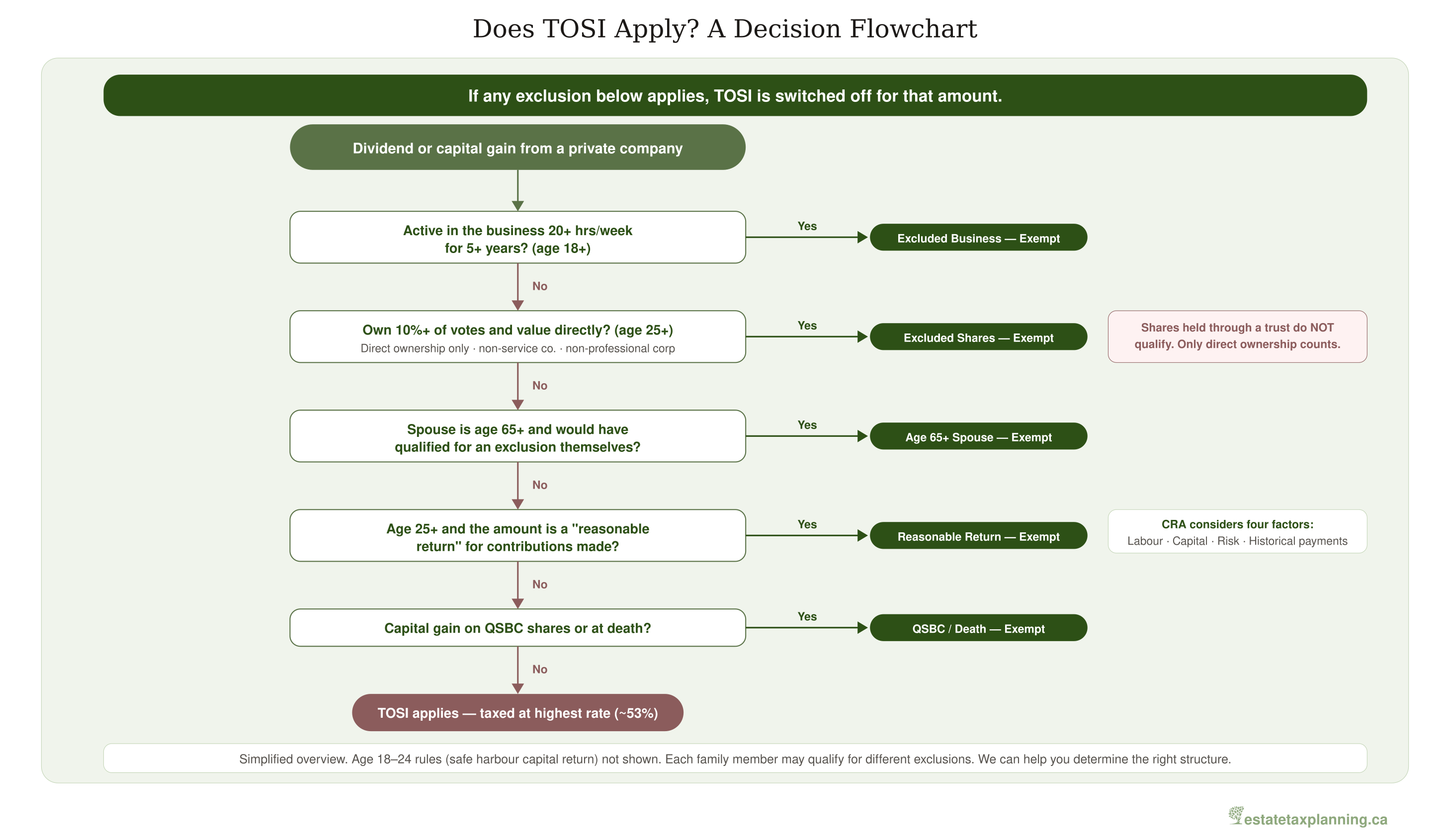
The Key TOSI Exclusions
The TOSI rules contain several exclusions. The following table summarizes each one at a glance — the detailed discussion of each exclusion follows below.
| Exclusion | Minimum Age | Key Test | Limitation |
|---|---|---|---|
| Excluded Business | 18 | 20+ hrs/week for 5+ years | Must be active in the business itself |
| Excluded Shares | 25 | ≥10% of votes and value, held directly | Not available for service cos (90%+ service income) or professional corps |
| Age 65+ Spouse | 65 (spouse) | Spouse would have qualified for an exclusion | Only applies in year spouse turns 65+ |
| Reasonable Return | 25 | Amount is reasonable given contributions | Subjective; CRA weighs labour, property, risk, historical payments |
| Safe Harbour Capital Return | 18 | Return on arm's-length capital contributed | Capped at prescribed rate (3%) on capital invested — narrow in practice |
| QSBC / Death Gains | Any | Gain on QSBC shares or deemed disposition at death | Applies to capital gains only, not dividends |
| Death Continuity | Any | Shares inherited from someone who met excluded business test | May be lost on post-mortem reorganization |
Current as of April 2026. These rules are subject to legislative change.
Excluded Business (Age 18+)
Income from a business is excluded from TOSI if the individual was actively engaged in the business on a regular, continuous, and substantial basis for at least five prior taxation years (not necessarily consecutive). The CRA considers an individual to have met this test if they worked an average of at least 20 hours per week during the operating period of the business.
This is the exclusion that does most of the heavy lifting in a typical family freeze. Any adult child who joins the business and puts in twenty hours a week from day one will cross the five-year line in their late twenties — and then hold the exclusion for the rest of their working life, regardless of whether they scale back later.
- Get the children involved early, even in a part-time capacity, and document the hours. The five-year clock runs on "any five prior taxation years," so the years do not need to be consecutive — which gives families more flexibility than most people realize.
- Once the five-year threshold is met, it is met permanently. A family member who worked 20+ hours per week for six years and then stepped back to a non-active role keeps the exclusion.
- This is the exclusion we rely on most in practice for active family members.
Excluded Shares (Age 25+)
Dividends on shares are excluded from TOSI if the individual owns shares directly that represent at least 10% of the votes and 10% of the fair market value of the corporation. The individual must be at least 25 years old, and the corporation cannot be a professional corporation (such as a medical, dental, legal, or accounting professional corporation).
The Service-Corporation Limitation
The excluded-shares exception has a second gate that is easy to miss. Two separate carve-outs block it:
Professional corporations are excluded by definition, regardless of revenue mix. If the corporation carries on the professional practice of an accountant, dentist, lawyer, medical doctor, veterinarian, or chiropractor (section 248(1) ITA), the excluded-shares exception is unavailable — full stop.
Service corporations are excluded where 90% or more of the corporation's business income comes from the provision of services. This is a revenue-mix test, and it captures most consulting firms, IT companies, staffing agencies, and management companies — even if they are not "professional" in the ITA sense.
- For both regimes, the excluded-shares exception is unavailable to every shareholder — regardless of how much they own or whether they work in the business.
- The primary path to TOSI-free income then becomes the excluded-business exception (five years of active involvement at 20+ hours/week). The reasonable-return exception is the secondary path but is subjective and harder to rely on.
- For a professional corporation, the excluded-shares door is permanently closed. For a service corporation, a shift in the 90% revenue mix (for example, through acquiring a product line) can reopen it — which is worth revisiting as the business evolves.
The Age 65+ Spouse Exclusion
TOSI does not apply to income received from a related business if the recipient's spouse has attained age 65 and would have qualified for an exclusion themselves. The statute frames this as the spouse having "attained the age of 64 years before the year" (paragraph 120.4(1.1)(a)) — which in practice means the exclusion is available for every taxation year starting with the one in which the spouse turns 65. The business owner does not need to have retired. No change in the recipient spouse's involvement is required.
- David, 66, has run his manufacturing company for 30 years and easily meets the excluded-business test. His wife Karen has never worked in the business. Until the calendar year David turned 65, dividends paid to Karen through the family trust were fully taxed under TOSI.
- In the year David turned 65 — and in every year after — the exclusion is available. Karen can now receive dividends from the company without TOSI, because David would have qualified for the excluded-business exception himself.
- Because the test looks at the spouse's age at the start of the taxation year, the exclusion applies for the full year — not from the spouse's birthday onward. Planning dividends around that full-year window (rather than waiting until after the birthday) captures the benefit for a complete twelve months.
The Reasonable Return Exception (Age 25+)
For individuals aged 25 and older, income from a related business is not subject to TOSI if the amount received is a "reasonable return" considering all relevant contributions. This is a subjective test, and the CRA has published guidance on the four factors it considers:
- Labour contribution — the nature and extent of the individual’s work for the business. This is the most straightforward factor, but document it carefully.
- Property contribution — capital or assets contributed to the business by the individual.
- Risk assumed — financial risks taken by the individual. The CRA has confirmed that a spouse who guarantees a business loan or mortgages their home to finance the business has assumed significant risk. We rely on this one frequently for spouses who aren’t active in the business.
- Historical payments — the pattern and amount of compensation previously paid to the individual. Consistency matters here — the CRA is more likely to accept a dividend level that’s in line with what the individual has received in the past.
Karen has never worked in the business but personally guaranteed a $2 million bank loan secured against the family home. The CRA has accepted that this level of financial risk can support a reasonable return on dividends — but the return must be proportionate to the risk. A $50,000 annual dividend might be defensible; a $500,000 dividend against the same guarantee would not. Contemporaneous documentation of the guarantee, the amount at risk, and the reasoning behind the dividend level is essential.
The CRA has stated it does not intend to substitute its own judgment for a good-faith taxpayer assessment — but "good-faith" is only as strong as the contemporaneous record behind it. In practice, we maintain a running file for each family member: hours worked and nature of duties, capital contributed, guarantees given, and the reasoning behind each year's dividend level. It is not elegant, but it is the file that wins a reasonable-return argument on audit.
Safe Harbour Capital Return (Ages 18–24)
For individuals aged 18 to 24, the exclusions are narrower. The excluded-shares exception is not available to this age group at all. Instead, an 18–24-year-old can receive income up to a safe-harbour capital return — a return on arm's-length capital they have personally contributed to the business, calculated at the CRA prescribed rate for the quarter (3% in Q2 2026, updated quarterly).
In practice this exclusion is very narrow. A 22-year-old who contributed $50,000 of inherited money to the business could receive roughly $1,500 of dividends a year without TOSI — anything above that is caught unless the excluded-business exception is available. For most estate-freeze structures involving adult children under 25, the real path to TOSI-free income is the excluded-business test: twenty hours a week for five years.
Capital Gains on QSBC Shares and at Death
Capital gains arising from a deemed disposition at death are generally excluded from TOSI. The gain on your frozen preferred shares at death is protected even if your involvement in the business has diminished by then.
Capital gains on the disposition of qualified small business corporation (QSBC) shares or qualified farm or fishing property are likewise excluded — relevant when shares are rolled out from a family trust to beneficiaries and subsequently sold.
The Death Continuity Rule
When shares are inherited as a consequence of death, the TOSI rules include a continuity provision under subsection 120.4(1.1). If the deceased individual met the excluded business exception (because they were actively engaged in the business for 5+ years), any child who inherits the shares is deemed to meet the same test. This means dividends and capital gains on the inherited shares are not subject to TOSI for the child, even if the child has never worked in the business.
This continuity rule applies through successive deaths. If the first spouse dies and the second spouse inherits via the spousal rollover, the second spouse is deemed to have met the excluded-business test. When the second spouse later dies and the children inherit, the same deeming rule applies to the children — protecting TOSI-free status on the inherited growth shares across multiple generations, even for children who never worked in the business.
- The CRA has confirmed (2019-0824401C6) that the continuity rule under paragraph 120.4(1.1)(b) applies only to dividends declared on the actual shares received as a consequence of death.
- If 100% of those inherited shares are subsequently redeemed or exchanged for new shares — for example, as part of a post-mortem pipeline or refreeze — the continuity protection may be lost.
- This creates a tension between post-mortem planning strategies and long-term TOSI protection. Your tax advisor should model the TOSI consequences of any post-mortem reorganization before proceeding.
- A related question we get often: does a stock split break TOSI continuity? A simple stock split that preserves proportionate ownership generally does not change the identity of the shares — but a reorganization that exchanges inherited shares for a new class (as in a refreeze or pipeline) may. Any corporate restructuring involving inherited shares should be reviewed for its impact on death continuity before proceeding.
Practical TOSI Planning for Estate Freezes
The first question is whether to use direct share ownership, a family trust, or both. If income splitting is a primary goal and your family members are already active in the business, issuing shares directly (to qualify for the excluded shares exception) may be more tax-efficient than using a trust. But you lose the flexibility and creditor protection that a trust provides. Some families use a combination — direct shares for active members who qualify for excluded shares, and a trust for flexibility with other family members.
Sequencing the freeze around the TOSI clock is often the highest-leverage move. If children plan to join the business, the freeze can be timed so that by the time dividends start flowing, they have accumulated the required five years of active involvement under the excluded-business test. If the freezor or spouse is approaching 65, the spouse exclusion is about to become available — factoring that into the income-allocation plan can open up meaningful TOSI-free dividend flow without any change in the spouse's involvement.
- Map each family member's current TOSI status and available exclusions.
- For adult children joining the business, start the excluded business clock early — 20+ hours/week for 5 years.
- Consider direct share ownership (≥10% of votes and value) for family members who will qualify for excluded shares.
- If the freezor or spouse is approaching 65, factor the spouse exclusion into the income allocation plan.
- Use a family trust where flexibility outweighs the loss of excluded shares — but direct trust distributions to members with available exclusions.
TOSI Planning Technique: The 10% Direct Ownership Strategy
The excluded-shares exception under subsection 120.4(1) requires direct ownership of at least 10% of the votes and value — shares held through a trust do not qualify. That creates a specific problem when a family trust holds the growth shares: the trust's beneficiaries cannot use the excluded-shares exception, even if one of them would otherwise be a perfect fit for it.
The workaround is to split the common shares into two classes. At the time of the freeze, the non-active spouse subscribes personally for a separate class (say, 10 Class B common shares) representing at least 10% of the votes and value; the family trust subscribes for the remaining 90 Class A common shares. The result is a two-track income flow.
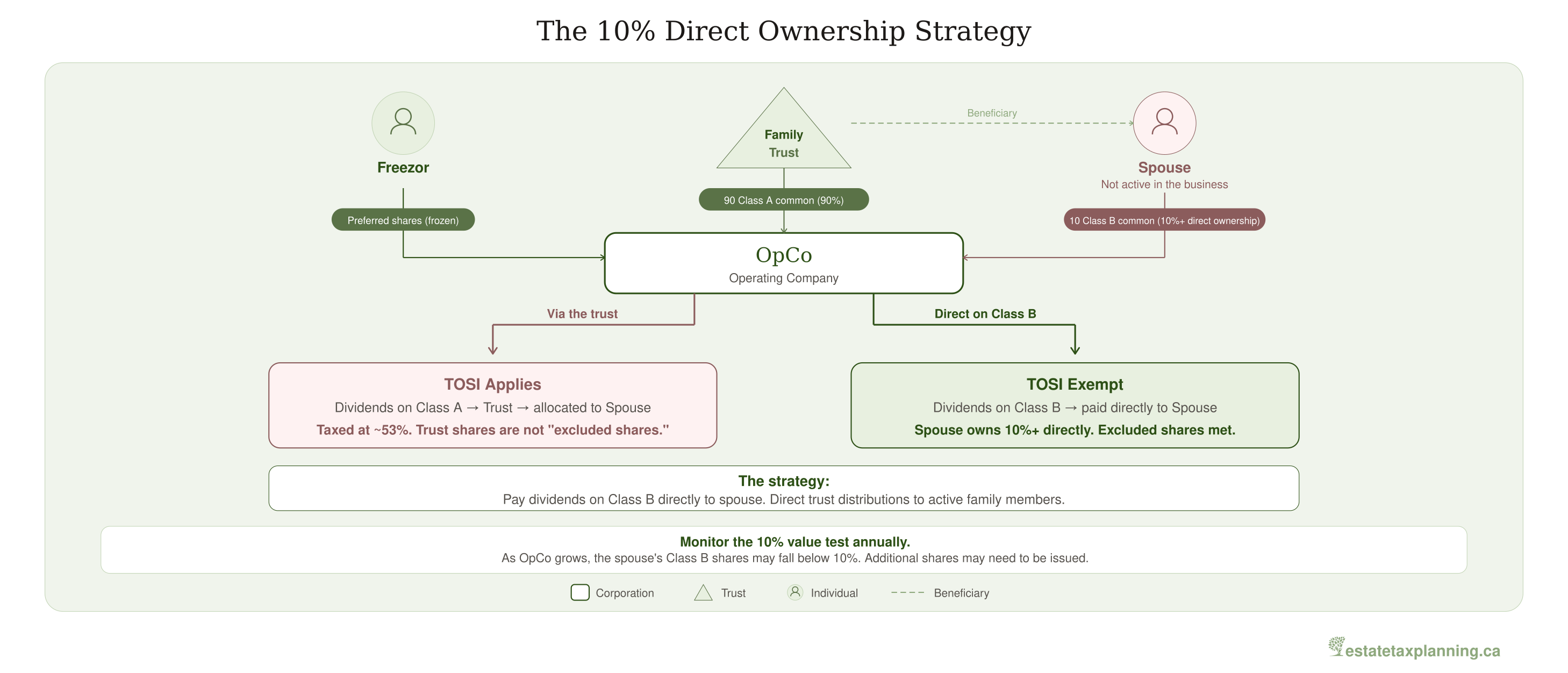
Dividends on the Class B shares flow directly to the non-active spouse free of TOSI — excluded shares via direct ownership. Deemed dividends on preferred-share redemptions to the same spouse are also excluded, because the excluded-shares test looks at every share she owns, including the Class B shares. Dividends allocated to her through the trust remain subject to TOSI (trust-held shares are not directly owned) — but in practice those allocations can be routed to the active spouse, who qualifies via the excluded-business exception.
- Requires precise structuring and multi-class share design.
- The non-active spouse must remain a direct shareholder.
- Class B shares must represent ≥10% of votes and value.
- Does not work for professional corporations or service businesses earning 90%+ of income from services — the excluded shares exception is unavailable regardless of ownership percentage. For these businesses, the excluded business exception (active involvement) or reasonable return exception are the only paths.
- CRA may challenge the allocation of voting rights and economic interests.
Numerical Example: The Cost of TOSI
Emma is 28. She works ten hours a week at her father's company — enough to stay involved, not enough to meet the excluded-business threshold of roughly twenty hours per week for five years. Her shares are held through the family trust, so the excluded-shares exception is also unavailable. This year the trust allocates her $200,000 of non-eligible dividends.
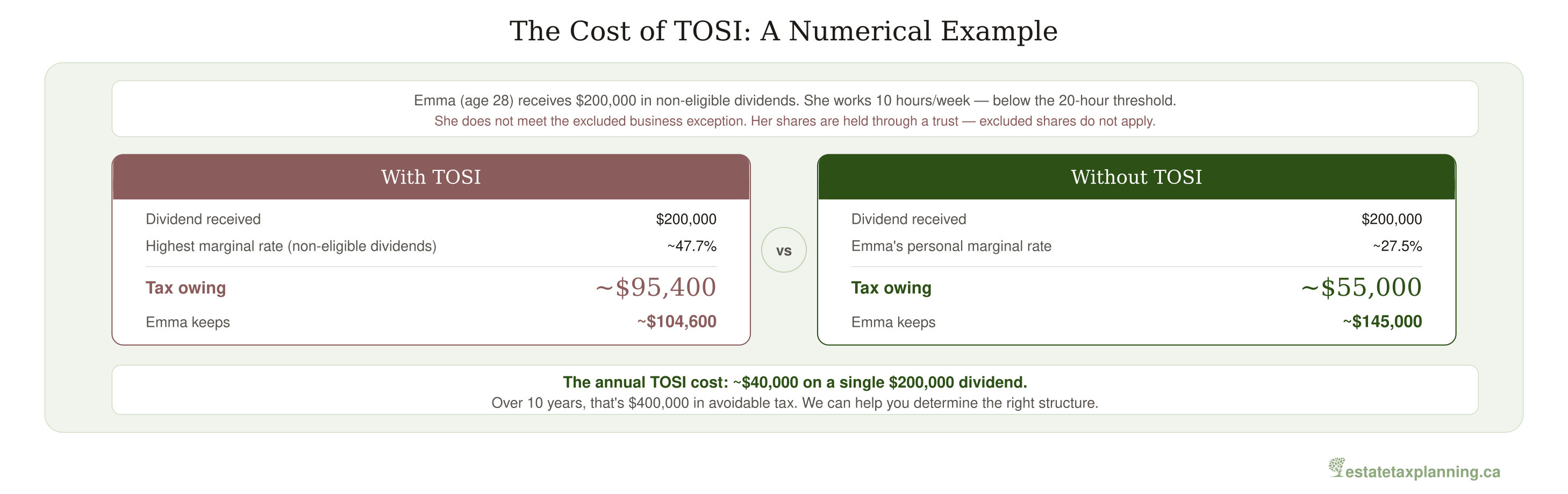
With TOSI, the $200,000 is taxed at the top Ontario rate on non-eligible dividends — roughly 47.7%, or about $95,400 of tax. Emma keeps about $104,600. Without TOSI — if Emma had met an exclusion — the same $200,000 would run through her personal brackets with no other income. After the dividend gross-up, dividend tax credit, and basic personal amount, the real-world tax bill lands somewhere in the $50,000–$55,000 range, and she keeps roughly $145,000–$150,000. That's about $40,000 of extra tax every year the dividend is paid, for no reason other than that Emma doesn't quite clear the activity threshold.
The planning lever is real. If Emma moves to twenty hours a week and keeps it up for five cumulative years, the excluded-business exception opens. The same $200,000 dividend is then taxed at her personal rate — saving the family roughly $40,000 a year, every year, for as long as the dividends flow.
Putting It All Together
The planning principle is straightforward even where the rules are not. Before the freeze is structured, each family member's TOSI position should be mapped — who qualifies for excluded business today, who is building toward it, who might defend a reasonable return, and who has no path to a current exclusion at all. That map drives the structure: trust versus direct shares versus a hybrid; which share classes to create; how income is allocated year by year.
TOSI planning is not a one-time decision at the time of the freeze — it is an annual discipline for the life of the structure. Children graduate, join the business, leave the business. Spouses turn 65. The service-revenue mix shifts. The allocation strategy that is optimal in year one may be leaving money on the table by year five. The families that get the best long-term outcomes from an estate freeze are the ones that revisit the TOSI map every year the dividends flow.
The share-class architecture that TOSI planning produces is inseparable from the broader structural choice — trust, holdco, or direct issuance — covered in Choosing Your Freeze Structure. The TOSI map and the structure map are two views of the same decision.
What's Next
Every TOSI strategy in this article depends on one thing being right: the valuation that anchors the freeze. In Valuation: The Make-or-Break Step in an Estate Freeze, we explain why an independent, defensible valuation by a Chartered Business Valuator is essential — and what can go wrong when the valuation is shortcut or skipped.
A conversation with a qualified CPA and CBV is a good place to start — mapping each family member's available TOSI exclusions is the first practical step before the share classes are designed.
For definitions of the key terms used in this article — including TOSI, excluded business, excluded shares, split income, gel freeze, and family trust — see our Key Terms and Definitions reference guide.
This article is for informational purposes only and does not constitute legal, tax, or financial advice. Estate freezes are complex transactions that require the coordinated involvement of qualified tax, valuation, and legal professionals. Always consult your advisors before acting on any of the information discussed here.