
Subsection 74.4(2) can attribute deemed interest income to the freezor every year — even if no dividends are paid — when a spouse or minor can benefit from the corporation. The small business corporation exception is the primary defence, but it must be maintained continuously. Lose SBC status and the attribution begins immediately.
Of all the traps in estate freeze planning, this is the one that catches families most often — and it’s rarely on anyone’s radar until it’s too late. The corporate attribution rules apply when property is transferred to a corporation and a “designated person” — typically a spouse, common-law partner, minor child, or minor niece or nephew — can benefit from the corporation. When triggered, these rules attribute deemed interest income back to the transferor, even if no actual income is paid to anyone.
If your estate freeze involves — or could involve — your spouse or common-law partner or minor family members as shareholders or trust beneficiaries, you need to understand these rules. We’ve seen cases where missing this trap created six-figure annual tax bills attributed to the freezor, year after year, with no offsetting cash flow.
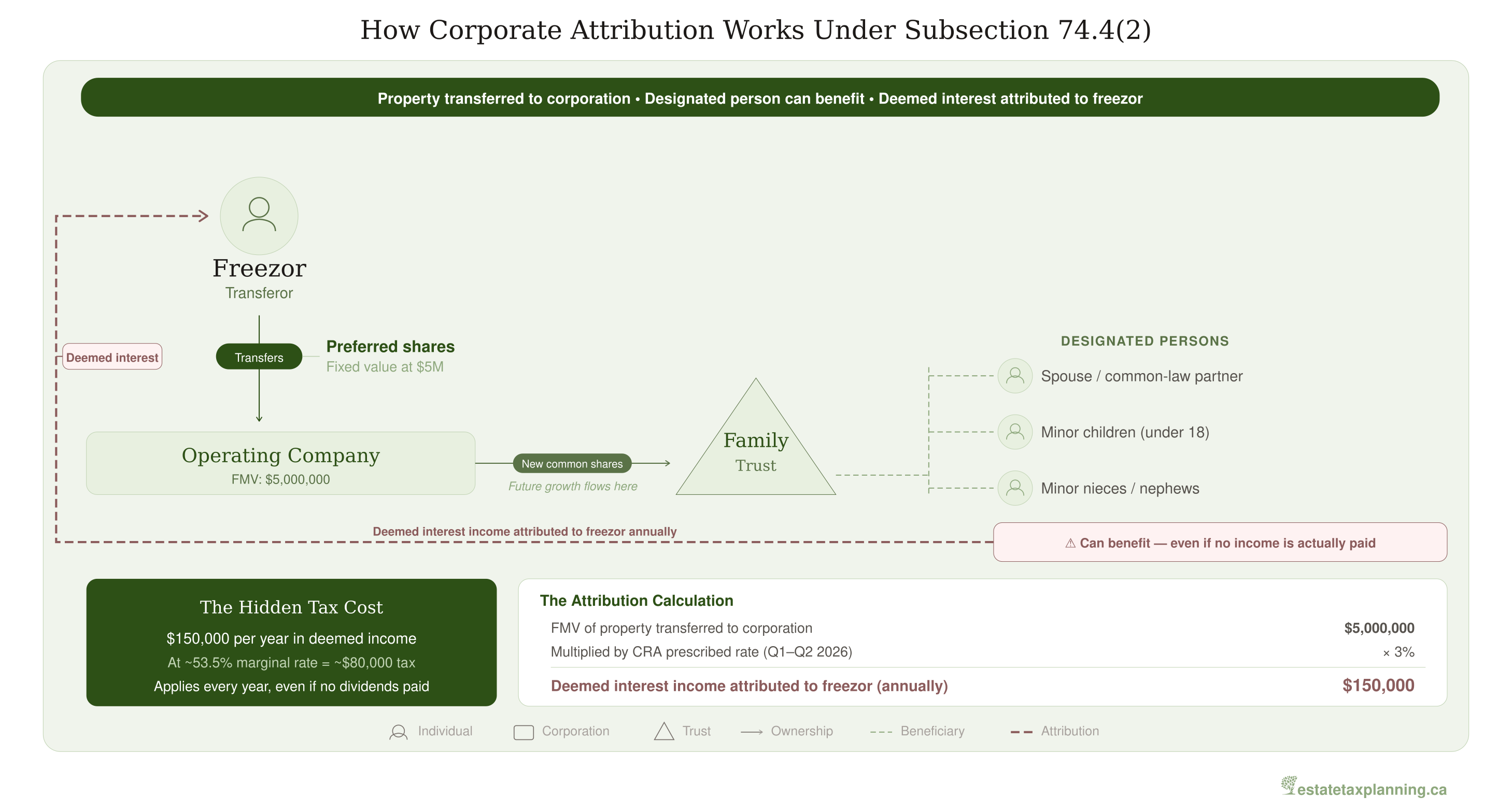
Under subsection 74.4(2) of the Income Tax Act, if an individual transfers property to a corporation and one of the main purposes is to reduce the individual’s income and benefit a designated person, the individual is deemed to receive interest income. This deemed income is calculated by multiplying the outstanding amount of the transferred property by the CRA’s prescribed interest rate, and it is attributed to the freezor every year, regardless of whether the corporation pays any dividends or other amounts to the designated person.
And the trigger is broad — a “one of the main purposes” test, not the sole purpose, and not even the primary purpose. If income reduction and benefiting a designated person is one of the main purposes of the transfer, the rule applies. The CRA has interpreted this broadly, and frankly, it’s hard to argue that income-splitting wasn’t at least one of the main purposes when the freeze shifts future growth to family members or a family trust that includes the freezor’s spouse or minor children.
- Your spouse or common-law partner — whether they hold shares directly or are a beneficiary of the family trust.
- Any person under 18 who is related to the transferor — including minor children, minor nieces, and minor nephews (as defined in subsection 74.5(5)).
- Once a minor turns 18, they cease to be a designated person for this purpose — but the attribution may still apply if a spouse or common-law partner remains a beneficiary.
How Corporate Attribution Works
The mechanics are technical but the consequences are severe, so it is worth walking through carefully. When a freezor transfers property to a corporation — say, by rolling common shares into preferred shares under subsection 85(1) or exchanging them under Section 86 — and new common shares are issued to family members or a family trust, the CRA looks at whether any designated person can benefit from the corporation.
The outstanding amount, defined in subsection 74.4(3), is the fair market value of the property at the time of transfer, less any consideration received by the individual that isn’t “excluded consideration.” Excluded consideration includes shares, indebtedness, and rights to receive either — which means the typical freeze consideration (preferred shares plus a promissory note) doesn’t reduce the outstanding amount at all. If the freezor transfers property worth $5 million and receives only preferred shares and a promissory note, the outstanding amount is the full $5 million. If the freezor also receives $500,000 in cash, the outstanding amount drops to $4.5 million — because cash is not excluded consideration. This amount is fixed at the date of transfer; it doesn’t increase if the corporation’s value grows afterward, and it doesn’t decrease unless the individual receives further non-excluded consideration (such as cash on a share redemption).
And because the outstanding amount depends on the fair market value at the time of transfer, the valuation used in the freeze matters enormously. If the CRA reassesses the freeze valuation upward on audit, the outstanding amount increases — and so does the annual deemed interest attributed to the freezor. This is one of the reasons we always recommend a price adjustment clause in freeze transactions: it adjusts the consideration retroactively if the CRA determines a different fair market value, limiting the cascading impact on corporate attribution.
The Deemed Interest Calculation
The prescribed rate is set quarterly by the CRA under Regulation 4301 (3% for Q1–Q2 2026, updated quarterly). On a $5 million freeze, that 3% rate creates $150,000 of deemed interest income annually attributed to the freezor — taxed as interest income at the freezor’s top marginal rate. The attribution continues every year that the designated person can receive benefits from the corporation, even if no dividends are ever declared.
Current as of April 2026. These rules are subject to legislative change.
- In Lipson v. Canada, 2009 SCC 1, the Supreme Court of Canada held that using the attribution rules to generate a tax benefit — specifically, engineering a spousal transfer to attribute an interest deduction back to the transferor — constituted abusive tax avoidance under GAAR.
- The decision was split 4–3, but it established an important principle: even when individual provisions of the attribution rules are technically satisfied, the CRA can challenge the overall arrangement under GAAR if the purpose is to produce a tax result that frustrates the intent of the rules.
- For estate freeze planning, this means that aggressive structures designed to exploit the attribution rules — rather than legitimately avoiding them — carry meaningful GAAR risk. Straightforward planning (prescribed-rate loans, safe harbour trusts, CCPC exemptions) remains safe. That’s where we focus our work.
When It Applies to Estate Freezes
In a typical estate freeze, the freezor transfers common shares to the corporation and new common shares are issued to family members or a family trust. If the new shareholders — or the beneficiaries of the trust — include a designated person, corporate attribution can apply. And it comes up more often than you’d think.
We see this most commonly in three scenarios. First, when your spouse or common-law partner is a shareholder or trust beneficiary — corporate attribution applies to the entire value of the transferred property. Second, when the family trust names minor children as beneficiaries, even if they never receive a penny. Third, when minor nieces and nephews are included in the trust’s beneficiary list — a common choice for flexibility, but one that can inadvertently trigger the rules.
There’s also a threshold test that gets overlooked: paragraph 74.4(2)(a) requires that the designated person would be a “specified shareholder” of the corporation — generally meaning a 10% or greater interest, using a modified version of the definition in subsection 248(1). In most freeze structures, the family trust holds 100% of the new common shares, and the trust’s beneficiaries are treated as having an interest through the trust, so this test is almost always met. But if the designated person’s interest (direct or through a trust) is less than 10%, paragraph (a) isn’t satisfied and corporate attribution doesn’t apply — regardless of the other conditions. This can matter in structures involving multiple unrelated shareholders where the family trust holds a minority position.
- Many estate freeze trust deeds include the freezor’s spouse or common-law partner and minor children as beneficiaries for maximum flexibility. If the freeze involves a transfer of property to a corporation — such as a subsection 85(1) rollover — this can inadvertently trigger corporate attribution. We see this in a surprising number of files we inherit.
- The attribution applies even if the designated person never receives a penny from the trust. The mere ability to benefit is enough. This is the part that catches people off guard.
- Always analyze corporate attribution before finalizing the trust’s beneficiary list. We run this analysis on every freeze engagement before the trust deed is drafted.
The Active Business CCPC Exemption
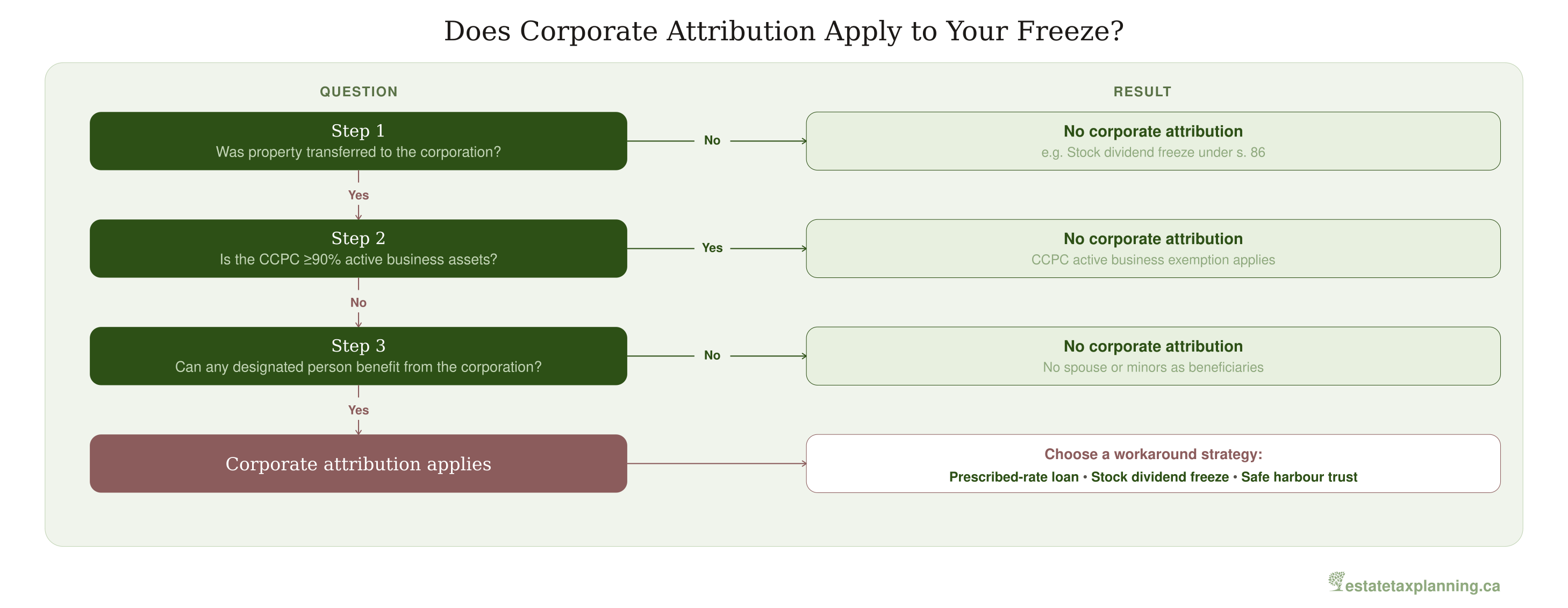
There is one important exception that can eliminate the corporate attribution problem entirely. One of the preconditions for subsection 74.4(2) to apply is that the corporation is not a “small business corporation” as defined in subsection 248(1). A small business corporation is a CCPC where all or substantially all of the fair market value of its assets are used in an active business carried on primarily in Canada. The CRA interprets “all or substantially all” as 90% or more. If the corporation qualifies as a small business corporation, paragraph 74.4(2)(c) is not satisfied and corporate attribution simply does not apply.
In practical terms, if your operating company’s assets are at least 90% active business assets — equipment, inventory, receivables, active business real estate, goodwill — the corporation qualifies as a small business corporation and corporate attribution simply doesn’t apply. The freeze can proceed with a standard subsection 85(1) or Section 86 rollover, and no prescribed-rate interest workaround is needed. For many of our clients, this is the end of the analysis.
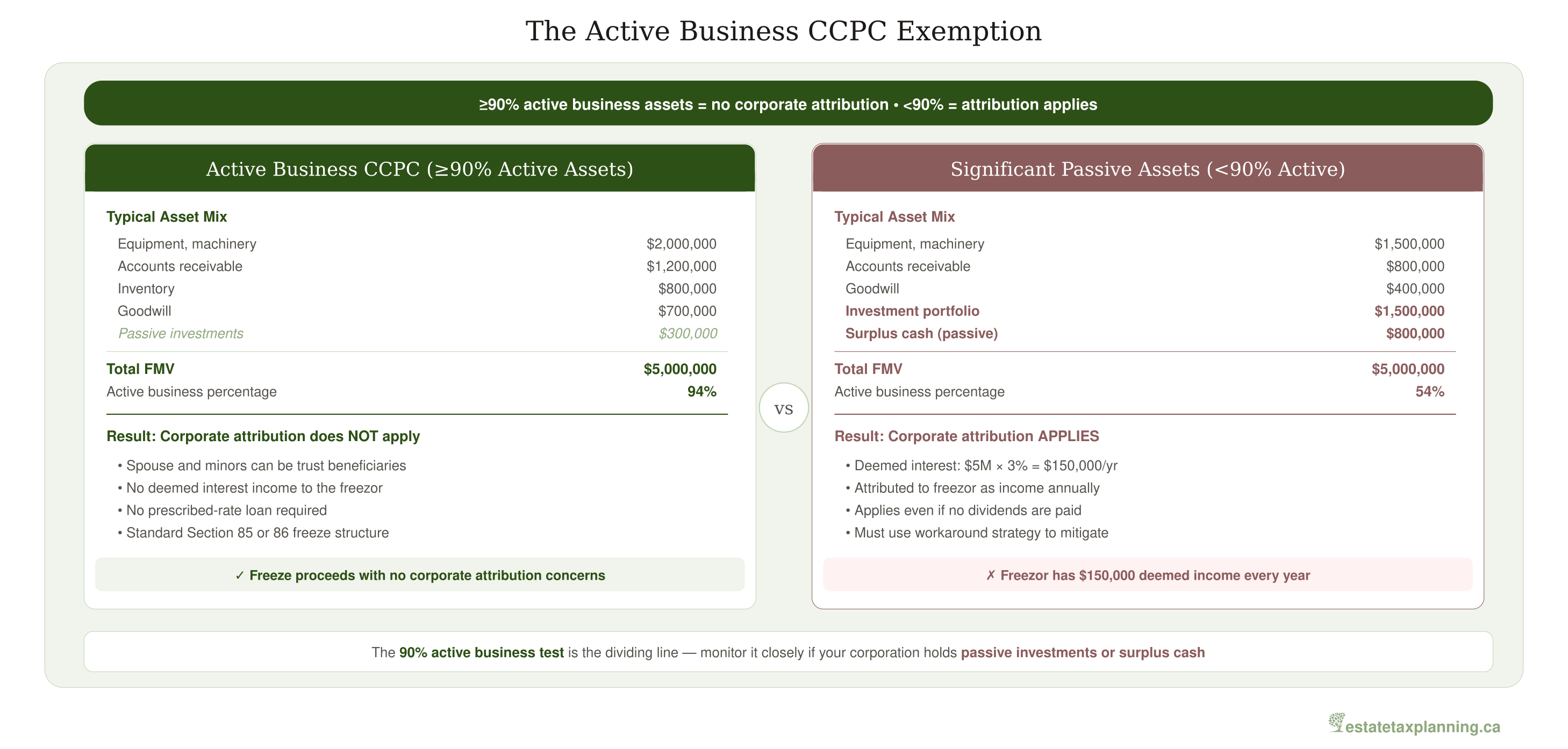
So corporate attribution is primarily a concern for corporations holding significant passive investment assets — exceeding 10% of total fair market value. Think investment holding companies, corporations with large surplus cash balances, or corporations that own non-operating real estate. For a pure operating business with minimal passive assets, corporate attribution is generally not an issue.
- The 90% test is not a one-time check. A corporation that qualifies today can lose the exemption if it accumulates passive investments, retains surplus cash beyond operating needs, or acquires non-active assets. We flag this in every annual freeze review.
- If the corporation drops below the 90% threshold in a subsequent year, corporate attribution applies for that year — creating an unexpected tax bill even though the exemption was met in prior years. We’ve seen this happen when a corporation retains a few years of strong profits as cash.
- If a holding company is part of the freeze structure, the 90% test must be assessed at the holding company level, which often fails if the holding company’s primary purpose is investment management.
- Operating company (typically passes): $5M total FMV — $4.7M in equipment, inventory, receivables, goodwill; $300K in surplus cash (6% passive). Result: 94% active, exemption applies, no corporate attribution.
- Holding company (typically fails): $5M total FMV — $2M in shares of Opco (active); $2.5M in investment portfolio; $500K in cash (60% passive). Result: 40% active, exemption fails, corporate attribution applies to the full outstanding amount.
- The critical risk: many freeze structures involve a holding company sitting above the operating company. Even though the Opco’s assets are 94% active, the Holdco’s assets are assessed separately — and the Holdco often holds the very passive investments that fail the test. This is explored in detail in the investment holding company article later in this series.
How to Plan Around Corporate Attribution
When the active business exemption isn’t available, you’re not out of options. There are several well-established strategies, and the right one depends on your family’s structure, the corporation’s asset mix, and the long-term succession plan.
The Prescribed-Rate Loan
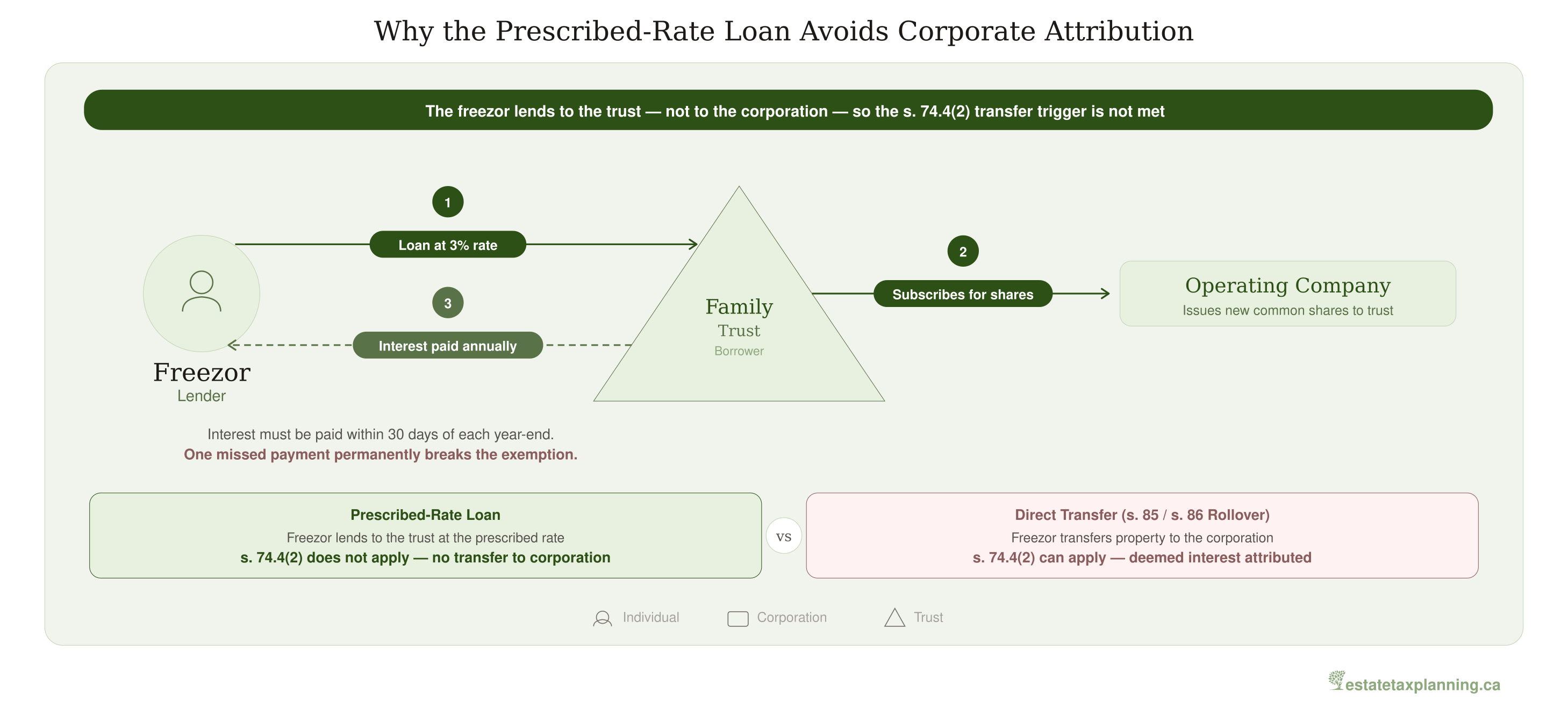
The most common workaround is the prescribed-rate loan. Instead of transferring shares directly, the freezor lends funds to the trust or family member at the CRA’s prescribed interest rate. The trust then uses those funds to subscribe for new common shares of the corporation. Because the freezor made a loan rather than a transfer of property to the corporation, the precondition for subsection 74.4(2) is not met — no property was transferred to the corporation by the individual. As long as the loan interest is actually paid within 30 days of each year-end (January 30 for calendar year-end taxpayers, or within 30 days of the relevant fiscal year-end otherwise), the personal attribution rules under sections 74.1 and 74.2 are also excluded by section 74.5.
An important distinction that’s often misunderstood: section 74.5 provides a direct exception to the personal attribution rules in sections 74.1 and 74.2, but it doesn’t directly override corporate attribution under subsection 74.4(2). The prescribed-rate loan avoids corporate attribution because the loan structure sidesteps the “transfer of property to a corporation” trigger — not because section 74.5 provides a blanket exemption. This distinction matters when evaluating alternative loan structures that may still involve a transfer.
This strategy works best when the prescribed rate is low. Loans made when the rate was 1% (from mid-2020 through early 2022) continue at 1% even if rates rise later, creating a significant income-splitting opportunity over time. At the current 3% rate, the economics are less dramatic but still meaningful on large transfers. We strongly encouraged prescribed-rate loan planning during that low-rate window, and for good reason.
| Period | Prescribed Rate | Annual Interest on $5M Loan | Annual Tax at ~53.5% |
|---|---|---|---|
| Q1–Q2 2020 | 2% | $100,000 | ~$53,500 |
| Q3 2020 – Q2 2022 | 1% | $50,000 | ~$26,750 |
| Q3 2022 – Q2 2024 (rising) | 2% → 6% | $100,000–$300,000 | ~$53,500–$160,500 |
| Q3–Q4 2024 | 5% | $250,000 | ~$133,750 |
| Q1–Q2 2025 | 4% | $200,000 | ~$107,000 |
| Q3 2025 – Q2 2026 | 3% | $150,000 | ~$80,250 |
For the full quarterly history from 2009 to present, see our CRA Prescribed Interest Rates Table — updated quarterly.
The rate is permanently locked at the time the loan is made. A loan established at 1% in 2021 stays at 1% indefinitely, even though today’s rate is 3%. On a $5 million loan, that rate lock saves $100,000 per year in interest cost compared to a loan made today — a $535,000 tax difference over 10 years at the Ontario top marginal rate. That window is closed now, but if you locked in at 1%, you’re sitting on one of the most valuable tax planning advantages available.
- The loan avoids corporate attribution because the freezor lends to the trust, not to the corporation. The trust — not the freezor — subscribes for new shares, so the “transfer of property to a corporation” precondition in subsection 74.4(2) is not met. It’s one of the cleanest workarounds in the Act.
- The rate is permanently locked at the time the loan is made — it does not adjust when the CRA changes the prescribed rate in later quarters. When rates are low, we always tell clients to lock in.
- The interest must be actually paid, not merely accrued. One missed payment within the 30-day window permanently breaks the exemption — not just for the year of the missed payment, but for all subsequent years as well. Once broken, the loan cannot be “repaired” by resuming interest payments; the only fix is to repay the original loan in full and establish a new loan at the then-current prescribed rate. We calendar the January 30 deadline for every prescribed-rate loan client.
- If the freezor guarantees a loan made to a spouse, common-law partner, or related minor, subsection 74.5(7) deems the freezor to have made the loan directly — which can trigger attribution even if the original loan was at arm’s length.
- In tiered corporate structures, back-to-back loan arrangements can be caught by subsection 74.5(6), which deems an indirect transfer through a third party to be a direct transfer by the individual. We’ve seen this trap spring on multi-entity structures where the lending path looked clean on paper.
- Always ensure the prescribed-rate loan is made directly from the freezor to the trust or family member, without intermediate parties or guarantees that could collapse the structure. Keep the lending chain simple.
The Stock Dividend Freeze
A stock dividend freeze takes a different approach entirely: it avoids the transfer of property to the corporation altogether. Instead of exchanging existing shares under Section 86, the corporation issues new preferred shares to the freezor as a stock dividend. The freezor’s existing common shares remain outstanding, and the new preferred shares capture the corporation’s current value — effectively freezing it. Because the freezor didn’t transfer any property to the corporation, the precondition for subsection 74.4(2) isn’t met.
The distinction is subtle but important. Section 86 involves an exchange of existing shares for new shares, which constitutes a transfer. A stock dividend is an issuance of additional shares by the corporation — no property moves from the shareholder to the corporation. That structural difference eliminates the corporate attribution trigger. The trade-off is complexity: the stock dividend freeze requires careful planning to ensure the preferred share terms properly capture the freeze value, and the existing common shares have to be dealt with (typically cancelled or converted) to direct future growth to the next generation.
Excluding Designated Persons
Sometimes the simplest solution is the best one: make sure no designated person is a shareholder or trust beneficiary. If the family trust’s beneficiary class is limited to the freezor’s adult children (18 or older), corporate attribution doesn’t apply — adult children aren’t designated persons. This works well when the freezor’s children are already adults and the spouse or common-law partner has independent financial resources or is provided for through other means (insurance, a separate spousal trust, or direct asset transfers outside the corporation).
Where minor children are involved, we often recommend a staged approach. The trust initially names only non-designated persons as beneficiaries, and the trust deed includes a power to add beneficiaries in the future. Minor children are then added after they turn 18, at which point they cease to be designated persons. The key is ensuring the trust deed is drafted to permit this — and that no designated person has even a contingent right to benefit before the amendment.
The Safe Harbour Trust
This one is underused, in our experience. Subsection 74.4(4) provides an exception that lets you include designated persons in the trust — as long as the trust deed is structured so they can’t receive or otherwise obtain the use of any income or capital while they remain designated persons. The trust can include the spouse and minor children as potential future beneficiaries, but the terms must explicitly prohibit distributions to them while they qualify as designated persons under subsection 74.4(2).
For a spouse, this means the spouse cannot benefit from the trust at all — which defeats the purpose of including them. For minor children, the restriction only needs to last until they turn 18, at which point they cease to be designated persons and can become active beneficiaries. This makes the safe harbour trust particularly useful when the freezor’s children are young but the family wants to retain future flexibility without triggering corporate attribution during the intervening years.
- The trust deed must contain explicit language preventing distributions to designated persons while they remain designated persons. General discretionary language is not sufficient — we’ve seen trusts that tried to rely on the trustee’s discretion alone, and that doesn’t meet the standard.
- For minor children, the trust effectively becomes a “waiting room” — they are named beneficiaries but cannot receive anything until they turn 18. It’s a good compromise between flexibility and compliance.
- The safe harbour trust can be combined with other strategies. For example, a prescribed-rate loan can fund the trust, and the safe harbour provision protects against corporate attribution during the years when minors are beneficiaries. We use this combination regularly.
- Have the trust deed reviewed by tax counsel to ensure the language satisfies subsection 74.4(4). Ambiguous terms may not withstand CRA scrutiny.
- In Advance Ruling 2022-0954211R3, the CRA confirmed that a family trust structured to prevent designated persons from receiving any benefit while they remained designated persons satisfied subsection 74.4(4), and corporate attribution did not apply to the proposed estate freeze. This ruling gives us a solid precedent to rely on in practice.
The Dividend Offset
If corporate attribution does apply and can’t be avoided, there’s still a way to soften the blow. Paragraphs 74.4(2)(e) and (f) provide a partial offset built directly into the deemed interest formula. The deemed interest attributed to the freezor is reduced by any interest received on the transferred property under paragraph (e), and by any taxable dividends received from the corporation under paragraph (f). If the corporation pays dividends on the freezor’s preferred shares, those dividends reduce the deemed interest calculation dollar for dollar.
If the deemed interest on a $5 million freeze is $150,000 and the corporation pays $80,000 in dividends on the freezor’s preferred shares during the year, the net attribution drops to $70,000. The freezor reports $70,000 as deemed interest income and the $80,000 dividend separately. Because dividends are taxed at a lower rate than interest income, this can meaningfully reduce the overall tax cost compared to the full $150,000 being taxed as interest.
To quantify the benefit: if the full $150,000 were taxed as interest income at the top combined marginal rate of approximately 53.53% (Ontario), the tax cost would be roughly $80,300. With the dividend offset, the freezor instead pays tax on $80,000 of eligible dividends at approximately 39.34% ($31,472) plus $70,000 of deemed interest at 53.53% ($37,471), for a combined tax cost of approximately $68,943 — an annual saving of roughly $11,350. Over a 10-year freeze horizon, this difference accumulates to over $113,000 in tax savings, making the dividend offset a meaningful planning tool even though it does not eliminate the attribution entirely.
This approach does not eliminate the problem — it manages it. The freezor still includes the deemed interest in income and claims the offset, and the dividends themselves are taxable. The net benefit depends on the relative tax rates of interest income versus dividend income, and the corporation has to have sufficient cash flow to sustain the dividend payments.
- Paragraph 74.4(2)(f) explicitly excludes dividends “deemed by section 84 to have been received.” This means that if freeze preferred shares are redeemed and a deemed dividend arises under subsection 84(3), that deemed dividend does not reduce the attributed interest. Only dividends actually declared and paid by the corporation on the freeze shares qualify for the offset. This is a technical distinction that trips people up.
- This distinction matters on a refreeze: if existing preferred shares are redeemed (triggering a section 84(3) deemed dividend) while a new freeze is implemented, the deemed dividend from the old shares will not offset the deemed interest arising on the new freeze. We always flag this when modelling a refreeze.
The design of the freeze preferred share dividend terms directly affects this strategy. Non-cumulative dividends give the corporation discretion over whether and when to declare dividends, preserving cash flow flexibility but providing no guarantee that the offset will be available in any given year. Cumulative dividends create a fixed obligation that accumulates whether or not declared, ensuring the offset amount is predictable — but they reduce corporate flexibility and create a growing liability on the balance sheet. In practice, most tax advisors recommend cumulative dividends when the dividend offset is a central part of the attribution management plan, and non-cumulative dividends when the offset is a secondary benefit rather than a primary strategy.
Compensation Planning
Another approach that often gets overlooked is compensation itself — increasing the freezor’s salary or bonus from the corporation. Higher compensation to the freezor reduces retained earnings and may reduce or eliminate the economic benefit that makes corporate attribution punishing. It doesn’t technically avoid the application of subsection 74.4(2), but it can make the net tax cost manageable — the freezor is already receiving and reporting the income, and the corporation gets a deduction for the salary paid. In some cases, adjusting compensation is simpler than restructuring the entire freeze.
The limitation is that salary and bonuses have to be reasonable under section 67 of the ITA to be deductible. If the CRA considers the compensation excessive relative to the services performed, the excess won’t be deductible — creating a double tax cost. This strategy works best where the freezor is actively involved in the business and the compensation level can be justified by the work actually performed.
- A refreeze involves a new transfer of property to the corporation. If the refrozen shares are issued to the same family trust — and that trust still includes designated persons as beneficiaries — the corporate attribution analysis must be performed again from scratch. Don’t assume the original analysis still holds.
- The prescribed rate at the time of the refreeze will apply, not the rate from the original freeze. If rates have risen, the deemed interest cost increases. This is one of the hidden costs of a refreeze that clients don’t always anticipate.
- Always assess corporate attribution as part of any refreeze planning. We include it as a standard checklist item in every refreeze engagement.
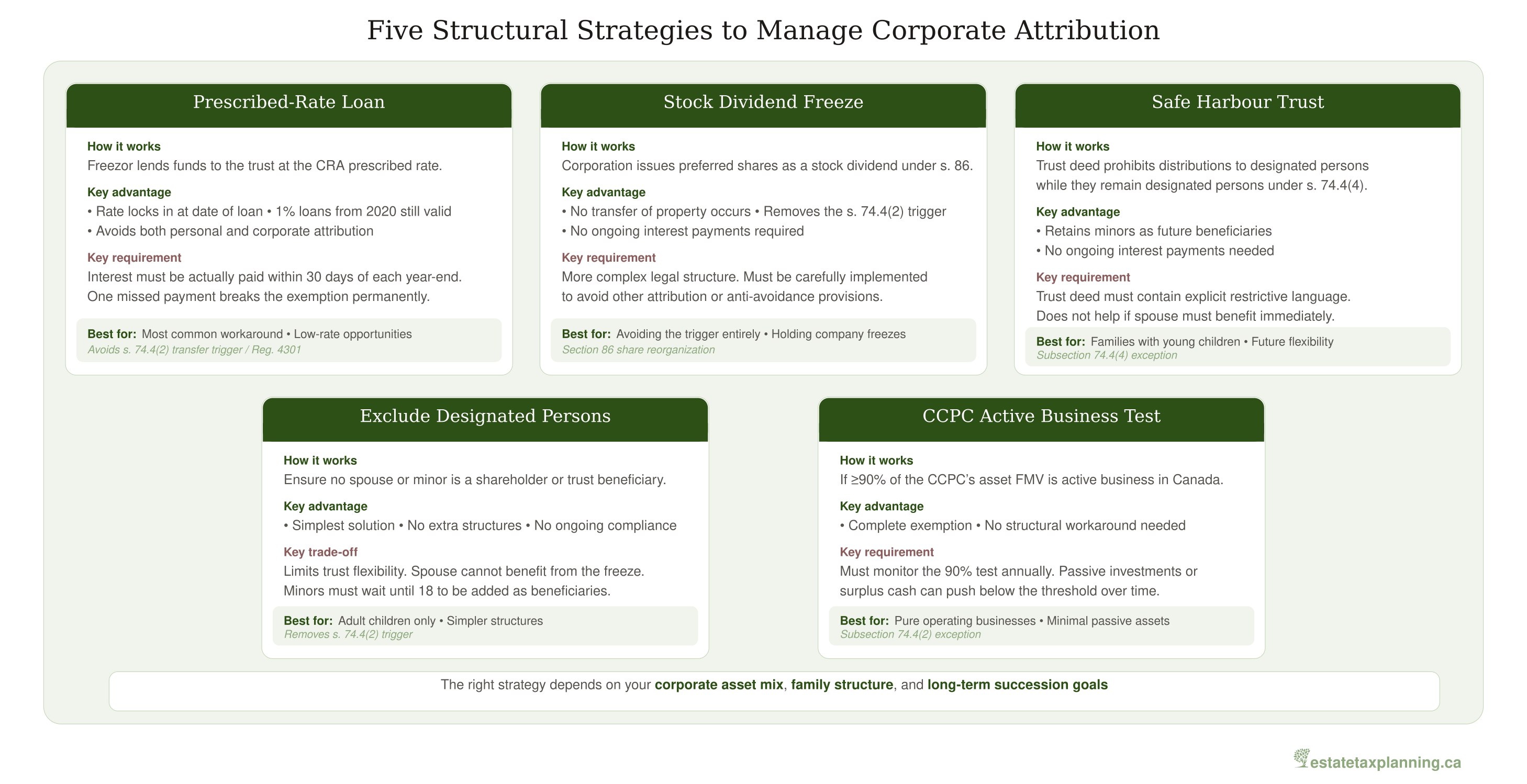
The two additional approaches below — the dividend offset and compensation planning — don’t change the structure of the freeze; they manage its impact after the fact.
| Strategy | How It Works | Best For | Key Limitation | ITA Reference |
|---|---|---|---|---|
| CCPC Active Business Exemption | If 90%+ of corporate assets are active business assets, the corporation qualifies as a small business corporation and corporate attribution does not apply | Operating companies with minimal passive investments | Fails if passive assets exceed 10% of FMV; must be monitored annually | para. 74.4(2)(c); s. 248(1) SBC def. |
| Prescribed-Rate Loan | Freezor lends funds at the CRA prescribed rate; interest must be paid within 30 days of year-end | Families wanting maximum flexibility with income splitting | Interest must actually be paid every year (by January 30); rate is locked at inception | s. 74.5 |
| Stock Dividend Freeze | Corporation issues new preferred shares as a stock dividend instead of exchanging existing shares | Situations where no property transfer to the corporation is desired | More complex legal implementation; may not suit all corporate structures | N/A (avoids trigger) |
| Safe Harbour Trust | Trust deed prevents designated persons from receiving any benefit while they remain designated persons | Families with minor children who want to retain future flexibility | Must be carefully drafted; general discretionary language is not sufficient | ss. 74.4(4) |
| Excluding Designated Persons | Remove spouse, minors, and minor nieces/nephews from the shareholder or beneficiary list | Simple structures where designated persons do not need to benefit | Limits estate planning flexibility; may conflict with family objectives | N/A (avoids trigger) |
| Dividend Offset | Corporation pays dividends on freeze preferred shares to reduce the deemed interest attribution | Situations where attribution cannot be avoided but can be managed | Does not eliminate attribution; requires sufficient corporate cash flow | paras. 74.4(2)(e)–(f) |
| Compensation Planning | Increase freezor salary/bonus to reduce retained earnings and economic benefit in the corporation | Active business owners already drawing compensation | Compensation must be reasonable under s. 67; CRA may challenge excess amounts | ss. 67 |
Interaction With the Tax on Split Income
Even with the right strategy in place, there’s one more layer to consider. Corporate attribution doesn’t operate in isolation. When a designated person is also a “specified individual” under the tax on split income rules, both subsection 74.4(2) and the TOSI provisions can apply simultaneously to the same arrangement. For example, if a family trust distributes dividends to a minor beneficiary, TOSI may apply to the minor’s income, and corporate attribution may simultaneously deem interest income to the freezor on the same underlying property.
To prevent double taxation in these situations, paragraph 74.4(2)(g) reduces the deemed interest attributed to the freezor by the amount of any split income included in a designated person’s income under section 120.4 for the same year. If the TOSI inclusion on dividends paid to the designated person is $100,000, and the deemed interest under corporate attribution would otherwise be $150,000, the net attribution to the freezor is reduced to $50,000. The coordination is mechanical — it applies automatically — but both the freezor and the designated person must correctly report their respective inclusions for the offset to work.
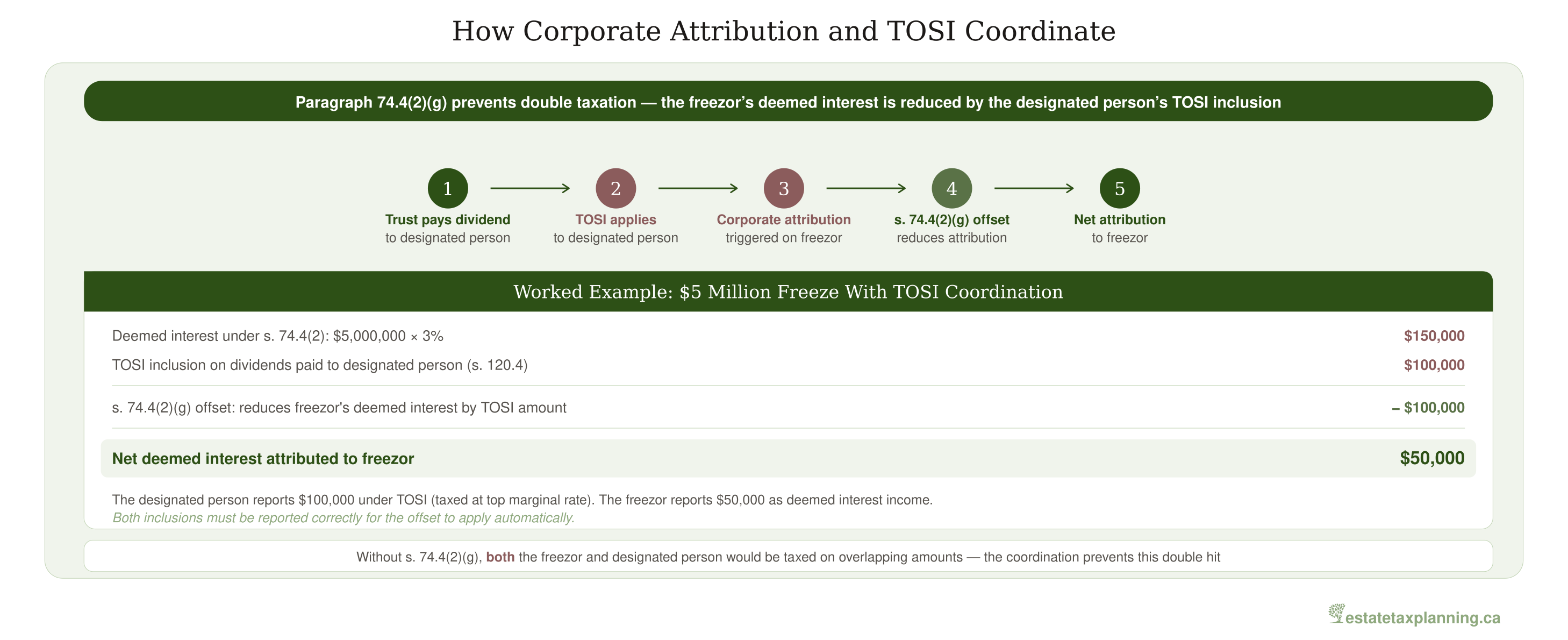
The coordination is built into the formula, but the freezor and the designated person each have to report their respective inclusions correctly for the offset to work. Addressing one rule in isolation can leave unexpected exposure under the other.
Corporate attribution rarely operates in isolation. It intersects with the surplus-stripping rules in Section 84.1 and Intergenerational Transfers, coordinates with the TOSI regime in TOSI and the Estate Freeze, and is particularly relevant for Estate Freezes for Investment Holding Companies, where the 90% active business test frequently fails.
For definitions of the key terms used in this article — including corporate attribution, designated person, prescribed-rate loan, CCPC active business exemption, and safe harbour trust — see our Key Terms and Definitions reference guide.
Your tax advisor, CBV, and legal counsel can help you evaluate how this applies to your situation — a structured review of your corporation’s asset mix, the trust’s beneficiary list, and the prescribed-rate loan (if any) is usually enough to confirm whether you’re exposed.
This article is for informational purposes only and does not constitute legal, tax, or financial advice. Estate freezes are complex transactions that require the coordinated involvement of qualified tax, valuation, and legal professionals. Always consult your advisors before acting on any of the information discussed here.