
Investment holding companies use asset-based valuations, not earnings multiples — and the latent tax deduction on unrealized gains (at ~50.17% for passive investments in a CCPC) can reduce the frozen value by hundreds of thousands of dollars. QSBC qualification is nearly impossible, so the LCGE is usually unavailable. Size insurance and structure the freeze accordingly.
So far in this series, most examples have focused on operating businesses — manufacturing companies, dental practices, and other active enterprises. But some of the most effective estate freezes we’ve implemented have been for individuals who hold a portfolio of investments through a private corporation, commonly known as an investment holding company.
If you’ve accumulated a significant investment portfolio inside a corporation — perhaps from retained earnings of a former business, from an inheritance, or simply as a tax-efficient savings vehicle — an estate freeze can help you cap your tax liability and shift future growth to the next generation. The mechanics are the same, but several important differences affect the planning, and getting them wrong can be costly.
Why Freeze an Investment Holding Company?
The rationale is the same as for an operating business: if the corporation’s value is expected to grow, the freeze locks in today’s value as your tax liability at death and transfers the future growth to your successors. The difference is that investment portfolios can grow substantially through reinvestment and compounding, often without the owner doing anything at all.
Consider a portfolio worth $3 million today. At a 6% average annual return, that portfolio could be worth approximately $7.2 million in 15 years. Without a freeze, the entire accrued gain is taxable at death. With a freeze, your liability is capped at the $3 million value, and the $4.2 million of future growth shifts to the next generation. That’s $4.2 million of growth that never shows up on your final tax return.
This is particularly valuable for individuals who have no plans to draw down the portfolio during their lifetime. If the investments are growing but the funds aren’t needed for retirement income, the accrued gain simply accumulates — and so does the eventual tax bill. A freeze stops the tax meter from running.
- An estate freeze is most valuable when the corporation’s value is expected to grow significantly after the freeze date.
- Investment holding companies often fit this profile perfectly: liquid assets, compounding returns, and a long time horizon.
- The freeze caps today’s value as the tax liability and shifts all future compounding to the next generation.
First Question: Should You Even Hold Investments in a Corporation?
Before implementing a freeze on an investment holding company, there’s a threshold question that needs to be answered first: should the investments be held inside a corporation at all? This needs to be settled before any freeze planning begins, because once the investments are inside a corporation and a freeze is in place, extracting them to personal ownership triggers tax that may outweigh the benefits.
Holding investments personally rather than in a corporation may be more tax-efficient in several specific scenarios. Canadian eligible dividends received personally benefit from the enhanced dividend tax credit, which can result in an effective tax rate as low as approximately 39% at the top Ontario bracket — compared to the combined corporate and personal tax rate on the same income flowing through a corporation. Capital gains on a principal residence are exempt from tax entirely, a benefit that’s lost once the property is held inside a corporation. And individuals in lower tax brackets may pay less total tax on investment income than the combined corporate-plus-personal rate, because the integration system is imperfect and there’s often a small cost to earning investment income through a corporation.
On the other hand, corporate ownership provides significant advantages for high-income individuals who don’t need the investment income right now. The initial tax deferral — the difference between the top personal rate and the corporate rate — allows more capital to compound inside the corporation. You also get creditor protection, estate planning flexibility through multiple share classes, and the ability to fund a wasting freeze.
| Factor | Personal Ownership | Corporate Ownership |
|---|---|---|
| Tax on Canadian eligible dividends | Enhanced dividend tax credit — effective rate ~39% at top Ontario bracket | Double tax: ~50.17% corporate + ~39–47% on personal withdrawal = integration cost |
| Capital gains on principal residence | Fully exempt — no tax on sale | No principal residence exemption available inside a corporation |
| Tax deferral on reinvested income | None — full personal tax paid immediately | Significant deferral: corporate rate ~50.17% vs personal rate ~53.53%; more capital compounds |
| Creditor protection | Investments exposed to personal creditors | Corporate veil provides meaningful protection for passive assets |
| Estate planning flexibility | Limited — investments pass as a single asset | Multiple share classes, freeze preferred shares, wasting freeze, trust structures |
| Breakeven holding period | Better for short holding periods (under ~5–10 years) | Better for long holding periods where deferral advantage compounds |
- Canadian eligible dividends: enhanced dividend tax credit gives a lower effective rate personally.
- Principal residence: the exemption is only available for personally-held property.
- Lower-bracket individuals: the integration “cost” of corporate ownership can exceed the deferral benefit.
- Short holding periods: if you plan to spend the money within a few years, the deferral advantage is minimal.
- Analyze the breakeven holding period with your tax advisor before incorporating investments. We run this analysis for every client before recommending an investment holdco freeze.
How It Differs from an Operating Business Freeze
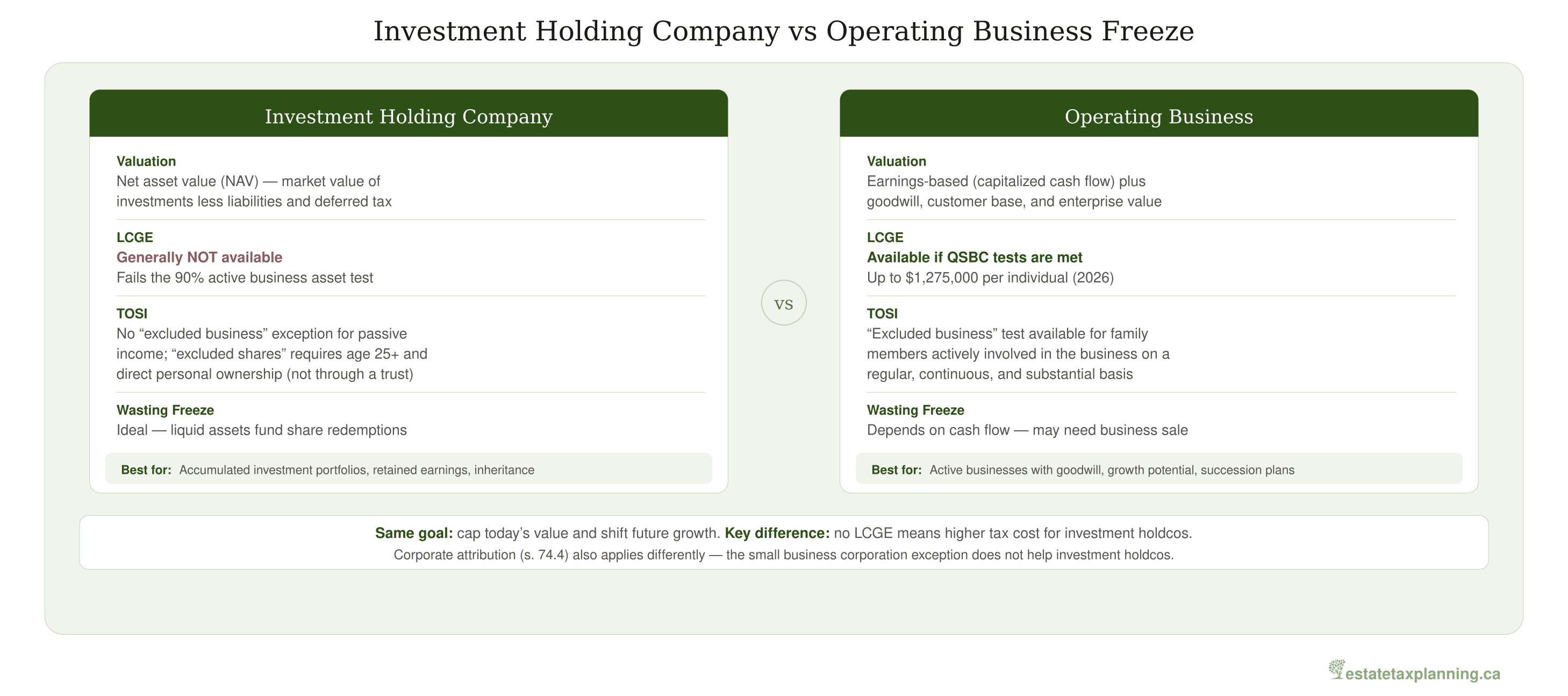
| Factor | Operating Business | Investment Holding Company |
|---|---|---|
| Valuation approach | Earnings-based (capitalized cash flow, market multiples) — requires professional judgment on goodwill and intangibles | Net asset value (market value of portfolio less liabilities and deferred tax) — generally simpler |
| LCGE available? | Yes — up to $1,275,000 per individual (2026) if QSBC test is met; family trust can multiply the exemption | Generally no — passive investments fail the 90% active business asset test for QSBC qualification |
| TOSI exclusions | Excluded business exception available if family member is actively involved; excluded shares exception also available | Excluded business exception unavailable (no active business); excluded shares exception may apply if age 25+, direct ownership, 10%+ votes and value |
| Corporate attribution (s. 74.4) | SBC exception often applies — if 90%+ active business assets, attribution is avoided | SBC exception does not apply — attribution at the prescribed rate is triggered whenever a spouse or minor benefits |
| Wasting freeze suitability | Depends on liquidity — may require sale of the business or borrowing to fund redemptions | Ideal — liquid assets can be sold to fund redemptions without disrupting operations |
| Passive income SBD clawback | Passive income above $50,000 erodes the SBD directly | Passive income in the holdco can erode the SBD of an associated operating company |
Valuation Is Simpler
Valuing an investment portfolio is generally more straightforward than valuing an operating business. The value is typically the net asset value of the corporation — market value of the investments, plus cash, minus liabilities. There’s no goodwill, no customer relationships, and no earnings-based valuation to argue about.
That said, adjustments are still needed. Deferred tax on unrealized gains reduces the net asset value, because the corporation will eventually owe tax when those gains are realized. Illiquid holdings — private equity, real estate limited partnerships, or thinly traded securities — may require discounts. And corporate overhead and ongoing liabilities have to be factored in. We see people skip these adjustments more often than you’d expect.
- Portfolio market value: $5,000,000
- Less deferred tax on $2.4M of unrealized capital gains (at ~25% combined corporate capital gains rate): ($600,000)
- Less discount for $500K in illiquid private equity holdings (30% discount): ($150,000)
- Less outstanding corporate liabilities: ($0)
- Adjusted NAV = $4,250,000 — this is the freeze value a CBV would support.
- Without these adjustments, the freezor would be locked into a higher preferred share value than the corporation is actually worth, increasing the eventual tax bill at death. We’ve seen valuations that missed the deferred tax adjustment — it’s one of the most common errors.
The LCGE Is Generally Not Available
This is the most significant difference. The Lifetime Capital Gains Exemption only applies to shares of a qualified small business corporation, which requires that substantially all — at least 90% — of the corporation’s assets be used in an active business. An investment holding company that primarily holds passive investments will not meet this test.
This means the LCGE multiplication strategy — which can shelter up to $1,275,000 per individual (2026, indexed) in capital gains — is generally not available for investment holding companies. For an operating business, a family of four using a trust structure could potentially shelter over $5 million. For an investment holding company, the entire gain is taxable at the applicable inclusion rate.
- At Ontario’s top combined rate of approximately 53.53% on the taxable portion of the gain, a $3 million gain (at 50% inclusion) produces approximately $803,000 of tax on the final return — with no LCGE offset.
- That makes the frozen value especially important. An inflated valuation directly increases the tax liability, and every dollar of overvaluation comes straight out of the estate.
- A defensible, independent valuation is where we spend the most time on an investment holdco freeze.
Passive Investment Income and the RDTOH System
Investment income earned inside a corporation is taxed at a high initial rate — approximately 50.17% in Ontario on passive investment income. That’s significantly higher than the small business rate on active business income. But this high rate is by design: a substantial portion — approximately 30.67% — is refundable through the Refundable Dividend Tax on Hand mechanism when the corporation pays taxable dividends to its shareholders.
This refundable tax system is what makes holding passive investments inside a corporation viable. Think of the initial ~50% tax as a deposit with CRA: the corporation gets back roughly $0.38 for every $1 of taxable dividends paid out. This refund is particularly relevant for wasting freeze redemptions, because each preferred share redemption creates a deemed dividend that triggers the RDTOH refund — effectively recovering a portion of the tax the corporation already paid on its investment income.
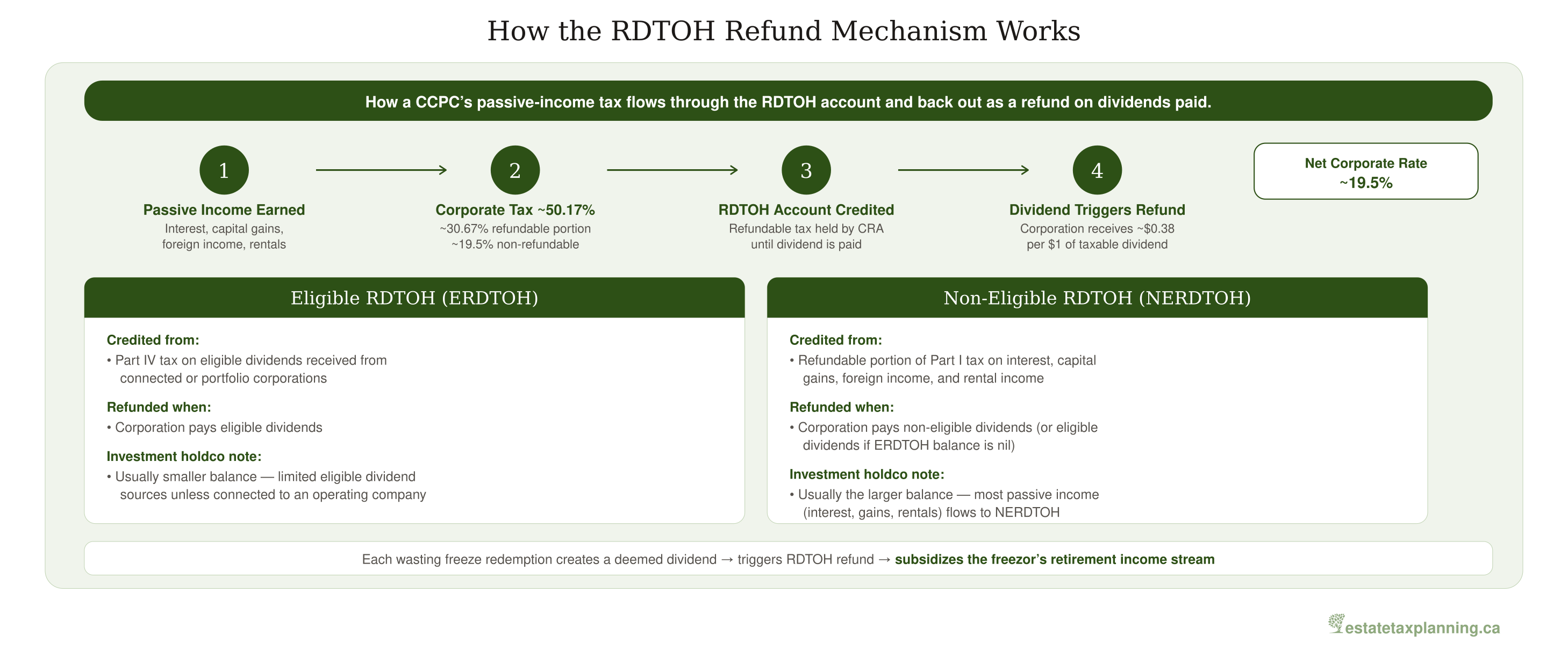
| Eligible RDTOH (ERDTOH) | Non-Eligible RDTOH (NERDTOH) | |
|---|---|---|
| Income source credited | Part IV tax on eligible dividends received from connected or portfolio corporations | Refundable portion of Part I tax on interest, capital gains, foreign income, and rental income |
| Refund triggered by | Paying eligible dividends | Paying non-eligible dividends (or eligible dividends if ERDTOH is nil) |
| Typical balance for investment holdcos | Smaller — limited eligible dividend sources unless connected to an operating company | Larger — most passive income (interest, gains, rentals) flows here |
| Wasting freeze interaction | Refund if redemptions create eligible dividends and ERDTOH has a balance | Primary refund source — most wasting freeze redemptions create non-eligible deemed dividends |
- Each preferred share redemption in a wasting freeze creates a deemed dividend.
- That deemed dividend triggers a refund from the corporation’s RDTOH account — recovering roughly $0.38 per $1 of dividends. It’s money the corporation already paid to CRA that comes back.
- This means the wasting freeze doesn’t just reduce the estate tax bill — it also unlocks refundable taxes the corporation has already paid. For many clients, this is the part that makes the whole structure click.
- The RDTOH refund effectively subsidizes the retirement income stream from the wasting freeze. We model this cash flow as part of every wasting freeze schedule.
The AAII Clawback of the Small Business Deduction
Beyond the RDTOH system, passive investment income also affects associated operating companies. Under subsection 125(5.1) of the ITA, every dollar of adjusted aggregate investment income earned by an associated corporate group above $50,000 reduces the small business deduction by $5. At $150,000 of passive income, the small business deduction is eliminated entirely.
If you hold both an investment holding company and an operating company, the passive income earned by the holding company can affect the tax rate on the operating company’s active business income — potentially increasing it from approximately 11.2% to 26.5% in Ontario. Your tax advisor should model these interactions as part of the freeze planning, particularly if the investment portfolio is large enough to generate more than $50,000 of annual investment income.
- An investment holding company earns $80,000 of passive investment income in a year.
- The excess over the $50,000 threshold is $30,000. The SBD clawback is $30,000 × $5 = $150,000 of reduced business limit.
- If an associated operating company earns $500,000 of active business income, only $350,000 is now eligible for the small business rate.
- The remaining $150,000 is taxed at the general corporate rate (~26.5%) instead of the small business rate (~11.2%) — an additional tax cost of approximately $22,950 per year.
- At $150,000 of passive income, the SBD is eliminated entirely, and all $500,000 of active business income is taxed at the general rate.
- Ontario Budget 2026 reduces the provincial small business rate from 3.2% to 2.2%, effective July 1, 2026.
- The combined federal-Ontario small business rate drops from 12.2% to 11.2%. For corporations with a December 31 year-end, the blended 2026 rate is approximately 11.7% (six months at each rate).
- A related change: Ontario’s non-eligible dividend tax credit rate will decrease from 2.9863% to 1.9863% in 2027, increasing the top combined non-eligible dividend tax rate from 47.74% to 48.89%.
- Wasting freeze redemptions paid as non-eligible dividends after January 1, 2027 will therefore carry a slightly higher personal tax cost — factor this into multi-year redemption schedules.
TOSI Limitations
The TOSI rules limit income splitting through investment holding companies, and this is an area where the rules bite hard. The “excluded business” exception — which requires active involvement in the business on a regular, continuous, and substantial basis — doesn’t apply to a passive holding company. There’s simply no business to be active in.
The “excluded shares” exception may be available in narrower circumstances. To qualify, the family member must be at least 25, must hold shares directly (not through a trust — the CRA has confirmed that trust ownership doesn’t qualify), and must hold at least 10% of the votes and value of the corporation. Even then, the “reasonable return” test applies, and for passive investment income, the CRA’s view of what constitutes a reasonable return to a family member who contributed no capital and took no risk is quite restrictive.
For individuals aged 65 and older, split income from a corporation is excluded from TOSI regardless of the source. This opens meaningful income-splitting opportunities in retirement. Planning for TOSI should begin at the time of the freeze, not after — the structure of the shareholdings and the choice between trust and direct ownership has significant TOSI consequences.
Corporate Attribution Rules
This is the issue that trips up investment holding company freezes more than any other. Section 74.4 attributes income back to the transferor at the prescribed rate (currently 3%) on the value of the property transferred whenever one of the main purposes is to reduce the transferor’s income and benefit a “designated person” — typically a spouse or minor.
The critical issue for investment holding companies is that the exception to section 74.4 only applies to “small business corporations” — defined as Canadian-controlled private corporations where substantially all assets are used in an active business. An investment holding company, by definition, does not meet this test. This means that if the freezor’s spouse or minor children are beneficiaries of the new common shares (whether directly or through a trust), the corporate attribution rule will apply, and income will be attributed back to the freezor at the prescribed rate.
This doesn’t make the freeze unworkable, but it’s a cost that has to be modelled upfront. The attributed income equals the prescribed rate (currently 3%) multiplied by the fair market value of the property transferred. If the corporation’s investments earn more than 3%, the freeze strategy is still beneficial overall. But the attribution erodes part of the income-splitting advantage that the freeze was designed to achieve — and at lower return rates, it can wipe it out entirely.
- The small business corporation exception to section 74.4 does not apply to investment holding companies. This is the single biggest difference from an operating business freeze.
- If a spouse or minor benefits from the freeze (as a common shareholder or trust beneficiary), income will be attributed back to the freezor at the prescribed rate (currently 3%).
- Unlike operating business freezes, there is no way to avoid this attribution by meeting the SBC test. You have to plan around it using prescribed-rate loans or by excluding designated persons.
- Model the attribution cost against the expected investment return before proceeding. We’ve seen families proceed without this analysis and then be unpleasantly surprised at the annual tax cost.
- The freezor transfers $5,000,000 of investments to an investment holding company. Spouse and children hold common shares through a family trust.
- Attribution under section 74.4: $5,000,000 × 3% prescribed rate = $150,000 of income attributed to the freezor annually.
- At the top Ontario marginal rate of 53.53%, this attribution costs the freezor approximately $80,295 per year in personal tax.
- If the portfolio earns 6% ($300,000), only the excess over the prescribed rate ($150,000) effectively benefits the family members.
- Compare: if the portfolio earns only 3%, the attribution wipes out the entire income-splitting benefit — the family members receive growth, but all current income is attributed back.
- This cost persists annually as long as the designated persons benefit. For a lower-return portfolio, it may make the freeze uneconomical.
- In Canada v. DAC Investment Holdings Inc. (2026 FCA 35), the Federal Court of Appeal applied GAAR to a corporation that continued to a foreign jurisdiction solely to exit the CCPC regime before realizing a capital gain.
- The case is a direct warning for investment holdco planning. Any structure that changes a corporation’s CCPC status — through foreign continuance or otherwise — primarily to reduce Canadian tax on a future gain is now at meaningful GAAR risk.
Inter-Corporate Dividends, RDTOH, and the Safe Income Trap
If your investment holding company sits within a corporate group — say, it receives dividends from an operating company, or the freeze structure involves both an opco and a holdco — the inter-corporate dividend rules become a critical planning consideration. This is where we see some of the most expensive mistakes.
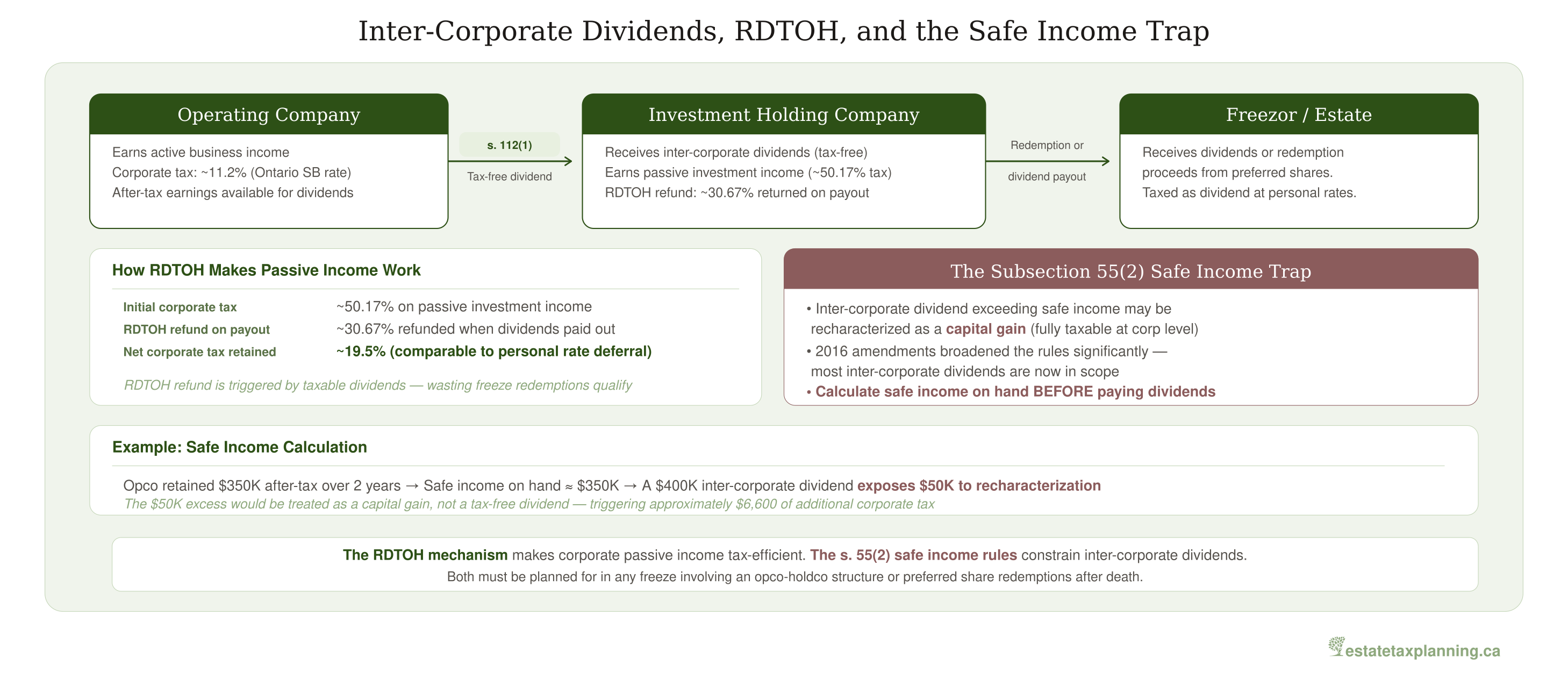
The general rule is straightforward. When a Canadian corporation pays a taxable dividend to another Canadian corporation that controls it or is connected to it, the receiving corporation can generally deduct the full amount under subsection 112(1) of the ITA, resulting in no additional tax on the dividend. This is the mechanism that allows profits to flow from an operating company to a holding company on a tax-free basis — enabling creditor protection, asset purification, and retirement income planning through the holdco structure.
However, not all inter-corporate dividends are automatically safe. Subsection 55(2) is an anti-avoidance rule that can recharacterize a tax-free inter-corporate dividend as a capital gain if the dividend exceeds the corporation’s “safe income on hand” attributable to the relevant shares. Safe income is essentially the after-tax retained earnings that have accumulated on a specific class of shares since they were last acquired.
The 2016 amendments to subsection 55(2) significantly broadened its scope. Before 2016, inter-corporate dividends between related parties were generally exempt. After the amendments (applicable to dividends received after April 20, 2015), the related-party exception was narrowed dramatically, and most inter-corporate dividends are now caught unless they can be supported by safe income. Advisors who are working from pre-2016 assumptions should update their analysis.
- An operating company earned $500,000 of active business income over the past two years.
- After corporate tax at ~11.2% (Ontario small business rate): approximately $444,000 of after-tax retained earnings.
- Less: dividends previously paid, reserves, and other adjustments: ($94,000).
- Safe income on hand attributable to the shares: approximately $350,000.
- If the holdco pays an inter-corporate dividend of $400,000, the $50,000 excess over safe income may be recharacterized as a capital gain — triggering approximately $6,600 of additional corporate tax.
- Always calculate safe income before paying inter-corporate dividends, especially on preferred share redemptions after the freezor’s death. We build this calculation into every freeze file from day one.
Implementation
The mechanics of the freeze are the same as for an operating business — the four steps we’ve walked through earlier in this series. The valuation approach and some planning considerations differ, but the structure is familiar.
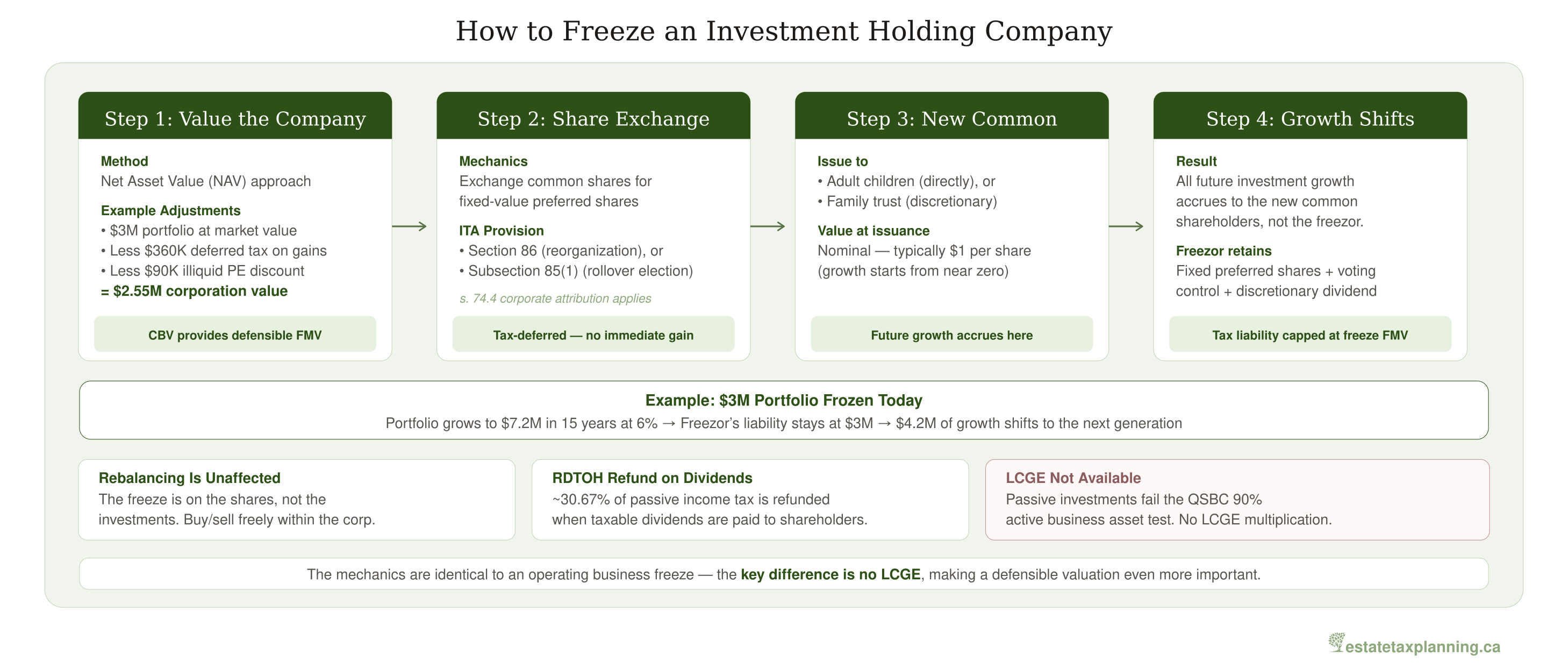
If the investment holding company doesn’t already exist, you’ll need to incorporate one and transfer the portfolio into it. This transfer can typically be done on a tax-deferred basis using subsection 85(1), but it requires careful planning. Each security or class of property may require its own election, and the elected amount for each must be at least equal to the lesser of cost and fair market value. Filing deadlines are strict, and late-filed elections carry penalties.
Corporate attribution under section 74.4 also needs to be addressed at this stage — not later. If the transfer is structured so that a spouse or minor will benefit through the new common shares, the attribution begins immediately and applies to the fair market value of the property transferred. This is the time to model the cost and decide whether to structure the freeze to exclude designated persons, or to accept the attribution as a cost of the broader estate planning benefit.
- When transferring an existing portfolio into a new corporation, a blanket election is not sufficient — each security or class of property typically requires its own election. For a diversified portfolio, this can mean dozens of individual elections.
- The elected amount must be at least the lesser of cost and fair market value for each property. Getting this wrong on even one line can trigger an unexpected gain.
- Filing deadlines are strict, and late-filed elections under subsection 85(7.1) carry penalties of $100 per month to a maximum of $8,000.
- Work with your tax advisor to prepare and file the elections on time. We prepare a property-by-property schedule as part of the engagement.
Real Estate Holding Companies
If your corporation primarily holds real estate — commercial properties, rental units, or development land — the freeze mechanics are the same, but there are several additional wrinkles that can significantly affect the planning and the economics.
Land Transfer Tax
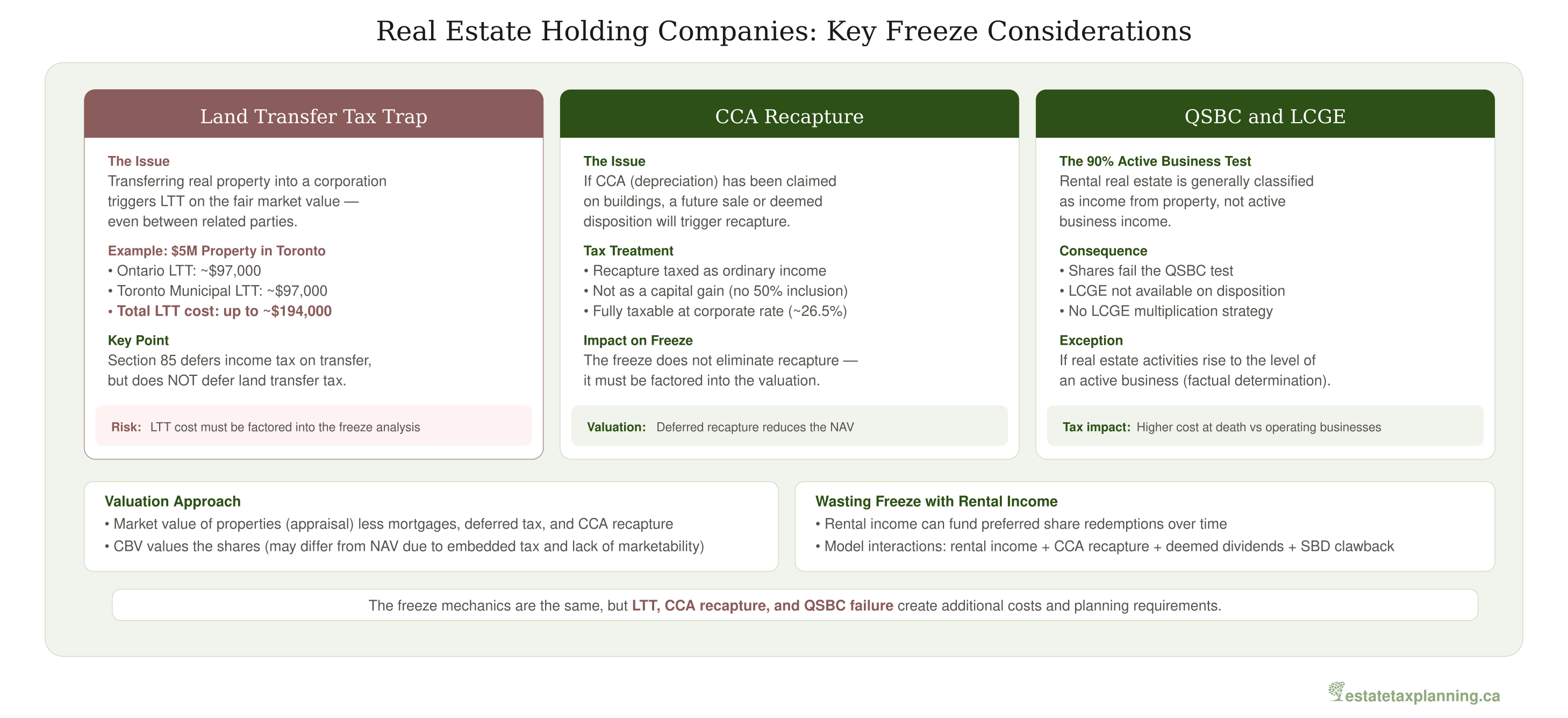
The freeze itself — exchanging shares for shares — doesn’t involve a transfer of the real property and therefore doesn’t trigger land transfer tax. But if the freeze involves transferring real property into a corporation for the first time, land transfer tax applies on the fair market value of the property, even between related parties.
In Ontario, the combined provincial and municipal land transfer tax on a $5 million commercial property can reach approximately $194,000 in Toronto. A subsection 85(1) rollover defers the income tax on the transfer, but it doesn’t defer the land transfer tax. This cost has to be factored into the freeze analysis — and in some cases, it can tip the economics against incorporating the real estate at all.
Depreciation Recapture
If the corporation has claimed capital cost allowance on its buildings, a future sale or deemed disposition will trigger recapture of the CCA previously claimed. This recapture is taxed as ordinary income — not as a capital gain — at the applicable corporate rate of approximately 26.5% in Ontario. The freeze doesn’t eliminate recapture. It remains a liability that will eventually be triggered, and it has to be reflected in the valuation.
Valuation Considerations
Real estate holding companies are typically valued on a net asset value basis. An accredited appraiser values the underlying properties using comparable sales, income capitalization, or discounted cash flow approaches. The CBV then values the corporation’s shares, which may be worth less than the simple NAV due to the embedded tax liability on unrealized capital gains and depreciation recapture, as well as any applicable discount for lack of marketability.
QSBC Qualification
A corporation that primarily holds rental real estate will generally not qualify as a qualified small business corporation, because rental income is classified as income from property rather than active business income. This means the LCGE is unavailable on a sale or deemed disposition of the shares. The exception is where the corporation’s real estate activities rise to the level of an active business — a factual determination that depends on the level of management, staffing, and services provided.
- Under subsection 125(5.1), passive investment income above $50,000 reduces the small business deduction for associated operating companies.
- Rental income earned by a real estate holding company counts toward this threshold. A lot of clients don’t realize rental income gets caught here.
- If the freezor’s corporate group includes both an opco and a real estate holdco, the rental income can erode the opco’s SBD — increasing the corporate tax rate from ~11.2% to ~26.5% in Ontario.
- Model these interactions before structuring the freeze. We run the SBD clawback numbers on every freeze involving a holding company.
The Wasting Freeze: Why It Works So Well Here
Because an investment holding company is essentially a pool of liquid assets, the wasting freeze — gradually redeeming preferred shares to fund retirement — is particularly easy to implement. The corporation can sell investments to fund the redemptions without needing to sell a business, find a buyer, or wait for a liquidity event. This makes the investment holding company an ideal candidate for a wasting freeze strategy.
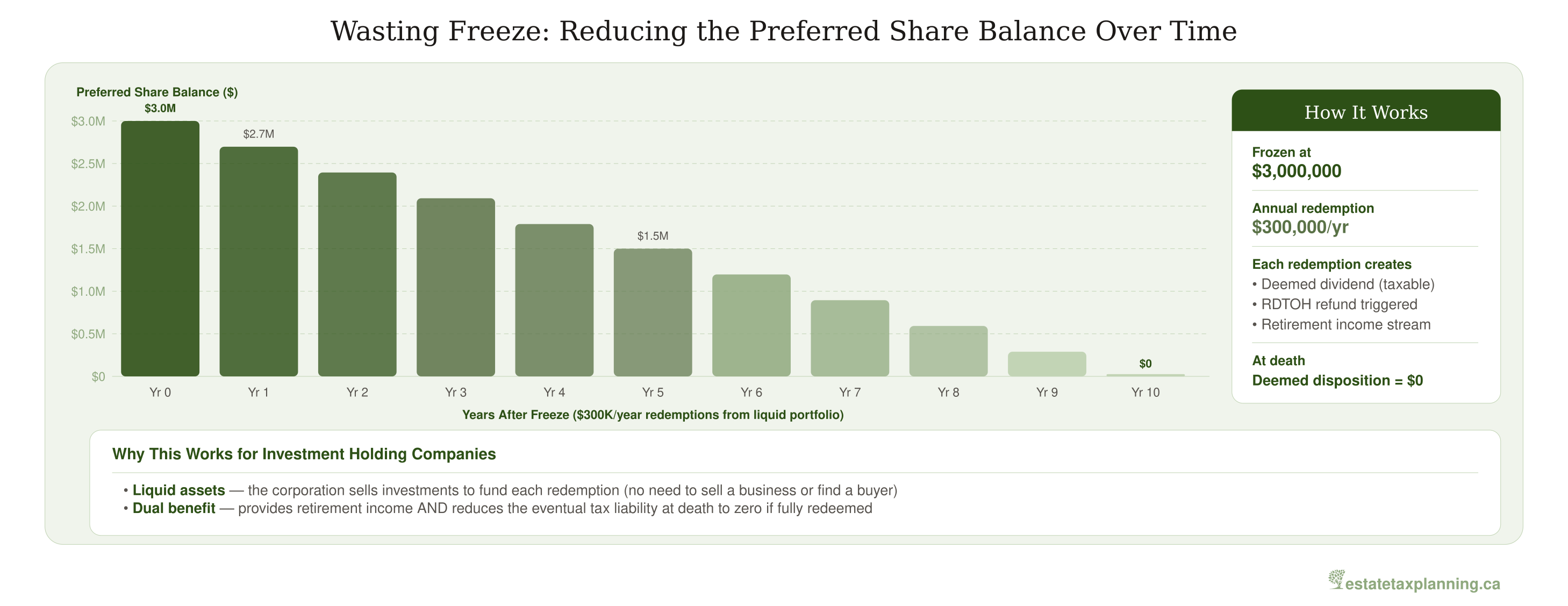
Each preferred share redemption reduces the freezor’s outstanding liability at death. If the preferred shares are fully redeemed before death, the deemed disposition at death is zero — no capital gain, no tax. The freezor gets a regular income stream during retirement, and the estate avoids the liquidity crunch that so often accompanies a large tax bill at death. It’s one of the most elegant solutions in the estate planning toolkit.
- Preferred shares frozen at $3,000,000.
- Annual redemption: $300,000 per year for 10 years.
- Each redemption creates a deemed dividend (excess of redemption amount over paid-up capital).
- Deemed dividend triggers RDTOH refund to the corporation (~$0.38 per $1 of dividend).
- After 10 years, preferred share balance = $0. Deemed disposition at death = $0.
- Total retirement income: $3,000,000 (before personal tax on deemed dividends).
- Personal tax on the deemed dividends, RDTOH refund timing, OAS clawback exposure, and TOSI for any family members under 65 all need to be modelled alongside this schedule — they’re what determine the after-tax result.
For real estate holding companies, rental income can fund the redemptions, providing a natural cash flow source. However, the interaction between rental income, depreciation recapture, deemed dividends on redemption, and the SBD clawback must be carefully modelled. Each redemption creates a deemed dividend, and the tax treatment of that deemed dividend depends on the corporation’s RDTOH balance, CDA balance, and GRIP/LRIP accounts.
Estate Planning Considerations
An investment holding company freeze creates specific estate planning issues that differ from operating business freezes. These need to be addressed at the time of the freeze — not left for the estate to sort out after death.
Deemed Disposition at Death and the Tax Bill
When the freezor dies, the preferred shares are deemed to be disposed of at fair market value under subsection 70(5). For an investment holding company, that fair market value equals the redemption amount — the frozen value. If the preferred shares haven’t been reduced through a wasting freeze, the full accrued gain hits the final return.
And because the LCGE is unavailable for investment holding companies, the entire gain is taxed at the applicable rate. At Ontario’s top combined rate of approximately 53.53% on the taxable portion of a capital gain (at 50% inclusion), a $5 million gain results in approximately $1,338,000 of tax on the final return. That’s a significant liquidity demand on the estate, and it has to be planned for well in advance.
- A corporate-owned life insurance policy can fund the tax liability at death. For investment holdcos without LCGE access, insurance is often the most important piece of the plan.
- The death benefit is received tax-free by the corporation and credited to the capital dividend account (CDA) to the extent of the death benefit minus the policy’s adjusted cost basis.
- The CDA balance can then be paid out as a tax-free capital dividend to the estate or surviving shareholders.
- This converts the tax liability into a series of predictable premium payments during the freezor’s lifetime. We coordinate the insurance amount directly with the freeze valuation.
- The insurance proceeds can also be used to redeem the preferred shares from the estate, providing the liquidity needed to pay the tax bill without forcing the sale of portfolio assets at an inopportune time. Selling into a down market to fund taxes is exactly the scenario we’re trying to prevent.
Post-mortem planning for investment holding companies follows the same principles as for operating businesses: the estate’s advisors should evaluate the pipeline election, the loss carryback under subsection 164(6), and the potential for a subsection 88(1)(d) bump on eligible assets. These strategies are explored in Post-Mortem Planning.
The 21-Year Rule and Trust-Held Common Shares
If the new common shares issued in the freeze are held by a family trust — as they often are, for income splitting and estate planning flexibility — the 21-year deemed disposition rule under subsection 104(4) applies. Every 21 years, the trust is deemed to have disposed of its capital property at fair market value, triggering a capital gain on any appreciation.
- If the trust is created as part of the freeze, the 21-year clock starts on the date the trust acquires the common shares.
- For a family trust created in 2026, the first deemed disposition occurs in 2047. If the portfolio has grown significantly by then, the tax bill can be substantial.
- Strategies to manage the 21-year rule include distributing property to capital beneficiaries before the anniversary, selling shares to a beneficiary, or implementing a refreeze at the trust level.
- This is a critical planning point that is often overlooked — and it applies regardless of whether the underlying corporation is an operating business or an investment holding company. We start the 21-year conversation with every trust client well before the anniversary date.
The Refreeze Option
If the investment portfolio has declined in value since the original freeze — say, after a significant market downturn — the freezor may be locked into a frozen value that’s higher than what the corporation is actually worth. The preferred shares have a redemption value that exceeds the corporation’s net asset value, creating an economic mismatch and an unnecessarily high tax liability at death.
A refreeze fixes this. The freezor exchanges the original preferred shares for new ones at the current (lower) fair market value, effectively resetting the frozen amount to match reality. For investment holding companies, a refreeze is particularly relevant because portfolio values can fluctuate significantly with market conditions, and the NAV-based valuation makes the decline straightforward to document.
Non-Resident Beneficiaries
If any beneficiaries of the family trust — or direct common shareholders — are non-residents of Canada, additional tax considerations apply. Dividends paid to non-residents are subject to Part XIII withholding tax (typically 25%, reduced to 15% under most tax treaties), and distributions of trust income or capital to non-resident beneficiaries may trigger additional reporting obligations. The cross-border implications can significantly affect the economics of the freeze and should be modelled before the freeze is implemented. See Cross-Border Complications for a full walk-through.
- Threshold question: should the investments be held in a corporation at all? Analyze the breakeven holding period for corporate vs personal ownership before proceeding.
- Confirm whether the LCGE is available — if the corporation fails the 90% active business asset test, plan for the full tax cost at death with no LCGE cushion.
- Model the corporate attribution cost under section 74.4 — the SBC exception does not apply, so any designated person benefiting from the freeze triggers attribution at the prescribed rate.
- Track RDTOH balances (ERDTOH and NERDTOH) — each wasting freeze redemption triggers a refund that subsidizes retirement income.
- Calculate safe income on hand before paying inter-corporate dividends or redeeming preferred shares after death — the 2016 amendments to subsection 55(2) apply broadly.
- For real estate holdcos, factor in land transfer tax on any property transfers, CCA recapture on buildings, and the impact of rental income on an associated operating company’s SBD.
- Consider life insurance to fund the deemed disposition tax at death — particularly important because the LCGE is unavailable.
- If common shares are held by a family trust, calendar the 21-year deemed disposition date and plan distribution or refreeze strategies in advance.
- If portfolio values have declined, evaluate a refreeze to reset the frozen amount to current fair market value.
- If any beneficiaries are non-residents, model Part XIII withholding tax and treaty implications before implementing the freeze.
Three adjacent pieces in this series are particularly relevant. The attribution mechanics that bite so hard for passive portfolios are walked through in Corporate Attribution Rules; the wasting freeze strategy that fits liquid portfolios so well is introduced in Freeze, Gel, Thaw, and Wasting Freeze; and the 21-year deemed disposition that will one day catch any trust holding the new common shares is covered in The 21-Year Rule and the Family Trust.
For definitions of the key terms used in this article — including investment holding company, net asset value, RDTOH, ERDTOH, NERDTOH, safe income on hand, wasting freeze, and corporate attribution — see our Key Terms and Definitions reference guide.
Your tax advisor, CBV, and legal counsel can help you evaluate how this applies to your situation — a structured review of the portfolio composition, the active-vs-passive asset mix, the attribution cost, and the wasting freeze schedule is usually what separates an investment holdco freeze that works from one that doesn’t.
This article is for informational purposes only and does not constitute legal, tax, or financial advice. Estate freezes are complex transactions that require the coordinated involvement of qualified tax, valuation, and legal professionals. Always consult your advisors before acting on any of the information discussed here.