
The tax rules are federal, but probate fees, trust law, family law, and professional corporation restrictions vary by province. Ontario’s 1.5% estate administration tax makes dual wills essential. Quebec’s civil law creates unique trust structures and forced heirship rules. British Columbia’s WESA introduces will variation claims that can override freeze planning. Know your province’s rules before finalizing the structure.
The income tax rules governing estate freezes are federal, which means the core mechanics work the same way whether you’re in Toronto, Vancouver, or Montreal. But the legal framework, probate regime, and professional corporation rules vary significantly by province — and those differences can affect the structure of your freeze, the probate savings available, and the legal documents required.
In this article, we compare the three provinces where we see the most estate freeze activity: Ontario, Quebec, and British Columbia.
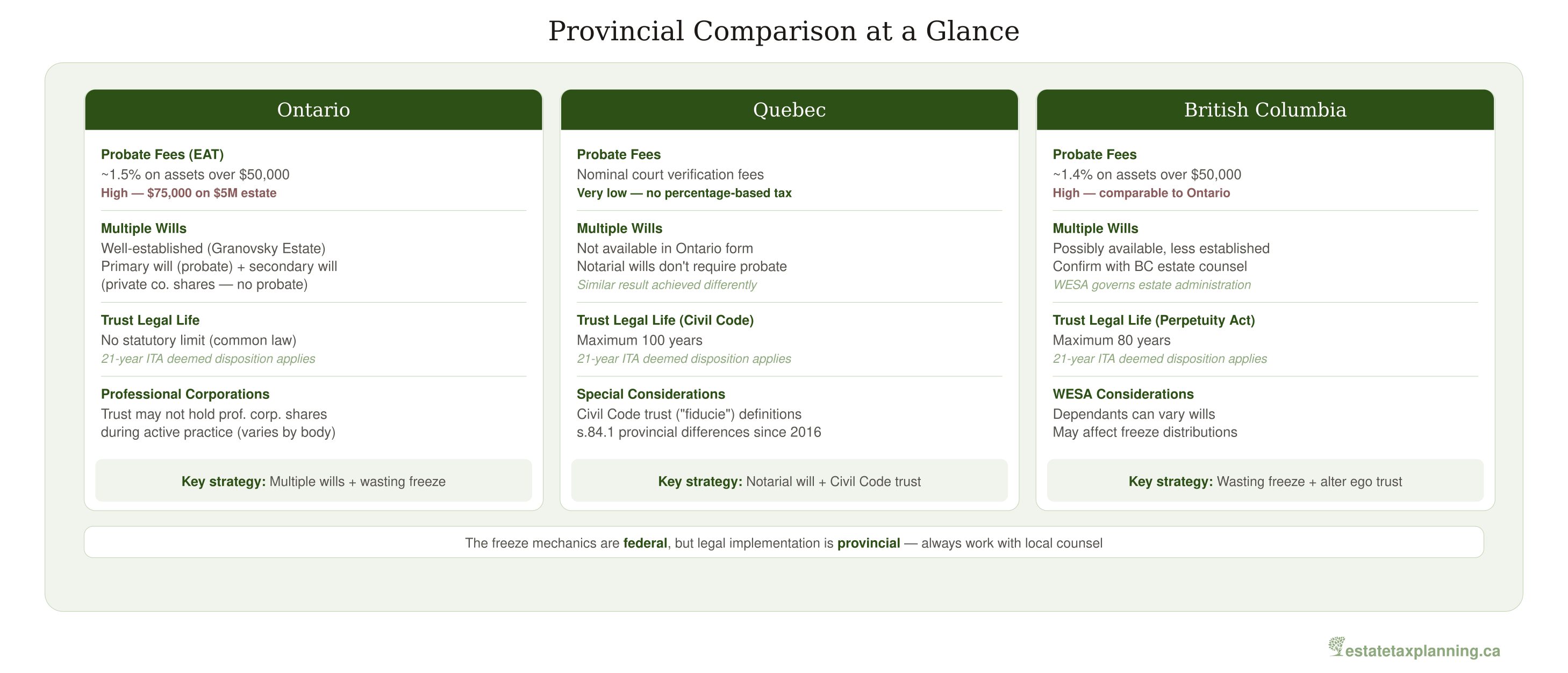
Provincial Comparison at a Glance
Ontario
Probate Fees (Estate Administration Tax)
Ontario has among the highest probate fees in Canada, at approximately 1.5% on estate assets exceeding $50,000. On a $5 million estate, that’s approximately $74,250 — a number that gets our clients’ attention right away. It makes probate planning a significant consideration for any Ontario business owner.
Multiple Wills Strategy
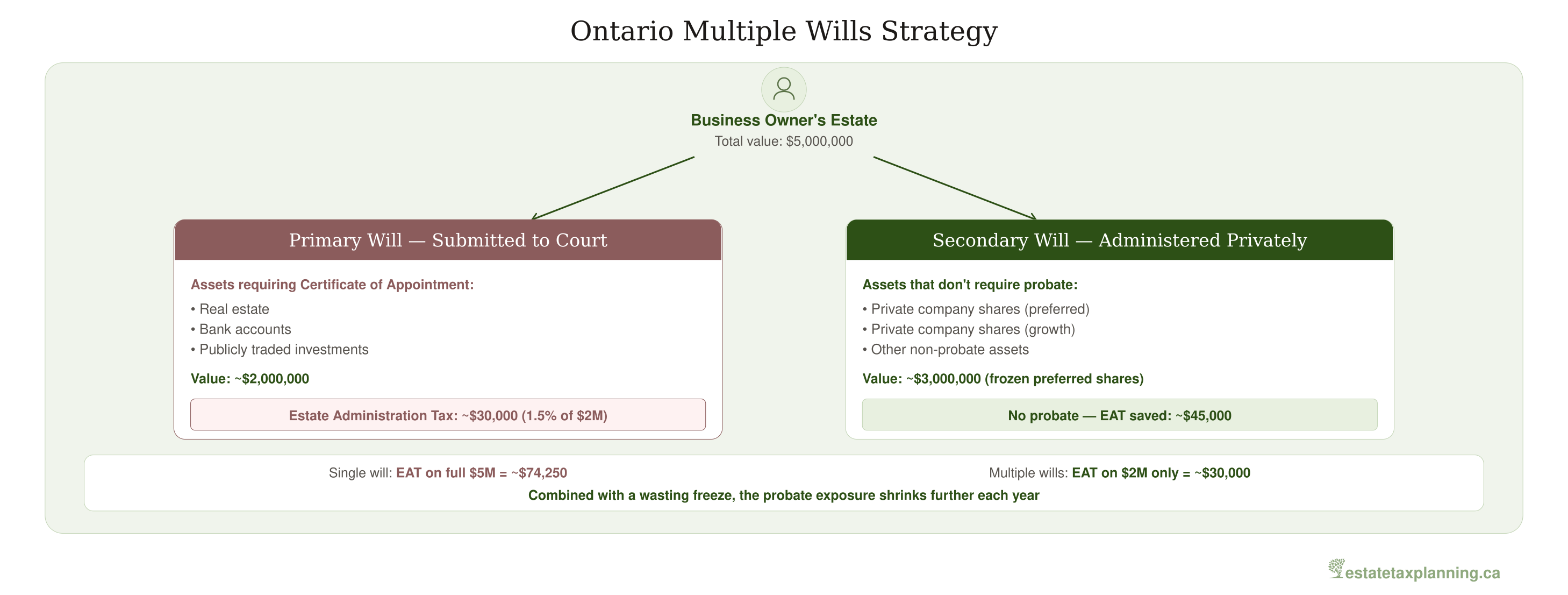
Ontario is the leading jurisdiction for the multiple (or dual) wills strategy, validated by the Ontario Court (General Division) in Granovsky Estate v. Ontario. The concept is straightforward: instead of a single will, the estate plan uses two wills. The "primary will" covers assets that require a Certificate of Appointment (probate) to transfer — typically real estate and bank accounts. The "secondary will" covers assets that do not require probate — most importantly, private company shares. Only the primary will is submitted to the court and subject to the Estate Administration Tax. The secondary will is administered privately by the estate trustee.
Both the freezor's (the business owner who implemented the freeze) preferred shares and any growth shares held directly (rather than through a trust) are private company shares that can be dealt with under the secondary will. If the freezor holds $3 million in preferred shares, the multiple wills strategy saves approximately $45,000 in probate fees (1.5% of $3 million). When combined with a wasting freeze — a strategy that gradually redeems the preferred shares during the freezor's lifetime, reducing the frozen value over time — the probate exposure shrinks further each year.
- Private company shares avoid probate in Ontario when held under a secondary will. This is one of the easiest wins in the entire plan.
- On a $3 million freeze, savings equal approximately $45,000 in Estate Administration Tax. That’s real money for what amounts to a drafting choice.
- Combine multiple wills with a wasting freeze to reduce probate exposure even further.
- The multiple wills strategy was validated by the Ontario Court (General Division) in Granovsky Estate. We rely on this in virtually every Ontario freeze.
Implementation Considerations
The two wills must be carefully drafted to avoid conflicts. Each will should clearly identify which assets it governs. The secondary will should appoint the same estate trustee as the primary will (or a coordinated trustee) to avoid administrative confusion. One thing we always flag for clients: some financial institutions may still request a Certificate of Appointment before releasing assets, even for private company shares. Your estate lawyer should confirm in advance that the corporate minute book and share register are sufficient for the transfer. The multiple wills strategy should be implemented at the same time as the estate freeze and updated whenever the corporate structure changes.
The primary and secondary wills must be coordinated to avoid conflicts and administrative confusion. Appoint the same trustee to both, clearly delineate assets in each will, and confirm with financial institutions that share register documentation is sufficient for asset transfer.
Alter Ego and Joint Partner Trusts as a Probate Alternative
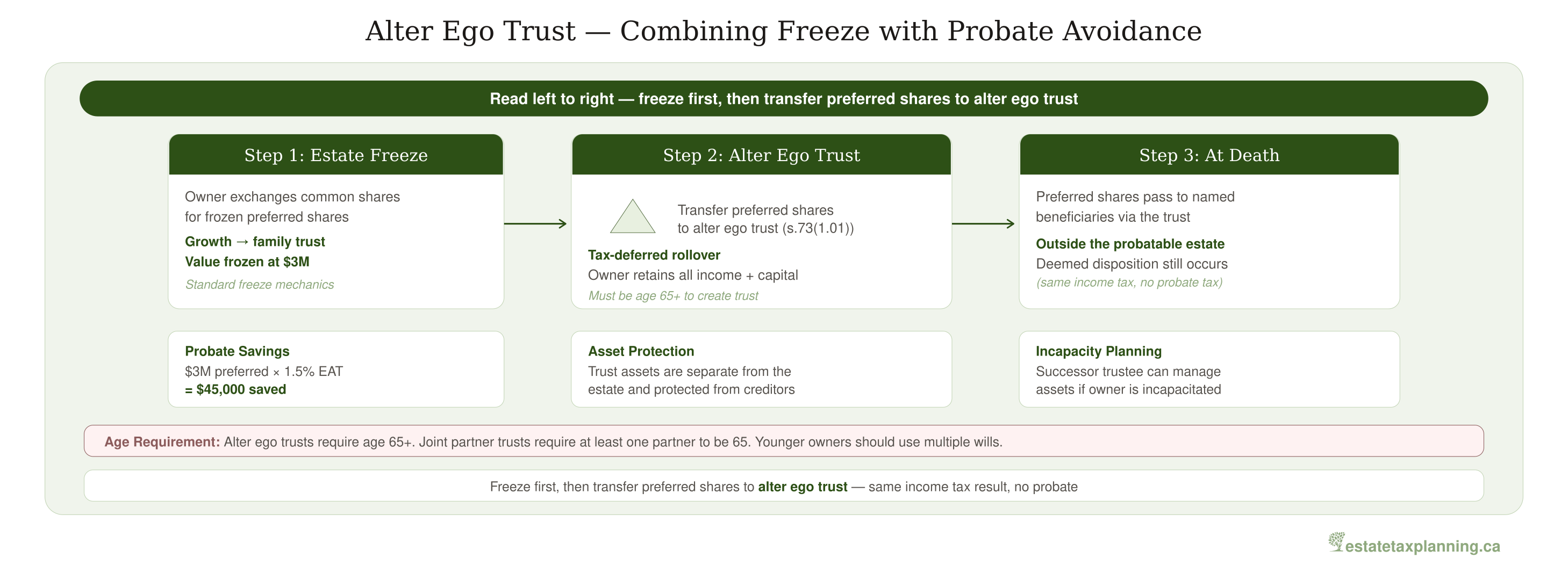
For Ontario business owners aged 65 or older, an alter ego trust (for individuals) or a joint partner trust (for couples) offers a powerful probate alternative. These trusts allow you to transfer property — including your frozen preferred shares — to the trust on a tax-deferred rollover basis. During your lifetime (or both partners' lifetimes), you retain the right to all income and capital from the trust. At death, the assets pass to the named beneficiaries outside of your probatable estate, avoiding the Estate Administration Tax entirely.
This strategy can be combined with the estate freeze: implement the freeze first (locking in value and transferring growth), then transfer the preferred shares into a joint partner trust (removing them from probate). The income tax result is the same as holding the shares personally — the deemed disposition still occurs at the death of the surviving partner — but the probate savings are the same as the multiple wills approach. What our clients appreciate most is that the alter ego or joint partner trust also provides asset protection and incapacity planning benefits that a simple will doesn’t.
- Multiple wills: Simple, cost-effective, works for any age, court-validated approach. This is our default recommendation for most Ontario clients.
- Alter ego/joint partner trust: Provides asset protection and incapacity planning in addition to probate savings. We recommend this for clients over 65 with more complex situations.
- Both strategies achieve the same result on a $3 million freeze: approximately $45,000 in EAT savings.
- Choose based on your need for incapacity planning and asset protection, not just probate avoidance. We walk through both options with every client.
The Trade-Offs of an Alter Ego Trust
While the alter ego trust offers real probate and incapacity planning advantages, it comes with meaningful costs and limitations that we always walk through with clients before they commit.
Principal residence exemption (PRE) complications. If the family home is transferred into the alter ego trust, the PRE may still be available — but only if the settlor ordinarily inhabits the property and no other property is designated as a principal residence for the same period. The post-2016 rules significantly tightened PRE eligibility for trusts, and the requirements are strict. If the trust fails to meet them, the home's appreciation becomes fully taxable at death. Your tax advisor should confirm PRE eligibility before transferring real property into the trust.
No graduated rate estate (GRE) treatment. Assets held in the alter ego trust at death are not part of the deceased's estate for the purposes of the graduated rate estate rules. This means the trust is taxed at the top marginal rate from the outset, rather than benefiting from the graduated tax brackets available to a GRE for up to 36 months after death. On a large deemed disposition, this can cost tens of thousands of dollars in additional tax.
Ongoing trust administration costs. An alter ego trust requires its own annual T3 trust return, separate investment accounts, and professional administration. The T3 filing itself may cost only a few hundred dollars, but total annual administration — accounting, legal, and investment management — typically runs $2,000 to $5,000 per year depending on the complexity of the trust's assets. These ongoing costs continue for the life of the trust and must be weighed against the one-time probate savings.
Irrevocability and complexity. Once the preferred shares are transferred into the trust, the transfer is effectively irrevocable — the shares cannot be returned to the individual without triggering a taxable disposition. If circumstances change (for example, the business owner needs to sell the shares or restructure the corporation), the trust structure adds a layer of legal and tax complexity.
Setup costs. Legal fees for establishing an alter ego or joint partner trust typically range from $3,000 to $10,000, depending on the complexity of the assets being transferred. This is in addition to any costs associated with the freeze itself.
The probate savings from an alter ego trust must be measured against potential PRE complications, loss of GRE graduated rates, ongoing administration costs, and setup fees. In some cases — particularly where the home is the most valuable asset — the tax cost of the trust exceeds the probate savings. Run the full comparison before committing.
Professional Corporation Restrictions
As discussed in Estate Freezes for Professional Corporations, Ontario professional regulators generally restrict who may hold voting shares in a professional corporation. The rules vary by profession: some regulators permit trusts to hold non-voting shares (for example, the Royal College of Dental Surgeons of Ontario allows non-voting shares to be held in trust for minor children), while others impose stricter limits. In most cases, the voting common shares must remain with the practising professional during active practice. This constrains the freeze structures available — particularly the ability to use a family trust to hold growth shares — and makes it essential to confirm the specific rules with the applicable regulator before implementing a freeze.
Corporate Law
Ontario's Business Corporations Act (OBCA) governs the corporate mechanics of the freeze (share classes, articles of amendment, resolutions). The OBCA is well-established and provides a flexible framework for freeze transactions.
Quebec
Probate Fees
Quebec has only nominal court verification fees for wills that are not notarized. There is no percentage-based probate tax. This means the probate savings argument for an estate freeze is much weaker in Quebec than in Ontario or BC.
Civil Code Trust Rules
Quebec trusts ("fiducies") are governed by the Civil Code of Quebec rather than common law. Under the Civil Code, a trust has a maximum legal life of 100 years (compared to no statutory limit in common law provinces). However, the 21-year deemed disposition rule under the Income Tax Act still applies regardless of the trust's legal life. The concepts of settlor, trustee, and beneficiary exist in Quebec but are defined somewhat differently under the Civil Code.
Section 84.1 and Provincial Tax Asymmetries
This is one that catches people off guard. Quebec has not yet confirmed whether it will adopt the federal intergenerational transfer rules enacted in 2024, meaning that transfers structured under the new rules may face different tax treatment in Quebec. That can create asymmetries between the federal and Quebec tax treatment in some freeze scenarios. Your tax advisor should model both the federal and provincial tax outcomes when structuring a freeze involving a Quebec corporation.
In Quebec, the provincial tax treatment of certain share transactions may differ from the federal treatment. Always model both levels of tax when planning a freeze involving a Quebec corporation — a result that works federally may not produce the same outcome provincially.
Multiple Wills
The multiple wills strategy isn’t available in Quebec in the same form as in Ontario. But notarial wills in Quebec don’t require probate at all, which achieves a similar result without the complexity.
Family Patrimony
Quebec's family patrimony regime is unique in Canada and can directly affect estate freeze planning. Under Quebec's Civil Code, certain assets are automatically subject to equal partition between spouses on the dissolution of a marriage — including death. The family patrimony includes the family residence, household furnishings, vehicles, and certain pension rights, regardless of who holds title.
While private company shares are generally excluded from the family patrimony, the interaction isn’t always straightforward. If freeze proceeds were used to acquire a family residence, or if the value of the shares is reflected in registered retirement savings, the partition rules may apply indirectly. More importantly — and this is the part that often surprises Ontario-trained advisors — the surviving spouse’s right to the family patrimony is calculated before the estate is distributed. That means the freeze structure must account for this prior claim on the estate.
Quebec also protects the surviving spouse's right to the family patrimony as a statutory entitlement that cannot be overridden by a will — unlike common law provinces, where a will generally governs distribution. Advisors structuring a freeze for a Quebec business owner should ensure the family patrimony calculation has been modelled as part of the estate plan, particularly where the business owner's spouse is not a beneficiary of the freeze trust.
The surviving spouse's right to the family patrimony under the Civil Code of Quebec is calculated and satisfied before the will takes effect. A freeze structure that ignores this prior claim may fail to achieve its intended distribution. Always include the family patrimony calculation in the estate plan for Quebec business owners.
British Columbia
Probate Fees
BC's probate fees are approximately 1.4% on estate assets exceeding $50,000 — comparable to Ontario. On a $5 million estate, BC probate fees total approximately $69,450. This makes the estate freeze and wasting freeze strategies just as valuable for probate reduction in BC as in Ontario. If a business owner freezes $3 million in preferred shares and those shares can be kept outside the probatable estate — through a wasting freeze, alter ego trust, or (potentially) a multiple wills strategy — the probate savings are approximately $42,000.
Multiple Wills
The multiple wills strategy may be available in BC, but unlike Ontario — where the Granovsky decision provides clear judicial endorsement — there is no equivalent BC court decision validating the approach. BC practitioners considering a dual wills strategy should obtain a current legal opinion confirming that WESA and recent case law support the distinction between probatable and non-probatable assets.
Trust Legal Life
Under the Perpetuity Act, trusts in BC can have a legal life of up to 80 years. This provides more runway than in some other provinces, but the 21-year deemed disposition rule under the Income Tax Act still applies independently of the trust's legal life.
WESA Will Variation Risk
BC's Wills, Estates and Succession Act includes a powerful will variation provision (Part 4, Division 6) that does not exist in Ontario or most other provinces. Under WESA, a spouse or child of the deceased can apply to the court to vary the will if the court finds that the will does not make "adequate provision" for their proper maintenance and support. This applies even if the will was carefully drafted as part of an estate freeze plan.
Example: A BC business owner completes an estate freeze, issuing growth shares to a family trust for the benefit of two children from a first marriage. The freeze preferred shares are left to the surviving second spouse under the will. The second spouse applies to vary the will, arguing that the preferred shares alone are insufficient — particularly if the business has grown significantly since the freeze and the growth shares (held in trust for the first-marriage children) are now far more valuable. The court may order a redistribution that undermines the intended freeze structure.
The WESA variation risk is particularly acute in blended family situations, where the interests of a surviving spouse and children from prior relationships may conflict. Unlike in Ontario, where dependant support claims are more limited, the BC court has broad discretion to rewrite the distribution. We’ve seen advisors structuring a freeze for a BC business owner underestimate this risk — building in a buffer through life insurance, a spousal trust, or a larger allocation to the surviving spouse can significantly reduce the likelihood of a successful variation claim.
Under WESA, a BC court can vary a will that does not make adequate provision for a spouse or child — even if the will was designed to implement an estate freeze. Blended family situations are especially vulnerable. Consider building a "buffer" into the plan (insurance, spousal trust, or a larger spousal allocation) to reduce variation risk.
Probate Savings: Before and After the Freeze
Let’s put numbers to it. The following table illustrates the probate fee impact of a $5 million estate freeze across all three provinces, comparing the result with no planning, with a freeze and secondary will or alter ego trust, and with a freeze plus a wasting freeze that has redeemed half the preferred shares before death.
| Scenario (probatable estate) | Ontario (EAT) | BC (Probate) | Quebec |
|---|---|---|---|
| No planning — $5M probatable | ~$74,250 | ~$69,450 | ~$65 |
| Freeze + secondary will — $2M probatable (preferred shares removed) | ~$29,250 | ~$27,450 | ~$65 |
| Freeze + wasting freeze + secondary will — $1.5M probatable | ~$21,750 | ~$20,450 | ~$65 |
| Probate savings (scenario 1 vs 3) | ~$52,500 | ~$49,000 | $0 |
In Ontario and BC, the combination of a freeze and probate planning strategies can save $50,000 or more. In Quebec, probate savings are negligible — but the income tax benefits of the freeze (growth shifting, lifetime capital gains exemption multiplication, and tax deferral) remain equally valuable regardless of province.
A Note on Other Provinces
While Ontario, Quebec, and BC account for the majority of estate freeze activity, the probate landscape varies across Canada. Alberta has among the lowest probate costs — a flat fee of approximately $525 for estates over $250,000, regardless of size. Manitoba eliminated its probate fees entirely in November 2020, making it the only province with no probate costs at all. Saskatchewan charges approximately 0.7% on larger estates, while New Brunswick uses a tiered system ranging from 0.5% to 1.5%. These differences matter: in Alberta and Manitoba, probate avoidance is rarely a driver of freeze structure, whereas in high-cost provinces like Ontario and BC, the savings can easily justify the additional complexity and expense of multiple wills or alter ego trusts.
- In low-probate provinces like Alberta, Manitoba, and Quebec, the estate freeze still delivers income tax deferral, growth shifting, and lifetime capital gains exemption (LCGE) multiplication. The income tax benefits dwarf the probate savings in every province.
- Do not skip the freeze just because probate savings are small — the income tax benefits are often far more valuable. We’ve had clients in Alberta assume a freeze wasn’t worth it because probate was cheap. The income tax savings told a very different story.
- Probate avoidance is a bonus in high-cost provinces, not the primary objective of the freeze.
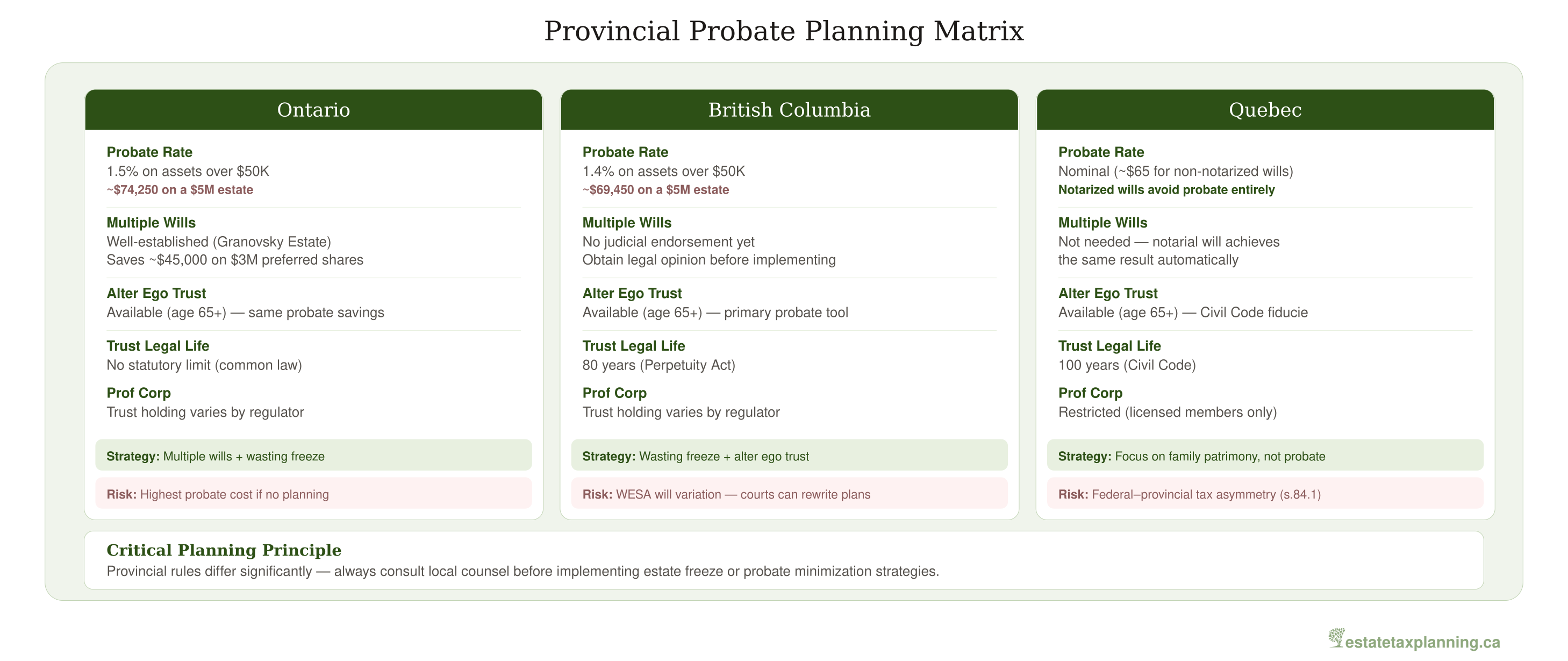
| Factor | Ontario | British Columbia | Quebec |
|---|---|---|---|
| Probate rate | ~1.5% over $50K | ~1.4% over $50K | Nominal (~$65) |
| EAT on $5M estate | ~$74,250 | ~$69,450 | ~$65 |
| Multiple wills | Well-established (Granovsky) | No judicial endorsement yet | Not needed (notarial will avoids probate) |
| Alter ego trust | Available (age 65+) | Available (age 65+) | Available (age 65+) |
| Trust legal life | No statutory limit | 80 years (Perpetuity Act) | 100 years (Civil Code) |
| 21-year ITA rule | Applies | Applies | Applies |
| Prof. corp. trust holding | Varies by regulator | Varies by regulator | Restricted (members only) |
| Key risk | High probate cost if no planning | WESA will variation claims | Federal–provincial tax asymmetry |
- The corporate and trust mechanics of an estate freeze are federal, but the legal implementation is provincial. This is the part most people underestimate.
- Always work with a lawyer who is familiar with the corporate law, trust law, and estate law of your specific province. We’ve seen Ontario-drafted trust deeds used for Quebec clients — and the issues only surfaced years later.
- A trust deed or corporate reorganization that works in Ontario may need modification for Quebec or BC. If you’re crossing provincial lines, get local counsel involved early.
What's Next?
In Alternative Freeze Methods, we explore freeze approaches beyond the standard Section 85 and Section 86 structures.
For more on related topics, see Protecting Estate Freeze Shares from Divorce (structuring freezes to survive family law challenges), Estate Freezes for Professional Corporations (navigating regulatory constraints), and Estate Freezes and Blended Families (balancing fairness to children from multiple relationships).
The tax mechanics of a freeze are federal, but the legal implementation is provincial — and the differences matter more than most people realize. If you’re implementing a freeze in Ontario, BC, or Quebec, make sure your advisory team includes someone who knows the local rules inside and out.
For definitions of the key terms used in this article — including Estate Administration Tax, multiple wills, alter ego trust, joint partner trust, family patrimony, WESA will variation — see our Key Terms and Definitions reference guide.
This article is for informational purposes only and does not constitute legal, tax, or financial advice. Estate freezes are complex transactions that require the coordinated involvement of qualified tax, valuation, and legal professionals. Always consult your advisors before acting on any of the information discussed here.