
When the standard Section 85 or Section 86 freeze doesn’t fit — particularly where corporate attribution is a concern — four alternatives can solve the problem: stock dividend freezes, reverse freezes, prescribed-rate loans, and remainder interest freezes. Each has specific trade-offs in complexity, cost, and flexibility.
The two most common estate freeze methods — the Section 86 share exchange and the Section 85 transfer to a corporation — are the workhorses of estate freeze planning and will be the right choice in most situations.
But we regularly encounter situations where these standard methods don’t work optimally — particularly when corporate attribution rules are a concern (as we explored in Corporate Attribution Rules) or when the freeze involves a spouse or minor children. In these cases, alternative freeze methods can solve the problem.
The Alternative Methods at a Glance
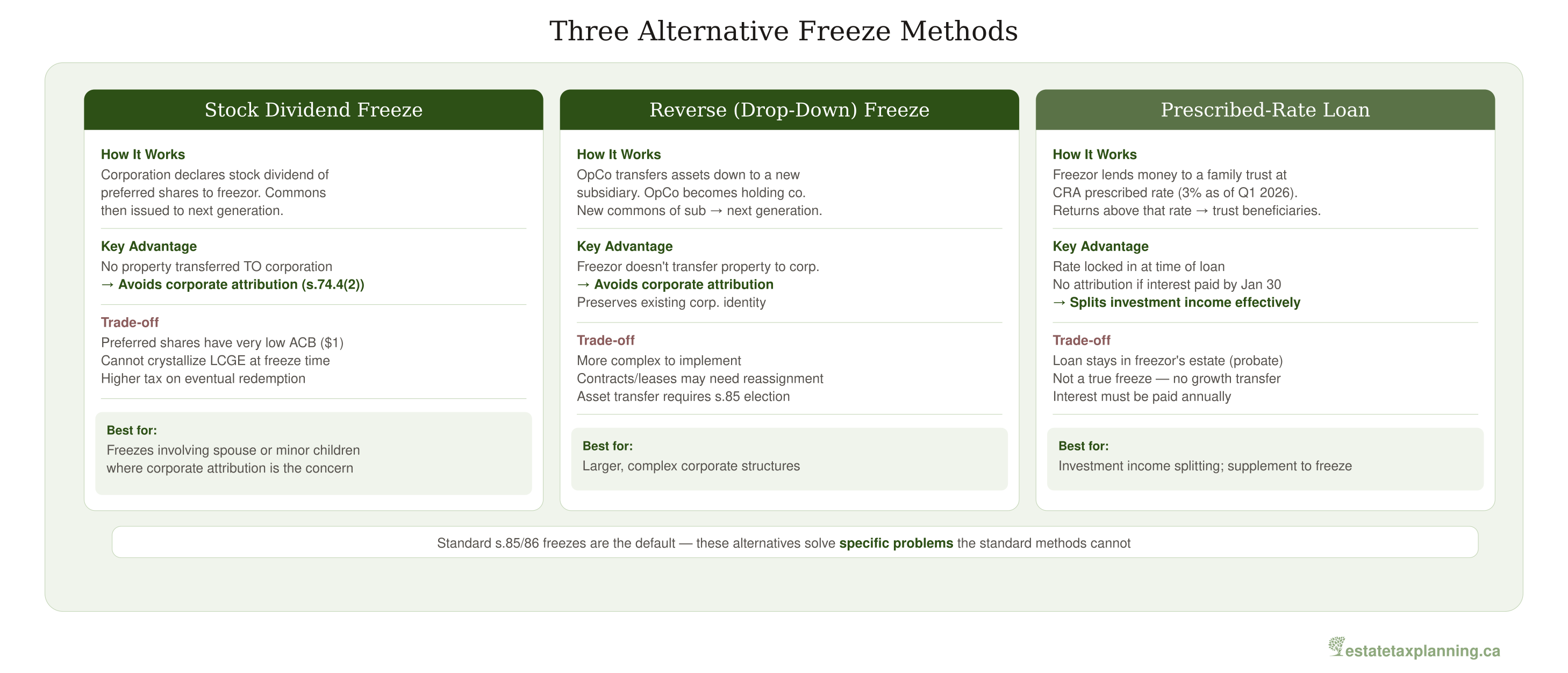
This article covers five alternative approaches — three corporate freeze methods (stock dividend, reverse, and prescribed-rate loan), one pre-freeze reorganization technique (the butterfly transaction), and one non-corporate method for real property (the remainder interest freeze). We begin with the three most commonly used corporate alternatives.
Stock Dividend Freeze
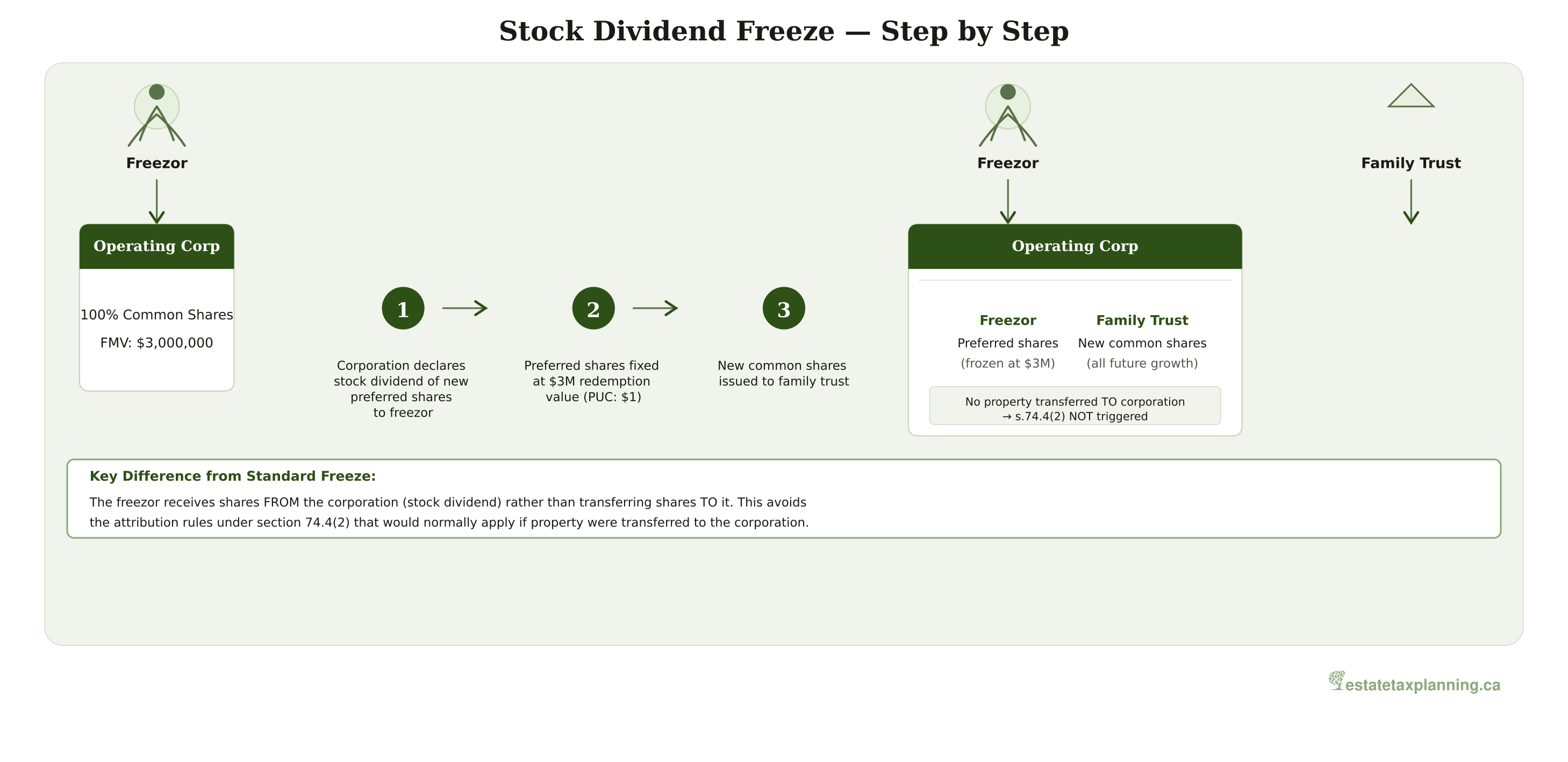
A stock dividend freeze works fundamentally differently from a Section 85 or Section 86 freeze. Instead of the freezor transferring shares to the corporation, the corporation declares a stock dividend of a new class of preferred shares to the freezor. The freezor's existing common shares remain in place and are then transferred (or new common shares are issued) to the next generation.
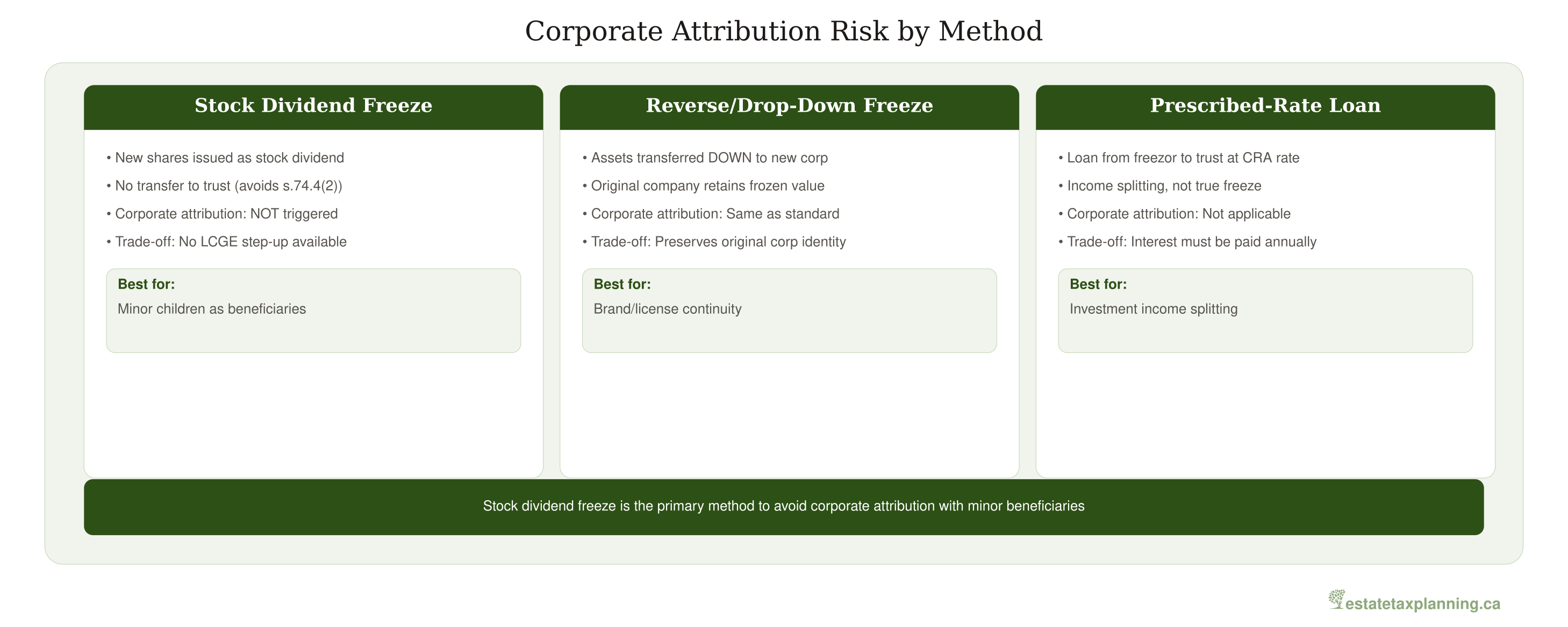
The key advantage is that no property is transferred TO the corporation by the freezor. Since corporate attribution under subsection 74.4(2) — the rule that deems investment income earned by a family trust back to the person who originally transferred property to the corporation — requires a transfer of property to a corporation, the stock dividend freeze can avoid triggering this rule entirely.
How the Tax Works
The stock dividend is generally received at a nominal amount (PUC of $1), which means the preferred shares have a very low cost base. When these shares are eventually redeemed, the excess of the redemption value over the PUC is treated as a deemed dividend. This can result in higher tax on redemption compared to a Section 85 freeze where the ACB could have been stepped up through LCGE crystallization.
One technical wrinkle to be aware of: subsection 15(1.1) of the Income Tax Act — the shareholder benefit rule for stock dividends — can deem a taxable benefit when a stock dividend is received, to the extent the paid-up capital increase exceeds the increase in the corporation's stated capital. In a properly structured stock dividend freeze, the articles of the new preferred share class are drafted so that the PUC and stated capital align at a nominal amount, avoiding a 15(1.1) benefit. But if the corporate law requirements are not carefully followed — for example, if the stated capital is inadvertently set higher than the PUC — the excess can be taxed as a shareholder benefit. This is a drafting issue, not a fundamental flaw in the method, but it underscores the need for experienced legal counsel.
Trade-off
So the stock dividend freeze avoids corporate attribution but gives up the ability to crystallize the LCGE at the time of the freeze. It’s a trade-off between avoiding one problem (attribution) and accepting another (higher tax on redemption). We model both scenarios for our clients to determine which produces the better outcome — and the answer isn’t always obvious.
Unlike a Section 85 or Section 86 freeze, the CRA does not accept price adjustment clauses on stock dividend freezes. In a standard freeze, a price adjustment clause protects the parties if the CRA later reassesses the fair market value — the freeze value adjusts automatically to match the reassessed FMV, preventing double taxation. With a stock dividend freeze, no such safety net exists. If the CRA reassesses the FMV of the preferred shares, the tax consequences cannot be retroactively corrected. This makes it essential to obtain an independent, defensible valuation before implementing a stock dividend freeze.
Stock Dividend Freeze for a Refreeze
The stock dividend freeze is particularly useful in refreeze situations — where an existing freeze needs to be redone at a lower value (for example, after a decline in the business's fair market value). In a refreeze using a standard Section 85 or 86 method, the "outstanding amount" under subsection 74.4(2) may not be nil, which can trigger corporate attribution on the new freeze. With a stock dividend refreeze, the outstanding amount remains nil because no property is being transferred to the corporation — the corporation is simply declaring a new stock dividend. This makes the stock dividend method the cleanest way to refreeze when designated persons are involved.
Worked Example: Stock Dividend Freeze vs. Section 85 Freeze
Consider a business owner in Ontario whose QSBC shares are worth $3,000,000. They want to freeze the value and shift future growth to a family trust for their minor children. Corporate attribution under subsection 74.4(2) is a concern, so the advisor is comparing a stock dividend freeze with a standard Section 85 freeze. The clearest way to see the difference is what happens on the freezor’s death, because the ACB step-up from LCGE crystallization flows through the deemed disposition calculation.
| Section 85 Freeze (with LCGE) | Stock Dividend Freeze | |
|---|---|---|
| FMV of shares at freeze | $3,000,000 | $3,000,000 |
| LCGE claimed at freeze | $1,275,000 | $0 (not available) |
| ACB of freeze shares after freeze | $1,275,000 | $1 (nominal) |
| Capital gain on deemed disposition at death | $1,725,000 | $2,999,999 |
| Tax on capital gain (~26.76%) | ~$461,600 | ~$802,800 |
| Net tax advantage of s.85 | — | ~$341,200 lower tax |
The Section 85 freeze produces roughly $341,000 less tax at death because LCGE crystallization steps up the ACB of the preferred shares by $1,275,000, which directly reduces the capital gain on the deemed disposition. One technical note worth being precise about: if the preferred shares are redeemed during the freezor’s lifetime instead of being held until death, both methods generate the same deemed dividend of roughly $3 million (the deemed dividend under subsection 84(3) equals the redemption amount minus the paid-up capital, not minus the ACB, and PUC is nominal under both methods). Under the Section 85 method, however, the redemption also generates an offsetting capital loss of approximately $1.27 million on the preferred shares, which can be carried back under subsection 164(6) to offset the capital gain on the final return or used against other capital gains — producing a similar economic result to the death scenario above.
If corporate attribution would apply to the Section 85 freeze — deeming the trust’s income back to the freezor at the top marginal rate — the stock dividend freeze may still produce a better after-tax outcome despite giving up the LCGE benefit. The comparison depends on how long the freeze is in place and how much income the trust earns during that period. We model both sides for every client where attribution is in play.
Reverse (Drop-Down) Freeze
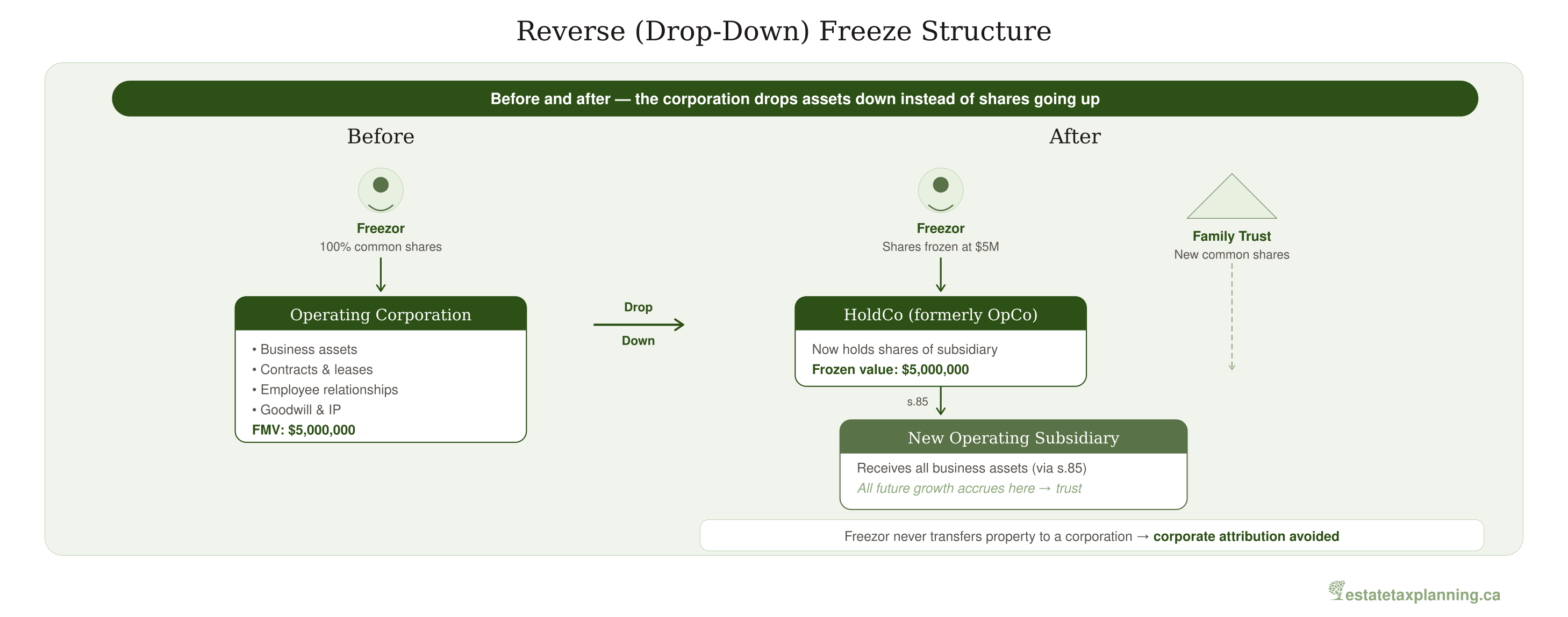
In a reverse or drop-down freeze, instead of the freezor transferring shares up to a holding company, the operating corporation transfers its assets down to a newly incorporated subsidiary. The existing corporation effectively becomes the holding company, and the subsidiary becomes the new operating company.
After the transfer, the freezor holds shares of what is now the holding company (with the frozen value), and new common shares of the subsidiary are issued to the next generation. The existing corporation's shares serve as the freeze shares.
This method can also avoid corporate attribution because the freezor is not transferring property to a corporation — the corporation is transferring its own assets to a subsidiary. The structure preserves the existing corporation's history, bank accounts, contracts, and relationships.
Complexity and Hidden Costs
The reverse freeze involves more moving parts than a standard freeze — and that’s worth acknowledging upfront. The asset transfer to the subsidiary must be structured carefully (typically using Section 85) to avoid triggering tax. Contracts, leases, licenses, and employee relationships may need to be assigned to the new subsidiary. This method is best suited for situations where the corporate attribution issue justifies the additional complexity.
- When assets move from the original corporation to the new subsidiary, certain tax accounts stay behind with the transferor corporation (which becomes the holdco). These do not follow the assets automatically.
- The RDTOH balance (refundable dividend tax), Capital Dividend Account (CDA), non-capital loss carryforwards, and GRIP/LRIP balances all remain with the original corporation. We’ve seen advisors overlook this — the CDA balance they were counting on for tax-free dividends was sitting in the wrong entity.
- If the business was relying on any of these — for example, a CDA balance to pay tax-free capital dividends, or losses to offset future income — the advisor needs to plan for how those attributes will be accessed after the reorganization. Map every tax account before signing off.
- Reverse freezes require careful attention to contract assignments, leasing arrangements, and operational continuity. This method should only be attempted with experienced tax and legal counsel.
- If the original corporation holds real property, transferring it to the subsidiary may trigger provincial land transfer tax — even if the transfer is otherwise tax-deferred under Section 85. In Ontario, land transfer tax applies on the fair market value of the property transferred, with limited exceptions for transfers between associated corporations.
- GST/HST may also apply on the asset transfer unless the parties file a joint section 167 election (which deems the transfer to be made for nil consideration for GST/HST purposes). This election must be filed — it is not automatic.
- Existing contracts may contain "change of control" or "assignment" clauses that require counterparty consent before the operating assets can be moved to a new entity. Key contracts with customers, landlords, lenders, and licensing authorities should be reviewed before implementing the reverse freeze.
Worked Example: Reverse Freeze vs. Standard Section 85 Freeze
Dr. Nguyen operates a medical clinic through a professional corporation worth $4,000,000. She wants to freeze the value and shift future growth to a trust for her two minor children. Her tax advisor flags corporate attribution under subsection 74.4(2) as a risk because the trust beneficiaries are designated persons.
| Standard s.85 Freeze | Reverse (Drop-Down) Freeze | |
|---|---|---|
| Corporate attribution risk | Yes — s.74.4(2) applies | No — freezor does not transfer property to corp. |
| LCGE crystallization | Yes ($1,275,000 ACB) | Yes (on holdco shares) |
| Deemed dividend on redemption | $2,725,000 ($4M − $1,275,000) | $2,725,000 (same) |
| Tax on redemption (~39.34%) | ~$1,072,000 | ~$1,072,000 |
| Land transfer tax (if real property) | N/A | ~$86,500 (Ontario, on $4M property) |
| GST/HST risk | None | Requires s.167 election |
| Attribution income (10 years at $200K/yr) | ~$1,070,600 (at 53.53%) | $0 (avoided) |
In this example, the reverse freeze involves additional complexity (and potential land transfer tax), but avoids approximately $107,000 per year in attributed income tax. Over the 10-year life of the freeze, the attribution savings are substantial — making the reverse freeze the clear choice when minor children are beneficiaries.
Prescribed-Rate Loan Strategy
Strictly speaking, the prescribed-rate loan is not an estate freeze in the traditional sense — it's an income-splitting strategy that achieves a similar economic result. The freezor lends money to a family trust (or directly to a family member) at the CRA's prescribed interest rate. The trust uses the loan proceeds to invest, and any investment return above the prescribed interest rate accrues to the trust (and its beneficiaries) rather than to the freezor.
The attribution rules do not apply to loans made at the prescribed rate, provided the interest is actually paid within 30 days of each year-end. The prescribed rate is locked in at the time the loan is made, so if the loan is established during a low-rate period, the benefit continues even if rates rise later. This strategy is particularly useful for splitting investment income with lower-income family members, and it can be used alongside a traditional corporate estate freeze or as a standalone strategy.
One important limitation: unlike a true freeze where the growth leaves the estate permanently, the prescribed-rate loan stays on the freezor's balance sheet (though it doesn't grow in value). Probate fees will still apply to the loan amount. And the strategy requires strict annual compliance — the trust must pay the prescribed interest by January 30 of each year, or the attribution exemption is lost retroactively with no remedy. We calendar the January 30 deadline the moment the loan is struck, and we treat it as non-negotiable — a single missed payment wipes out every prior year of income splitting.
A prescribed-rate loan avoids the attribution rules under subsection 74.5(2) — the exception that exempts loans at the CRA's prescribed rate from income attribution — but it does not automatically avoid the Tax on Split Income (TOSI). If the family trust distributes income to adult children who are not "excluded individuals," TOSI applies at the top marginal rate — eliminating the income-splitting benefit entirely. Avoiding attribution is necessary but not sufficient; the TOSI analysis must also be satisfied.
For a complete treatment of prescribed-rate loan mechanics — including worked examples, the current prescribed rate, TOSI interaction, and the critical January 30 deadline — see Prescribed-Rate Loan Strategies.
Butterfly Transactions: Splitting Before Freezing
A butterfly transaction (named after the "wings" of the reorganization) is a divisive reorganization under subsection 55(3.1) of the Income Tax Act that allows a corporation to split its assets into two or more separate corporations on a tax-deferred basis. While not a freeze method itself, a butterfly is frequently used as a precursor to an estate freeze — particularly when business partners want to go their separate ways, or when a family business has distinct divisions that should be separated before implementing individual freeze structures.
In a typical pre-freeze butterfly, the operating corporation transfers a portion of its assets to a new corporation. The shareholders exchange their shares for shares of both the original and new corporations, in proportion to the assets divided. If the transaction qualifies under the butterfly provisions, no immediate tax is triggered. Each shareholder then implements their own estate freeze on their respective corporation.
Consider two equal partners in a manufacturing company worth $10,000,000. One partner wants to freeze and pass growth to her children; the other wants to sell in three years. A butterfly transaction splits the company into two separate $5,000,000 corporations on a tax-deferred basis. Each partner then pursues their own planning — without the complications of unwinding a joint freeze later.
Butterfly transactions are among the most technically complex reorganizations in Canadian tax law. The requirements under subsection 55(3.1) are detailed and inflexible, the safe income calculations under subsection 55(2) are frequently contested by the CRA, and the 2024 GAAR amendments add a 25% penalty for transactions lacking economic substance. Never attempt a butterfly without experienced tax counsel and a Chartered Business Valuator.
- Two or more business partners want to separate their interests before each implements their own estate freeze. This is the most common scenario we see.
- A family business has operationally distinct divisions (e.g., real estate and manufacturing) that should be isolated in separate corporations.
- The freezor wants to separate active business assets from passive investments before freezing, to ensure the operating company qualifies for the small business deduction. We’ve used this approach for clients whose passive investments were pushing them past the 90% threshold.
For a complete treatment of butterfly mechanics, safe income calculations, the pro rata distribution requirement, and the 2024 GAAR amendments, see Butterfly Transactions and Divisive Reorganizations.
Remainder Interest Freeze
Section 43.1 of the Income Tax Act provides a unique freeze mechanism for real property. When a taxpayer transfers a remainder interest in real property to a family member while retaining a life interest, the Act splits the property's fair market value between the life interest and the remainder interest using prescribed actuarial tables. The remainder interest — representing the right to receive the property after the life tenant's death — transfers to the next generation at a value that reflects the life tenant's age and the property's current worth.
The practical effect is similar to an estate freeze: the transferor locks in a portion of the property’s value (the life interest, which decreases over time as life expectancy shortens), while future appreciation accrues to the remainder holder. Unlike a corporate freeze, this method applies to real property directly — no corporate structure, no share exchange, no Section 85 election. We’ve used this for families with significant cottage or farm property held outside a corporation.
How It Works
The transferor conveys the property to the next generation while reserving a life estate (the right to use and occupy the property for life). The transfer of the remainder interest is a disposition for tax purposes, and the proceeds are determined under section 43.1 based on actuarial factors — primarily the life tenant's age at the time of transfer and the CRA's prescribed interest rates. The older the life tenant, the smaller the life interest and the larger the remainder interest (and therefore the larger the deemed proceeds on the transfer). In practice, we’ve found this method works best when clients are in their seventies or later — the math starts producing meaningful freeze value at that age, and the deemed proceeds become more defensible.
When It Applies
The remainder interest freeze is most commonly used for farm properties, cottages, and other real estate holdings where the owner wants to retain use of the property for life while passing the future appreciation to the next generation. It can be particularly useful where the property owner does not operate through a corporation, making the standard Section 85 or 86 corporate freeze unavailable.
Worked Example: Cottage Transfer at Age 65
A 65-year-old Ontario taxpayer owns a cottage worth $2,000,000 (ACB of $500,000). They transfer the remainder interest to their adult child while retaining a life interest. Under section 43.1, the actuarial split depends on two factors: the transferor's age and the CRA prescribed interest rate at the time of transfer. At age 65, and using illustrative assumptions, the split might allocate approximately 55% to the remainder interest and 45% to the life interest — but this ratio can shift significantly if the prescribed rate changes. A lower prescribed rate increases the remainder interest value (and the immediate tax cost); a higher rate decreases it.
| Value | Notes | |
|---|---|---|
| FMV of cottage | $2,000,000 | |
| Life interest (retained, ~45%) | ~$900,000 | Decreases as life expectancy shortens |
| Remainder interest (transferred, ~55%) | ~$1,100,000 | Deemed proceeds to transferor |
| ACB allocated to remainder | ~$275,000 | Pro rata share of $500,000 ACB |
| Capital gain on transfer | ~$825,000 | $1,100,000 − $275,000 |
| Tax on gain (at 26.76%) | ~$220,770 | Ontario top effective CG rate |
If the cottage appreciates to $3,000,000 by the time the life tenant dies, the full $1,000,000 of additional appreciation belongs to the child — outside the parent's estate. The parent has effectively frozen their exposure at $2,000,000 while retaining the right to use the cottage for life. The trade-off is the immediate tax bill of roughly $221,000 on the remainder interest transfer.
Two tax reliefs can dramatically reduce the immediate cost of a remainder interest transfer. If the property qualifies as the transferor’s principal residence for all or part of the ownership period, the principal residence exemption under section 40(2)(b) may shelter some or all of the capital gain — the exemption is pro-rated by year of designation, so a cottage designated as the principal residence for 20 of 25 years would see roughly 84% of the gain sheltered. Only one property per family unit can be designated each year, so this has to be coordinated with the family’s overall PRE planning, which is something we map out before the transfer is executed.
For qualifying farm or fishing property, section 73 allows intergenerational transfers to a child or grandchild on a tax-deferred rollover basis, potentially deferring the entire capital gain on the remainder interest transfer (or triggering just enough gain to absorb available LCGE room). The interaction between section 43.1 and section 73 is technical, and the requirements turn on whether the property has been used principally in farming for the required period — this is specialist territory, and we always bring in agricultural-tax counsel when farm property is in play. For a comprehensive treatment of the remainder interest freeze for farm property, including ACB allocation and provincial registration, see Estate Freezes for Farming Operations.
- Section 43.1 applies only to real property — it cannot be used for shares, business assets, or investment portfolios.
- The actuarial split is prescribed by regulation, not negotiated, so there is limited flexibility in determining the values allocated to the life interest and remainder interest.
- The life tenant loses the ability to sell or mortgage the property without the remainder holder’s consent, which can create practical complications. We always flag this early — it changes the dynamics of family decision-making around the property.
- Provincial land transfer tax may apply on the transfer of the remainder interest, depending on the jurisdiction.
- The attribution rules may still apply if the remainder interest is transferred to a spouse or minor — consult your tax advisor on the interaction with sections 73 and 74.1.
- You own significant real property (farm, cottage, rental property) outside a corporate structure.
- You want to retain use of the property for life while passing future appreciation to the next generation.
- A corporate freeze is not practical because the property is held personally, not in a corporation.
- The property has significant unrealized appreciation and you want to cap your future tax exposure on it.
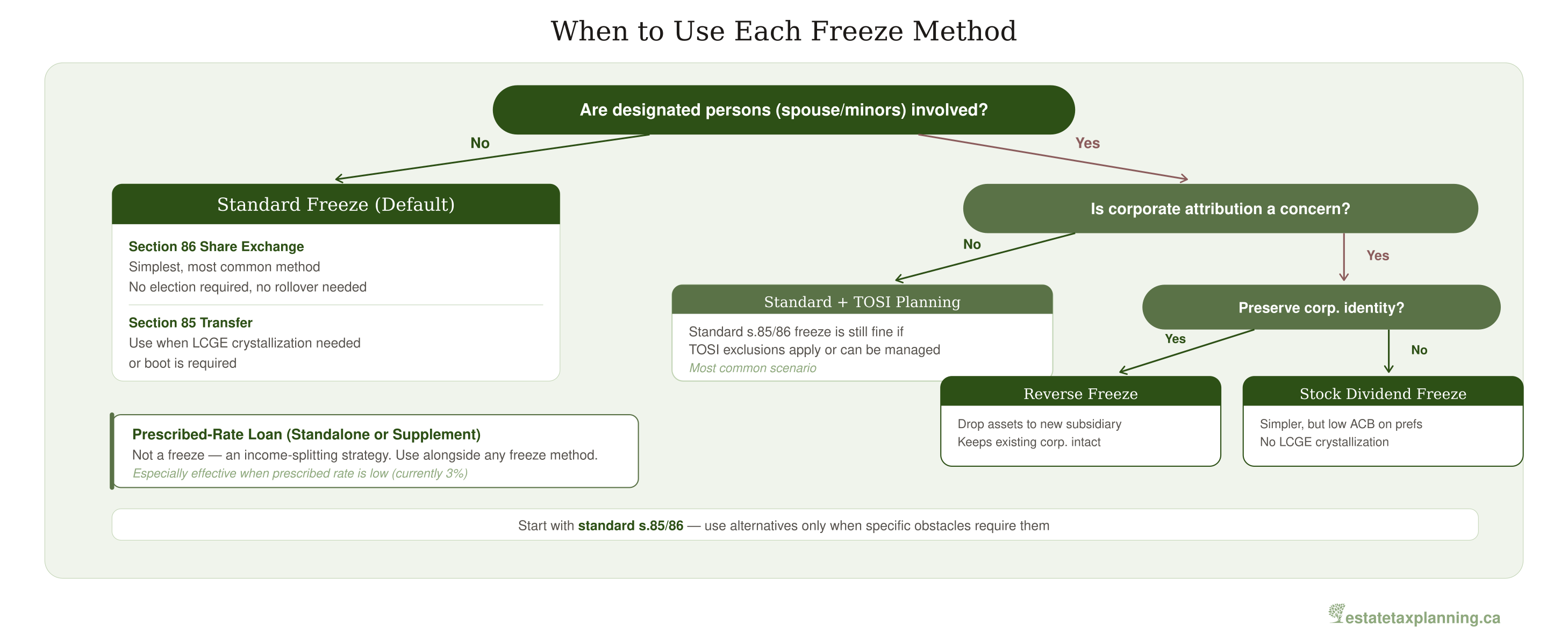
When to Use Each Method
Standard Section 85 or 86 Freeze
The default choice for most situations. Use when there are no designated persons (spouse, minor children) involved, or when corporate attribution can be managed through other means.
Stock Dividend Freeze
Use when the freezor's spouse or minor children will be shareholders or trust beneficiaries and you need to avoid corporate attribution. Accept the trade-off of lower cost base on the preferred shares.
Reverse (Drop-Down) Freeze
Use when corporate attribution is a concern and you want to preserve the existing corporation's identity and relationships. Best for larger, more complex corporate structures.
Prescribed-Rate Loan
Use for investment income splitting, particularly when the prescribed rate is low. Can supplement a traditional freeze or stand alone.
Remainder Interest Freeze
Use for real property held outside a corporation — farms, cottages, rental properties — where the owner wants to retain use for life while capping estate exposure. Not available for shares or business assets.
- Stock dividend freezes attract attention on the subsection 15(1.1) shareholder benefit calculation — if PUC and stated capital are misaligned, the CRA will reassess. The absence of a price adjustment clause means there is no safety net if the freeze value is challenged. This is why the valuation has to be bulletproof.
- Reverse freezes are reviewed for land transfer tax compliance and proper section 167 GST/HST elections. The CRA also examines whether the asset transfer to the subsidiary was completed at fair market value. We’ve seen audit queries on exactly this point.
- Butterfly transactions face the highest audit risk. Safe income calculations under subsection 55(2) are among the most frequently contested items in CRA reassessments, and the 2024 GAAR amendments add additional scrutiny for transactions lacking economic substance. We treat every butterfly as a potential audit file from day one.
Regardless of which freeze method is chosen, if the next-generation holders of the growth shares later sell those shares to a non-arm's length corporation (for example, selling back to the family holdco), subsection 84.1 — the anti-surplus-stripping rule — can recharacterize what would otherwise be a capital gain as a deemed dividend, which is taxed at a higher rate and does not qualify for the LCGE. This rule applies to all of the freeze methods discussed in this article. Any future sale or reorganization involving the growth shares should be reviewed for section 84.1 implications before proceeding.
| Method | Attribution Risk | LCGE? | Best Use Case |
|---|---|---|---|
| Section 86 share exchange | Standard rules apply | No (no election) | Default choice — simplest freeze with the fewest moving parts |
| Section 85 rollover | Standard rules apply | Yes — crystallize at freeze | LCGE crystallization needed to step up cost base on preferred shares |
| Stock dividend freeze | Avoids s.74.4(2) | No — low ACB on prefs | Minor children as beneficiaries and corporate attribution is a concern |
| Reverse (drop-down) freeze | Avoidable with careful structuring | Depends on structure | Preserve existing corporation’s identity, contracts, and banking relationships |
| Prescribed-rate loan | N/A (not a freeze) | N/A | Investment income splitting alongside or instead of a corporate freeze |
| Remainder interest (s.43.1) | May apply to spouse/minors | N/A (real property) | Farm land, cottages, or rental property held outside a corporation |
Why Most Freezes Are Still Section 85 or 86
Most clients end up with a Section 85 or Section 86 freeze — and for good reason. The alternatives in this article exist for the cases where the standard approach would create more problems than it solves: corporate attribution that eats the benefit, a spouse or minor children in the picture, or real property that sits outside a corporate structure. Knowing when to reach for these tools, and when to stick with the default, is what separates adequate planning from effective planning. In our practice, roughly four out of every five freezes still come together as a straightforward Section 85 or Section 86 — the alternative methods are the right answer for the fifth.
What’s Next?
In the next article, Shareholder Agreements and the Estate Freeze, we examine how shareholder agreements protect the freeze structure legally — including buy-sell provisions, shotgun clauses, and valuation mechanisms that coordinate with your freeze.
Related Articles
For the context that sits around the alternatives discussed here, see Corporate Attribution Rules for when s.74.4(2) forces you to reach for one of these methods in the first place, Freeze, Gel, Thaw, and Wasting Freeze for related variations on the freeze structure, TOSI and the Estate Freeze for how split-income rules intersect with prescribed-rate loans, Butterfly Transactions and Divisive Reorganizations for the deeper mechanics under subsection 55(3.1), Prescribed-Rate Loan Strategies for the full income-splitting treatment, and Estate Freezes for Farming Operations for the specialist territory of remainder-interest freezes on farm property.
Your tax advisor, CBV, and legal counsel can help you evaluate how this applies to your situation — most freezes are still Section 85 or Section 86, but if corporate attribution, a partnership split, or real property outside a corporate structure is in play, one of these alternative methods is usually the better fit. The only way to know is to model the options side by side with actual numbers.
For definitions of the key terms used in this article — including stock dividend freeze, reverse freeze, prescribed-rate loan, corporate attribution, and remainder interest — see our Key Terms and Definitions reference guide.
This article is for informational purposes only and does not constitute legal, tax, or financial advice. Estate freezes are complex transactions that require the coordinated involvement of qualified tax, valuation, and legal professionals. Always consult your advisors before acting on any of the information discussed here.