
Without post-mortem planning, the same value can be taxed twice — once as a capital gain on the freezor’s final return, and again as a deemed dividend on share redemption. The pipeline strategy and the subsection 164(6) loss carryback can eliminate this double taxation, but the planning must be built into the freeze from day one.
Introduction
An estate freeze is designed to cap your tax liability at death. But there’s a hidden problem that can arise after the freezor dies — and it’s one we see families unprepared for more often than we’d like: double taxation. Without proper post-mortem planning, the same economic value can be taxed twice — once as a capital gain on the freezor’s final tax return, and again as a deemed dividend when the estate redeems the preferred shares.
This article explains how double taxation arises, why it matters, and the two main strategies — the pipeline and the loss carryback — that your estate’s advisors can use to eliminate it. The key takeaway: this planning needs to be built into the freeze from day one, not improvised after someone dies.
The Double Taxation Problem
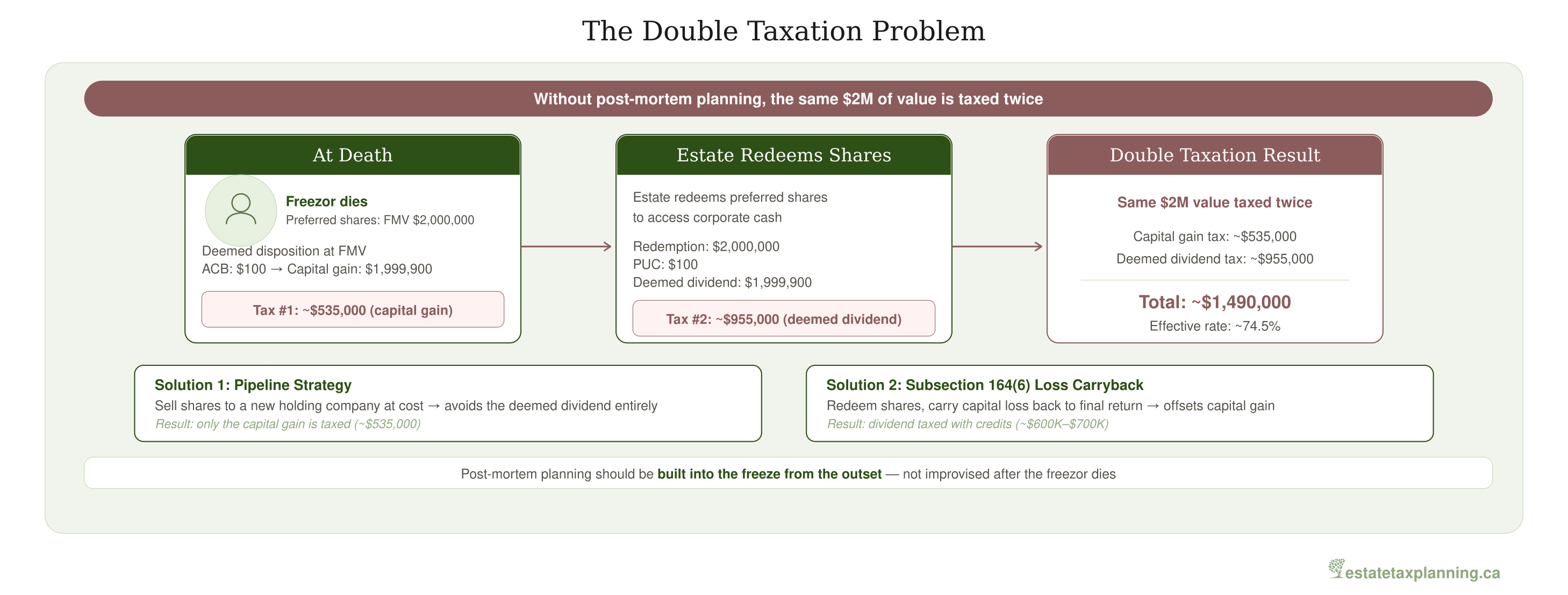
When the freezor dies, two tax events can occur in quick succession. First, the Income Tax Act deems the freezor to have disposed of their preferred shares at fair market value immediately before death — triggering a capital gain on the final tax return. Second, when the estate redeems the preferred shares to access the cash, the redemption amount in excess of the paid-up capital (PUC) is treated as a deemed dividend. If the PUC is nominal (which it almost always is in a freeze), the entire redemption amount can be taxed as a dividend.
The result? The same $2 million of value is taxed twice: once as a capital gain and once as a dividend. This was never the intent of the freeze, and the combined tax hit can be devastating.
Why PUC Drives the Double Tax
The deemed dividend on redemption is calculated as the redemption amount minus the paid-up capital (PUC) of the shares under subsection 84(3). In a standard estate freeze, the PUC of the preferred shares is typically nominal — often $100 or less — because it is set equal to the PUC of the old common shares that were exchanged in the section 85 rollover. This means that virtually the entire redemption amount is treated as a deemed dividend.
To illustrate: if the preferred shares have a redemption value of $2 million and a PUC of $100, the deemed dividend is $1,999,900. The proceeds of disposition for capital gains purposes are then reduced to $100 (redemption amount minus deemed dividend), which is compared to the adjusted cost base (ACB) to determine any capital gain or loss. This PUC-driven mechanics is what creates the double taxation problem and is the reason post-mortem planning is essential for every estate freeze.
Solution 1: The Pipeline Strategy
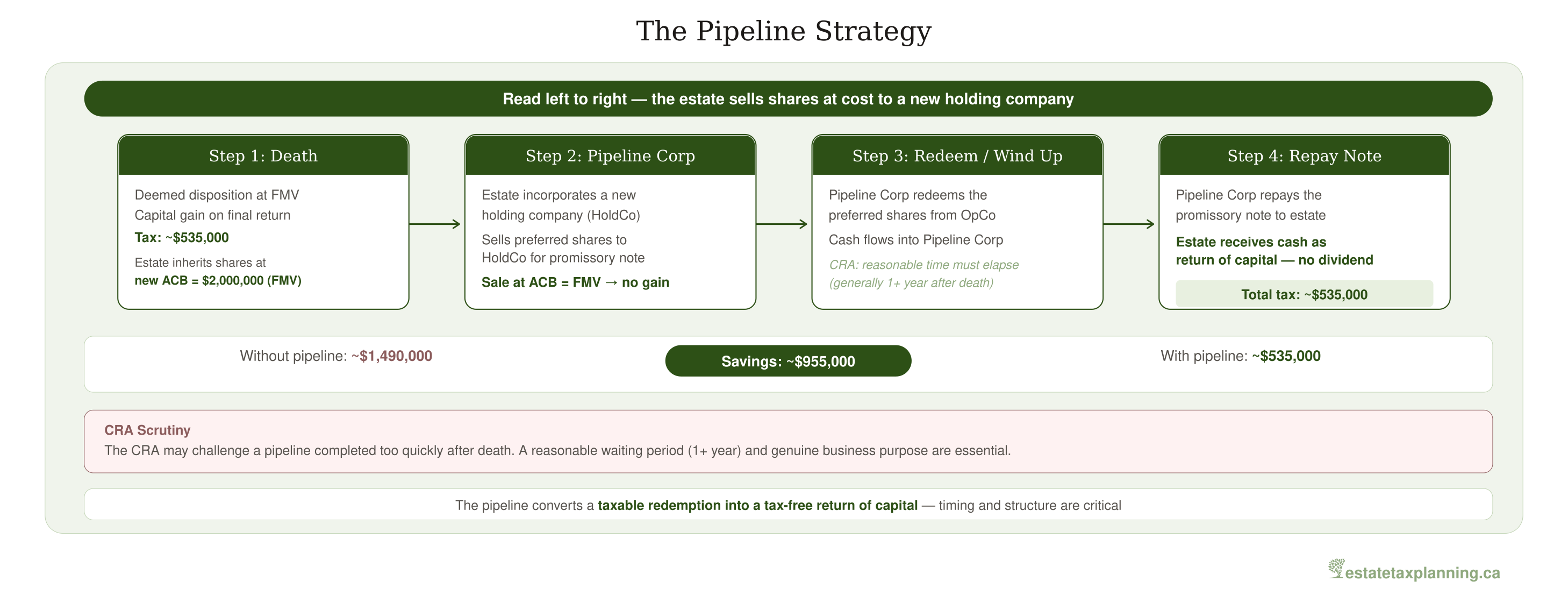
Because the estate acquired the shares at their FMV on death (the deemed disposition set the cost base to FMV), the sale to the pipeline corporation occurs at cost — no additional capital gain is triggered. The pipeline corporation then redeems the preferred shares from itself (or winds up the original corporation), and uses the proceeds to repay the promissory note to the estate. The estate receives the cash as a return of capital, not as a dividend. The double tax is avoided.
How the Pipeline Works: Step by Step
We walk every executor through these steps before anything is signed. The mechanics matter — skip a step or get the sequence wrong, and the CRA can collapse the entire transaction.
- Step 1: Incorporate a new holding company (the “pipeline corporation”). The estate is the sole shareholder. This is a new, clean corporation with no prior history — its only purpose is to facilitate the pipeline. We typically incorporate it within a few weeks of the date-of-death valuation being completed.
- Step 2: The estate sells its preferred shares to the pipeline corporation in exchange for a promissory note equal to the FMV of the shares (which equals the ACB set by the deemed disposition at death). Because the estate is selling at cost, no capital gain is triggered on this sale. This is the critical transaction — the note must equal FMV, and the terms must be commercially reasonable.
- Step 3: The pipeline corporation redeems the preferred shares from the operating company, or the operating company is wound up into the pipeline corporation under subsection 88(1). Either way, the pipeline corporation receives the underlying corporate funds. The deemed dividend on redemption occurs at the corporate level — but because the recipient is a corporation (not an individual), the intercorporate dividend flows tax-free under subsection 112(1), subject to the section 55 safe income rules we discuss below.
- Step 4: The pipeline corporation uses the funds received to repay the promissory note to the estate. The estate receives cash as a return of capital — not as a dividend, not as a capital gain. The double tax is avoided.
The entire sequence typically takes 12 to 18 months from death to completion. We tell executors to think of it as four dominoes — each one has to fall in the right order, with enough time between them to satisfy the CRA that these are genuine, separate transactions.
The CRA has historically accepted pipeline transactions, but certain conditions have to be met — including that sufficient time passes between the death and the redemption, and that the transaction has a genuine business purpose beyond tax reduction. Getting the timing right is critical.
Pipeline Timing: The CRA's Position
GAAR and the Pipeline: Where Things Stand
We get asked about this regularly: have the 2024 GAAR amendments — particularly the new economic substance test and the 25% penalty — changed the CRA’s position on pipeline transactions? To date, the answer is no. The CRA has consistently treated properly implemented pipelines as legitimate post-mortem planning, and no court decision or CRA bulletin has suggested otherwise. The pipeline has genuine economic substance: the estate is disposing of shares at their cost base, and the pipeline corporation is using actual corporate funds to repay the promissory note. These are real transactions with real consequences, not circular arrangements.
That said, the new GAAR penalty raises the stakes for getting it wrong. If a pipeline is implemented without proper timing, without a genuine business purpose beyond tax reduction, or with aggressive shortcuts (such as completing the entire transaction within weeks of death), the consequences of a GAAR reassessment are now more severe. The 25% penalty on the denied tax benefit is in addition to the regular tax, interest, and any other penalties. This reinforces the importance of following the CRA's administrative guidance: allow reasonable time to elapse, document the business purpose, and ensure the steps are genuine.
Solution 2: The Subsection 164(6) Loss Carryback
The estate then elects under subsection 164(6) to carry the capital loss back to the freezor's final tax return, where it offsets the capital gain from the deemed disposition at death. The net result: the capital gain on the final return is eliminated by the loss carryback, and the deemed dividend is taxable. The dividend tax credit (DTC) reduces the effective rate on the dividend, but because the full deemed dividend is taxed as a non-eligible dividend, the overall tax cost is higher than the pipeline strategy. The loss carryback eliminates the capital gains tax (~$535,000 in our example), but the remaining dividend tax (~$955,000) is still substantial.
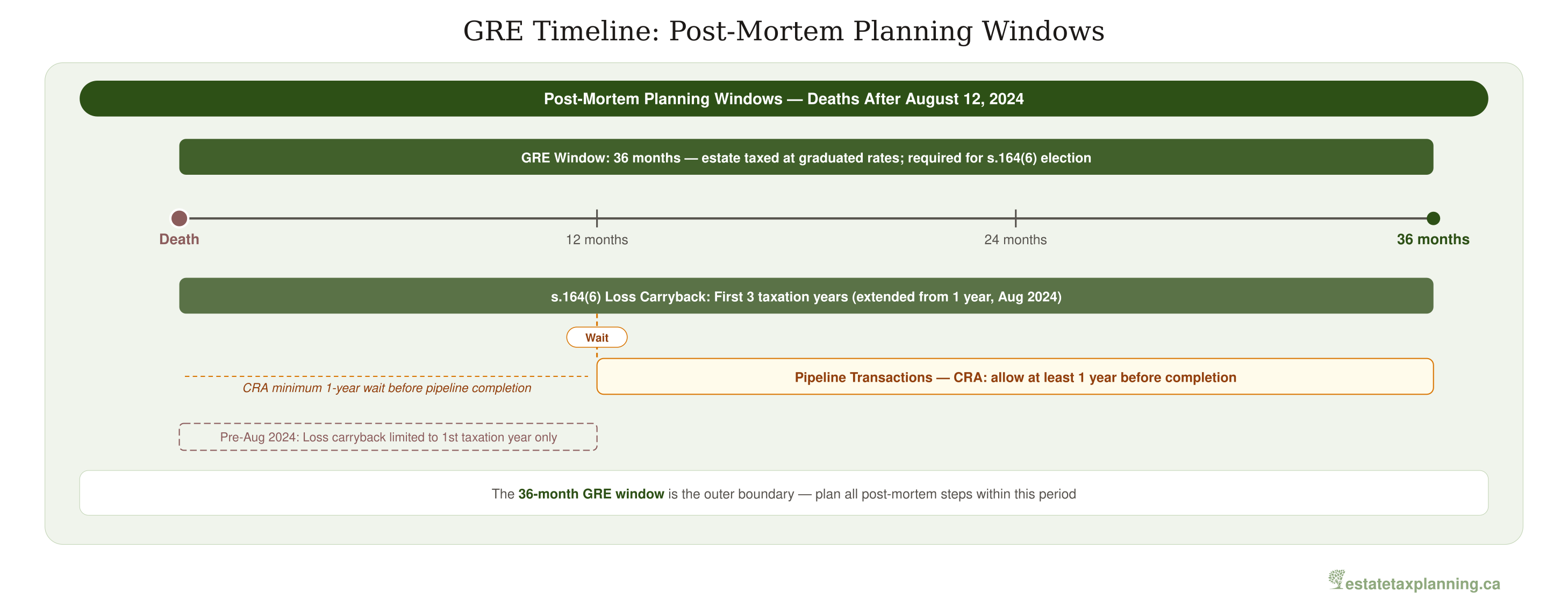
For deaths before August 12, 2024, this election had to be made within the first taxation year of the estate. For deaths after that date, the window has been extended to the first three taxation years (see callout above). The estate must be a graduated rate estate (GRE) as defined in subsection 248(1) of the ITA to use this election — another reason why proper estate administration matters.
For deaths occurring after August 12, 2024, the subsection 164(6) carryback window is now the first three taxation years of the GRE (up from one) — giving the executor more room to time the redemption, while the 36-month GRE window itself is unchanged.
- These are not the same timeline, and confusing them is a mistake we see advisors make. The GRE window is 36 calendar months from the date of death — a fixed period. The subsection 164(6) window is measured in taxation years of the estate, not calendar months.
- An estate’s taxation year doesn’t have to follow the calendar year. The executor chooses the first year-end (up to 12 months after death), and subsequent years follow from there. A strategically chosen year-end can extend the s.164(6) window across parts of four calendar years while staying within three taxation years.
- Here’s the catch: subsection 164(6) is only available to a GRE. If the estate loses its GRE status — whether by exceeding the 36-month window or failing another GRE condition — the loss carryback election is no longer available, even if the estate is still within its first three taxation years.
- We always map both timelines on a single chart at the start of every post-mortem engagement. The executor needs to see exactly when each window opens and closes, because the consequences of missing either deadline are permanent.
The GRE Requirement
A graduated rate estate (GRE) has a window of 36 months after death to make post-mortem elections. During this period, the estate is taxed at graduated rates (like an individual) rather than at the top marginal rate. The GRE designation is also required for certain elections, including the subsection 164(6) loss carryback. If the estate loses its GRE status (for example, by continuing beyond 36 months without winding up), the loss carryback election is no longer available. Advisors and executors must plan around these critical deadlines.
Numerical Comparison: Pipeline vs. Loss Carryback
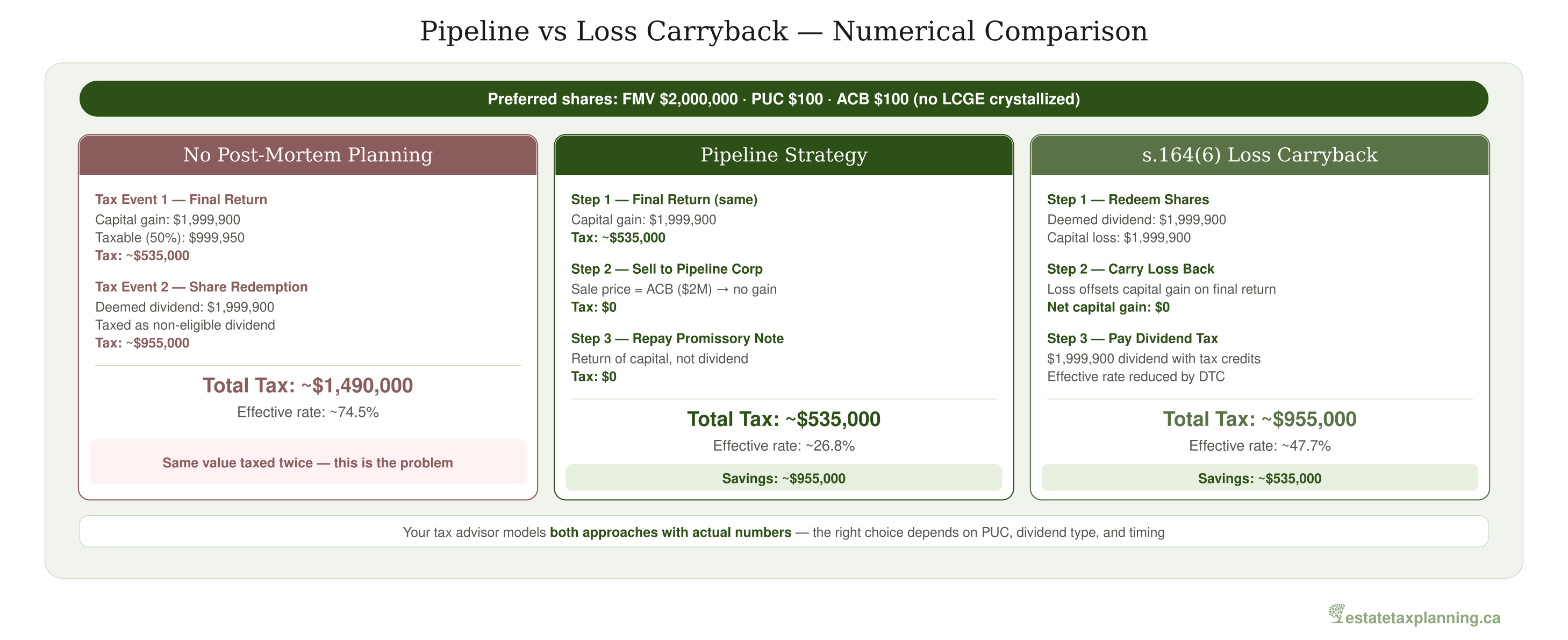
| No Planning | Pipeline | Loss Carryback | |
|---|---|---|---|
| Capital gain on final return | $1,999,900 | $1,999,900 | $1,999,900 (offset by loss) |
| Tax on capital gain | ~$535,000 | ~$535,000 | $0 (loss carried back) |
| Deemed dividend | $1,999,900 | Avoided | $1,999,900 |
| Tax on dividend | ~$955,000 | $0 | ~$955,000 |
| Total tax | ~$1,490,000 | ~$535,000 | ~$955,000 |
| Effective rate | ~74.5% | ~26.8% | ~47.7% |
| Tax savings | — | ~$955,000 | ~$535,000 |
In this example, the pipeline produces a significantly better result because it avoids the non-eligible dividend entirely — saving ~$955,000 versus ~$535,000 for the loss carryback. The gap narrows when dividends qualify as eligible (lower tax rate with enhanced DTC) or when the PUC is higher, reducing the deemed dividend. Your tax advisor will model both approaches with the actual numbers.
The comparison above assumes the preferred shares have an ACB of $100 — meaning the lifetime capital gains exemption (LCGE) was not crystallized at the time of the freeze. If the freezor crystallized the LCGE ($1,275,000 for 2026 QSBC shares, indexed annually), the ACB of the preferred shares would be much higher, reducing the capital gain on death and shrinking the double taxation problem. For example, with a fully crystallized LCGE, the ACB might be $1,275,000 instead of $100, reducing the capital gain from ~$2 million to ~$725,000 and the capital gains tax from ~$535,000 to ~$194,000. Note that the LCGE limit in effect at the time the freeze was implemented determines the crystallized amount — freezes done years ago may have used a lower limit (for example, $1,016,836 for 2024). Your CBV and tax advisor should confirm whether the LCGE was crystallized and at what amount.
Eligible vs. Non-Eligible Dividends: Why It Matters
The comparison above assumes the deemed dividend on redemption is a non-eligible dividend, which is the most common scenario for Canadian-controlled private corporations (CCPCs) that pay tax at the small business rate. Non-eligible dividends carry a lower gross-up (15%) and a smaller dividend tax credit (DTC), resulting in a combined top marginal rate of approximately 47.7% in Ontario.
If the corporation has a significant balance in its general rate income pool (GRIP) — typically because it has paid tax at the general corporate rate on active business income over $500,000 — some or all of the deemed dividend may qualify as an eligible dividend. Eligible dividends carry a higher gross-up (38%) but a correspondingly larger DTC, reducing the combined top marginal rate to approximately 39.3% in Ontario. In our $2 million example, if the entire deemed dividend were eligible, the loss carryback tax would drop from ~$955,000 to approximately ~$786,000, and the savings gap between the pipeline and loss carryback would narrow from ~$420,000 to approximately ~$251,000.
Which Strategy Is Better?
The honest answer is: it depends on the specific circumstances. In practice, we model all three approaches using the actual numbers and recommend the combination that produces the lowest overall tax cost for the estate and its beneficiaries. The table below summarizes when each strategy tends to be the right fit.
| Strategy | Best When | Key Advantage | Key Risk or Limitation |
|---|---|---|---|
| Pipeline | Low PUC; non-eligible dividend exposure; estate can wait 12–18 months | Eliminates the deemed dividend entirely — typically the lowest-tax outcome | Timing-sensitive; shortcuts invite GAAR and the 25% penalty |
| s.164(6) Loss Carryback | Pipeline not feasible; GRE still open; large GRIP balance makes dividend eligible | Simpler mechanics; faster to execute inside the GRE window | Dividend tax still applies; requires GRE status and election within three taxation years |
| s.88(1)(d) Bump | Opco holds non-depreciable capital property (land, portfolio shares, partnership interests) with latent gains | Steps up ACB of underlying assets — complements the pipeline rather than replacing it | Limited to non-depreciable property held continuously since acquisition of control; 90%-subsidiary requirement |
In most estates we work on, the answer isn’t a single strategy — it’s a combination. The pipeline handles the share-level double tax, the bump cleans up the asset-level latent gains inside Opco, and the loss carryback sits in reserve as a fallback if timing or GRE constraints force a change of plan. There’s no reason to guess when you can model all three side by side.
Solution 3: The Subsection 88(1)(d) Bump
There’s a third post-mortem strategy that doesn’t get as much attention as the pipeline or the loss carryback, but it’s an important tool — particularly when the operating company holds non-depreciable capital property like land, portfolio shares, or partnership interests.
The bump is limited to non-depreciable capital property: land, shares of other corporations, and partnership or trust interests. Depreciable property — buildings, equipment, vehicles — does not qualify. The property must also have been held continuously by the subsidiary from the time of the acquisition of control through the wind-up. And the total bump cannot exceed the capital gain recognized on the parent’s shares of the subsidiary.
- The bump is most useful when the operating company holds significant non-depreciable assets — land, portfolio investments, or interests in other entities — that have unrealized gains.
- It complements the pipeline and loss carryback rather than replacing them. In practice, we often use a combination: the bump handles the underlying asset gains, while the pipeline addresses the share-level double taxation.
- The bump is also valuable in multi-entity structures where a holding company owns an operating subsidiary. The wind-up of the subsidiary into the holding company can be combined with post-mortem pipeline planning on the holding company’s shares.
- We always calculate the bump room available before deciding on the overall post-mortem strategy. In some files, the bump alone eliminates enough of the double tax to make the pipeline unnecessary.
Funding the Tax Bill: The Role of Life Insurance
Even with optimal post-mortem planning, there will be a tax bill — at minimum, the capital gains tax on the final return (~$535,000 on $2 million of preferred shares). Life insurance on the freezor, payable to the corporation or the estate, can provide the liquidity needed to fund this tax without forcing a fire sale of business assets. As discussed in Life Insurance and the Estate Freeze, the death benefit is received tax-free and can be credited to the corporation's capital dividend account (CDA), allowing tax-free distribution to shareholders.
This $1,850,000 tax-free capital dividend covers the pipeline's capital gains tax (~$535,000) with $1,315,000 to spare — more than enough to fund executor fees, legal costs, and beneficiary distributions. Without the insurance, the estate might need to sell business assets at a discount or borrow against them to fund the tax bill. The CDA mechanism is one of the most powerful tools in post-mortem planning, and the insurance should be put in place when the freeze is implemented — not after the freezor becomes uninsurable.
Post-mortem planning should be built into the estate freeze from the outset, not improvised after the freezor dies. Your will should authorize the executor to implement either a pipeline or loss carryback strategy, and your advisory team should have a plan documented in advance. The double taxation problem is entirely avoidable with proper planning.
Section 55: The Intercorporate Dividend Trap
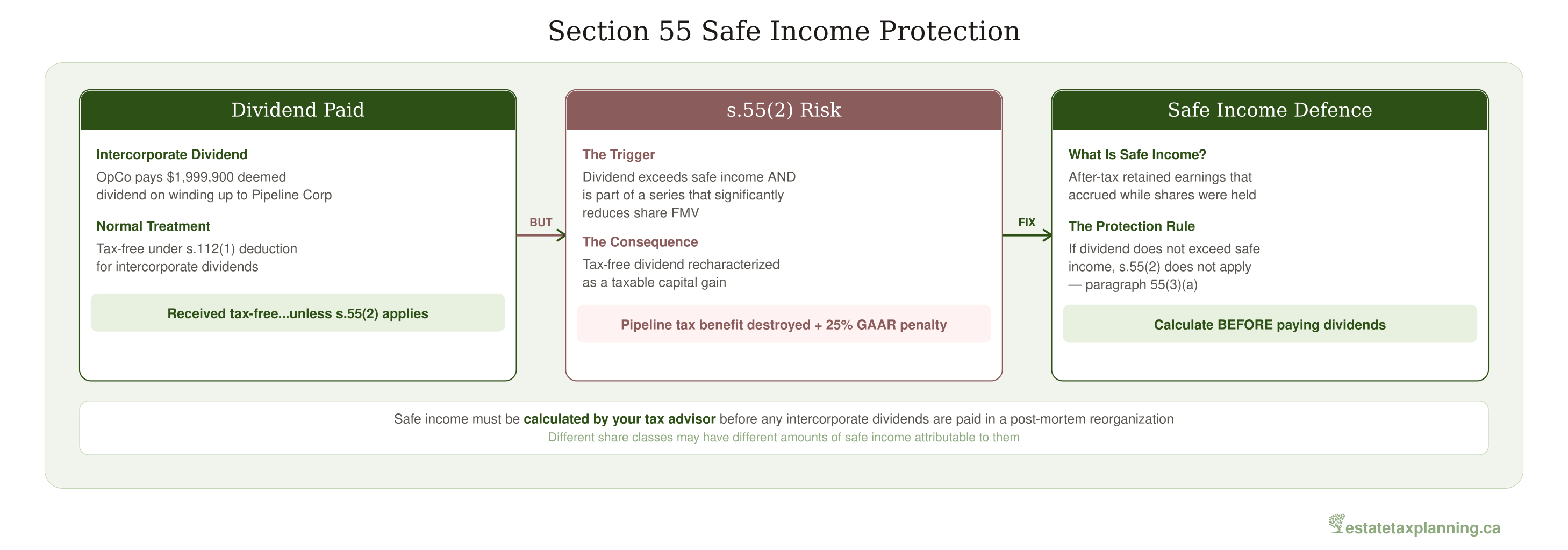
Here’s the trap within the trap. A corporation can only pay tax-free dividends to another corporation up to the amount of after-tax profits it has accumulated. Anything beyond that amount can be recharacterized as a taxable capital gain under section 55 of the Income Tax Act — and in a post-mortem pipeline, this can destroy the entire tax benefit the pipeline was designed to achieve.
Both the pipeline strategy and many post-mortem reorganizations involve intercorporate dividends — dividends paid from one corporation to another. In most cases, these dividends flow tax-free under subsection 112(1). But subsection 55(2) of the Income Tax Act can recharacterize an intercorporate dividend as a capital gain if the dividend is part of a transaction or series of transactions that results in a significant reduction in the fair market value of any share, or in an increase in the total direct cost of the property of the dividend recipient.
In the post-mortem context, this rule is relevant because the pipeline corporation receives dividends (or deemed dividends on winding up) from the operating corporation. If the CRA determines that these dividends were part of a series that significantly reduced the value of the operating company's shares, subsection 55(2) could recharacterize the tax-free intercorporate dividend as a capital gain — eliminating the tax benefit of the pipeline.
The Safe Income Exception
The primary defence against subsection 55(2) is the safe income exception under paragraph 55(3)(a). A dividend is protected from recharacterization if it does not exceed the safe income attributable to the shares on which it was paid. Safe income is generally the after-tax retained earnings of the corporation that have accrued during the period the shares were held. The safe income calculation is highly technical — it starts with taxable income, adjusts for non-deductible items and tax payable, and must be allocated among the various classes of shares. An error in the safe income calculation can expose the entire dividend to recharacterization. Your tax advisor must perform this calculation before any intercorporate dividends are paid, and different share classes may have different amounts of safe income attributable to them.
The Related Person Exception
Subsection 55(3)(a) also provides a related person exception: if the dividend is received as part of a transaction between related persons and no unrelated person is involved, subsection 55(2) generally does not apply. In a typical post-mortem scenario where the estate, the pipeline corporation, and the operating company are all related, this exception may apply — but the analysis is fact-specific and should be confirmed with your tax advisor before proceeding.
- Subsection 55(2) can recharacterize a tax-free intercorporate dividend as a capital gain, destroying the tax benefit of a pipeline strategy. Always calculate safe income before paying intercorporate dividends in a post-mortem reorganization. We treat this as a mandatory step, not optional.
- The 2024 GAAR amendments add another layer of risk: if the CRA views the dividend as lacking economic substance beyond tax reduction, both subsection 55(2) and GAAR could apply simultaneously.
- Dividends that exceed safe income are exposed to subsection 55(2) recharacterization, even in an otherwise legitimate pipeline transaction. The CRA actively scrutinizes safe income calculations in post-mortem audits. We’ve seen audit queries specifically targeting safe income — have the calculation ready.
- This is one of the most technically complex areas of post-mortem planning — your CPA, estate lawyer, and CBV all need to be involved. This is not a place to cut corners.
Choosing the Right Executor
This is an area that doesn’t get enough attention. The executor (called a “liquidator” in Quebec) is named in the freezor’s will and is responsible for administering the estate after death. In an estate freeze context, the executor’s role is far more complex than in a typical estate, because the preferred shares create the specific tax and planning opportunities we’ve described above. An executor who doesn’t understand the pipeline strategy — or who doesn’t implement it within the required timeframe — can cost the estate hundreds of thousands of dollars in avoidable tax.
Why Executor Selection Matters More with a Freeze
In a typical estate, the executor collects assets, pays debts, files final returns, and distributes to beneficiaries. With a freeze in place, the executor must also: coordinate the date-of-death valuation of the preferred shares, decide between the pipeline and loss carryback strategies (in consultation with the tax advisor), manage the timing of share redemptions to satisfy CRA's administrative position on pipelines, coordinate with the trustees of the family trust on corporate decisions, and administer the Graduated Rate Estate within its 36-month window.
For a detailed breakdown of the executor's responsibilities after the freezor's death, see Choosing Your Settlor, Trustees, and Executor.
Probate Avoidance with Multiple Wills
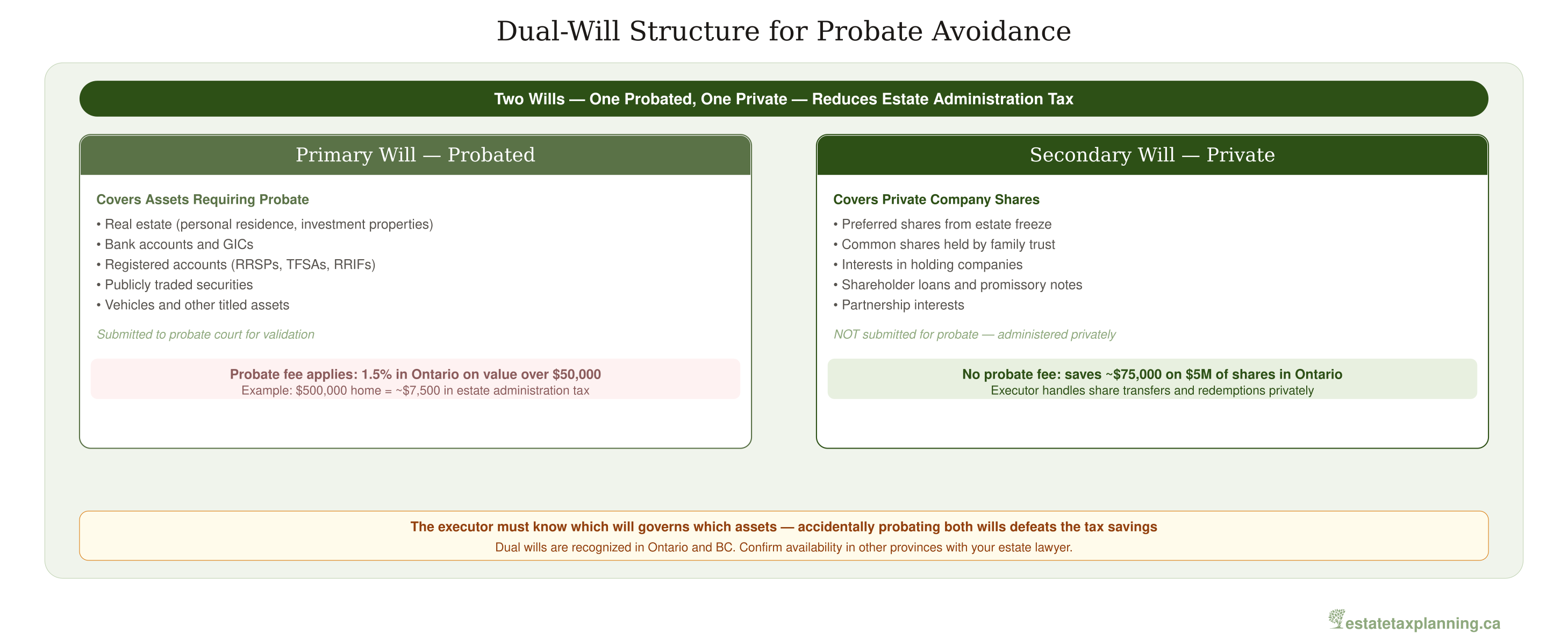
In Ontario and British Columbia, it is common practice to prepare two wills: a primary will that covers assets requiring probate (real estate, bank accounts), and a secondary will that covers private company shares and other assets that do not require probate. The secondary will is not submitted for probate, which avoids the estate administration tax (probate fee) on the value of the preferred shares. For a freezor with $5 million in preferred shares, the probate savings in Ontario can be approximately $75,000. The executor must understand which will governs which assets and must not accidentally submit both wills for probate.
The executor should understand (or be willing to learn about) the pipeline strategy, deemed dispositions, and post-mortem planning. Consider appointing co-executors: a family member for personal matters and a professional (accountant or trust company) for the corporate and tax elements. Ensure the will gives the executor sufficient authority to implement post-mortem tax planning, including share redemptions and corporate reorganizations. The executor and the trustees of the family trust must work together — consider whether the same person should serve in both roles.
The First Year: What Actually Happens After the Freezor Dies
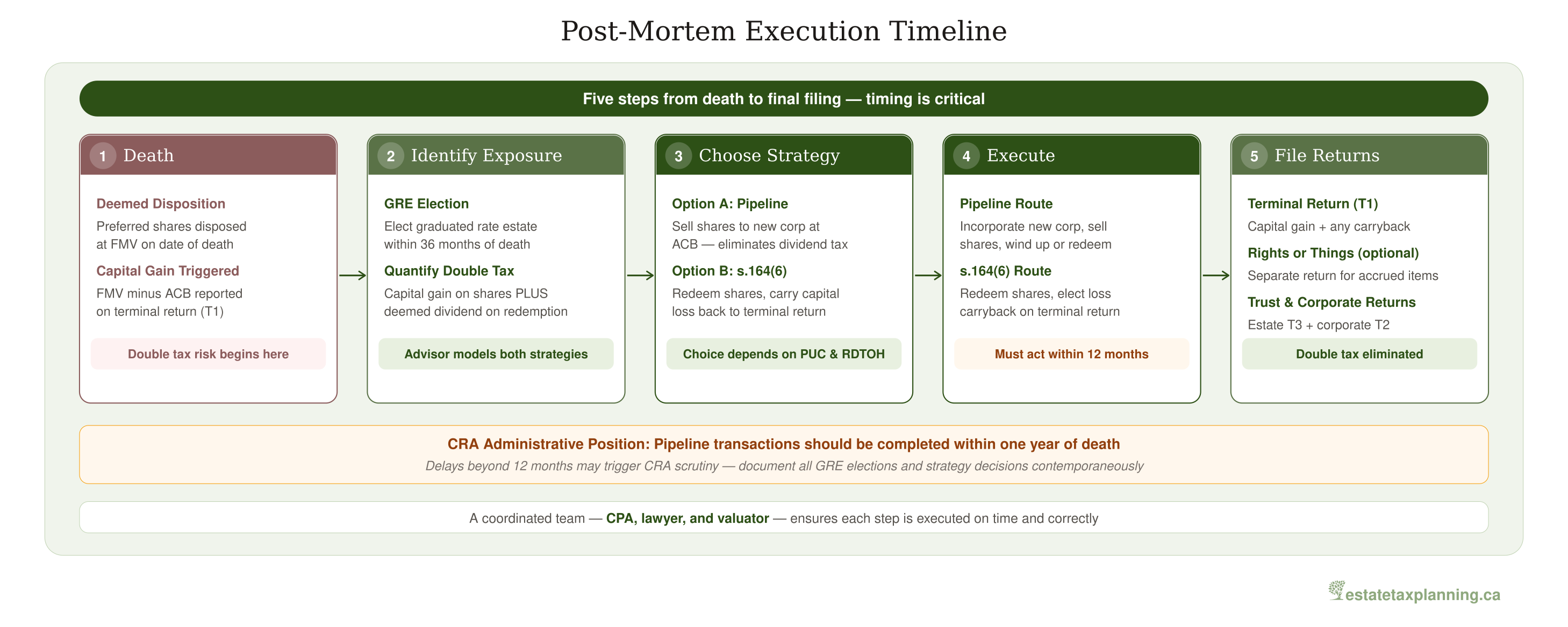
The first call usually comes within a week of the death. A family member, an executor, or sometimes a lawyer phones to say the business owner has passed away and there are preferred shares in a corporation. What happens next? In our experience, the first twelve months follow a fairly consistent pattern — and understanding that pattern helps executors feel less overwhelmed by what is, by any measure, a technically demanding process.
Week One: Immediate Steps
The executor secures the corporate records and identifies all entities the deceased was connected to: operating companies, holding companies, trusts. If dual wills are in place, the executor confirms which will governs which assets and ensures only the primary will is submitted for probate. We get our first call during this period — and the single most important thing we tell the executor is: do not redeem the preferred shares yet. Any premature redemption can trigger the double taxation the pipeline is designed to avoid.
Month One to Three: Valuation and Strategy
The CBV begins the date-of-death valuation. This is the foundation for everything that follows — the capital gain on the final return, the pipeline or carryback strategy, and the insurance claim. Simultaneously, the CPA files a request with the CRA to establish the estate as a graduated rate estate and selects the estate’s first taxation year-end. We choose the year-end strategically, because it affects both the GRE window and the s.164(6) carryback timeline. The CPA also obtains the deceased’s prior-year returns and begins assembling the information for the final T1.
Month Three to Six: Modelling and Decision
Once the valuation is complete, the CPA models both the pipeline and the loss carryback using actual numbers — not estimates. We run the two strategies side by side, factoring in the dividend type (eligible vs. non-eligible), the safe income available, any s.88(1)(d) bump room, and the insurance proceeds. The executor, with the CPA’s recommendation, makes the strategic decision. If the pipeline is chosen, the CPA begins preparing the incorporation documents for the pipeline corporation.
Month Six to Twelve: Execution
If the pipeline is the chosen strategy, the pipeline corporation is incorporated and the preferred shares are transferred for a promissory note. The CPA files the final T1 return (due six months after death, or April 30 of the following year, whichever is later). The life insurance claim is processed and the CDA credit is calculated. The first T3 return for the estate may also be due during this period, depending on the chosen year-end. Throughout all of this, the CPA is coordinating with the lawyer and the family trustee to ensure every step is documented and every deadline is met.
Beyond Year One
The pipeline typically takes 12 to 18 months to complete. The remaining steps — the redemption of preferred shares by the operating company, the repayment of the promissory note, and the wind-up of the pipeline corporation — happen during this period. The GRE status must be maintained throughout (36 months maximum). Any s.164(6) elections must be filed within the first three taxation years. We calendar every single deadline and review them monthly with the executor.
- At the time of the freeze: Confirm whether LCGE was crystallized (affects ACB and the magnitude of the double tax problem). Document the PUC of the preferred shares. We include this in every freeze closing binder.
- During the freezor’s lifetime: Put life insurance in place (corporate-owned, naming the corporation as beneficiary). Prepare dual wills if in Ontario or BC. Ensure the will authorizes post-mortem tax planning. Don’t leave this for later — we’ve seen estates where the will didn’t give the executor authority to implement the pipeline.
- Immediately after death: Obtain a date-of-death valuation (CBV). File the T1 final return. Establish and maintain GRE status. The clock starts immediately.
- Within the first year: Model both the pipeline and loss carryback strategies with actual numbers. Calculate safe income before paying any intercorporate dividends. Begin pipeline steps if that strategy is chosen. We run both models side by side for every estate.
- Within 36 months: Complete all post-mortem transactions before the GRE window closes. File all elections (including s.164(6) if using the loss carryback). Wind up or restructure as needed.
What's Next?
In Provincial Nuances, we examine how estate freeze rules vary across Ontario, Quebec, and British Columbia.
Related Articles
For deeper dives on the topics adjacent to post-mortem planning, see Life Insurance and the Estate Freeze for how the death benefit and CDA mechanics fund the tax bill, Valuation: The Make-or-Break Step for why the date-of-death valuation sets the ceiling on every strategy in this article, Incapacity and Disability Planning, and Choosing Your Settlor, Trustees, and Executor for the governance side of who actually carries out the plan.
Your tax advisor, CBV, and legal counsel can help you evaluate how this applies to your situation — post-mortem planning isn’t something to figure out after the funeral. The strategies outlined here work best when they’re built into the freeze from day one, with the will, the insurance, and the advisory team all pointing in the same direction.
For definitions of the key terms used in this article — including post-mortem planning, graduated rate estate (GRE), pipeline strategy, deemed dividend, and paid-up capital (PUC) — see our Key Terms and Definitions reference guide.
This article is for informational purposes only and does not constitute legal, tax, or financial advice. Estate freezes are complex transactions that require the coordinated involvement of qualified tax, valuation, and legal professionals. Always consult your advisors before acting on any of the information discussed here.