
The capital gains inclusion rate is still 50%. The LCGE is now $1,275,000 (2026, indexed). The AMT rules changed significantly on January 1, 2024 — model any LCGE crystallization before filing. The CEI was never enacted. Plan based on enacted law, not headlines.
If you’ve been following the capital gains saga over the past two years — the proposed rate increase, the reversal, the budget announcements — you’re not alone in feeling uncertain about what the rules actually are. For business owners planning an estate freeze, that uncertainty is more than academic. The capital gains rules determine how much of your freeze is taxable, how much you can shelter, and whether crystallizing your exemption will cost you more than you expect.
The good news is that the dust has settled. The rules are clear, they’re enacted, and they’re workable. This article walks through where things stand in 2026 and what the recent changes actually mean for your estate freeze — so you can plan based on law, not headlines.
Where Things Stand in 2026
The capital gains inclusion rate is still 50% — where it’s been since October 2000. The 2024 federal budget proposed increasing it to 66.67%, but that proposal was never enacted into law. It was formally cancelled on March 21, 2025. If you’ve been holding off on a freeze because you weren’t sure what rate you’d be dealing with, the answer is the same rate we’ve had for a quarter century.
What does that mean in dollars? At Ontario’s top combined rate of approximately 53.53%, a $1,000,000 capital gain at the 50% inclusion rate produces roughly $267,650 in tax. On a $5 million freeze, that’s over $1.3 million. The number is significant — but it’s predictable, and that predictability is what makes planning possible.
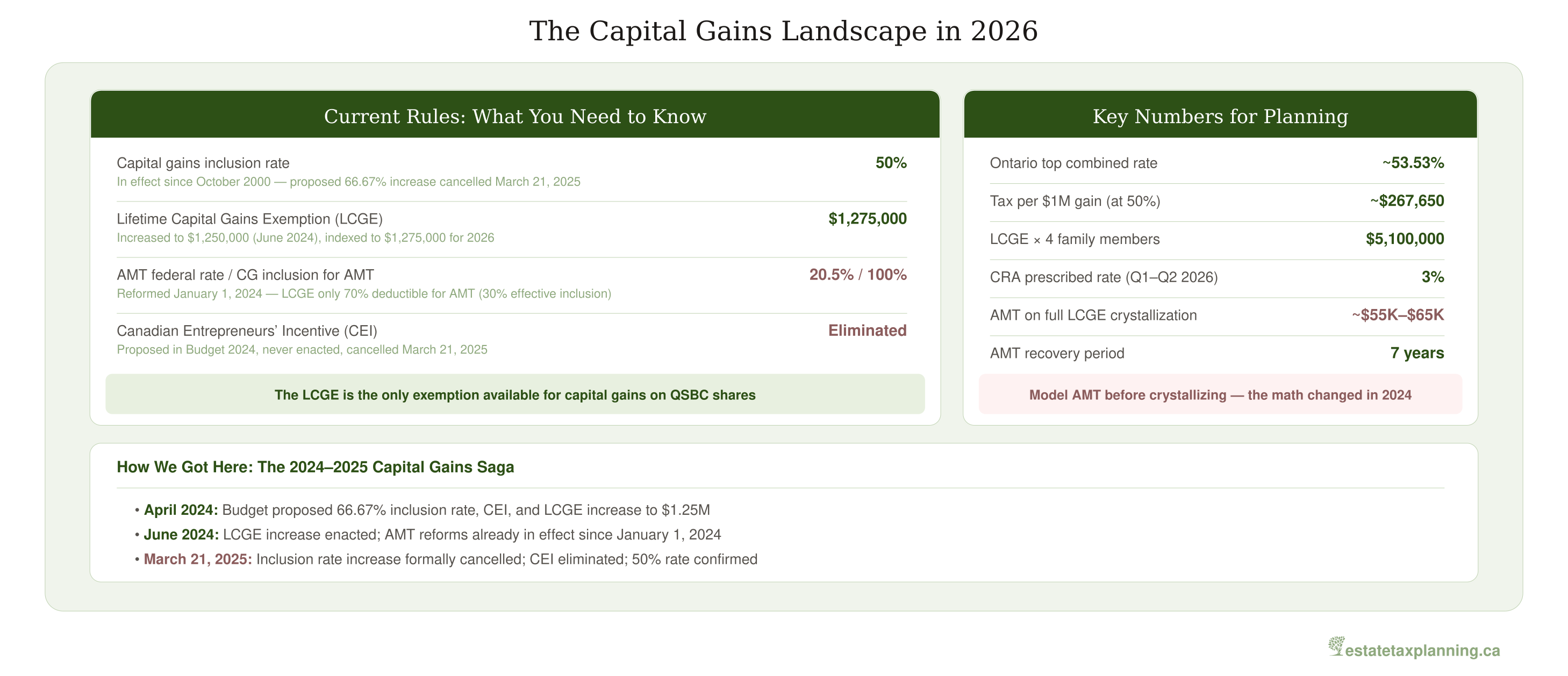
- The LCGE increase to $1,250,000 was enacted and is in effect. Indexation resumes in 2026, bringing the exemption to $1,275,000.
- The AMT reforms took effect on January 1, 2024 and are permanent.
- The 66.67% inclusion rate was never enacted into law and was formally cancelled on March 21, 2025.
- The Canadian Entrepreneurs’ Incentive was never enacted and has been eliminated.
The Three Changes That Matter
The inclusion rate didn’t change, but three other things did — and each one matters for your freeze.
The LCGE: Now $1,275,000
This is the welcome news. The Lifetime Capital Gains Exemption jumped from approximately $1,016,836 to a base of $1,250,000 effective June 25, 2024. With indexation resuming in 2026, it now sits at $1,275,000. That’s a meaningful increase in how much you can shelter when you dispose of qualified small business corporation shares.
For estate freeze planning, the higher LCGE makes multiplication even more powerful. A family of four can now potentially shelter over $5,000,000 in capital gains on QSBC shares — that’s a tax savings of over $1.3 million. And if you implemented a freeze years ago and crystallized your LCGE at the old limit, you may have room you didn’t have before. It’s worth revisiting with your advisor.
- Each Canadian resident gets their own LCGE. By structuring your freeze so that growth shares are held by or allocated to multiple family members, the family multiplies the exemption — potentially sheltering millions.
- A family trust can allocate capital gains to individual beneficiaries, each of whom claims their own LCGE. The key requirement: the shares must qualify as QSBC shares at the time of disposition, not just at the time of the freeze.
- Direct share issuance to family members is another approach, though you give up the flexibility of a trust. For most families, the trust route is worth the added complexity.
For a deeper look at LCGE crystallization strategies and multiplication through family trusts, see The Lifetime Capital Gains Exemption and the Estate Freeze.
Alternative Minimum Tax: The Hidden Cost of Crystallizing
Here’s the one that catches people off guard. The AMT rules changed on January 1, 2024, and the new math hits estate freeze planning directly. The federal AMT rate went from 15% to 20.5%, and — critically — the capital gains inclusion rate for AMT purposes jumped to 100%. So even though your regular inclusion rate is 50%, for AMT purposes the full gain is counted.
Why does this matter? If you’re considering crystallizing your LCGE at the time of the freeze — which is a common and often sensible strategy — claiming the exemption reduces your regular tax to zero. But the AMT calculation only allows you to deduct 70% of the LCGE. The remaining 30% of the gain stays in your adjusted taxable income for AMT purposes, and you end up owing AMT even though your regular tax bill is nil.
The math on a full crystallization of the $1,275,000 LCGE works out roughly as follows: the full gain is included at 100% for AMT, minus the 70% LCGE deduction ($892,500), minus the basic AMT exemption of approximately $178,000, leaving an AMT base of about $204,500. At 20.5%, that’s approximately $42,000 in federal AMT. Add provincial AMT and you’re looking at $55,000 to $65,000 combined. You do get this back as a credit over the following seven years — but it’s real money out the door upfront, and it needs to be part of the conversation.
- Before 2024, crystallizing the full LCGE typically triggered little or no AMT. The old rules used an 80% inclusion, a 15% rate, and more limited LCGE deductibility — but the numbers generally stayed below the AMT threshold. Many advisors treated crystallization as essentially free. That’s no longer the case.
- Under the new rules, 100% of the gain is included for AMT, only 70% of the LCGE is deductible, and the federal AMT rate is 20.5%. Full crystallization now triggers approximately $42,000 in federal AMT alone — $55,000 to $65,000 combined with provincial AMT.
- Have your tax advisor model the AMT before you proceed. A partial crystallization — or spreading it across tax years — may keep you below the threshold entirely.
| Pre-2024 Rules | Post-2024 Rules | |
|---|---|---|
| Capital gains inclusion for AMT | 80% | 100% |
| Federal AMT rate | 15% | 20.5% |
| LCGE deductibility for AMT | 50% | 70% |
| Effective inclusion on LCGE gains | Low (often below AMT threshold) | 30% |
| AMT on full LCGE crystallization | Minimal or nil | ~$42K federal / ~$55K–$65K combined |
The Canadian Entrepreneurs’ Incentive: Gone
The Canadian Entrepreneurs’ Incentive (CEI) was proposed in Budget 2024 alongside the inclusion rate increase. It would have reduced the inclusion rate to one-third on qualifying gains, phasing from $400,000 in 2025 to $2 million by 2029. It sounded attractive. But it was never enacted into law.
When the inclusion rate increase was cancelled on March 21, 2025, the rationale for the CEI fell away with it. Budget 2025 confirmed its elimination. For your freeze, this means the LCGE is the only capital gains shelter available for QSBC share dispositions. If you’ve seen references to the CEI in planning materials or other articles, disregard them — the measure is gone.
- The CEI is a useful cautionary tale. It was proposed, widely discussed in planning circles, incorporated into client presentations — and never enacted. Advisors who built strategies around it had to unwind them.
- The lesson is straightforward: build your estate freeze on enacted law, not proposals. The LCGE, the 50% inclusion rate, and the AMT rules are all enacted and in effect. Plan around those.
- Tax policy can change with every budget. Your freeze structure should be resilient enough to accommodate that reality.
Practical Implications for Estate Freeze Planning
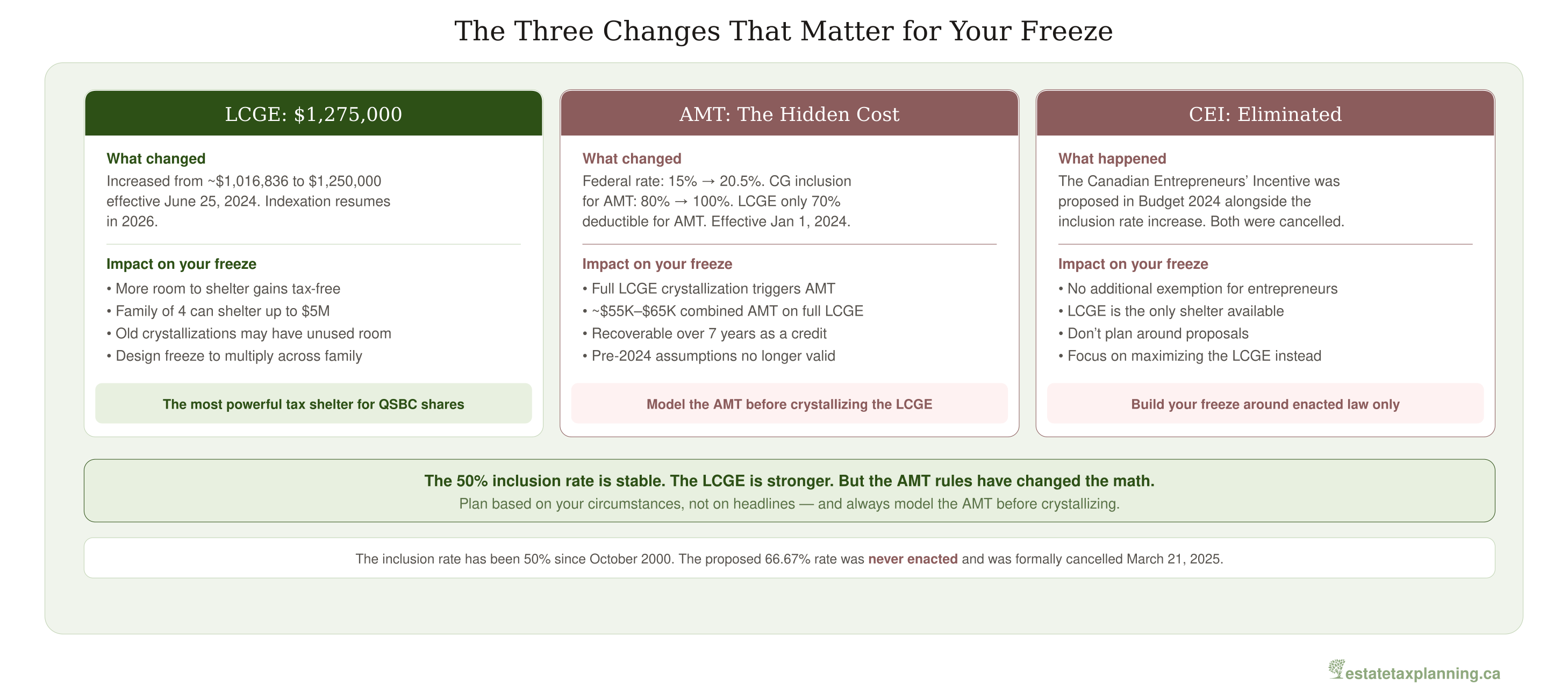
You don’t need to rush. With the inclusion rate stable at 50%, there’s no urgency to implement a freeze to “beat” a rate increase. Take the time to plan properly, get an independent valuation, and choose the right structure. A well-planned freeze implemented at the right time will almost always produce better results than a hasty one driven by headline anxiety. We saw a number of rushed freezes in 2024 — some of them will need to be revisited.
LCGE multiplication is more valuable than ever. At $1,275,000 per person (indexed for 2026), multiplied across family members, this is the single most powerful tax shelter available for QSBC share dispositions. Make sure your freeze structure is designed to maximize it — whether through a family trust that allocates gains to individual beneficiaries or through direct share issuance to adult children. A family of four can shelter over $5 million. That’s not a rounding error.
Model the AMT before you crystallize. If you’re considering a subsection 85(1) freeze with LCGE crystallization, have your tax advisor run the AMT numbers under the new rules before you proceed. The math has changed significantly since 2023, and the upfront cost on a full crystallization can surprise people. A partial crystallization — or spreading it across tax years — may be the better approach. The AMT interaction is covered in detail in The Lifetime Capital Gains Exemption and the Estate Freeze.
Build for uncertainty. Tax rules can change with every budget and every election. The capital gains saga of 2024–2025 is proof that what is proposed is not always enacted, and what is enacted is not always permanent. Build flexibility into your freeze structure — trust provisions, redemption features on preferred shares, refreeze mechanisms — so it can adapt to whatever comes next.
Review existing freezes. If you implemented a freeze in 2024 specifically to “beat” the proposed rate increase, the fundamental rationale hasn’t changed — the freeze still caps your tax liability and transfers growth to the next generation. But it’s worth reviewing whether the timing and structure are still optimal now that the urgency has passed. In particular, if the valuation was rushed to meet a perceived deadline, a fresh independent assessment may be worthwhile.
What This Means for Your Insurance Coverage
Your capital gains exposure directly determines how much insurance coverage your estate freeze needs. Because the inclusion rate is staying at 50%, the insurance math is stable — and that’s something you can plan around with confidence.
| Frozen Share Value | Approx. Tax at Death | With 15% Margin |
|---|---|---|
| $1,000,000 | $267,650 | $307,800 |
| $3,000,000 | $802,950 | $923,400 |
| $5,000,000 | $1,338,250 | $1,539,000 |
| $10,000,000 | $2,676,500 | $3,078,000 |
These figures assume no remaining LCGE and Ontario’s top combined rate of approximately 53.53%. The margin column adds 15% for professional fees, estate administration, and potential rate changes — a reasonable starting point when sizing your coverage. If the freezor crystallized the full $1,275,000 LCGE at the time of the freeze, the stepped-up ACB reduces the eventual gain — and the required coverage — by roughly $341,000 in tax savings. That reduction should be reflected in the insurance sizing from the outset.
Had the inclusion rate gone to 66.67% as proposed, those same freezes would have required significantly more coverage — roughly $356,800 per million, or $1,784,000 on a $5 million freeze. The cancellation means that existing insurance policies purchased to fund estate freezes are likely still adequately sized. But here’s something worth checking: if you purchased additional coverage in 2024 anticipating the rate increase, you may now be over-insured. As discussed in Life Insurance and the Estate Freeze, a review with your insurance advisor is worthwhile.
- At 50% inclusion, budget approximately $268,000 in tax per $1,000,000 of frozen share value (Ontario rates).
- Add 10–15% for professional fees, estate administration, and potential rate changes.
- If you increased coverage in 2024 anticipating the 66.67% rate, review whether that extra coverage is still needed — you may be paying premiums on insurance you don’t require.
- If you’re implementing a wasting freeze, coordinate the declining frozen value with declining insurance coverage so the two stay in step.
The cancellation of the inclusion rate increase is welcome news, but it doesn’t change the fundamental reasons for implementing a freeze. The core benefits — capping your tax liability, transferring growth to the next generation, facilitating succession — are driven by the structure of the freeze itself, not the specific inclusion rate. The rules are clear, the math is workable, and you can plan with confidence.
What’s Next
If your business involves U.S. persons — whether as shareholders, beneficiaries, or through cross-border operations — the estate freeze raises additional complications. In Cross-Border Estate Freezes: When U.S. Persons Are Involved, we explore how U.S. tax obligations interact with the Canadian freeze structure.
If you froze your corporation before the 2024 changes, it’s worth revisiting the numbers. The LCGE increase and the AMT changes may have shifted the math — and a quick review with your CPA and CBV can tell you whether your current structure is still working as hard as it should.
For definitions of the key terms used in this article — including capital gains inclusion rate, AMT, LCGE, crystallization, and CEI — see our Key Terms and Definitions reference guide.
This article is for informational purposes only and does not constitute legal, tax, or financial advice. Estate freezes are complex transactions that require the coordinated involvement of qualified tax, valuation, and legal professionals. Always consult your advisors before acting on any of the information discussed here.