
Most estate freeze failures are preventable. Get an independent CBV valuation, crystallize the LCGE at the time of the freeze, include a price adjustment clause, and schedule a biennial review with your advisory team. The mistakes that compound most painfully are the ones that go undetected for years.
An estate freeze is one of the most powerful estate planning tools available to Canadian business owners. But it is also one of the most complex — involving corporate reorganizations, trust structures, tax elections, insurance strategies, and family governance decisions that must all work together. When any one of these elements is done wrong, the consequences can be costly, difficult to reverse, and sometimes not discovered until years after the freeze is implemented.
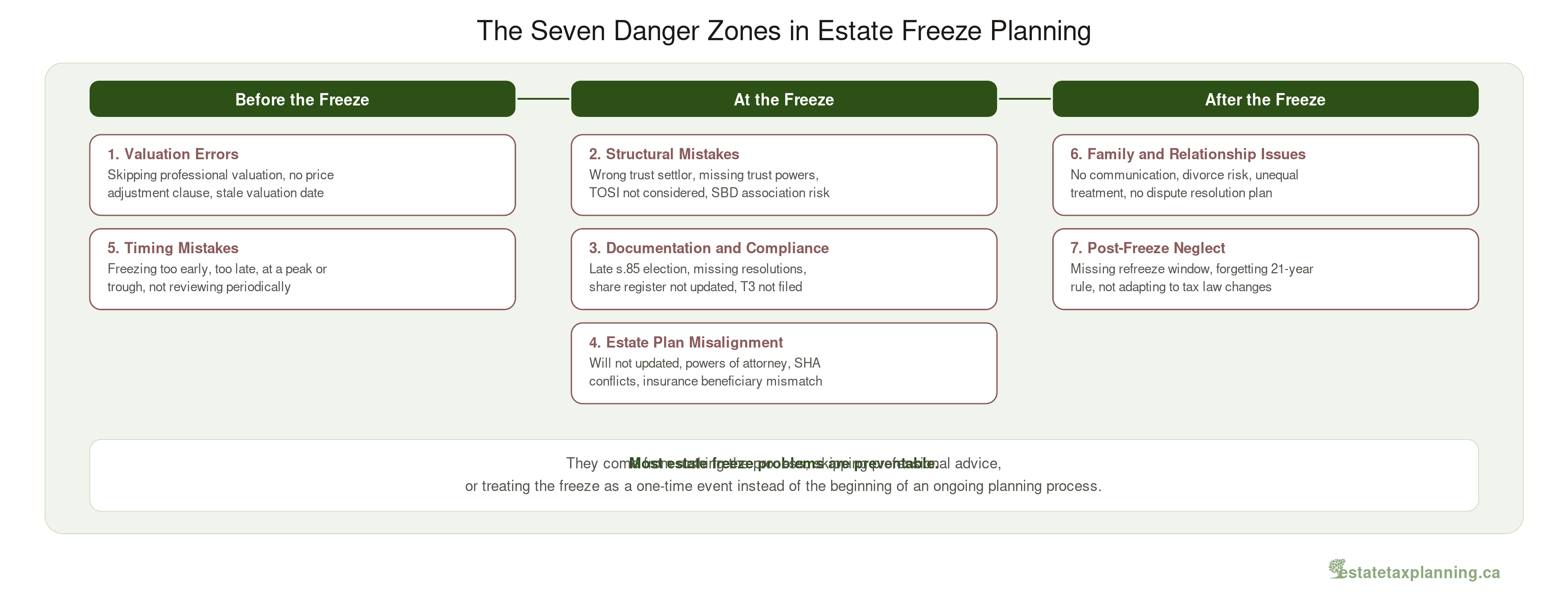
The best way to avoid these problems is to know what to look for before they happen. This article maps the most common estate freeze mistakes across seven danger zones, organized by when they typically occur: before the freeze, at the time of the freeze, and in the years that follow.
The Seven Danger Zones
Estate freeze mistakes tend to cluster around seven areas. Some occur before the freeze is implemented, some at the time of the freeze itself, and some in the years that follow. Understanding the full landscape of risk — not just the technical tax rules — is what separates a freeze that works from one that creates more problems than it solves.
1. Valuation Errors
This is the single most common source of problems in estate freezes. As discussed in Valuation: The Make-or-Break Step , the entire freeze rests on the fair market value of the shares being frozen. Getting the number wrong — in either direction — can have serious consequences.
In our experience, the single most common estate freeze mistake is not getting an independent valuation. Business owners often assume they know what their company is worth — and they're usually wrong by 20% or more in one direction.
Skipping the Professional Valuation
Some business owners try to save money by using an informal or internal estimate of their company’s value. This is a false economy. The CRA has the right to challenge the valuation under subsection 69(1), and without a formal report from a Chartered Business Valuator (CBV), you have limited ammunition to defend your position. The cost of a professional valuation — typically $10,000 to $25,000 for a straightforward operating company — is a fraction of the cost of a CRA reassessment.
Forgetting the Price Adjustment Clause
A price adjustment clause (PAC) in the freeze documents allows the parties to adjust the transaction value if the CRA later determines the FMV was different from the amount used. Without a PAC, a CRA reassessment can create permanent tax mismatches — the freezor is taxed on a higher value while the preferred shares retain their original redemption amount, resulting in double taxation on the difference. Including a PAC is standard practice and provides critical protection. The CRA has accepted PACs as valid where the parties genuinely intended to transact at FMV, as established by the Federal Court of Appeal’s framework in Income Tax Folio S4-F3-C1 (which replaced IT-169).
Using a Stale Valuation
If there is a significant delay between the date of the valuation and the date the freeze is implemented, the valuation may no longer reflect FMV. Business conditions change, and a valuation that was accurate six months ago may not be accurate today. The valuation should be dated as close to the freeze date as practical, and any material changes in the business between the valuation date and the freeze date should be documented and addressed.
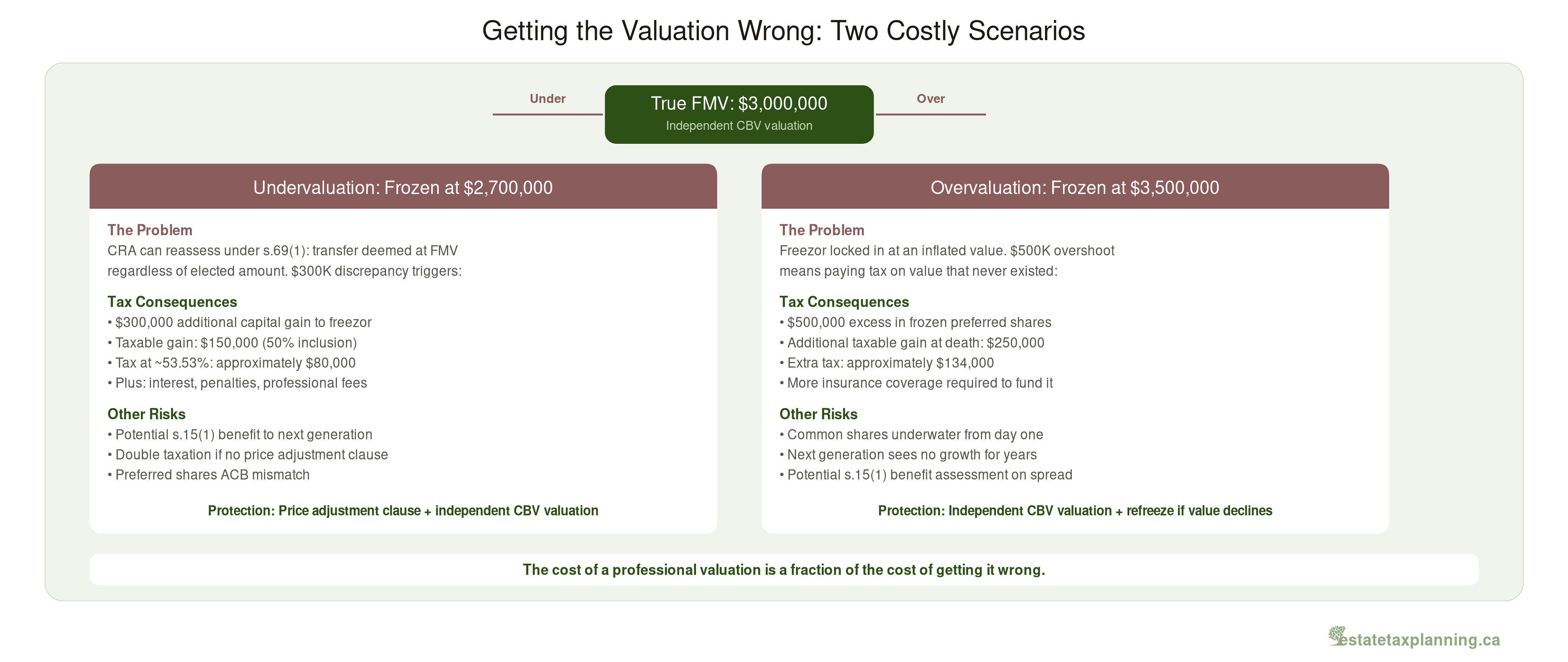
- Undervaluation by $300,000: approximately $80,000 in additional tax ($300K × 50% inclusion × ~53.53% top rate), plus interest, penalties, and professional fees to resolve the reassessment.
- Overvaluation by $500,000: approximately $134,000 in excess tax at death ($500K × 50% × ~53.53%), plus years of lost growth for the next generation as the common shares start underwater.
- In either case, the cost dwarfs the $10,000–$25,000 fee for a proper independent valuation.
2. Structural Mistakes
Choosing the wrong structure can undermine the very goals of the freeze. The three main structural choices — direct to family, holding company, or family trust — each have significant trade-offs, and the wrong choice can lead to unexpected tax consequences.
Wrong Settlor for the Trust
If the settlor of the family trust is the freezor, their spouse, or a trust beneficiary, the reversionary trust rules under subsection 75(2) may apply. This attributes the trust’s income and gains back to the settlor, defeating the purpose of the freeze entirely. The settlor should always be an arm’s-length person who is not a beneficiary of the trust — this is one of the most basic requirements, yet it continues to be a source of problems in practice.
Missing Powers in the Trust Deed
A trust deed that does not authorize the trustees to participate in corporate reorganizations, allocate capital gains to specific beneficiaries, or add new beneficiaries can cripple the trust’s usefulness. These gaps are often not discovered until years later, when the trustees try to do something the trust deed does not permit. Amending a trust deed after the fact is possible in some cases but can be expensive and uncertain, particularly if it requires a court application.
Not Considering TOSI Before Choosing the Structure
As outlined in TOSI and the Estate Freeze , the Tax on Split Income rules can significantly affect which structure is most effective. If income splitting is a primary goal, issuing shares directly to family members who may qualify for the “excluded shares” exception may be more effective than using a trust. Conversely, if flexibility and creditor protection are priorities, a trust may be worth the TOSI trade-off. This analysis should happen before the freeze is implemented, not after.
Ignoring the Small Business Deduction Implications
If your children or other family members already own shares in other private companies and they acquire shares in your company through the freeze, the companies may become associated under the associated corporation rules in section 256. This can result in the $500,000 small business deduction limit being shared among multiple corporations, increasing the corporate tax bill. Ontario’s combined small business rate is approximately 12.2% for the first half of 2026, dropping to approximately 11.2% effective July 1, 2026 under the Ontario 2026 budget. Compared to the general corporate rate of 26.5%, the difference is meaningful — and losing access to the small business deduction through an unplanned association can add tens of thousands of dollars in annual corporate tax.
Getting the Preferred Share Terms Wrong
The design of the preferred shares is locked in at the time of the freeze and is extremely difficult to change after the fact. Common mistakes include: omitting retraction rights (which makes the wasting freeze impossible without the corporation’s voluntary cooperation), setting an inadequate dividend rate (which can support a CRA argument that a benefit has been conferred under subsection 15(1)), failing to include voting provisions (causing the freezor to lose control of the corporation), and fixing the redemption amount without building in any mechanism for downside protection if the business subsequently declines in value.
These are drafting decisions made by the lawyer, but they must be informed by the tax advisor’s understanding of the freeze strategy. If the preferred shares are designed to be gradually redeemed during retirement, they must include retraction rights. If the freezor needs to maintain board control, the preferred shares must carry sufficient votes. If the dividend rate is too low, CRA may argue the growth shares received a benefit. Getting these terms right at the outset is far less expensive than trying to fix them later through an amendment or a new reorganization.
Triggering Corporate Attribution Under Subsection 74.4(2)
When the freezor transfers property to a corporation and a spouse or minor child holds growth shares — either directly or through a family trust — the corporate attribution rules in subsection 74.4(2) can apply. The rule deems the freezor to earn income equal to the CRA prescribed interest rate (3% as of Q2 2026, updated quarterly) on the value of the property transferred, less any actual dividends received on the preferred shares. On a $3 million freeze, that is $90,000 in deemed income annually — even if the freezor receives no actual cash.
The corporate attribution rules are separate from the general attribution rules in sections 74.1 and 74.2, and they apply specifically to corporate transfers. They are a common trap in estate freezes because they can be triggered by standard freeze structures that are otherwise perfectly sound. The rules do not apply if the corporation qualifies as a “small business corporation” at the time of the transfer — but if the corporation later loses that status (for example, by accumulating passive investments), the exception may no longer be available. As we explore in more detail in a later article in this series on corporate attribution, careful structuring at the time of the freeze is essential to avoid this trap.
- Before choosing the freeze structure, your advisory team should analyze: (1) TOSI exposure for each family member, (2) creditor protection needs, (3) LCGE multiplication potential, (4) association risk with other family-owned corporations, (5) flexibility requirements for future reorganizations, and (6) the family’s succession timeline.
- The structure that is best from a pure tax perspective may not be the best overall. Liability protection, family governance, and practical flexibility all factor into the decision.
3. Documentation and Compliance Gaps
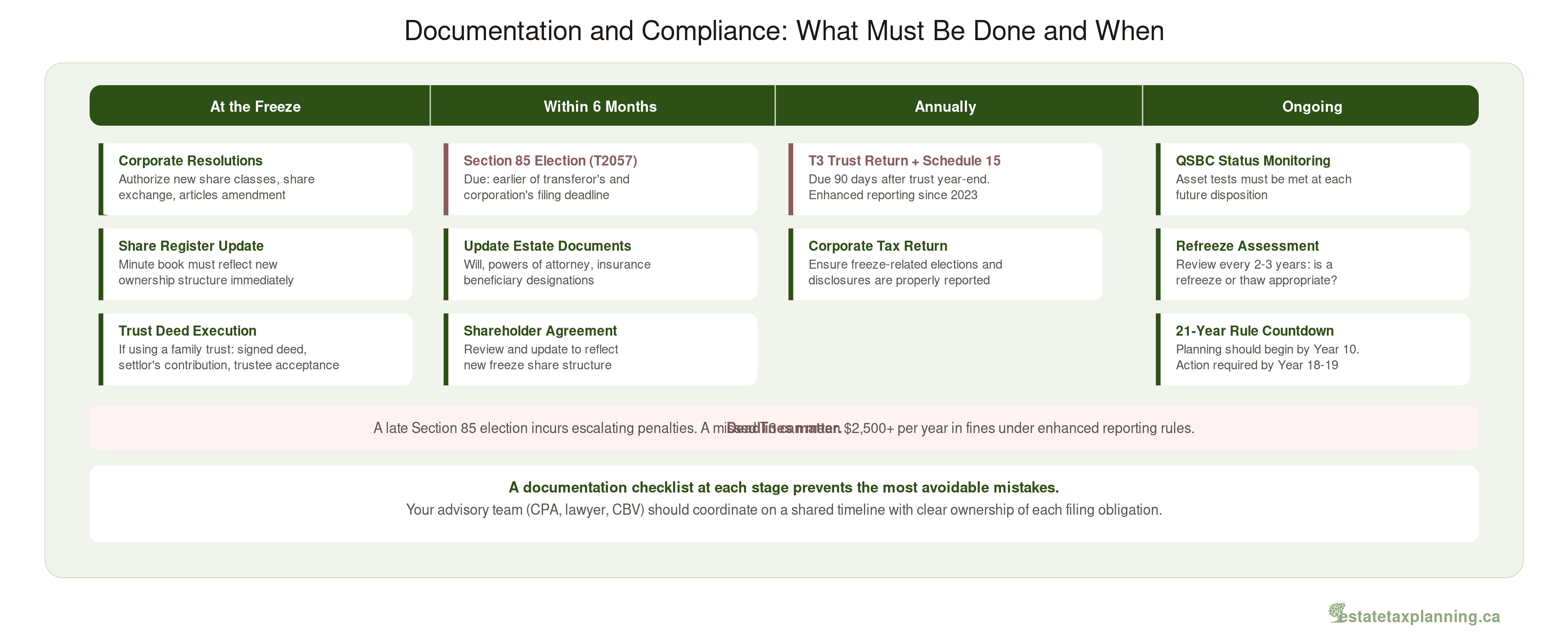
An estate freeze involves multiple legal and tax documents that must be completed correctly and filed on time. Missing or incomplete documentation is one of the most avoidable — yet most common — mistakes.
Late or Missing Section 85 Election
If the freeze uses a subsection 85(1) rollover, the joint election (Form T2057) must be filed with the CRA by the earlier of the tax return filing deadlines for the transferor and the transferee corporation. Late-filed elections are subject to penalties under subsection 85(7). The penalty is the greater of $100 per month late (up to a maximum of $8,000) or 0.25% per month of the fair market value of the property transferred (also capped at $8,000). On a $3 million freeze, the 0.25% calculation produces a penalty of $7,500 per month — reaching the $8,000 cap almost immediately. The election must be filed within three years of the filing deadline to be accepted at all; beyond that window, a very late election may be denied entirely.
Incomplete Corporate Resolutions
The share exchange requires proper corporate resolutions authorizing the issuance of new share classes, the exchange of existing shares, and the amendment of the articles of incorporation (or the filing of articles of amendment). Missing or improperly drafted resolutions can leave the entire freeze open to legal challenge and create uncertainty about whether the reorganization was validly completed.
Share Register Not Updated
The corporation’s share register (the minute book) must be updated to reflect the new share ownership. If the register still shows the old structure, it can create confusion and disputes, particularly if the business is later sold or if there is a CRA audit. The share register is the official record of who owns what, and it must match the legal reality of the freeze.
Failing to File T3 Trust Returns
If a family trust is used, it must file an annual T3 return, including Schedule 15 for beneficial ownership information. Failure to file can result in penalties of $25 per day (minimum $100, maximum $2,500) under subsection 162(7.01), and the enhanced trust reporting requirements introduced in 2023 have made compliance more onerous. Every trust with a December 31 year-end must now disclose the identity of all trustees, beneficiaries, and settlors, with limited exceptions.
- A late Section 85 election on a $3 million freeze: the 0.25%-of-FMV penalty hits $7,500 per month, reaching the $8,000 cap almost immediately. The election must be filed within three years of the deadline or it may be denied entirely.
- A missed T3 return for two consecutive years: up to $5,000 in penalties, plus potential gross negligence penalties under subsection 163(2) if the omission was deliberate. The trust may also lose its ability to make certain elections retroactively.
- These are entirely avoidable costs. A compliance checklist reviewed by both the CPA and the lawyer can prevent them.
4. Estate Plan Misalignment
An estate freeze changes the ownership structure of your business. If your estate plan is not updated to reflect that change, you are setting the stage for confusion, conflict, and potentially costly litigation.
Will Not Updated
Your will should reflect your new share ownership. Before the freeze, you owned common shares. After the freeze, you own preferred shares. If your will still refers to the common shares, or if it does not account for the preferred share redemption strategy (including the subsection 164(6) loss carryback election), the executor may face difficulties administering the estate. A will review should be part of every estate freeze engagement.
Powers of Attorney Not Updated
If you become incapacitated, your attorney for property needs the authority to manage your preferred shares, vote them, and potentially implement redemptions as part of the wasting freeze strategy. If the power of attorney does not contemplate this, the attorney may be unable to act, requiring a costly and time-consuming court application for a guardianship order.
Shareholder Agreement Conflicts
If there is an existing shareholder agreement, it may contain provisions that conflict with the new freeze structure — for example, rights of first refusal, buy-sell provisions, or restrictions on share transfers that were not designed with the freeze in mind. The shareholder agreement should be reviewed and updated as part of the freeze to ensure it works with, not against, the new structure.
Insurance Beneficiary Misalignment
If life insurance is being used to fund the tax liability at death, as covered in Life Insurance and the Estate Freeze , the beneficiary designations on the policy must align with the freeze structure. If the policy is corporate-owned, the corporation should be the beneficiary to ensure the proceeds flow through the capital dividend account (CDA). A misaligned designation — naming a personal beneficiary on a corporate-owned policy, or vice versa — can result in the proceeds going to the wrong person or being taxed in unintended ways.
Not Planning for Probate on the Preferred Shares
In Ontario, estate administration tax (probate fees) is 1.5% on the value of the estate above $50,000. On $3 million in preferred shares, that represents approximately $45,000 in probate fees alone — a cost that is entirely avoidable with proper planning. A dual will strategy (one will for the privately held shares, which does not need to be probated, and a second will for all other assets) can eliminate probate on the preferred shares entirely. An alter ego trust is another option for freezors aged 65 or older. These strategies should be discussed with the estate lawyer as part of the freeze engagement, not as an afterthought years later.
5. Timing Mistakes
Freezing Too Early
If you freeze before you are confident you have enough assets for retirement, you may find yourself locked out of the business’s future growth. As we discussed in Freeze, Gel, Thaw, and Wasting Freeze , the “gel” structure (where the freezor remains a trust beneficiary and can receive distributions from future growth) can mitigate this, but a hard freeze done prematurely can create real financial stress. The freezor’s retirement needs should be modelled before the freeze is finalized.
Freezing Too Late
If you wait until the business has reached peak value, the frozen amount — and your eventual tax liability — will be much larger than it would have been if you had frozen earlier. Every year you delay, the “frozen” number gets bigger. A $3 million business that could have been frozen five years ago at $1.5 million represents approximately $400,000 in additional tax at death (assuming the 50% inclusion rate and Ontario’s top combined rate of approximately 53.53%).
Freezing at a Temporary Peak or Trough
If you freeze during a temporary spike in value, you lock in an inflated amount. If you freeze during a temporary dip, you get a favourable frozen value but may not have intended to implement the freeze at that point. The freeze should reflect the company’s normalized, sustainable performance — which is exactly what a proper CBV valuation provides. A refreeze can correct for value changes, but it requires a new reorganization and a new valuation.
Not Crystallizing the LCGE at the Time of the Freeze
If the freezor has unused LCGE room and the shares qualify as QSBC shares, the estate freeze is the natural moment to crystallize — electing a transfer amount under subsection 85(1) that triggers a capital gain equal to the available exemption, then offsetting it with the LCGE deduction. This steps up the ACB of the preferred shares, permanently reducing the capital gain at death. Failing to crystallize at the time of the freeze means leaving up to $341,000 in tax savings on the table (based on a $1,275,000 LCGE at 50% inclusion and Ontario’s top rate of approximately 53.53%).
Crystallization is only available through a Section 85 election, not through a Section 86 reorganization. Whether Section 85 or Section 86 is the appropriate structure depends on the specific circumstances — Section 86 is perfectly suitable when LCGE crystallization is not a priority. But if crystallization is part of the plan and the freeze is structured as a Section 86 share exchange without a separate crystallization step, the opportunity may be permanently lost. The choice of structure should be made deliberately, with LCGE crystallization as one of several factors in the analysis. As detailed in The Lifetime Capital Gains Exemption and the Estate Freeze , the AMT implications of crystallization must also be modelled before any election is filed.
- There is no universally “right” time. But the analysis should consider: the freezor’s age and retirement timeline, the business’s growth trajectory and stability, current tax rates and rules (particularly the LCGE limit and capital gains inclusion rate), the readiness of the next generation, and whether the advisory team is in place.
- Most advisors recommend starting the conversation when the business owner is in their late 40s to mid-50s — early enough to benefit from growth shifting to the next generation, but late enough that the business is established and the freezor’s retirement needs are clearer.
6. Family and Relationship Mistakes
Estate freezes do not happen in a vacuum — they happen in families. Ignoring the human side of the equation is one of the most underestimated risks in estate freeze planning.
No Communication with Family Members
If your children do not know about the freeze, they may not understand their ownership stake, their responsibilities, or the tax implications of holding growth shares. Surprises in estate planning tend to breed resentment and conflict. The timing and extent of disclosure is a judgment call, but some level of communication is almost always better than none.
Ignoring Divorce Risk
If a child who holds growth shares goes through a divorce, those shares may be considered family property and subject to equalization or division under provincial family law. On a $3 million freeze where the growth shares have appreciated to $2 million, the equalization claim could be $1 million or more — potentially forcing a sale or buyout of shares that were intended to stay in the family. Holding shares through a trust provides some protection, but it is not absolute — the value of a beneficial interest in a trust can still be included in a net family property calculation in Ontario. A marriage or cohabitation agreement can provide an additional layer of protection, particularly for shares held directly.
Unequal Treatment Without Explanation
If some children receive growth shares (because they are active in the business) and others do not, the non-active children may feel excluded or unfairly treated. Life insurance can be used to equalize the estate — providing non-active children with an equivalent inheritance through insurance proceeds rather than business shares. But the plan should be communicated to the family to avoid misunderstandings that can fester for years.
Not Planning for Family Disputes
What happens if siblings who hold growth shares disagree about the direction of the business? What happens if one child wants to sell and the other does not? A well-drafted shareholder agreement (or trust deed, if a trust is used) should include dispute resolution mechanisms, buy-sell provisions, and valuation formulas for forced sales. Without these provisions, a family disagreement can become a costly and destructive legal battle. Shareholder disputes that reach litigation routinely cost $100,000 to $300,000 or more in legal fees alone — and that does not account for the business disruption, lost management attention, or the permanent damage to family relationships.
- In our experience, the freeze disputes that cost the most — in dollars and in family relationships — are not caused by getting a tax election wrong. They are caused by not communicating the plan, not planning for divorce, and not building dispute resolution into the structure.
- A family meeting (facilitated by a trusted advisor) before the freeze is implemented can prevent decades of conflict. It is one of the highest-value, lowest-cost planning steps available.
7. Post-Freeze Neglect
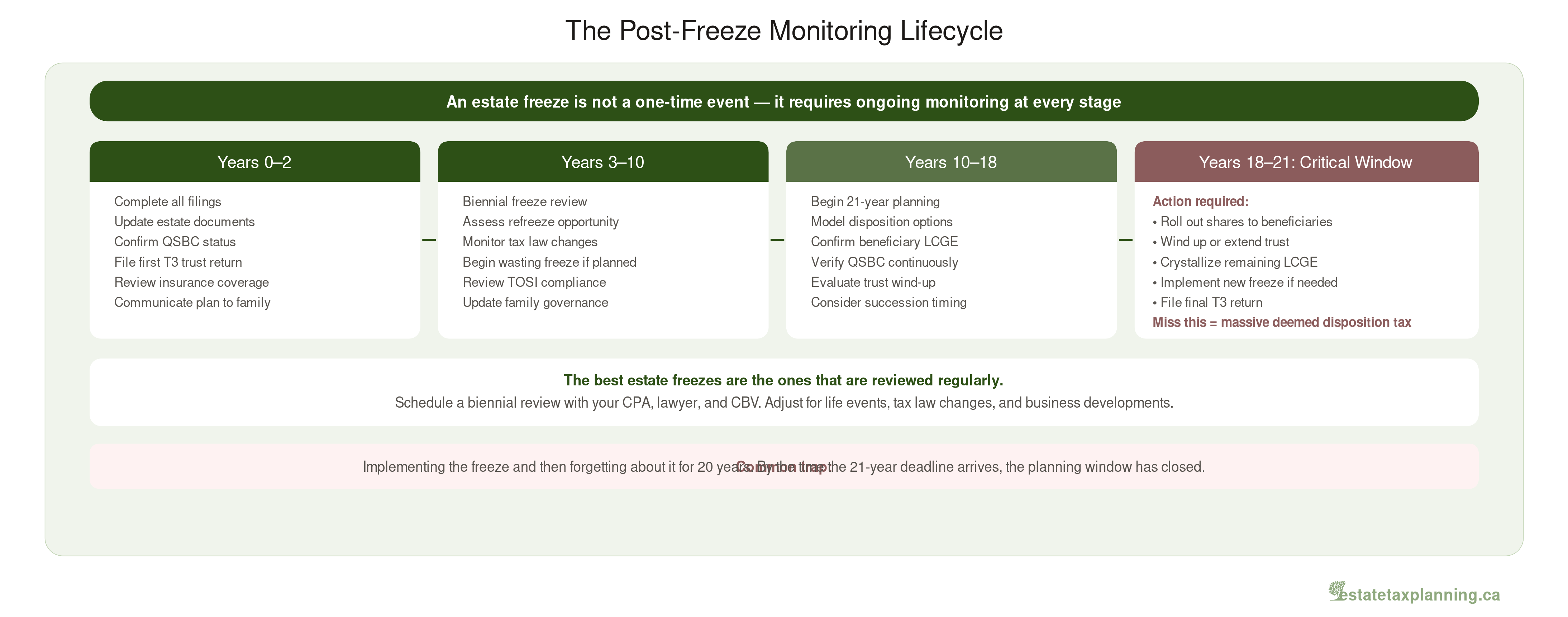
This may be the most common mistake of all: implementing the freeze and then forgetting about it. An estate freeze is not a one-time event. It is the beginning of an ongoing planning process that requires monitoring and periodic adjustment.
Missing a Refreeze Opportunity
If the business declines in value after the freeze, you have a window to refreeze at a lower value, reducing your eventual tax liability. But this opportunity only exists if someone is monitoring the company’s value and flagging the option. Many families miss this because they are not reviewing the freeze regularly. A refreeze requires a new reorganization and a new valuation, but the tax savings can be substantial — particularly if the decline is significant.
Forgetting the 21-Year Rule
If a family trust is used, the 21-year deemed disposition under subsection 104(4) can trigger a massive, unexpected tax bill. As discussed in The 21-Year Rule and the Estate Freeze , planning should begin at the 10-year mark and be finalized well before the deadline. Families that forget about the rule often discover it too late to take effective action — and the resulting tax bill can be catastrophic if the shares have appreciated significantly.
Not Adapting to Tax Law Changes
Canadian tax law evolves constantly. The TOSI rules introduced in 2018, the proposed (and ultimately cancelled) capital gains inclusion rate changes, the enhanced trust reporting requirements introduced in 2023, and the ongoing AMT reforms are all examples of changes that can affect the effectiveness of an existing freeze. Your advisory team should be reviewing your freeze in light of any significant tax law changes, at minimum every two to three years.
Failing to Implement the Wasting Freeze
Many freezes are designed with the intention of gradually redeeming preferred shares during retirement — the “wasting freeze” strategy that reduces the estate’s value over time. But if the redemptions are never actually implemented, the estate remains at its frozen value, and the tax and probate savings are never realized. The wasting freeze requires active management: planning redemption amounts, coordinating with dividend tax credit optimization, and ensuring the corporation has sufficient surplus to fund the redemptions.
Not Planning for the Section 84.1 Trap
When the next generation eventually sells or transfers their growth shares to a related corporation, the surplus stripping rules in section 84.1 can recharacterize what would have been a capital gain as a deemed dividend. This is particularly dangerous because a deemed dividend does not qualify for the LCGE deduction — potentially eliminating the tax shelter that was the entire point of the LCGE multiplication strategy. The 2021 amendments introduced by Bill C-208 carved out an exception for certain genuine intergenerational business transfers, but the conditions are specific and the rules continue to evolve. The trap is set at the time of the freeze but does not detonate until years or decades later, when the shares are finally disposed of. Your advisory team should model the section 84.1 implications of any future share disposition before the transaction occurs.
- We keep a checklist for every freeze client. At minimum, the following should be reviewed every two to three years: (1) the current FMV of the business versus the frozen amount, (2) QSBC status of the growth shares, (3) the freezor’s insurance coverage relative to the projected tax liability, (4) compliance with TOSI rules, (5) progress toward the 21-year trust deadline, (6) any changes in tax law that affect the freeze, and (7) family circumstances (marriages, divorces, new children, disputes).
- A structured review with your CPA, lawyer, and CBV takes a few hours once every two to three years. The cost is minimal. The cost of not reviewing is not.
How Mistakes Compound: A Case Study
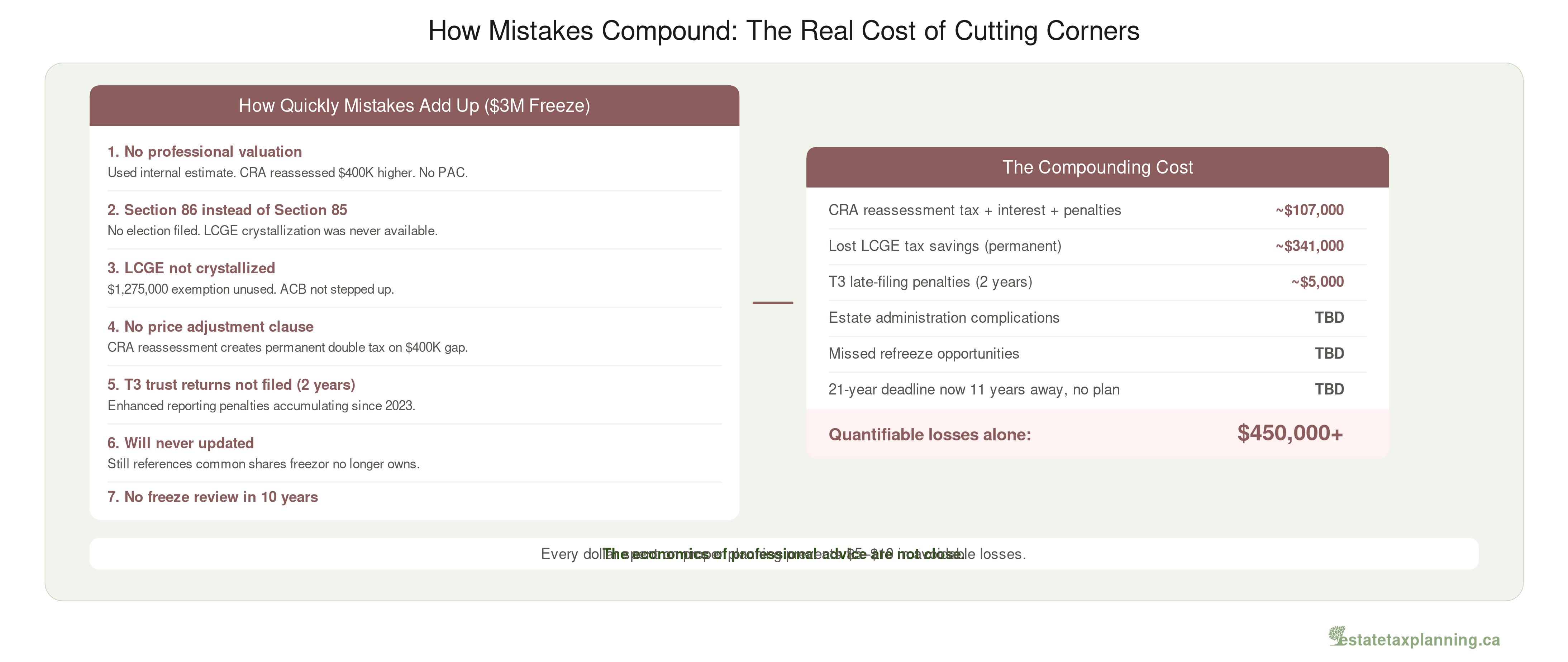
No single freeze is likely to involve every mistake in this article. But it does not take many to generate serious financial consequences. The following composite illustrates how quickly even a few common oversights can compound on a $3 million estate freeze implemented ten years ago.
Suppose the business owner skipped the professional valuation to save $15,000 and CRA later reassessed the freeze value $400,000 higher. Without a price adjustment clause, that reassessment triggers approximately $107,000 in additional tax, interest, and penalties — with no mechanism to correct the mismatch. Suppose the freeze used a Section 86 share exchange rather than a Section 85 election, and the LCGE was never crystallized. That is approximately $341,000 in permanent tax savings lost. Add two years of missed T3 trust returns under the enhanced reporting rules: another $5,000 in penalties.
In this illustration, just three categories of mistakes — valuation, structure, and compliance — produce over $450,000 in quantifiable losses. The specifics will differ in every case, but the pattern is consistent: the cost of cutting corners compounds over time, and the longer the mistakes go undetected, the more expensive they become to fix.
Had the freeze been done properly, the outcome would have been dramatically different. A CBV valuation would have established a defensible FMV, eliminating the reassessment risk entirely. A Section 85 election with LCGE crystallization would have stepped up the ACB of the preferred shares by $1,275,000, securing approximately $341,000 in permanent tax savings. A price adjustment clause would have provided a safety net against any residual valuation disagreement. And a compliance calendar would have ensured the T3 returns were filed on time. None of these steps are complex — they simply require the right team and a deliberate process.
The Most Important Takeaway
The best estate freezes are the ones that are implemented carefully, documented thoroughly, communicated openly, and reviewed regularly. The worst estate freezes are the ones that are done hastily, documented poorly, kept secret, and forgotten about. The difference between the two is usually not the technical complexity of the freeze itself — it is the quality of the advisory team and the commitment to ongoing planning.
If you take away three things from this article, make them these: first, get an independent CBV valuation — it is the single highest-return investment in the entire freeze process. Second, crystallize the LCGE at the time of the freeze if the shares qualify — the tax savings are permanent and the window closes once the freeze is complete. Third, schedule a biennial review with your advisory team — the freeze is not a one-time event, and the mistakes that compound most painfully are the ones that go undetected for years.
The freeze is the beginning, not the end. The families who get the most out of it are the ones who treat it as a living plan — reviewed regularly, adapted to changes in the law and the business, and supported by a team that understands how the pieces fit together.
What’s Next
The capital gains landscape in Canada has shifted significantly in recent years — the proposed inclusion rate increase, its cancellation, the LCGE expansion, and the AMT reforms. In the next article, we examine how these changes affect estate freeze planning and what business owners should be watching going forward.
For definitions of the key terms used in this article — including estate freeze, deemed disposition, price adjustment clause, GAAR, and T3 filing — see our Key Terms and Definitions reference guide.
This article is for informational purposes only and does not constitute legal, tax, or financial advice. Estate freezes are complex transactions that require the coordinated involvement of qualified tax, valuation, and legal professionals. Always consult your advisors before acting on any of the information discussed here.