
Every estate freeze is different, but the best ones share three things: an independent valuation that anchors the numbers, a structure chosen deliberately for the family’s circumstances, and a coordinated team that reviews the plan regularly. These case studies show what that looks like in practice.
Throughout this series, we’ve covered estate freezes from every angle — the fundamentals, the structures, the tax rules, the advanced strategies, and the pitfalls. Now let’s bring it all to life. The three case studies in this article show how the concepts come together in practice. These scenarios are fictional but based on the types of situations we work with regularly. Each involves different challenges, different structures, and different outcomes — but the same coordinated approach.
Case Study 1: The Manufacturing Business Owner
The Situation
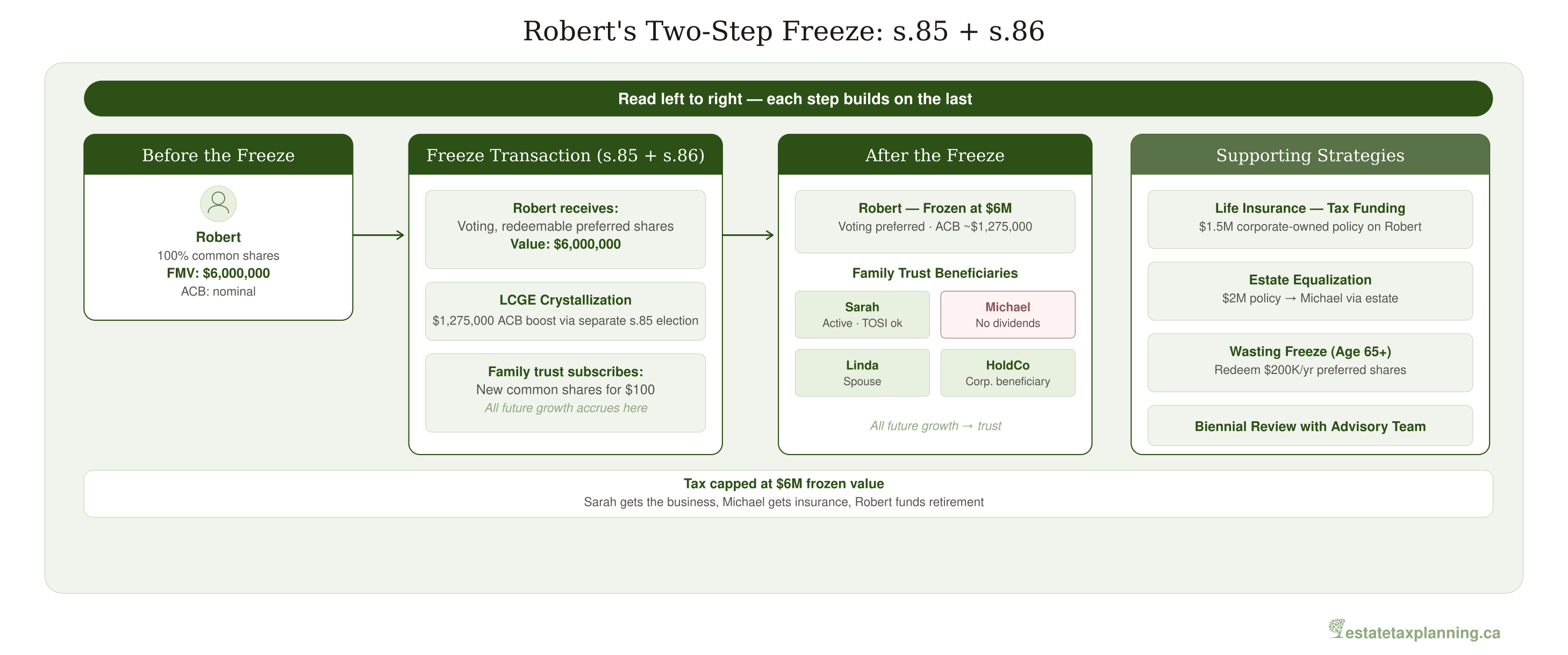
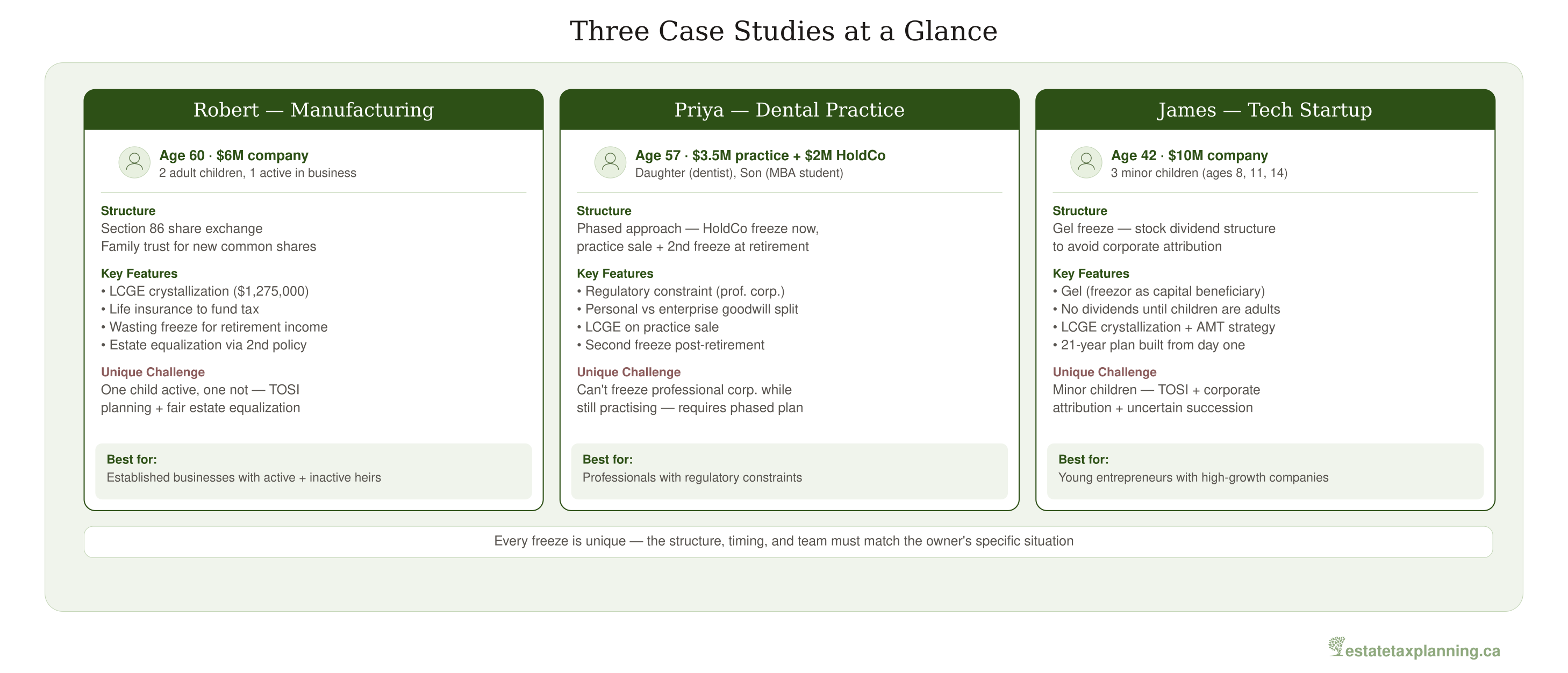
Robert, age 60, owns 100% of the common shares of a precision manufacturing company incorporated in Ontario. The company is worth $6 million and has been growing steadily. Robert has two adult children: Sarah (35), who works full-time as operations manager, and Michael (32), who is a teacher with no involvement in the business. Robert's spouse, Linda (58), handles the company's bookkeeping part-time but does not meet the 20-plus hours per week threshold required for the TOSI excluded business exception. Robert has $1.5 million in personal retirement savings and wants to retire at 65.
The Goals
Robert wants to cap his tax liability at death, transition the business to Sarah, treat Michael fairly despite his non-involvement, maintain voting control until retirement, and generate income once he stops working.
The Plan
Robert's tax advisor recommended a Section 86 share exchange as the simplest structure for his situation — no election filings, automatic rollover, and Robert retains full voting control through the preferred shares (see Choosing Your Freeze Structure for a comparison of Section 85 and Section 86 approaches). The LCGE crystallization described below is a separate, coordinated step that uses a Section 85 election on a different class of shares — it does not affect the simplicity of the main Section 86 exchange. The CBV prepared an independent valuation of the company at $6 million, and legal counsel drafted the articles of amendment and family trust deed. Here is how the pieces fit together:
| Element | Details |
|---|---|
| Structure | Section 86 share exchange — Robert exchanges common shares for voting, redeemable preferred shares worth $6 million. A family trust subscribes for new non-voting common shares for $100. |
| LCGE crystallization | A coordinated Section 85 election on a separate class of shares crystallizes $1,275,000 of LCGE, boosting Robert's overall ACB and reducing the eventual capital gain at death. The Section 86 exchange handles the main share swap; the Section 85 election handles the LCGE trigger. |
| TOSI planning | Sarah qualifies for the excluded business exception (20+ hours/week for 5+ years). Michael and Linda do not. Dividends are directed only to Sarah and to a corporate beneficiary of the trust. |
| Life insurance | The corporation purchases a $1.5 million permanent policy on Robert's life to fund the tax liability at death (see Life Insurance and the Estate Freeze for how CDA mechanics work). |
| Estate equalization | A second policy of $2 million names Michael as the eventual beneficiary through the estate, ensuring a fair inheritance despite his non-involvement. |
| Wasting freeze | Starting at age 65, Robert redeems $200,000 of preferred shares per year to fund retirement, gradually shrinking his taxable estate (see Freeze, Gel, Thaw, and Wasting Freeze for the mechanics). |
The Section 86 handles the main share exchange on a tax-deferred basis, while the separate Section 85 election is a coordinated step that allows Robert to crystallize his LCGE — something Section 86 alone cannot achieve.
The Outcome
The result: Robert’s tax liability at death is capped at the frozen value, less any preferred shares already redeemed through the wasting freeze. Sarah receives a growing business. Michael receives an equivalent inheritance through insurance. The family trust provides flexibility throughout, and the advisory team reviews the plan every two years to adjust for changes in the business, the family, or the tax rules. Nothing is left to chance.
Without crystallization, Robert's capital gain at death would be the full $6 million frozen value, producing a tax bill of approximately $1,606,000 at Ontario's top combined rate. By crystallizing $1,275,000 of LCGE at freeze time, his taxable gain drops to $4,725,000 and the tax bill falls to approximately $1,265,000 — a saving of roughly $341,000. The wasting freeze reduces the tax further: every $200,000 of preferred shares redeemed during retirement shrinks the remaining gain at death.
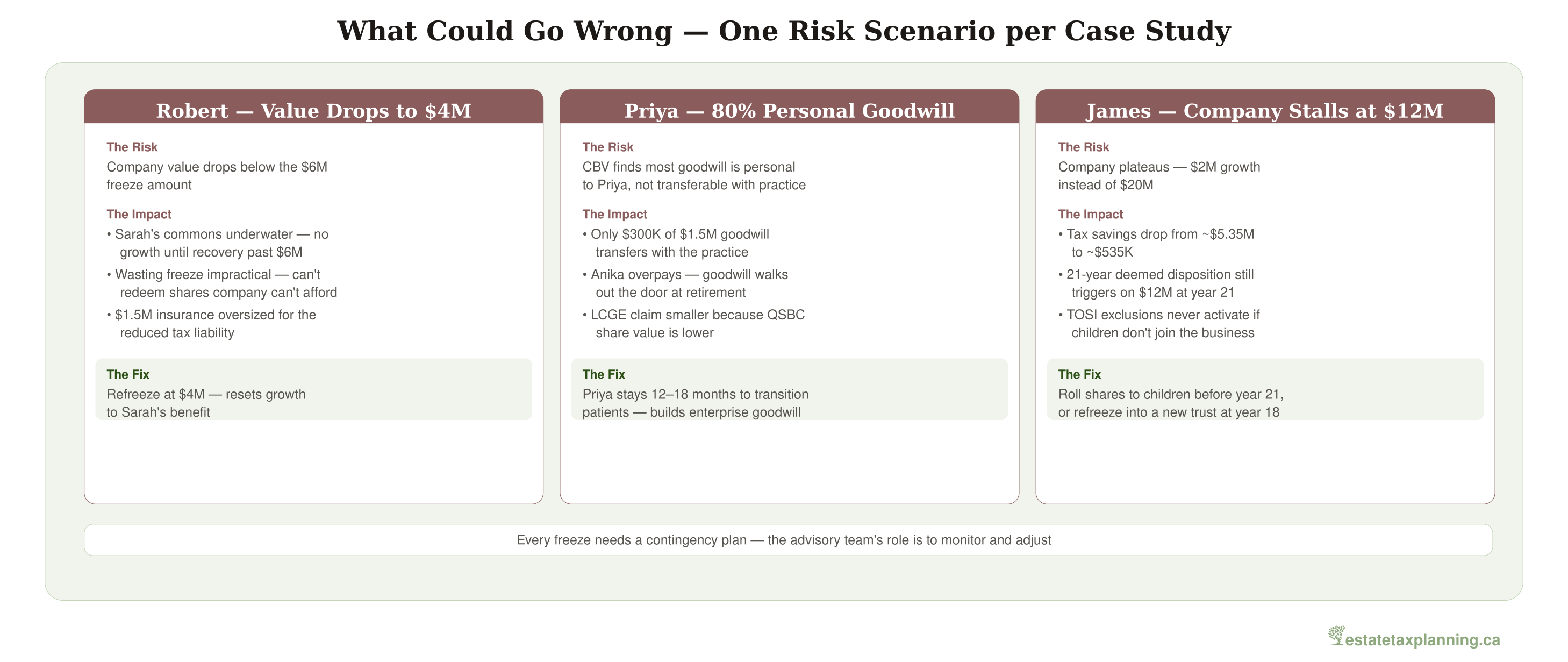
If the manufacturing company's value drops to $4 million after the freeze, Robert's preferred shares are now worth more than the company itself. Sarah's common shares are effectively underwater — no growth accrues until the company recovers past the $6 million frozen mark. The wasting freeze becomes impractical because redeeming preferred shares would extract capital the company cannot afford to lose. In this scenario, Robert's advisory team would need to consider a refreeze at the lower value — resetting the freeze to match the company's current worth and restoring growth potential to the next generation.
Case Study 2: The Dentist Approaching Retirement
The Situation
Dr. Priya Sharma, age 57, operates a successful dental practice through a professional corporation in Ontario. The practice is worth $3.5 million, including $1.5 million in goodwill. She also has $2 million in investments held inside a separate holding company. Her daughter, Anika (28), is a dentist working as an associate in the practice. Her son, Raj (25), is completing an MBA and has no involvement in dentistry.
The Goals
Priya wants to transition the dental practice to Anika, provide for Raj despite his lack of involvement in dentistry, minimize capital gains on both the investment portfolio and the eventual practice sale, and claim her LCGE when the time comes.
The Challenge
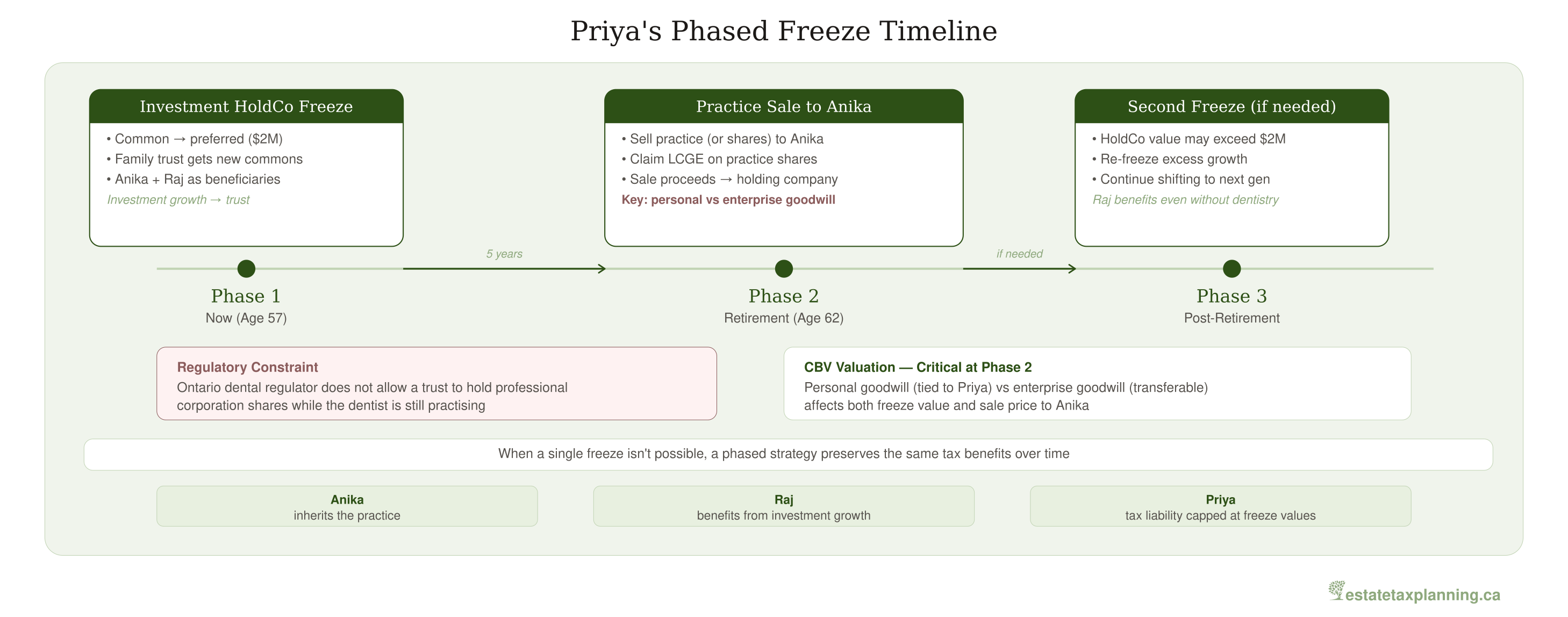
In Ontario, the Royal College of Dental Surgeons does not permit a family trust to hold shares of a professional corporation. The only trust arrangement the regulation allows is a trust holding non-voting shares exclusively for the minor children of a voting dentist shareholder — far too narrow for a conventional estate freeze (see Estate Freezes for Professional Corporations). Priya's tax advisor identified the constraint early, and the team designed a phased approach to work around it.
The Plan
Phase 1 — Investment HoldCo freeze (now): Priya implements an estate freeze of her investment holding company. She exchanges her common shares for preferred shares worth $2 million. A family trust (with Anika, Raj, and Priya as beneficiaries) subscribes for new common shares. All future investment growth accrues to the trust. The CBV values the investment portfolio and the tax advisor structures the exchange.
Phase 2 — Practice transition (at retirement): When Priya retires at 62, she sells the dental practice to Anika — either directly or through Anika's own professional corporation. Priya claims her LCGE on the sale of the practice shares, provided the professional corporation meets the qualified small business corporation tests at the time of sale — including the 24-month holding period and the requirement that 90% or more of assets be used in an active business. Legal counsel coordinates the share purchase agreement.
Phase 3 — Second freeze (post-retirement): After retiring and receiving the sale proceeds in her holding company, Priya can implement a second freeze if the holding company's value has grown beyond the original $2 million frozen amount.
Valuation: A CBV with dental practice experience values the practice, distinguishing between personal goodwill (tied to Priya's reputation and patient relationships) and enterprise goodwill (transferable with the practice — systems, brand, location, and staff). This distinction affects both the freeze value and the eventual sale price to Anika.
The Outcome
Priya achieves a phased transition that works within the regulatory constraints. The investment portfolio freeze shifts future growth to the trust immediately. The practice sale at retirement lets her claim the LCGE. Raj benefits from the trust's investment growth even though he's not involved in dentistry. The phased approach gives Priya the tax benefits of a freeze without fighting the regulatory restriction head-on.
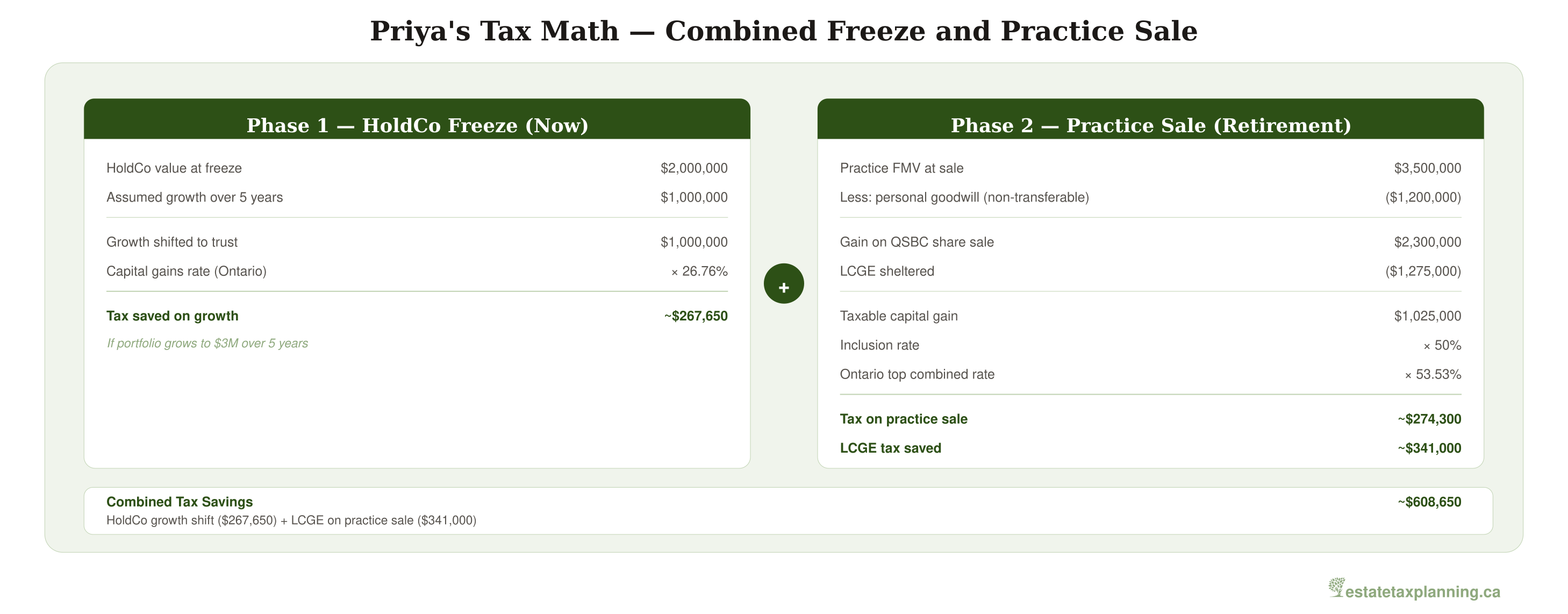
Assuming the investment portfolio grows by $1 million over the five years between the freeze and Priya's retirement, Phase 1 shifts that growth to the trust, saving approximately $267,650 in capital gains tax that would otherwise be owed at Priya's death (assuming the portfolio grows by $1 million over the relevant period). Phase 2 shelters $1,275,000 of the practice sale through the LCGE, saving approximately $341,000. Combined, the phased approach saves roughly $609,000 — and a potential Phase 3 refreeze could shift even more growth if the holding company continues to appreciate after retirement.
The biggest risk in Priya's plan is the goodwill split. If the CBV determines that 80% of the $1.5 million in goodwill is personal — tied to Priya's reputation and patient relationships rather than the practice's systems and brand — then only $300,000 of enterprise goodwill transfers with the practice. Anika would be paying a premium for goodwill that walks out the door when Priya retires. A strong transition plan — Priya staying on part-time for 12 to 18 months, introducing Anika to long-term patients — helps convert personal goodwill into enterprise goodwill before the sale.
Case Study 3: The Tech Entrepreneur with a Young Family
The Situation
James Chen, age 42, founded a software company five years ago. The company has grown rapidly and is now worth $10 million. James and his wife, Mei (40), have three young children (ages 8, 11, and 14). James believes the company could be worth $30–50 million in 10 years if growth continues. He has minimal personal savings outside the company.
The Goals
James wants to freeze the current $10 million value so that future growth accrues to his children, but he needs a safety net in case his personal finances require access to that growth. He also wants to crystallize his LCGE now while the company qualifies as a QSBC, and structure the freeze to avoid both TOSI problems and corporate attribution.
The Challenge
James is young and doesn’t yet have enough personal assets for retirement. His children are minors, which triggers both TOSI concerns and corporate attribution issues. The succession plan is uncertain — the children may or may not join the business. This is the kind of situation where the moving parts multiply fast. James’s tax advisor flagged corporate attribution as the critical structural risk, and the CBV noted that the company’s value is heavily tied to James himself, requiring careful discount analysis.
The Plan
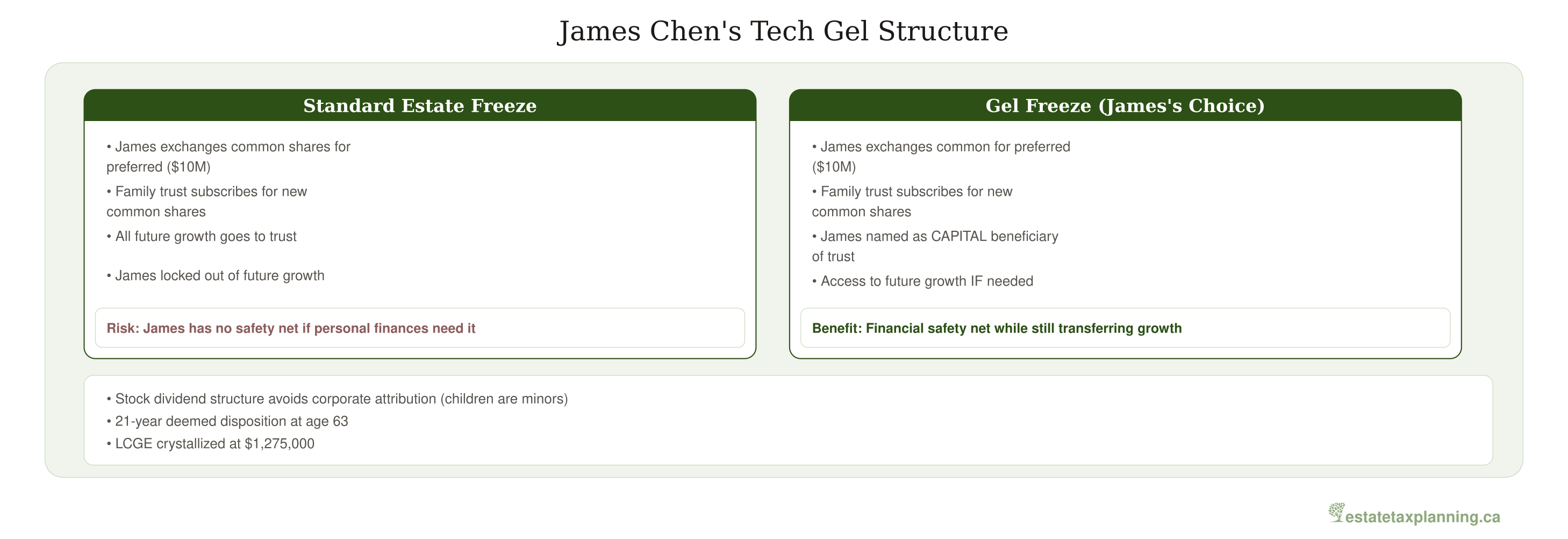
Given the complexity of minor children, corporate attribution, and uncertain succession, the advisory team recommended a gel structure with a stock dividend freeze. Here is how they addressed each constraint:
| Element | Details |
|---|---|
| Gel structure | James implements a freeze using a family trust but names himself as a capital beneficiary (creating a "gel"). This gives him a safety net to access future growth if his personal financial situation requires it. |
| Corporate attribution | The team uses a stock dividend freeze structure rather than a Section 85 transfer, avoiding the corporate attribution rules that would otherwise apply because the children are minors. Because a stock dividend is issued by the corporation rather than transferred by the shareholder, it does not meet the precondition for subsection 74.4(2). |
| TOSI planning | No dividends are paid to the trust beneficiaries until the children are adults and ideally actively involved in the business. The trust accumulates growth silently until the TOSI exclusions become available. |
| LCGE crystallization | James crystallizes his full $1,275,000 LCGE at freeze time, increasing his preferred share ACB. The AMT cost is approximately $43,000 (see Estate Freezes and the Capital Gains Landscape for the post-2024 AMT mechanics). This is recoverable over seven years against regular tax. |
| 21-year planning | The trust is created when James is 42. The 21-year deemed disposition will occur when he is 63 (see The 21-Year Rule for the mechanics and exit strategies). The team builds a review at the 10-year mark (age 52) and a firm exit plan by year 18 (age 60). Options include rolling shares to adult children or refreezing into a new trust. |
| Valuation | The CBV values the software company using a combination of earnings-based and revenue-multiple approaches, applying significant discounts for lack of marketability and key-person risk. |
The Outcome
If the company reaches $30 million by the time James is 52, the freeze will have shifted $20 million of growth to the next generation. At Ontario's effective capital gains rate of 26.76%, that growth would have produced approximately $5,352,000 in tax if left inside James's estate. Instead, it accrues to the family trust, where it can be distributed to adult children who qualify for the LCGE or who are taxed at lower marginal rates. The gel structure ensures James isn't locked out if he needs funds, and the corporate attribution issues are avoided through careful structuring.
This example uses simplified assumptions for illustration. Your actual tax outcome depends on your specific circumstances.
If the software company stalls at $12 million and never reaches the projected $30–50 million, the estate freeze still works — but the benefit is much smaller. The $2 million of growth shifted to the trust saves approximately $535,200 in tax rather than $5,352,000. The AMT cost from the aggressive LCGE crystallization is still recoverable over seven years, so that element pays for itself regardless. The bigger risk is the 21-year rule: if the company is worth $12 million at the deemed disposition and the trust hasn't yet distributed shares to adult children, the trust faces a capital gain on the full $12 million less the nominal ACB of the common shares. Planning for the 21-year exit well before year 21 is essential.
Comparing the Three Approaches
Each case study used a different structure to solve a different problem. That’s the point — there’s no default template. The table below highlights the key differences, and the common threads that run through every successful freeze.
| Factor | Robert | Priya | James |
|---|---|---|---|
| Business type | Manufacturing | Dental practice + HoldCo | Software / tech |
| Value at freeze | $6 million | $2M HoldCo + $3.5M practice | $10 million |
| Key constraint | Active vs. inactive heirs | Prof. corp. trust restriction | Minor children + corporate attribution |
| Structure | Section 86 exchange | Phased (HoldCo now, practice later) | Stock dividend gel freeze |
| LCGE used? | Yes — $1,275,000 crystallized | Yes — on practice sale at retirement | Yes — $1,275,000 crystallized |
| Tax savings | ~$341,000 from LCGE alone | ~$341,000 LCGE + ~$268K growth shift | ~$5,352,000 if $20M growth shifts |
| Key risk | Business value drops below freeze | Personal goodwill doesn't transfer | Growth stalls + 21-year rule |
- In all three case studies, the estate freeze was not a standalone transaction — it was part of a coordinated plan that integrated tax, legal, valuation, insurance, and financial planning. That coordination is what made the difference.
- In every case, the independent valuation was the foundation. Without an accurate fair market value, the freeze amount, the tax savings calculations, and the entire planning structure rest on uncertain ground. Robert’s manufacturing company, Priya’s dental practice goodwill split, and James’s key-person discount each required a CBV with industry-specific experience. This is the piece we spend the most time on — because everything else flows from the number.
- The details differed, but the approach was the same: start early, build the right team, choose the right structure, and review regularly. These are the kinds of engagements we do every week.
Lessons for Your Own Freeze
Every estate freeze is different, but these three case studies share patterns that apply broadly. Here’s what we’d want you to take away:
Start with the valuation. The freeze amount drives everything — the tax liability at death, the growth shifted to the next generation, the insurance funding calculation, and the LCGE crystallization decision. An inaccurate valuation doesn’t just create CRA risk; it undermines every downstream planning element.
Match the structure to the constraint. Robert used a Section 86 exchange because simplicity was the priority. Priya used a phased approach because her regulator blocked the standard trust freeze. James used a gel structure because he needed a safety net. There’s no default — the right structure depends on the specific facts.
Plan for what goes wrong. Every case study included a risk scenario. Business values drop. Goodwill doesn’t transfer. Growth stalls. The 21-year rule arrives. A well-designed freeze accounts for these possibilities with built-in flexibility — wasting freezes, refreezes, gel provisions, and regular advisory team reviews.
Coordinate the team. No single advisor can handle an estate freeze alone. The tax advisor structures the transaction, the CBV provides the valuation, legal counsel drafts the documents, and the insurance advisor funds the liability. In all three case studies, the team worked together from the start — not sequentially, but in parallel. That’s not a luxury; it’s how you avoid the mistakes we see when advisors work in silos.
These three scenarios cover the most common estate freeze profiles — operating business owners, regulated professionals, and tech founders — but they don't exhaust the possibilities. If your wealth is concentrated in a pure investment holding company rather than an operating business, the strategies in Investment Holding Companies and the Estate Freeze apply directly, and many of the same principles — accurate valuation, coordinated planning, and regular review — carry over unchanged.
Every family’s situation is different, but the planning process is the same: start with the tax strategy, get the valuation right, and make sure the legal documents reflect what you actually want to happen. If your situation resembles any of these case studies — or if it doesn’t — that’s exactly the kind of conversation we have with clients every week.
What’s Next?
In the next article, we cover Post-Mortem Planning — what happens after the freezor dies and how to avoid double taxation.
For definitions of the key terms used in this article — including estate freeze, LCGE crystallization, gel structure, TOSI, wasting freeze, and corporate attribution — see our Key Terms and Definitions reference guide.
This article is for informational purposes only and does not constitute legal, tax, or financial advice. Estate freezes are complex transactions that require the coordinated involvement of qualified tax, valuation, and legal professionals. Always consult your advisors before acting on any of the information discussed here.