
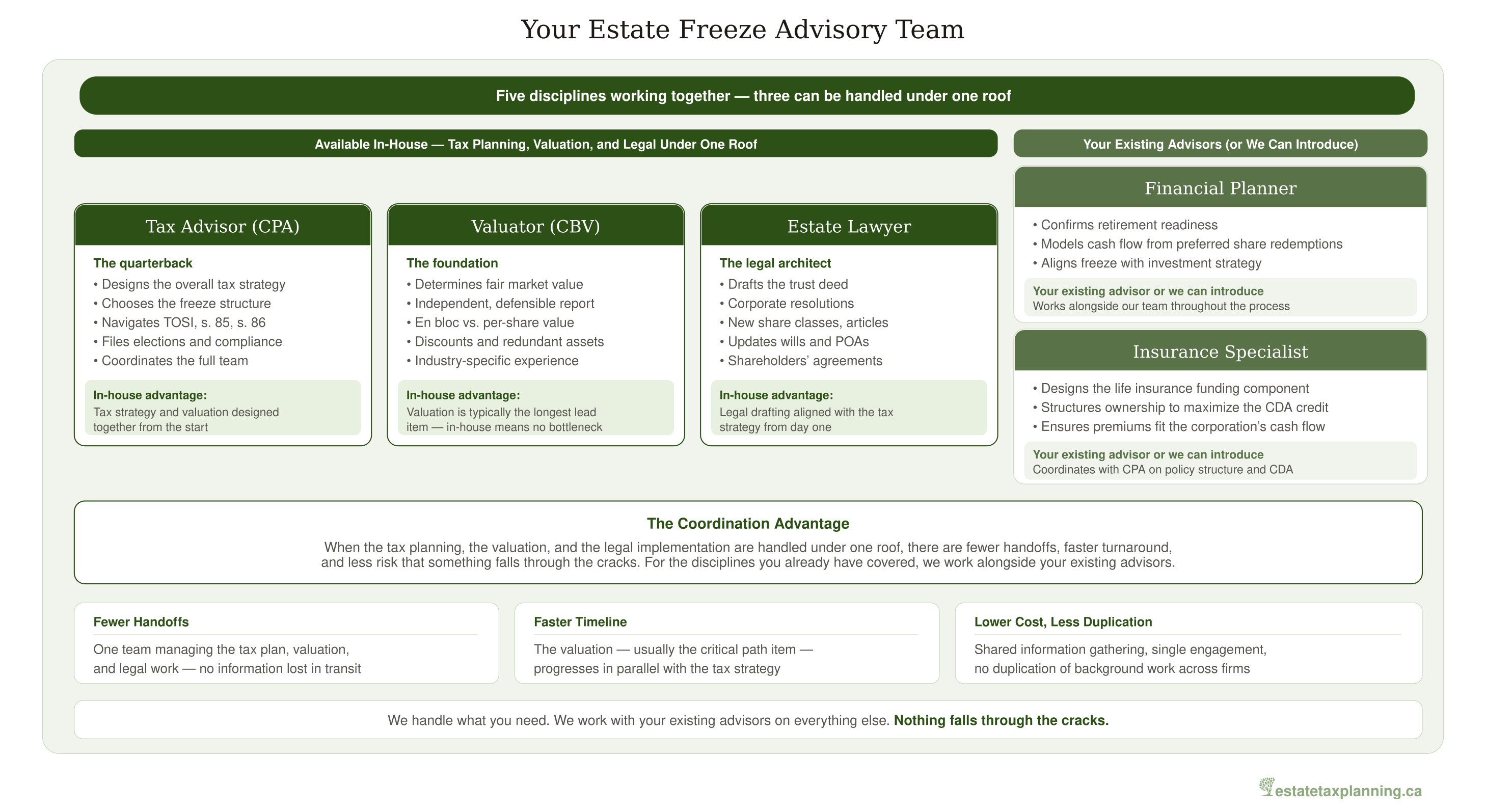
An estate freeze requires five disciplines working together: tax planning, business valuation, corporate law, financial planning, and insurance. The most common point of failure is not any single discipline — it’s the coordination between them. When tax, valuation, and legal are under one roof, the strategy and the documents are designed together from the start.
An estate freeze is not a single transaction — it’s an interdisciplinary project that sits at the intersection of tax law, corporate law, valuation science, financial planning, and insurance. Getting it right requires expertise across all five disciplines, working in coordination. And in our experience, coordination is where most freezes either succeed or fall apart.
The good news is that you don’t necessarily need to assemble five separate professionals from five separate firms. Some of these disciplines naturally belong together, and having them coordinated under one roof can significantly reduce cost, complexity, and the risk that something falls through the cracks.
The three core disciplines — tax planning, business valuation, and legal implementation — are the backbone of every estate freeze. When these three are handled by a single firm, the strategy, the valuation, and the legal documents are designed together from the start. There is no waiting for one advisor to brief another, no conflicting assumptions, and no duplication of background work. For the remaining disciplines — financial planning and insurance — we work alongside your existing advisors or can introduce you to trusted professionals.
Most business owners already have some of these advisors in place — a trusted accountant, a financial planner, an insurance advisor. The goal isn’t to replace what’s already working. It’s to make sure every discipline is covered, that the people involved are experienced with estate freezes specifically, and that they’re communicating with each other throughout the process. Where you already have advisors, we work alongside them. Where you have gaps, we fill them.
To make the moving parts concrete: consider a business owner whose company is worth $3 million. She exchanges her common shares for preferred shares worth $3 million, and new common shares are issued to a family trust. The CPA designs this structure and files the tax election. The CBV determines the $3 million value that underpins it. The lawyer drafts the trust deed, amends the corporate articles, and updates her will. All three need to be working from the same playbook — if any one of them is out of step, the freeze may not achieve what it was designed to do.
In this article, we explain who should be involved in your estate freeze, what role each discipline plays, and how the process works from start to finish. We also discuss what to expect in terms of cost, timing, and the ongoing relationship after the freeze is implemented.
The Five Disciplines Behind Every Estate Freeze
1. Tax Planning (CPA)
Your tax advisor is the quarterback of the estate freeze. They design the overall tax strategy, determine which freeze structure is optimal, analyze the TOSI implications, plan the LCGE crystallization, model the wasting freeze schedule, and ensure all tax elections and returns are filed correctly.
This isn’t general accounting work. Estate freezes involve subsection 85(1) and section 86 rollovers, corporate attribution analysis, TOSI planning, trust taxation, and the interaction of multiple provisions of the Income Tax Act. The CPA who handles your annual corporate and personal returns may or may not have the depth of experience required for this level of planning. What matters is that the person designing your freeze has done this work before — and understands the technical traps that can unwind years of planning.
The CPA also serves as the natural coordinator of the entire team. They are typically the first professional involved, and they remain involved long after the freeze is implemented — filing annual T3 trust returns, monitoring the wasting freeze schedule, and advising on refreezes or adjustments as circumstances change.
2. Business Valuation (CBV)
The Chartered Business Valuator provides the foundation that the entire freeze rests on: the fair market value of the shares being frozen. If the valuation is wrong, every element of the freeze that depends on it — the preferred share redemption amount, the Section 85 elected amount, the LCGE crystallization — is built on unstable ground.
As we explored in Valuation: The Make-or-Break Step, the valuation must be independent and defensible against CRA scrutiny. A formal valuation report from an accredited CBV — someone accredited by the CBV Institute (formerly the Canadian Institute of Chartered Business Valuators) — is the gold standard. The valuator should have experience in your industry and should be familiar with estate freeze valuation issues: the distinction between en bloc value and per-share value, minority discounts, the treatment of redundant assets, and the personal-versus-enterprise goodwill split for professional practices.
- The tax strategy determines what needs to be valued and how. The valuation determines the numbers the tax strategy is built around.
- When the CPA and CBV are in the same firm, the strategy and the valuation develop in parallel — not sequentially.
- The valuation is typically the longest lead item in the freeze timeline. Having it in-house eliminates the most common bottleneck.
- There is no risk of the CPA designing a structure based on assumptions that the valuation later contradicts.
3. Legal Implementation (Estate Lawyer)
The lawyer handles the legal architecture of the freeze. This includes drafting the trust deed, preparing the corporate resolutions and articles of amendment, creating the new share classes, updating shareholder agreements, and ensuring that the freeze complies with applicable corporate law.
The trust deed is particularly important and requires specialized drafting skills. A poorly drafted trust deed can undermine years of planning. As we discussed in Estate Freeze Mistakes, failing to update wills, powers of attorney, and other estate documents to reflect the new ownership structure is one of the most common and costly errors.
The lawyer should also update your will and powers of attorney to reflect the post-freeze ownership structure. If there is a shareholder agreement, it needs to address what happens to the frozen preferred shares on death, disability, or departure — including mandatory buyout or retraction provisions, insurance funding, and valuation mechanics.
When the legal work is handled by the same firm that designed the tax strategy and prepared the valuation, the documents are drafted to implement exactly what the tax plan requires — not a generic template that may miss critical details. The trust deed, the share attributes, and the corporate resolutions all reflect the specific strategy, the specific valuation, and the specific family circumstances.
4. Financial Planning and Insurance
Your financial planner ensures the freeze fits within your overall financial picture. Before any freeze can proceed, someone needs to answer the most important question: do you have enough assets outside the frozen shares to fund your retirement? The financial planner models the cash flow from preferred share redemptions, assesses whether the freeze structure aligns with your investment strategy and risk tolerance, and makes sure the freeze supports your lifestyle goals rather than undermining them. In fact, the financial planner is often the first professional to identify that a freeze may be appropriate, because they have visibility into both your personal and corporate financial position.
On the insurance side, corporate-owned life insurance is a key tool for funding the tax liability created by the freeze — as we explored in Life Insurance and the Estate Freeze. The insurance specialist recommends the appropriate type of policy — term, whole life, or universal life — the coverage amount, and the ownership structure. They work closely with the CPA to ensure the policy is structured to maximize the Capital Dividend Account credit and that the premiums fit within the corporation’s cash flow.
These are the two disciplines we don’t handle in-house. If you already have a financial planner and insurance advisor you trust, they should be part of the conversation from the start. If you don’t, we can introduce you to trusted professionals who understand how these pieces integrate with an estate freeze.
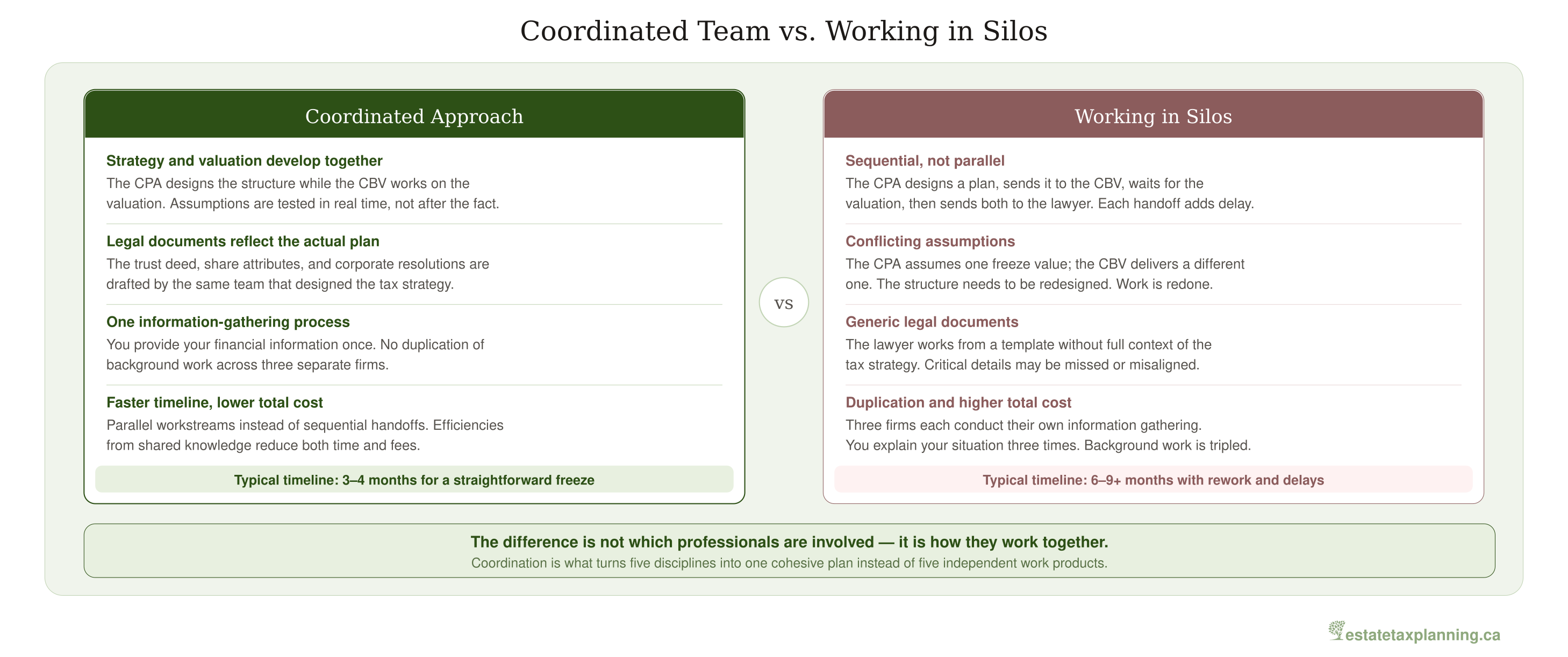
- In our experience, the most expensive freeze failures aren’t caused by bad tax advice or a flawed valuation. They happen when the CPA, the lawyer, and the valuator each do their piece without coordinating. We’ve inherited files where the trust deed contradicts the share terms — and nobody caught it because nobody was reading the whole picture.
- A lawyer who drafts a trust deed without understanding the tax strategy may create a document that doesn’t achieve the intended result. We’ve seen it happen — the trust deed names the wrong beneficiary class for TOSI purposes, and the entire income-splitting strategy falls apart.
- A valuator who prepares the report without knowing the freeze structure may value the wrong thing or use the wrong premise of value. If you’re freezing at fair market value and the report uses a different standard, the whole foundation is off.
- This is why we keep the core disciplines under one roof. Coordination isn’t a nice-to-have — it’s the difference between a freeze that works and one that creates problems down the road.
| Area | Generalist Approach | Freeze-Specific Specialist |
|---|---|---|
| Freeze structure | Defaults to section 86 reorganization | Evaluates s. 85 rollover vs. s. 86 vs. hybrid based on specific circumstances |
| Valuation | Uses book value or rule of thumb | Formal CBV report with defensible methodology, discount analysis, and redundant asset treatment |
| TOSI planning | May not identify TOSI exposure | Maps each beneficiary to the correct exclusion and structures dividends accordingly |
| Attribution rules | Overlooks corporate attribution under s. 74.4 | Designs share attributes and loan structures to avoid attribution traps |
| Trust deed | Generic template with standard terms | Custom deed with freeze-specific terms: preferred share retraction rights, 21-year planning, trustee powers |
| Ongoing compliance | Annual tax return only | T3 filing, wasting freeze monitoring, refreeze assessment every 2–3 years |
What happens if advisors disagree? It’s not unusual for the CPA and the lawyer to have different views on the optimal freeze structure, or for the valuation to come back at a number that changes the tax strategy. When the core disciplines are under one roof, these conversations happen in real time — the team works through the issue together and arrives at a coordinated recommendation. When the advisors are in separate firms, a disagreement can stall the project for weeks while emails go back and forth and assumptions are renegotiated. In our experience, one of the most common reasons estate freezes go over budget and over timeline isn’t the complexity of the freeze itself — it’s the coordination cost of multiple firms working from different assumptions.
How the Process Works
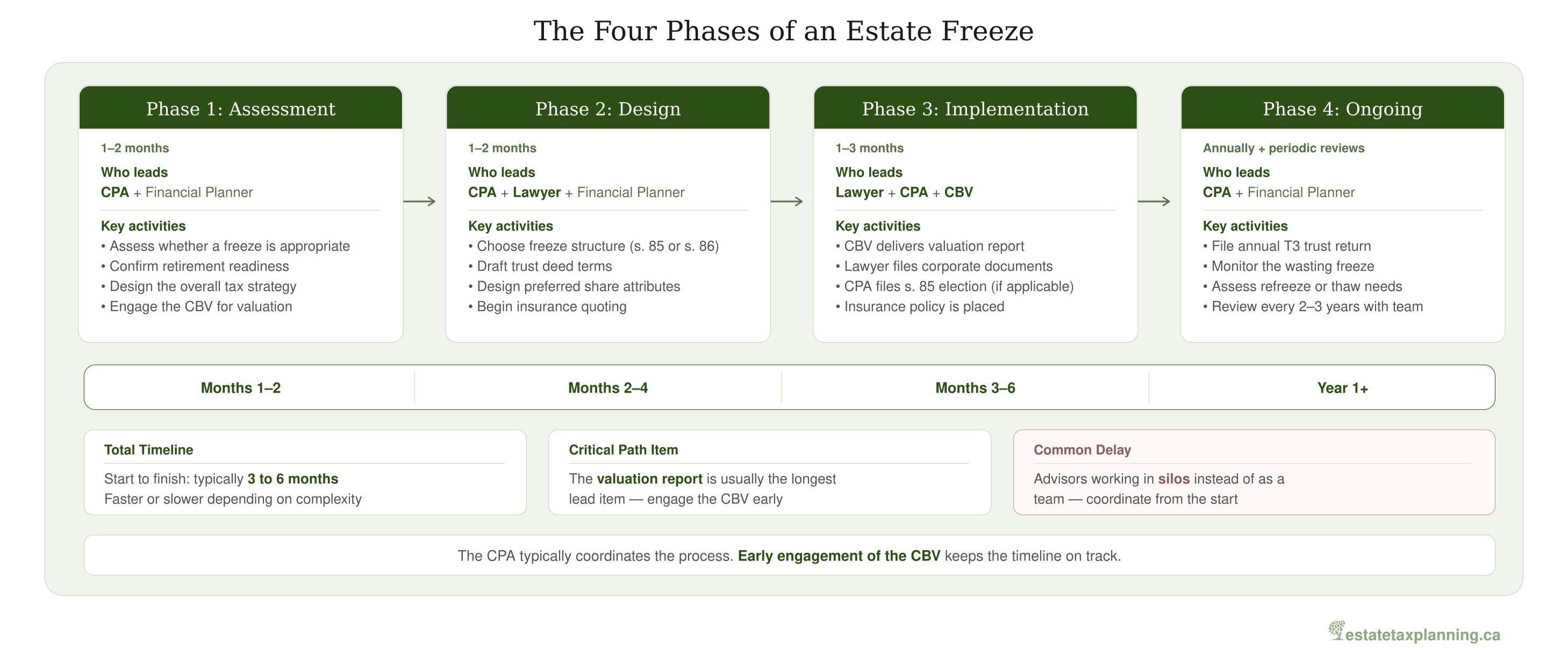
The most effective estate freezes we’ve worked on follow a structured process with four distinct phases. The total timeline from start to finish is typically three to six months, though it can be faster when the core disciplines are coordinated under one roof.
Phase 1: Assessment (1–2 Months)
The CPA and financial planner assess whether a freeze is appropriate and design the overall strategy. This includes confirming retirement readiness, analyzing the TOSI implications for family members, and determining which freeze structure — Section 85 rollover, Section 86 reorganization, or a hybrid — best fits the situation. The CBV is engaged to begin the valuation work.
Phase 2: Design (1–2 Months)
The CPA, lawyer, and financial planner collaborate on the freeze structure, trust deed terms, and preferred share attributes. Key decisions are made: Who will hold the growth shares? Will a family trust be used? What are the terms of the preferred shares — voting rights, redemption rights, dividend entitlements? The insurance specialist begins quoting policies based on the coverage amount implied by the freeze value.
Phase 3: Implementation (1–3 Months)
The CBV delivers the valuation report. The lawyer prepares and files the corporate documents — articles of amendment, resolutions, trust deed, updated share registers. The CPA files the Section 85 election (if applicable) and ensures all tax compliance is complete. The insurance policy is placed.
Phase 4: Ongoing (Annually)
This is the part people don’t always appreciate going in: the freeze is not a set-it-and-forget-it transaction. Once implemented, it creates obligations and monitoring requirements that continue for years — sometimes decades.
At minimum, the CPA files the annual T3 trust return for the family trust, ensures the preferred share dividend obligations are met, and monitors the wasting freeze schedule if one is in place. The financial planner reviews whether the wasting freeze redemptions are on track to meet the freezor’s retirement needs. The insurance specialist confirms that coverage remains adequate as the business value changes.
Beyond the annual compliance, the advisory team should reconvene every two to three years — or sooner if circumstances change — to assess whether adjustments are needed. Several events should trigger a review: a significant change in business value (up or down), a change in tax law that affects the freeze structure, a change in family circumstances such as a marriage, divorce, or new child, the approach of the 21-year deemed disposition under the trust, or a decision to sell the business. Each of these may warrant a refreeze, a thaw, a trust distribution, or a restructuring of the preferred shares.
This ongoing relationship is one of the strongest arguments for working with a firm that handled the original freeze. The advisors who designed the structure and prepared the valuation understand the assumptions behind it. They can assess what has changed, what still holds, and what needs to be adjusted — without re-learning the file from scratch.
- The valuation report is almost always the longest lead item in the freeze timeline. It’s the one thing that holds everything else up.
- When the CBV is in the same firm as the CPA, the valuation can progress in parallel with the tax strategy — rather than sequentially, where the CPA designs the plan and then waits weeks or months for the valuation to come back. We’ve seen external valuations take three to four months just to get started.
- This alone can shorten the total timeline by weeks. For clients who want to close before year-end, that difference matters.
What to Expect: Cost and Timing
Let’s talk about cost, because it’s a fair question. An estate freeze is a significant professional investment. The fees reflect the complexity and the number of disciplines involved, but they should be weighed against the tax savings, which can easily run into hundreds of thousands or even millions of dollars over the life of the freeze.
Typical costs for a well-implemented estate freeze range from $25,000 to $75,000 or more, depending on the complexity of the business, the number of entities involved, and the specific structure chosen. For a single operating company with a straightforward ownership structure and one family trust, the total cost is often at the lower end of this range. Multi-entity structures, professional corporations, or situations involving holding companies and multiple trusts push toward the higher end. When the tax planning, valuation, and legal work are handled under one roof, there are typically efficiencies — shared information gathering, a single engagement process, and no duplication of background work across firms.
| Discipline | Typical Range | Key Cost Drivers |
|---|---|---|
| Business Valuation (CBV) | $10,000 – $25,000+ | Complexity of business, intangible assets, multi-entity structures, goodwill allocation |
| Legal (Estate Lawyer) | $5,000 – $25,000+ | Trust deed complexity, number of entities, shareholder agreement updates, estate document revisions |
| Tax Advisory (CPA) | $10,000 – $20,000+ | Structure design, Section 85 election, TOSI planning, ongoing T3 compliance |
| Financial Planning | Varies | Retirement modelling, cash flow projections, preferred share redemption schedule |
| Insurance | Ongoing premiums | Policy type (term, whole, universal life), coverage amount, insured age and health |
What Drives the Cost Up or Down
The single biggest cost driver is complexity. A straightforward freeze — one operating company, one shareholder, one family trust — sits at the lower end because the valuation is simpler, the legal documents are fewer, and the tax planning has fewer moving parts. What pushes costs higher? Multiple operating companies or a holding company structure, intangible assets or goodwill that require detailed allocation, professional corporations with personal goodwill issues, more than one family trust or multiple classes of beneficiaries, cross-border elements involving U.S. or other foreign tax considerations, and — something we see more often than you’d expect — situations where the corporate records are incomplete or out of date and need to be cleaned up before the freeze can proceed.
On the valuation side, a service-based business with straightforward financials costs less to value than a manufacturing company with real estate, equipment, inventory, and intangible assets. A business where goodwill is clearly enterprise goodwill is simpler than a professional practice where personal goodwill needs to be separated out. If there are minority interests, holding company structures, or redundant assets that need to be identified and treated separately, each of these adds complexity to the report.
On the legal side, a single trust with standard terms costs less than a structure involving multiple trusts, complex share attributes, or a shareholder agreement that needs to address buyout provisions, insurance funding, and dispute resolution. If the existing corporate records need updating — share registers, directors’ resolutions, articles of incorporation — that work needs to happen before the freeze documents can be prepared.
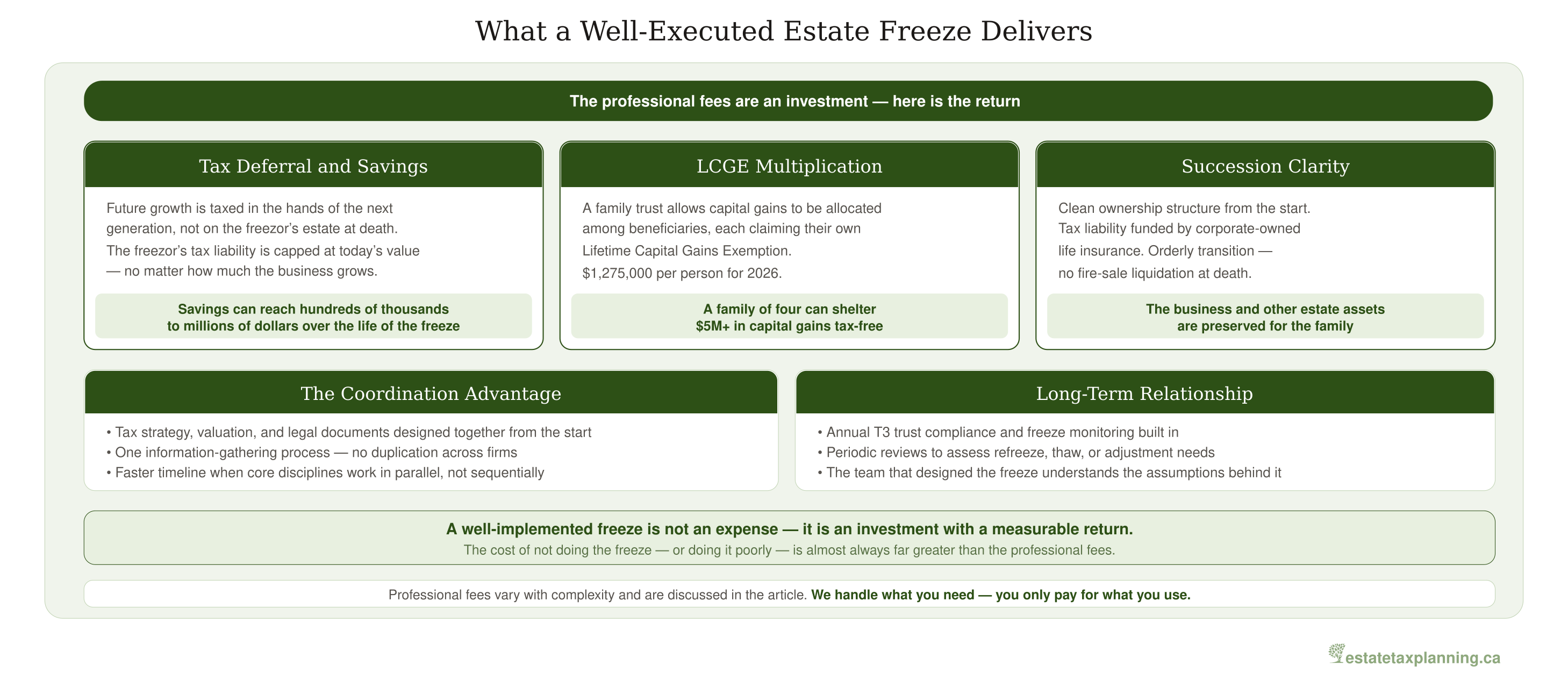
- A freeze done poorly can cost far more than the professional fees to do it right. We’ve seen remediation projects that cost three to five times what the original freeze should have cost.
- An incorrect valuation can trigger reassessment, penalties, and interest from CRA. If the freeze value is understated by $500,000, the resulting capital gain — $500,000 at 50% inclusion and Ontario’s top rate of approximately 53.53% — could cost the family roughly $134,000 in additional tax, plus penalties and interest.
- A poorly drafted trust deed can result in unintended tax consequences that take years and significant expense to unwind. We’ve inherited files where the fix required a complete restructuring.
- Skimping on professional fees to save money upfront often leads to much larger costs down the road. This is one area where the cheapest option is rarely the best one.
Questions to Ask Before Getting Started
Before engaging any professionals, it’s worth taking stock of where you stand. A few questions can help clarify the scope of the work and ensure the process starts on the right footing.
How complex is my corporate structure? A single operating company with one shareholder is a straightforward freeze. Multiple entities, holding companies, professional corporations, or cross-border elements add layers of complexity — and each layer requires more coordination among the disciplines involved. Knowing the complexity up front helps set realistic expectations for cost and timeline.
Do I already have advisors in place for some of these disciplines? If you have a financial planner who knows your situation well, or an insurance advisor who has placed your corporate policies, they should be part of the conversation. For the core disciplines — tax planning, valuation, and legal — the key question is whether your current advisors have specific experience with estate freezes, or whether this is an area where a specialist would add value.
Am I ready for a freeze — or is it too soon? The critical prerequisite is retirement readiness: enough assets outside the business to support your lifestyle without depending on future business growth. If you are still building the business and need the growth, a freeze may be premature. Your CPA and financial planner can model this.
What happens if I wait? Every year you defer the freeze, the business continues to grow — and that growth increases the eventual tax liability on your estate. If the company is worth $3 million today and $5 million in five years, the additional $2 million in growth is $2 million that could have been shifted to the next generation tax-efficiently. And if something happens before the freeze is implemented, the opportunity is lost entirely. The cost of delay is real and quantifiable.
What does the ongoing relationship look like after the freeze is done? A freeze creates obligations that continue for years — sometimes decades. The family trust requires an annual T3 return. The wasting freeze schedule needs to be monitored. The preferred share dividends need to be managed. Every two to three years, the team should assess whether a refreeze, thaw, or other adjustment is needed — and the 21-year deemed disposition under subsection 104(4) creates its own planning horizon, as we explored in The 21-Year Rule and the Family Trust. The firm that designed the freeze is best positioned to manage this ongoing relationship, because they understand the assumptions behind the original structure.
- Every year of business growth before the freeze increases the eventual tax bill on your estate. This is the number one reason we tell clients not to wait.
- A business growing at 10% annually roughly doubles in value every seven to eight years — so does the tax exposure.
- Consider a $3 million company growing at 8% annually. In ten years, it could be worth roughly $6.5 million. The additional $3.5 million of growth — at 50% inclusion and Ontario’s top rate of approximately 53.53% — represents approximately $936,000 in additional tax at death. That is the cost of a ten-year delay.
- If the owner dies before the freeze is implemented, the entire value of the company is included in the deemed disposition at death. We’ve seen families deal with exactly this scenario — the planning conversation was on the calendar but hadn’t happened yet.
- The best time to freeze is when the business has meaningful value but significant growth still lies ahead. If you’re reading this article, you’re probably in that window right now.
This example uses simplified assumptions for illustration. Your actual tax outcome depends on your specific circumstances.
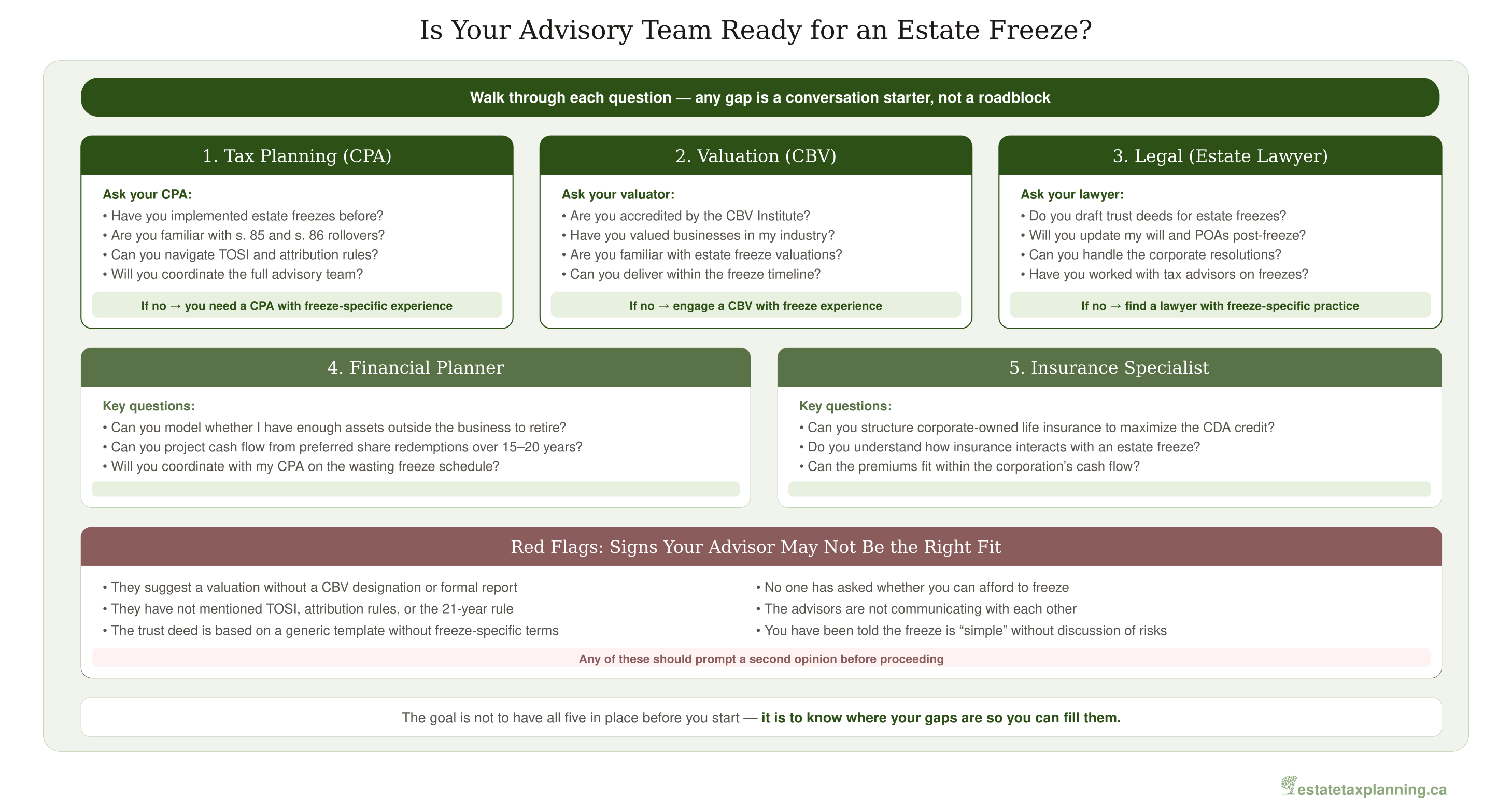
- They suggest a valuation without a CBV designation or formal report. An informal estimate or a "rule of thumb" valuation will not withstand CRA scrutiny. We’ve seen freezes where the valuation was a one-page letter — that’s not a defensible document.
- They have not mentioned TOSI, attribution rules, or the 21-year deemed disposition. These are fundamental features of every estate freeze involving a family trust — if your advisor hasn’t raised them, they may not have the experience this work requires.
- The trust deed is based on a generic template without freeze-specific terms. The trust deed needs to address preferred share retraction rights, trustee powers over growth shares, and 21-year planning provisions. Templates miss these consistently.
- No one has asked whether you can afford to freeze. Retirement readiness is the critical prerequisite — if no one is modelling your post-freeze cash flow, a key step is being skipped.
- The advisors are not communicating with each other. If the CPA, valuator, and lawyer are working independently without coordinating, the risk of conflicting assumptions and misaligned documents increases significantly. This is the red flag we see most often.
- You have been told the freeze is "simple" without any discussion of risks or alternatives. Every freeze involves trade-offs, and a responsible advisor will walk you through them.
- Three years of financial statements for the operating company (and any holding company)
- A corporate organization chart showing all related entities, shareholders, and ownership percentages
- Current shareholder agreements, if any
- Your most recent personal tax returns and financial plan
- Current wills, powers of attorney, and any existing trust deeds
- Life insurance policy summaries (corporate and personal)
- A list of your goals and concerns — what you want the freeze to achieve and what worries you about proceeding
Frequently Asked Questions
Do I lose control of my company? No. In an estate freeze, the freezor typically retains voting control through the preferred shares. The new common shares issued to the family trust carry the economic growth but not the voting power. You continue to run the business exactly as you did before the freeze. The trust deed can be structured so that you are a trustee — giving you control over how and when the growth shares are eventually distributed.
What if the business does not grow after the freeze? If the business does not grow, the freeze has no downside — you have simply locked in today’s value. The new common shares would have little or no value, and your preferred shares remain worth the freeze amount. In some cases, if the business value declines significantly, a "thaw" or refreeze at the lower value may be appropriate. Your advisory team should be monitoring this.
Can I undo an estate freeze? Yes, but it requires careful planning. A freeze can be reversed through a "thaw" — cancelling the preferred shares and reinstating the original common share structure. Alternatively, a "refreeze" resets the freeze at the current value, which may be appropriate if the original freeze value has become stale. Both options have tax implications that need to be analysed in advance. We cover these tradeoffs in detail in a separate article on The Refreeze: When and How to Reset Your Estate Freeze (forthcoming).
How do I know if now is the right time? The ideal time to freeze is when the business has significant value today but meaningful growth still lies ahead — and when you have enough personal assets outside the business to support your retirement. If both of those conditions are met, delaying the freeze only increases the tax exposure on your estate. Your CPA and financial planner can model whether the timing is right.
- We handle the tax planning, the business valuation, and the legal implementation under one roof — one team, one engagement, one point of coordination.
- For financial planning and insurance, we work with your existing advisors or introduce you to trusted professionals in each discipline.
- You only pay for what you need. If you already have a lawyer or valuator you want to work with, we handle just the pieces where you need help.
- We typically begin with an initial assessment meeting — no commitment required — where we review your corporate structure, discuss your goals, and outline what the freeze would look like, what it would cost, and how long it would take. That conversation alone often clarifies whether a freeze is the right move and what the next steps would be.
What’s Next
In the next article, Case Studies: Putting It All Together, we walk through three detailed scenarios showing how an estate freeze works in practice — from the initial assessment through implementation and ongoing management.
For more on the topics discussed in this article, see Valuation: The Make-or-Break Step (how the valuation process works and why it matters), Estate Freeze Mistakes (the most common errors and how to avoid them), and Life Insurance and the Estate Freeze (how insurance funds the tax liability created by the freeze).
If you take one thing from this article, let it be this: the advisory team you assemble at the start will determine how well the freeze works for the next twenty years. Take the time to get the right people around the table — and make sure they’re talking to each other.
For definitions of the key terms used in this article — including estate freeze, fair market value, family trust, preferred shares, and wasting freeze — see our Key Terms and Definitions reference guide.
Your tax advisor, CBV, and legal counsel can help you evaluate how this applies to your situation — for your estate freeze — ensuring the tax strategy, the valuation, and the legal documents are designed together from the start.
This article is for informational purposes only and does not constitute legal, tax, or financial advice. Estate freezes are complex transactions that require the coordinated involvement of qualified tax, valuation, and legal professionals. Always consult your advisors before acting on any of the information discussed here.